Your Health Magazine Contributor
4201 Northview Drive
Suite 102
Bowie, MD 20716
More Health News & Research Articles
How to Choose a Research Peptide Supplier
A certificate can be genuine and still describe a different batch from the one you are about to order. Before you buy peptides for laboratory research, check that you can connect the product specification, the test report and the container you will receive.
Then look at what the results actually tell you. Purity, identity and peptide amount are separate questions. Reading them separately helps you decide whether the material meets your project’s requirements.

Start With the Material Your Project Needs
Write down the specification before browsing suppliers. Include the exact peptide or sequence, any required modifications, the quantity and the analytical information your work needs. If the project requires a particular salt form or formulation, include it in the request.
That short description gives you a basis for comparing listings. An abbreviated name or an unclear modification is something to resolve before the order goes through. Keep the supplier’s written clarification with the specification.
Your experiment should also guide the testing requirements. A laboratory developing a quantitative assay may need more information about peptide content than a team doing an initial reagent screen. Decide what evidence you need rather than treating the highest advertised purity percentage as a complete answer.
Read the COA Against the Batch Being Offered
A certificate of analysis, or COA, reports the tests and results associated with a sample. Its value for your purchase depends on whether that sample can be connected to the material the supplier will ship.
Consider a hypothetical order. The supplier offers batch B12, but the available report names batch A08. The report may be authentic and accurately describe A08. It still leaves the results for B12 unresolved. Request the relevant report or a documented explanation connecting the identifiers.
Some laboratories use a sample identifier that differs from the supplier’s lot number. That difference can have an explanation; the record linking them is what you need to review.
On the COA, check the material’s identity and batch reference, who performed the testing, the analysis date, and the methods behind the results. A summary percentage is easier to assess when the chromatogram and other relevant analytical data are available.
Before you buy research peptides, establish which documents will accompany the order. If Pure Lab Peptides is on your shortlist, request the current batch documentation for the material you intend to purchase. Apply the same check to every supplier you are comparing, then match the container label to the records when the shipment arrives.
Separate Purity From Identity and Amount
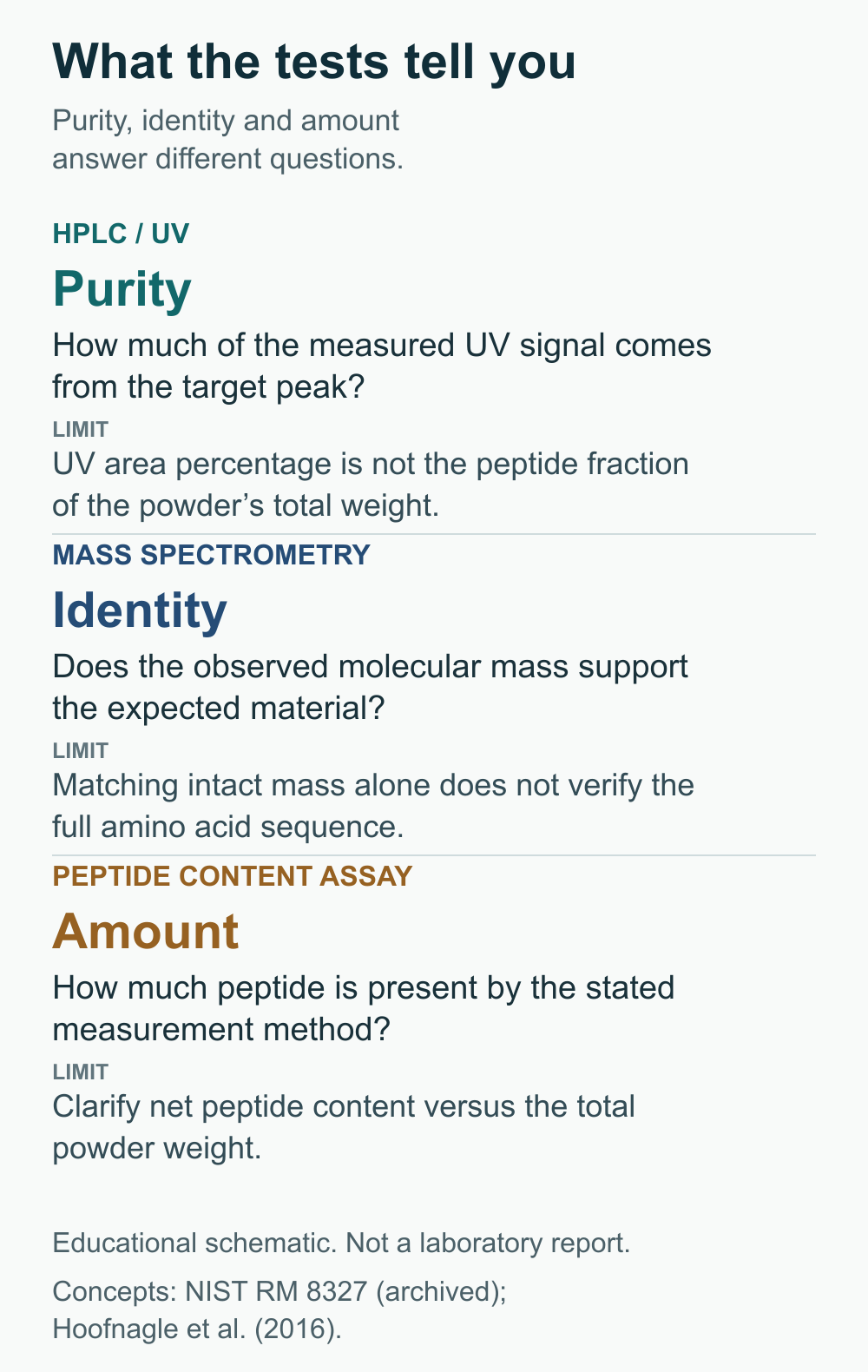
A useful report explains what was measured. The following comparison shows why one result cannot answer every purchasing question.
HPLC Purity
High-performance liquid chromatography (HPLC) separates components under specified analytical conditions. A reported UV area percentage describes their measured chromatographic signals. It does not directly give the proportion of the powder’s total weight that is peptide. The archived NIST peptide reference report defines UV area purity and peptide mass purity as distinct measurements.
Method details matter, too. Components that pass through the column together can conceal impurities. The published recommendations for peptides used in mass spectrometry assays discuss this limitation.
Molecular Identity
Mass spectrometry provides evidence about molecular mass. Agreement with the expected mass supports identification, but matching intact mass alone does not verify the full amino acid sequence. The same published recommendations distinguish mass-based checks from sequence information obtained through tandem mass spectrometry.
Peptide Content
Net peptide content concerns the amount of peptide within the weighed material. Water and counter-ions can contribute to powder weight. The assay-peptide recommendations describe amino acid analysis as one approach to measuring net content.
For example, a hypothetical vial labeled “10 mg” with “99% HPLC purity” does not, from those figures alone, establish 9.9 mg of net peptide. Clarify what the labeled amount represents and how it was determined before using it in a quantitative calculation.
Check How the Supplier Handles a Specific Question
Testing claims are easier to evaluate when you know who did the work. If independent testing is advertised, identify the laboratory and the tests it performed. Where the laboratory offers an official report lookup, use it. Otherwise, contact it through independently located details to ask whether it can authenticate the report identifier. It may have limits on what it can disclose about a client’s sample.
You can also learn something practical from the supplier’s response to an unclear result. A useful message is: “Could you send the report for the batch you will ship and explain how its sample ID connects to your lot number?”
Look for an answer that resolves the question and leaves a written record. An unexplained mismatch is a reason to pause the order. A clear explanation gives you something you can review alongside the data.
Extend that conversation to storage and shipping instructions for the material you are ordering. Confirm what supports those instructions, how delayed or damaged shipments are handled, and how a batch change would be communicated for a repeat purchase. Keep later batches’ records separately.
Compare Offers on the Same Basis
When comparing peptides for sale, check that each offer uses the same specification and quantity basis. If you buy peptides online, include shipping and any additional testing your laboratory plans to arrange. Also consider the time needed to obtain missing documentation before the material can be assessed for the project.
A lower price may meet your requirements. A higher price should come with a clear explanation of what you are receiving. Neither price, by itself, establishes the quality of the material.
For a first order, decide how your laboratory will assess the delivery against its requirements. Retain the specification, batch documents, supplier correspondence and receipt details together. That gives someone reviewing the experiment a record of what was purchased, which batch was involved and why it was selected.
Other Articles You May Find of Interest...
- The Evolution of Incretin Mimetic Research: How Triple Receptor Agonists Are Redefining Metabolic Science
- How to Choose a Research Peptide Supplier
- MK-677 and RAD-140: Understanding Two Very Different Research Compounds
- Biomarkers vs. Outcomes: How to Read Muscle-Peptide Research
- Beyond Single-Receptor Activity: Exploring Multi-Receptor Approaches in Metabolic Peptide Research
- KLOW Peptide: What’s Actually Inside the 80 mg Vial
- How to Evaluate Research Peptide Suppliers in the US