Your Health Magazine Contributor
4201 Northview Drive
Suite 102
Bowie, MD 20716
More Health News & Research Articles
KLOW Peptide: What’s Actually Inside the 80 mg Vial
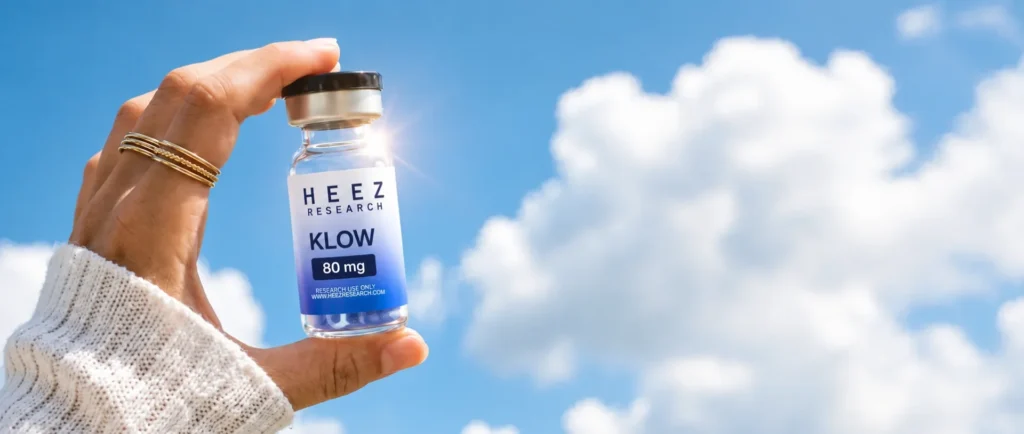
KLOW is a research peptide blend containing four separate components in a single lyophilized vial. Understanding the blend requires looking at each component individually, how the compounds differ chemically, and what analytical documentation can confirm about the material.
KLOW is sold strictly as a laboratory research material. Nothing below discusses human or veterinary use, dosing, or therapeutic effects. The focus is chemistry, analytical documentation, and identifying what is contained in the vial.
Four peptides sharing one cake of powder
KLOW isn’t a single molecule. It’s a blend of four separate peptides that are co-lyophilized together. That means they’re freeze-dried in the same vial at the same time, so what you get is one solid cake of powder instead of four little piles.
The four are:
- BPC-157
- TB-500
- GHK-Cu
- KPV
You’ll see it called the KLOW blend or the KLOW stack depending on who wrote the listing. Same product. The total fill is 80 mg, combined, across all four.
The total fill is listed as 80 mg, but the supplier does not publish a per-component split within that total, so individual quantities should not be inferred. What can be examined are the identity, structure and analytical characteristics of each component.
With the klow peptide format, the analytical challenge is different from a single-peptide vial. Instead of confirming one identity, the documentation must account for four components within one blend.
Let’s go through them one at a time.
BPC-157, the proline-heavy middle child
BPC-157 is a synthetic peptide, 15 amino acids long, with a molecular weight of about 1,419 Da. It’s proline-rich, and that’s the detail I’d want a new person to remember.
Proline is strange. It’s the only one of the standard amino acids whose side chain curls back and bonds to its own backbone nitrogen, forming a ring. That ring limits how the chain can twist. A peptide with a lot of proline in it tends to be stiffer and less floppy than you’d expect for its length.
For our purposes, that mostly matters on a column. BPC-157 is mid-sized for this vial. It’s not the heaviest thing in there and it’s not the lightest. On an HPLC trace it shows up with its own retention time, separate from the others, and that retention time is what gets matched against a reference standard to call the peak “BPC-157” instead of “unknown peak at 11 minutes.”
The card to keep in your head: 15 residues, roughly 1.4 kDa, lots of proline.
TB-500 and the thymosin beta-4 naming issue
The name TB-500 is not used consistently across research-material listings and chemical databases. PubChem identifies TB-500 as the N-acetylated seven-residue peptide Ac-LKKTETQ, with a molecular weight of approximately 889 Da.
HEEZ Research describes the component in its KLOW blend differently: as a 43-amino-acid, N-acetylated peptide in the thymosin beta-4 class. Full thymosin beta-4, also known as timbetasin, has 43 amino acids and a molecular weight of approximately 4,963 Da.
That distinction matters when evaluating a blend. A laboratory should not assume that every material marketed as “TB-500” represents the same molecular species. The supplier’s specification and lot-specific analytical documentation should identify what is actually present in the material being evaluated.
Full-length thymosin beta-4 is characterized as an actin-binding peptide. In analytical work, its substantially greater molecular size also distinguishes it from the much smaller components present in the KLOW blend.
GHK-Cu, or why the powder is blue
GHK-Cu also helps explain the blend’s blue tint. The blue coloration comes from the copper complex.
GHK is a tripeptide: glycyl-L-histidyl-L-lysine. Glycine, histidine, lysine. On its own, GHK weighs about 340 Da. As the copper(II) complex, it comes in around 403 Da. The copper ion coordinates with the peptide, mostly through the histidine and the nearby backbone, and copper(II) complexes tend to be blue. It’s the same basic reason copper sulfate crystals look the way they do.
Visual inspection can provide an additional basic check when receiving a KLOW vial. Under decent light, a faint blue cast is what you’d expect. A cake that’s stark white with no tint at all is worth writing down and checking against the COA before it goes anywhere.
I don’t want to overstate this. Lyophilized cakes vary in shade with fill and moisture, and a pale tint can be hard to see under the cheap fluorescent tubes most receiving areas have. One color observation proves nothing on its own. But it’s a free check, and it takes about two seconds.
KPV, the smallest piece
KPV is a tripeptide too: lysine, proline, valine. Lys-Pro-Val. It weighs about 342 Da and it’s the C-terminal fragment of α-MSH, residues 11 through 13.
It’s tiny. An important analytical point is that un-complexed GHK and KPV are almost the same mass, about 340 and 342 Da. Two tripeptides of near-identical weight sitting in the same vial. You can’t tell them apart by size alone.
You can tell them apart by chemistry, though. One has histidine and carries a bound copper ion. The other has proline and a hydrophobic valine at the end. A decent reverse-phase HPLC method resolves them because they interact with the column differently. Still, it’s the clearest example I can give of why a single purity figure is close to useless for a four-part blend. If the report doesn’t show which peak is which, two of the four components could be confused, and you’d never know from the number.
KPV is also the ingredient that separates KLOW from its sibling. GLOW is the related three-component blend (GHK-Cu, BPC-157 and TB-500) in a 70 mg vial. KLOW adds KPV and comes as 80 mg. That’s where the K comes from.
KLOW Component Reference
The four components can be summarized as follows:
| Component | What it is | Approx. mass | Note for the bench |
|---|---|---|---|
| BPC-157 | Synthetic 15-residue peptide | ~1,419 Da | Proline-rich, stiffer backbone |
| TB-500 | 43-residue N-acetylated peptide, thymosin beta-4 class | ~4,963 Da | Largest by far; actin-binding class |
| GHK-Cu | Copper(II) complex of Gly-His-Lys | ~340 Da (GHK), ~403 Da (complex) | Source of the blue tint |
| KPV | Tripeptide Lys-Pro-Val, α-MSH residues 11-13 | ~342 Da | Near-identical mass to GHK |
| Total fill | Four peptides, co-lyophilized | 80 mg combined | Split per component not published |
How a Blend Changes Laboratory Documentation
A multi-component blend creates different documentation requirements from a single-peptide material.
One vial corresponds to one lot and one certificate of analysis, but that certificate has to account for multiple components. For a four-component blend, confirming only an overall purity percentage provides limited information. The documentation should identify the individual components and provide sufficient analytical information to distinguish them.
This is especially important when compounds with very different molecular sizes and chemical characteristics are present together. A thorough certificate can simplify lot tracking, but the analytical burden is greater because the identity of each component must still be established.
What to Check on a Blend Certificate of Analysis
For a multi-component research blend, useful documentation may include:
- An HPLC chromatogram showing a separate, labeled peak for each component. Four peaks with names, not one peak and a percentage.
- Retention times compared against reference standards, so each peak is identified rather than assumed.
- A purity percentage.
- A lot number that matches the vial in your hand, character for character. Not close. Exact.
- A test date.
- The testing lab’s name, and confirmation that it’s independent of the seller.
- Total fill stated as 80 mg.
If important documentation is missing or does not match the vial, the material can be flagged and quarantined according to the laboratory’s standard operating procedures until the discrepancy is resolved.
As one current example, HEEZ Research publishes a certificate for KLOW lot HZ-1008-KLW80-01 reporting 99.87% HPLC purity and identity testing against reference standards. The certificate is available on the product page before purchase. HEEZ also publishes the previous lot certificate, HZ-2608-KLOW80-01, allowing researchers to compare documentation between lots.
A word about what’s out there
Search for KLOW and you’ll get pages of listings. Plenty of them show no lot-specific COA at all. Some show one purity number for what’s supposed to be a four-peptide product. A few post a generic “sample” certificate that doesn’t correspond to any vial they’re actually shipping.
I’m not naming anybody. That’s not the point. The point is simple: if a seller can’t show you which peak is which, you don’t know what’s in the vial. You know what’s printed on the label.
HEEZ Research is one example of a supplier that publishes lot-specific documentation for the blend before purchase. Regardless of supplier, researchers should confirm that the certificate corresponds to the specific lot being evaluated and provides enough information to identify the components represented on the report.
Receiving and Verifying a Research Blend
When a research blend arrives, a basic receiving process can help connect the physical vial with its analytical documentation:
- Check the seal on every vial before anything else.
- Note the color of the cake. Faint blue is expected.
- Read the lot number off the vial and write it in the log.
- Pull up the COA PDF for that lot and confirm the number matches.
- Save the PDF to the shared drive, named with the lot number.
- Move the vial into storage per the lab’s SOP.
The Takeaway
A four-component blend requires more analytical attention than a single-peptide material. Understanding the stated components, their chemical differences and the limitations of a single overall purity figure makes the certificate of analysis much more useful.
For KLOW, the key questions are straightforward: Does the documentation correspond to the exact lot? Does it identify the components represented in the blend? And does the analytical information support what is printed on the label?
For research materials, those questions are more informative than relying on a product name or overall purity percentage alone.
Other Articles You May Find of Interest...
- Biomarkers vs. Outcomes: How to Read Muscle-Peptide Research
- Beyond Single-Receptor Activity: Exploring Multi-Receptor Approaches in Metabolic Peptide Research
- KLOW Peptide: What’s Actually Inside the 80 mg Vial
- How to Evaluate Research Peptide Suppliers in the US
- Evaluating Research Peptides: A Practical Guide to Certificates of Analysis and Batch Transparency
- The Evolution of Incretin Mimetic Research: How Triple Receptor Agonists Are Redefining Metabolic Science
- Peptide Research Across Biological Systems: Comparing Metabolic Signalling and Cellular Pathway Investigations