Your Health Magazine Contributor
4201 Northview Drive
Suite 102
Bowie, MD 20716
More Neurology Articles
Migraine Diary Guide: How to Track Your Migraines and Find Your Triggers
If you get migraines, you have probably been asked “Do you know what sets them off?” and had no clear answer. Triggers are often hard to spot because they rarely act alone or straight away. A skipped lunch, a poor night’s sleep, and a stressful afternoon can combine into a migraine the next morning. Without a record, that chain of events is easy to miss.
A migraine diary helps you fix this. Tracking your attacks and daily habits over time turns vague hunches into patterns you can actually see. It also gives your doctor much better information to work with. This guide covers what to log, how long to track, which triggers are most common, how to read your data, and how to share it at your next appointment.
Why Tracking Your Migraines Matters
Memory is not reliable when you are in pain. Attacks blur together, and it’s natural to blame whatever happened just before the headache started, even when the real cause came earlier.
A consistent diary helps you:
- Identify personal triggers instead of guessing
- Notice early warning signs so you can act sooner
- Measure how often attacks happen and how severe they are
- See whether treatments help over weeks and months
- Have more productive conversations with your healthcare provider
Triggers vary a lot from person to person. Something that reliably sets off one person’s migraines may not affect yours at all, which is why your own records count for more than any general list.
What to Log in Your Migraine Diary
The best diary is one you will actually keep up. Start with the basics and add detail only if it helps.
The Attack Itself
Each time a migraine happens, write down:
- Date and start time, plus when it ended
- Pain intensity, using a simple scale such as mild, moderate, or severe, or 0–10
- Location and type of pain, such as one side, both sides, throbbing, or pressing
- Other symptoms, like nausea, sensitivity to light or sound, aura, dizziness, or neck stiffness
- Medication taken, including the dose, the time, and how well it worked
- Impact on your day, for example missed work, cancelled plans, or needing to lie down
Daily Factors (Even on Migraine-Free Days)
This part is easy to skip, but it matters most. If you only write things down on bad days, you have nothing to compare against. Try to note a few things every day:
- Sleep: what time you went to bed, what time you woke, and how well you slept
- Meals and hydration: when you ate, whether you skipped any meals, and roughly how much you drank
- Caffeine and alcohol: what you had and when
- Stress level: a quick rating, plus any major events
- Menstrual cycle (if relevant): the start and end dates of your period
- Physical activity: exercise, long periods sitting, or unusual exertion
- Environment: weather changes, strong smells, bright or flickering lights, screen time
- Neck or shoulder tension
Early Warning Signs
Some people notice changes hours or even a day before the pain begins, such as yawning, food cravings, mood changes, or fatigue. Note these too. They can help you act early, and they can stop you blaming the wrong trigger. A craving for chocolate before an attack may be an early symptom, not the cause.
How Long Should You Track?
A few weeks of data rarely shows a clear pattern, especially if your migraines are infrequent. Many clinicians suggest keeping a diary for at least two to three months, and longer if your attacks are spaced far apart.
If your migraines seem linked to your menstrual cycle, aim to cover several full cycles so you can tell whether attacks really cluster around particular days.
After that, you don’t have to stop. Many people keep a lighter version going for good to track how well treatment is working and to catch new patterns.
Common Migraine Triggers: What the Research Shows
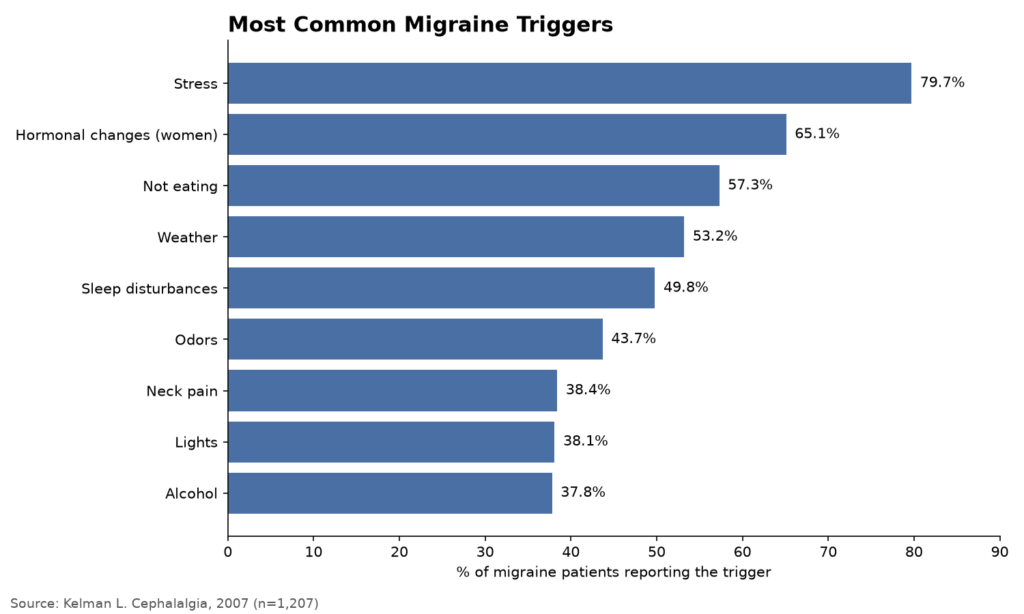
Your triggers are personal, but research can show you where to start looking. One of the most cited studies, published by Kelman in *Cephalalgia* in 2007, looked at 1,207 patients with migraine and asked which factors they linked to their attacks (Kelman, 2007).
The most frequently reported triggers were:
| Trigger | Patients reporting it |
|—|—|
| Stress | 79.7% |
| Hormonal changes (in women) | 65.1% |
| Not eating | 57.3% |
| Weather | 53.2% |
| Sleep disturbances | 49.8% |
| Odors | 43.7% |
| Neck pain | 38.4% |
| Lights | 38.1% |
| Alcohol | 37.8% |
Many of these triggers relate to routine and basic needs, such as eating regularly, sleeping consistently, and managing stress. That makes them good things to track first.
The study also highlights a limitation of lists like this. These figures come from what patients themselves reported, not from controlled testing. A trigger that is common across a group may still not be one of yours, and the only way to find out is to track your own experience.
How to Spot Patterns in Your Data
Once you have a month or two of entries, set aside some time to review them.
Look Back 24–48 Hours
For each attack, look at the day or two beforehand rather than only the hour before. Ask yourself:
- Did I sleep less or more than usual?
- Did I skip or delay a meal?
- Was I under unusual stress, or had a stressful period just ended?
- Was there a change in the weather?
- Where was I in my menstrual cycle?
Watch for Combinations
Triggers often add up. You might handle a late night or a skipped breakfast on its own, but the two together could be enough to tip you into an attack. Look for repeated combinations, not just single factors.
Compare With Good Days
If you had plenty of late nights that weren’t followed by a migraine, sleep alone probably isn’t the main cause. Your migraine-free days are just as useful for working this out.
Be Cautious About Conclusions
One coincidence doesn’t make a trigger. Before cutting foods or activities out of your life, look for a pattern that repeats. Cutting out too much can make life needlessly restrictive. Talk to your doctor before making major changes.
Paper or App? Choosing a Tracking Method
The method matters far less than doing it consistently.
Paper diaries work perfectly well. A notebook or a printed template by your bed is cheap, private, and needs no screen, which helps when light is a problem during an attack.
App-based trackers can make logging faster and can do some of the pattern-spotting for you. For example, Claru is an AI migraine tracker for iOS and Android that offers voice logging, trigger insights, a 7-day migraine risk forecast, and reports formatted for doctors. Other apps and general note-taking tools can also work. Choose whatever fits your routine.
Whichever you use, a few habits help:
- Log at the same time each day, for example before bed
- Keep entries short so they don’t feel like a chore
- Record attacks as soon as you’re able to, while the details are fresh
Sharing Your Migraine Diary With Your Doctor
A diary is one of the most useful things you can bring to an appointment. It helps your doctor understand how often your attacks happen and how severe they are, judge whether a treatment is working, and decide whether to consider other options.
To get the most out of it:
- Bring a summary. Include the number of migraine days per month, typical severity, and how often you took pain relief. Have the full diary on hand in case your doctor wants to see it.
- Highlight suspected triggers. Mention any patterns you think you’ve found, but stay open to other explanations.
- Track medication use carefully. Frequent use of acute pain relief is important for your doctor to know about.
- Note any changes. New symptoms, a change in your usual pattern, or attacks that feel different are worth raising.
- Prepare questions. Write down what you want to ask before the appointment.
Frequently Asked Questions
How soon after a trigger does a migraine start?
It varies. Some people react within hours, while for others the gap can be a day or more. This is why it helps to look back 24–48 hours before each attack.
Do I need to log every single day, even without a migraine?
Ideally, yes. Migraine-free days give you something to compare against, so you can tell real triggers from coincidences. Even a quick note about sleep, meals, and stress is useful.
Can I have more than one trigger?
Yes, and that is common. Many people find that triggers combine, and an attack happens only when several of them line up.
What if I can’t find any clear triggers?
That happens, and it doesn’t mean the diary was wasted. Your records of how often attacks happen, how severe they are, and how you respond to medication are still very useful to your doctor when planning treatment.
Should I avoid all the common triggers just in case?
Generally, no. Avoiding things unnecessarily can make daily life harder without helping. Focus on the triggers your own diary points to, and talk to your doctor before making significant changes.
—
*This article is for general educational purposes only and is not medical advice. If you have migraines or headaches, especially new, severe, or changing symptoms, please see a doctor or qualified healthcare professional for diagnosis and personalized treatment.*
Other Articles You May Find of Interest...
- Migraine Diary Guide: How to Track Your Migraines and Find Your Triggers
- What a Neuropsychology Clinic Uncovers About Cognitive Health
- How to Read a Nerve Conduction Study Report
- Can a Tissue Paper Test Detect a CSF Leak?
- What Does Cerebrospinal Fluid Taste Like During a CSF Leak?
- Cervical Laminectomy: A Complete Guide to This Spinal Decompression Surgery
- Why Concussion Symptoms Can Look Different From Person to Person