Your Health Magazine Contributor
4201 Northview Drive
Suite 102
Bowie, MD 20716
More Complementary & Integrative Healthcare Articles
Steam Room vs. Sauna: What Homeowners Should Know Before Buying

A steam room and a sauna both heat your body, but they do it in different air. A traditional sauna runs at 160 to 195°F (71 to 90°C) with 10 to 20% relative humidity. A steam room runs at 110 to 114°F (43 to 46°C) with humidity close to 100%.
That difference shapes almost every part of the steam room vs. sauna decision, from how hot each room feels to what you’ll need behind the walls.
What Is The Difference Between A Steam Room And A Sauna?
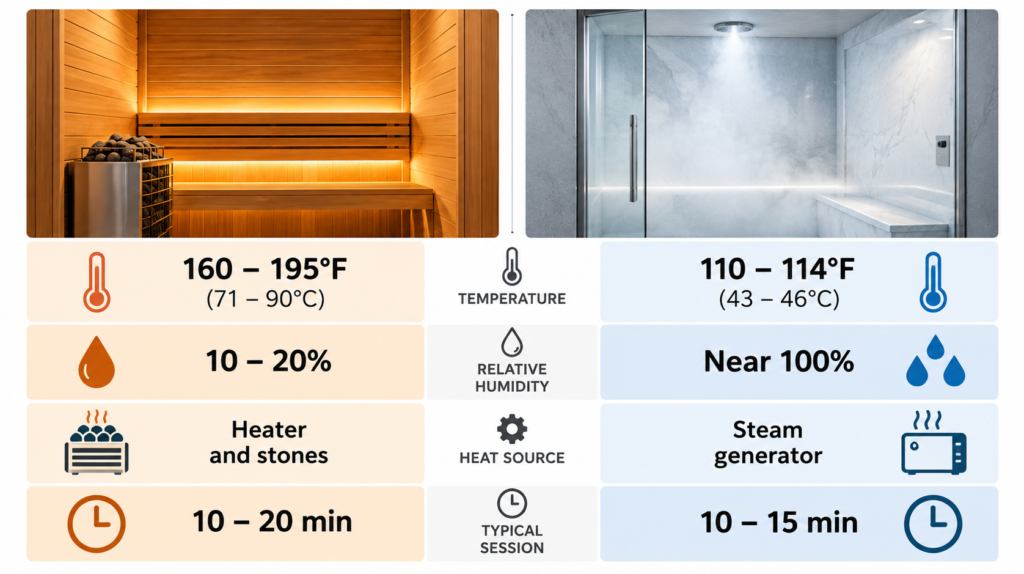
[Image file name: sauna-vs-steam-room-temperature-humidity.webp | Alt text: Chart comparing sauna and steam room temperature, relative humidity, heat source, and session length | Caption: A sauna runs about 50 to 80°F hotter than a steam room, while a steam room keeps relative humidity near 100%.]
The main difference between a steam room and a sauna is the moisture in the air. A sauna produces dry heat from an electric, wood-burning, or gas heater that warms a pile of stones. A steam room produces wet heat from a steam generator that boils water and pumps vapor into a sealed enclosure.
Humidity explains the gap. Dry air lets sweat evaporate and cool your skin, so a sauna stays tolerable at temperatures that sound extreme. Saturated air stops that cooling, so a steam room feels intense at a much lower reading. Ladling water over the hot stones releases a brief burst of steam, which Finns call löyly, but the air dries out again within minutes.
| Feature | Traditional Sauna | Steam Room |
| Temperature | 160 to 195°F (71 to 90°C) | 110 to 114°F (43 to 46°C) |
| Relative humidity | 10 to 20% | Near 100% |
| Heat source | Heater and stones | Steam generator |
| Interior materials | Cedar, spruce, or hemlock | Tile, stone, glass, or acrylic |
| Plumbing | Not required | Water line and drain (self-contained on some models) |
| Typical session | 10 to 20 minutes | 10 to 15 minutes |
How Do Sauna Heat And Steam Room Humidity Affect Your Body?
A sauna and a steam room both raise your skin and core temperature. Blood vessels widen and your heart speeds up. In a sauna, it can climb to 120 to 150 beats per minute, about the same as moderate- to high-intensity exercise like brisk walking, according to a 2018 review in Mayo Clinic Proceedings. You can also sweat out about 0.5 liters (17 ounces) in one session, which is why a water bottle belongs by the door. That lost weight is water, not fat, and it comes back once you rehydrate.
In a steam room, that sweat can’t evaporate, which is why steam can catch people off guard. It drips off without cooling you, so your core temperature climbs faster than the thermometer suggests. Start with 5 to 10 minutes if you’re new to either, and add time only once that feels easy.
What Are The Health Benefits Of A Sauna Vs. A Steam Room?
Saunas have the stronger research for heart and blood pressure benefits, while steam rooms may ease a stuffy nose and dry skin. Both can help you unwind and loosen tight muscles, but neither one treats or cures a medical condition.
Sauna Health Benefits
Most of the long-term evidence comes from Finland, where a sauna is part of ordinary weekly life. Men who used a sauna 4 to 7 times per week had a 50% lower risk of fatal cardiovascular disease than men who used one once per week, according to a 20-year study of 2,315 Finnish men published in JAMA Internal Medicine in 2015.
A 2017 follow-up study of 1,621 men from the same research group, published in the American Journal of Hypertension, reported a 46% lower risk of developing high blood pressure among men who used a sauna 4 to 7 times per week.
Other reported health benefits of saunas include:
- Reduced muscle soreness after exercise
- Improved arterial flexibility
- Better perceived sleep quality
- Lower stress through warmth and quiet time
One caveat: these studies show an association, not proof that saunas caused the drop, and every participant was a middle-aged Finnish man. A sauna can be part of a healthy routine. It doesn’t replace medical care.
Steam Room Health Benefits
Steam rooms are kinder to your nose and skin. Warm, humid air may make breathing through a stuffy nose feel easier for a while. And unlike a sauna, a steam room won’t leave your skin or airways feeling parched.
Moist heat loosens tight muscles and stiff joints about as well as dry heat does. Asthma is the tricky case: humid air eases symptoms for some people and sets them off for others, so check with your doctor first.
What Does It Take To Install A Home Sauna Or Steam Room?
A sauna needs power and airflow, while a steam room needs power, water, drainage, and walls that hold vapor in. That’s why installation is where the two really split.
Sauna Installation: Power, Ventilation, And Placement
Most home saunas use a 4.5 to 9 kW electric heater hardwired to a dedicated 240-volt circuit installed by a licensed electrician. A few compact models plug into a dedicated 120-volt outlet. You’ll also want a level floor of concrete, tile, or vinyl, plus a fresh-air vent below the heater and an exhaust vent on the opposite wall.
Prefabricated traditional saunas come as indoor kits or outdoor cabins and barrel designs. Outdoor models just need a level base, like a concrete pad, pavers, or compacted gravel. Infrared saunas, which warm your body directly at around 120 to 150°F, often plug into a standard 120-volt outlet, but most long-term heart research used traditional saunas.
Steam Room Installation: Custom Builds Vs. Prefabricated Cabins
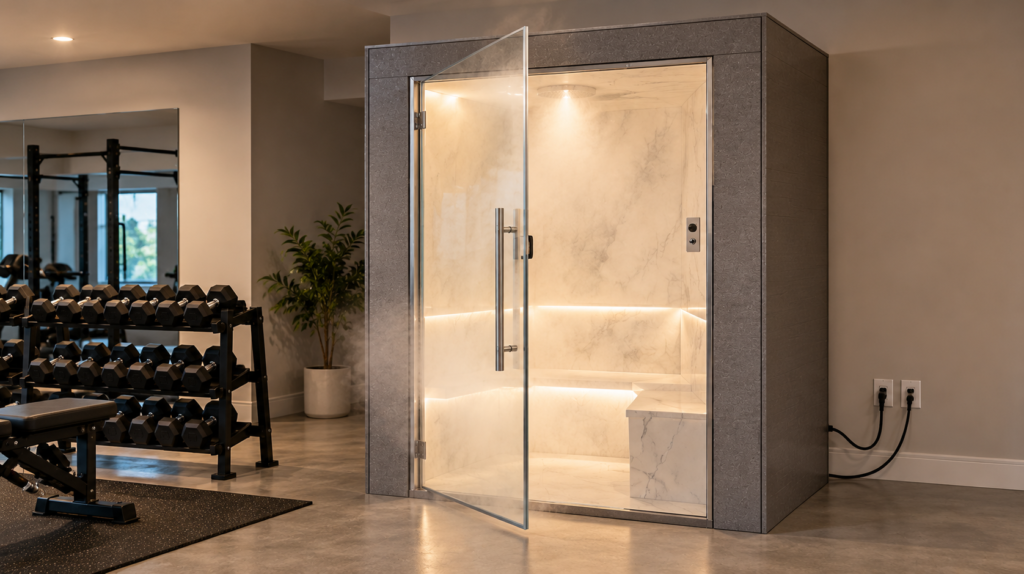
[Image file name: plug-and-play-steam-room-home-gym.webp | Alt text: Plug-and-play steam room cabin with marble interior and glass door in a home gym | Caption: Some prefabricated steam room cabins plug into standard 110-volt outlets and use a self-contained drain, so they skip the plumber.]
A custom steam room needs a steam generator sized to the room’s volume and wall material, a dedicated 208/240-volt circuit, a water supply line, and a floor drain. Every surface must be non-porous and vapor-sealed to stop moisture from reaching walls and framing. Put any exhaust fan outside the steam room door, never inside. The Tile Council of North America recommends a ceiling slope of at least 2 inches per foot (17 cm per meter) so condensation runs down the walls instead of dripping on you.
That’s a lot of trades for one room: a custom tiled steam shower needs a licensed plumber and electrician, plus a tile installer for waterproofing. A prefabricated steam room cabin ships as a sealed enclosure with engineered marble or composite surfaces and a generator matched to the space. Some plug-and-play models run on standard 110-volt outlets, use a self-contained drainage system, and assemble in 2 to 3 hours, so they need no plumber or electrician. That makes them a realistic fit for a basement, large bathroom, home gym, or even a patio.
Is A Sauna Or A Steam Room Cheaper To Buy, Run, And Maintain?
Saunas usually cost less to buy, while steam rooms heat up faster. Prefabricated traditional saunas start at about $4,350 for a 1-2 person unit and prefabricated steam rooms start at about $9,500 for 1 person.
Running costs are lower than most people expect. A 6 kW sauna heater preheats for 30 to 60 minutes and then cycles on its thermostat, so the first hour uses about 4 to 5 kWh. That’s roughly 75 to 90 cents at the projected 2026 U.S. average residential rate of 18.2 cents per kWh, per the Energy Information Administration. A steam generator heats the room in about 15 to 20 minutes, so total run time is shorter.
Upkeep tracks moisture, so a steam room asks for more of your time:
- Sauna: Wipe benches after use, sit on a towel, scrub the wood every few months, and restack heater stones at least once a year, replacing any that crack.
- Steam room: Squeegee walls after use, clean grout weekly to prevent mold, and flush the generator every 1 to 2 months, more often with hard water.
Who Should Avoid Or Limit Sauna And Steam Room Use?
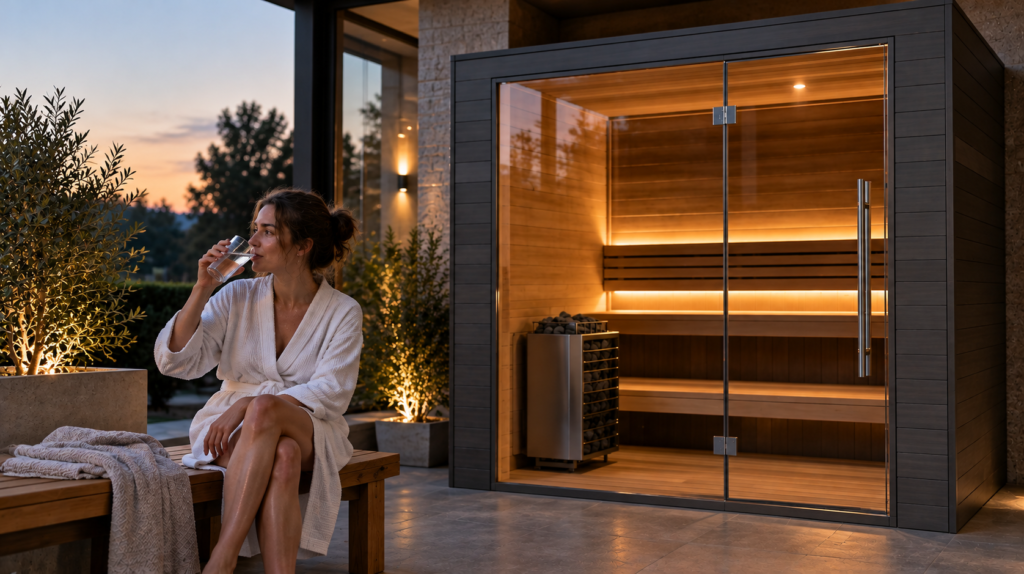
[Image file name: drinking-water-after-outdoor-sauna-session.webp | Alt text: Woman in a bathrobe drinking water after a session in an outdoor traditional sauna | Caption: Rehydrating after a session replaces the roughly 0.5 liters of sweat a sauna can draw out.]
Heat bathing is generally safe for healthy adults who stay hydrated. Talk to your doctor before using either option if you:
- Are pregnant
- Had a recent heart attack or have unstable angina
- Have uncontrolled high or low blood pressure
- Have severe aortic stenosis or kidney disease
- Take medications that affect sweating, heart rate, or blood pressure
Afterward, drink 2 to 4 glasses (0.5 to 1 liter) of water, and skip alcohol before and during a session. Get out right away if you feel dizzy, weak, or nauseous, or if a headache sets in. The Centers for Disease Control and Prevention lists these as signs of heat exhaustion. Keep sessions short if you get migraines, since heat and dehydration can both trigger headaches.
Should You Choose A Steam Room Or A Sauna For Your Home?
For most homeowners, it comes down to two questions: what kind of heat do you enjoy, and where is your plumbing? A traditional sauna suits you if you like intense dry heat, want the option with the most cardiovascular research, or have no water line near the spot you have in mind. A steam room makes more sense when dry air bothers you or you already have water and a drain in a bathroom or basement.
Before you buy, measure the space and check whether your electrical panel can take a new circuit. Then pick indoor or outdoor.
Try a steam room and a sauna at a gym or spa before you buy, if you can. Ten minutes in each tells you more than any spec sheet. And talk to your doctor first if you have a heart condition or another health concern.
Other Articles You May Find of Interest...
- The Paradigm Shift in Female Travel: Prioritizing Holistic Health
- Steam Room vs. Sauna: What Homeowners Should Know Before Buying
- Retreat in the Nepal Can Do More for Your Stress Than Another Vacation
- Could Mykonos After August Be an Ideal Base for a Wellness Retreat?
- Never Tried Sound Healing? Expert Reveals The Five Things Every Beginner Should Know Before Their First Session
- What Actually Happens in a Yagé Ceremony
- Understanding Pressure and Safety in Hyperbaric Therapy