Your Health Magazine Contributor
4201 Northview Drive
Suite 102
Bowie, MD 20716
More Health News & Research Articles
Research Peptide Names Can Be Confusing. Here’s What Buyers Should Actually Check
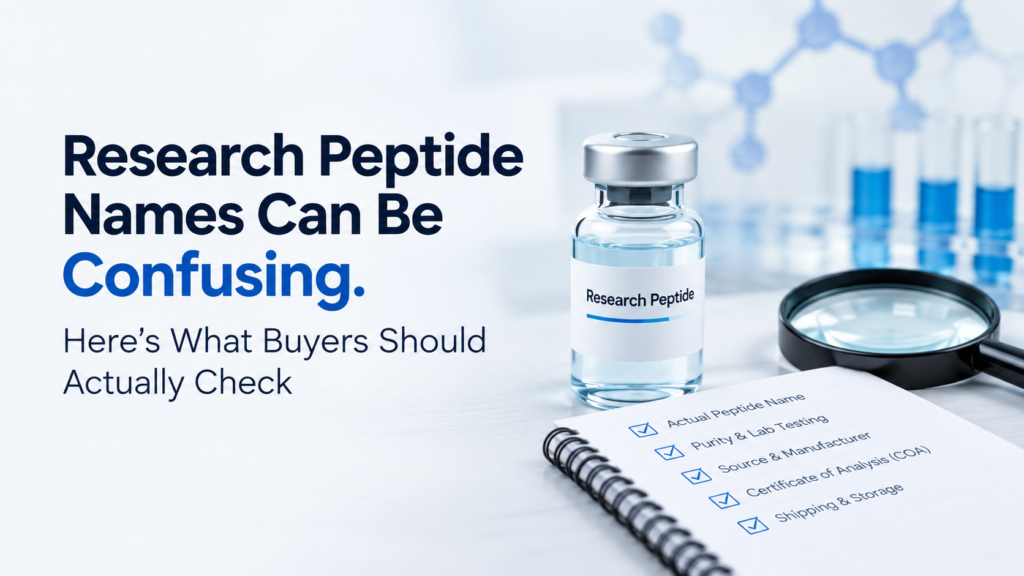
Buying research peptides sounds simple until two products with almost the same name turn out to be different.
A familiar label can hide changes in sequence, structure, added modifications or simply a different way of describing the product. That is why anyone looking at research peptides online should pay attention to more than the largest words on the product page.
The name is useful, but it is only the starting point.
Similar Names Do Not Always Mean the Same Material
Peptide naming can become confusing very quickly.
Sometimes a product is known by an abbreviation. Sometimes the same compound appears under a longer scientific name. In other cases, two closely related materials share most of the same wording even though an important modification separates them.
One of the clearest examples is CJC-1295. The name may be used for a longer-acting form with an added modification, while “CJC-1295 No DAC” is commonly used in research catalogs for a short-acting material associated with Modified GRF 1-29.
To someone seeing the names for the first time, they can look almost interchangeable.
They are not.
The same problem can appear with peptide fragments, modified sequences and slightly different versions of the same peptide. A small difference in the name can point to a meaningful difference in what is actually in the vial.
That is why product identity matters more than familiarity.
Start With the Exact Product Description
The first question should be straightforward:
What exactly is being supplied?
A useful product page should clearly identify the peptide and explain whether it is a standard sequence, a modified version or a combination of more than one material.
If a product has several common names, the description should make that clear instead of assuming the buyer already knows the terminology.
This is especially useful when comparing suppliers.
Two websites may appear to offer the same peptide, but one may provide a much clearer description of the form, research category and supporting information. That extra clarity can make it easier to avoid ordering a material that only sounds similar to the one intended for a project.
Look Beyond the Product Name
The product name should be supported by documentation.
That does not mean every buyer needs to become a chemist. It simply means there should be enough information to confirm that the product description and the supporting records make sense together.
A few things are worth checking:
- Does the product have clear identity information?
- Is batch or lot information available?
- Does it show the purity percentage and explain what was tested?
- Is the material clearly labeled for research use only?
A Certificate of Analysis — a lab report confirming what was tested — can also be useful, but it should not be treated as a magic quality badge. The important question is whether the document actually connects to the product and batch being sold.
A generic PDF that could apply to anything is much less useful than documentation tied to a specific lot.
Why Modified Peptides Need Extra Attention
Modified peptides are one of the easiest places for naming confusion to happen.
A change to a sequence or an added chemical feature can affect how a research material behaves. Even when the base name is familiar, the modified version may stay active for a different amount of time or behave differently in research.
This is why words such as “fragment,” “modified,” “DAC,” “No DAC” or a specific number in the product name should not be ignored.
They are not just extra marketing languages.
They may describe a real difference in the molecule.
For buyers, the practical lesson is simple: if two products look almost identical in name, compare the full description before assuming they are the same thing.
Blends Can Create Another Layer of Confusion
Single-compound products are usually easier to understand because one name refers to one main material.
Blends are different.
A blend may contain two or more peptides, and the important information is not just which compounds are included but also how clearly the supplier describes the composition.
A product called a “recovery blend” or “research stack,” for example, tells you very little on its own. The individual components should still be identified.
Names that sound convenient should never replace actual product information.
This is one reason broader research platforms such as Generic Peptides benefit from organizing products by individual compounds and research categories rather than relying only on marketing-style names.
The easier it is to understand what each listing contains, the easier it becomes to compare options.
Price Should Not Be the First Filter
When several suppliers appear to carry the same peptide, it is tempting to compare price first.
Price matters, but it should come after identity.
A lower price is not particularly useful if the product page is vague, the form is unclear or there is no obvious documentation connecting the material to a specific batch.
The same applies to purity claims. A large percentage printed near the top of the page may look reassuring, but buyers should still ask what was tested and whether the result belongs to the product being considered.
A better comparison starts with clarity, then documentation, then price.
The Bottom Line
Research peptide names are useful, but they can also create a false sense of certainty.
Two products with nearly identical names may still be different versions of the same peptide, include different modifications or be intended for different types of research. A familiar label should therefore be treated as the beginning of the evaluation, not the end of it.
Before choosing a research peptide, buyers should confirm what the material actually is, whether the product description is clear and whether the available documentation supports that description.
The best research platforms make those answers easy to find.
That is a much more reliable standard than choosing a product because the name looks familiar or the price is slightly lower.
Research-use note:
The compounds discussed here are presented for laboratory and analytical research context only. Research-use materials are not approved medicines and should not be interpreted as products for human or veterinary use.
Other Articles You May Find of Interest...
- Research Peptide Names Can Be Confusing. Here’s What Buyers Should Actually Check
- Smart Ways to Save When Purchasing Research Supplies at Peptira
- Retatrutide and Metabolic Research: Understanding the Science Behind the Peptide
- Research Peptides: A Complete Guide to Types, Uses, Quality and Research
- How Biomedical Researchers Turn Biological Questions Into Reliable Laboratory Data
- How to Read a Certificate of Analysis for Research Peptides
- Reta Pen Buying Guide: How to Avoid Scams When Buying a Retatrutide Pen