






Your Health Magazine Contributor
4201 Northview Drive
Suite 102
Bowie, MD 20716
More Medical Billing Articles
Top 4 Reasons for Medical Claim Denials
TL;DR: The top four reasons healthcare providers face claim denials are inaccurate patient and insurance information, missing or incorrect prior authorization, documentation gaps and medical coding errors, and claim submission and timely filing errors.
A January 2026 MGMA Stat poll found that 48% of practice leaders identified denials and appeals as their biggest revenue cycle leak. Another 23% pointed to front-end issues, including eligibility and benefits verification.
What’s more important is that respondents described much of the denial and appeals burden as preventable (due to reasons like poor documentation or insufficient verification of medical necessity). That means providers can reduce many denial risks through stronger internal controls. The key is identifying where errors enter the revenue cycle and correcting them early. Improving front-end patient data intake accuracy, authorization workflows, documentation, coding, submission processes, and denial analysis can help providers prevent avoidable denials before they become recurring revenue losses.
Why Do Claims Get Denied – What Industry Data Says
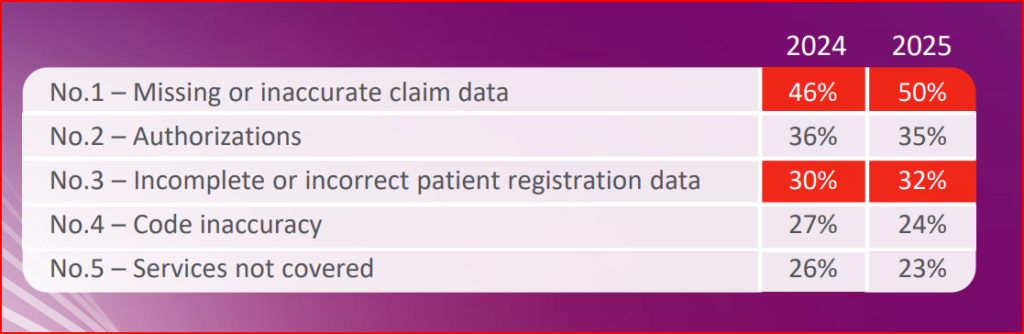
[ Source: State of Claims 2025 – Experian Health ]
To prevent denials or recover what they are owed, providers must first understand who owns the problem and where to start corrective action.
- Inaccurate Patient and Insurance Claim Data
Common registration and eligibility-related issues that can cause denials include:
- Incorrect patient demographics data entry
- Missing insurance details
- Incorrect member identification number
- Outdated coverage information
- Eligibility mismatches against payer policies
These errors often originate during patient registration or scheduling, but their impact appears later when claims are processed. For example, a payer may return a claim because it can’t identify the patient as an insured member or because coverage is no longer active. Adjustment reason codes such as code 31 and code 27 are commonly associated with these types of coverage-related issues.
Eligibility verification is therefore more than an administrative task. It determines whether a claim enters the reimbursement process with accurate foundational information. For practices that handle patient intake themselves, this calls for a stricter scrutiny of the data entering your systems when patients make an appointment. If your patient volume outpaces front-desk capacity, it is best to onboard third-party support to collect, capture, and validate healthcare data so errors are caught before the claim is built.
- Missing or Incorrect Prior Authorization
Prior authorization causes claim denials when the payer’s approval is missing, expired, or not aligned with the service the provider billed. Prior authorization is a payer’s advance approval for a specific service, and the claim must match that approval.
A claim may be denied when:
- Authorization was not obtained before treatment
- The approval expired before the date of service
- The authorized procedure and the billed service do not match
- Required notification steps were missed
Prior authorization errors are common because several teams share the process. Scheduling staff requests approval. Clinical teams deliver the care. Billing teams submit the claim. If the service changes at any point, such as a different procedure or a new date, the approval may no longer match the claim.
Authorization challenges also continue to rise. According to KFF analysis, Medicare Advantage insurers made nearly 52.8 million prior authorization determinations in 2024, with 7.7% denied. Of appealed denials, 80.7% were fully or partially overturned, showing that many initial authorization denials can change on appeal. Accurate records and timely follow-up can help providers address authorization issues and reduce avoidable denials.
- Medical Necessity and Medical Coding Errors
Clinical documentation and medical coding determine whether a payer can verify that the submitted claim accurately represents the care provided.
Medical necessity documentation-related healthcare claim denial issues may occur when:
- The clinical note does not explain the medical necessity of a service
- Required records are incomplete
- Supporting documentation is not submitted when requested
Medical coding adds another layer of complexity. Healthcare providers rely on standardized coding systems such as ICD-10-CM diagnosis codes and CPT procedure codes to communicate services to payers.
Common medical coding problems include:
- Diagnosis codes that do not match the procedure
- Incorrect procedure codes
- Missing modifiers
- Code combinations that conflict with payer rules
Documentation and medical coding are closely connected. Coders can only assign accurate codes when clinical records clearly describe the service provided. Improving documentation quality, coding reviews, and quality checks can help providers submit more complete claims and improve their first-pass claim acceptance rates.
- Claim Submission Errors and Timely Filing Issues
Even when patient information, authorization, documentation, and coding are accurate, claims can still fail if they are not submitted according to payer requirements.
Common submission-related problems include:
- Missing claim information
- Incorrect payer details
- Duplicate submissions
- Failure to meet timely filing limits
- Failure to meet payer’s submission policies
- Unresolved clearinghouse rejections
Not all submission problems affect a claim in the same way. Some prevent a claim from entering payer processing, while others affect whether the provider can still receive payment after the issue is identified.
Timely filing is especially important because claims must reach the payer within the applicable filing period. And that differs by the payer. For instance, the CMS Manual System requires medicare claims to be submitted to the appropriate Medicare Administrative Contractor no later than one calendar year after the date of service, subject to limited exceptions. Claims received after that period are generally denied for untimely filing.
This makes understanding the difference between a rejected claim and a denied claim very important. A rejected claim fails an initial format or data check before payer adjudication, while a denied claim has been reviewed and not approved for payment. If a provider does not correct and resubmit a rejected claim within the applicable filing period, it may lose the opportunity to be reimbursed.
Accurate claim preparation, prompt correction of rejected claims, and consistent follow-up can therefore help providers avoid preventable reimbursement delays and medical claim denials.
Lack of Denial Analysis and Preventive Management
Appealing one claim does not fix the process that caused it. Effective denial prevention requires providers to analyze patterns across:
- Denial reason codes
- Payer-specific trends
- Documentation issues
- Authorization failures
- Registration errors
A medical claim denial that appears in the billing department may have originated elsewhere in the organization. For example, repeated prior authorization denials may point to scheduling workflow issues, while recurring documentation denials may require improvements in clinical record creation or patient registration practices.
A preventive approach focuses on identifying root causes and assigning ownership to the right teams. Instead of only appealing denied claims after payment is refused, providers can use denial data to improve earlier stages of the revenue cycle.
This requires looking beyond the billing department and connecting denial patterns with the processes where they originate. However, overburdened healthcare staff rarely have the bandwidth to perform this deep-level analysis. Healthcare RCM services can support this broader approach by bringing together denial tracking, claim review, workflow analysis, and follow-up, giving providers greater visibility into where preventable issues occur and how to improve those processes.
Build a More Reliable Revenue Cycle by Understanding Your Denials
Fixing the key reasons for claim denials we just discussed helps you see where the loss happens and who causes it. But even when you fix the issues and lower your denial rate, it doesn’t immediately mean more revenue. That’s because, one, you need to drill into your denial rate metrics, and two, you need to see what was paid and then taken away to actually determine the revenue your practice is losing day by day.
- Initial denial rate shows how clean claims are at submission. It is the share of claims a payer denies the first time they are sent.
- Final denial rate shows how much revenue is lost for good. It is the share of claims that stay unpaid after all corrections and appeals.
- Post-payment takebacks show what payers recover later. These are amounts a payer pulls back after it has already paid a claim.
Kodiak Solutions found that initial denial rates fell to 10.63% in the first half of 2026, down from 12.00% a year earlier, while payer takebacks rose to 1.57% of accounts receivable, up from 1.38%. A provider watching only the initial denial rate would see progress, even as revenue still leaked out the back. Tracking these metrics also informs how practices address these issues. For instance, a payer with a low initial denial rate but high takebacks needs a different response than a payer that denies often at submission. The same payer-level data also gives providers evidence for appeals and for payer contract talks, where patterns carry more weight than single cases.
As payer requirements and administrative complexity continue to evolve, a proactive, well-informed approach becomes increasingly important for effective denial and revenue cycle management.
Author Bio:

Brown Walsh is a content analyst, currently associated with SunTec India – a leading multi-process IT outsourcing company. Over a ten-year-long career, Walsh has contributed to the success of startups, SMEs, and enterprises by creating informative and rich content around data-specific topics, like Data Annotation Services, ESG Data Research Services, Invoice Processing Services, and B2B Data Enrichment Services. Walsh also likes keeping up with the latest advancements and market trends and sharing the same with his readers.
Other Articles You May Find of Interest...
- Top 4 Reasons for Medical Claim Denials
- Comparing Charge Capture Tools: What Medical Practices Need to Know
- 5 Plastic Surgery Billing Companies in Florida for 2026
- Medical Billing Companies in the USA: 12 Providers and What They Offer
- Coding an Interatrial Septal Aneurysm: ICD-10 Explained
- How Better Billing Workflows Can Help Michigan OB/GYN Practices Focus More on Patients
- How Physicians Are Capturing Charges at the Point of Care





