Your Health Magazine Contributor
4201 Northview Drive
Suite 102
Bowie, MD 20716
More Legal and Health Articles
Why Pedestrian Injuries Are Often More Severe Than Drivers Expect
Pedestrians have no crumple zone, no airbag, and no seatbelt. When a vehicle strikes a person on foot, the entire force of the impact transfers directly to the body. That single fact explains why a collision at a speed a driver would describe as slow can put a pedestrian in the hospital for weeks.
Understanding how these injuries occur, and what tends to happen in the days afterward, helps both walkers and drivers make better decisions on the road.
Why Speed Changes Everything
Pedestrian survival is closely tied to impact speed. Research summarized by the National Highway Traffic Safety Administration shows that the risk of severe injury and death rises sharply as vehicle speed increases, and that the difference between 20 and 40 miles per hour is not incremental but dramatic.
Vehicle design matters as well. Taller front ends on SUVs and pickup trucks tend to strike an adult in the torso rather than the legs, and are more likely to push a pedestrian down and forward rather than onto the hood.
The Three-Impact Pattern
Most pedestrian collisions produce injuries in a recognizable sequence:
- Primary impact. The bumper or front end strikes the legs, hips or pelvis, commonly causing fractures of the tibia, femur or pelvis.
- Secondary impact. The body rotates onto the hood or windshield, which is where head, neck, shoulder and rib injuries typically occur.
- Ground impact. The person falls to the pavement. This third impact is frequently the one that causes the most serious head injury, and it is the one people are least likely to remember.
This pattern is why emergency clinicians evaluate pedestrian patients for multiple injuries even when only one is obvious at the scene.
Injuries That Show Up Late
Not everything appears immediately. Adrenaline blunts pain during and after the event, and inflammation builds over the following 24 to 72 hours. Injuries that commonly announce themselves days later include:
- Traumatic brain injury. A concussion does not require loss of consciousness. The Centers for Disease Control and Prevention notes that symptoms such as headache, difficulty concentrating, light sensitivity and sleep disruption may emerge hours or days after the injury.
- Internal bleeding. Abdominal pain, expanding bruising, dizziness or unusual fatigue in the days after an impact warrant prompt evaluation.
- Spinal disc injury. Radiating pain, numbness or weakness in an arm or leg can develop gradually over a week.
- Soft tissue damage. Stiffness and reduced range of motion often peak on the second or third day rather than the first.
What to Do in the First Few Days
Get evaluated even if you feel able to walk away. A clinical assessment establishes a baseline and catches what is not yet obvious.
Describe every symptom, including the ones that seem minor. Clinicians work from what you report, and vague accounts produce incomplete assessments.
Keep a short daily record of symptoms, sleep and what you could not do. Photograph bruising as it develops. Three weeks later, memory is a poor substitute for notes.
Follow through on the care plan. Gaps in treatment complicate recovery and make the injury picture harder to interpret.
Pedestrian crashes remain a serious safety concern in Austin, particularly along major roadways and other high-risk corridors.. For people struck while walking in the city, an experienced Austin pedestrian accident lawyer can help secure security footage and witness accounts before that evidence disappears, which often matters as much to the medical record as to the legal claim.
For Drivers
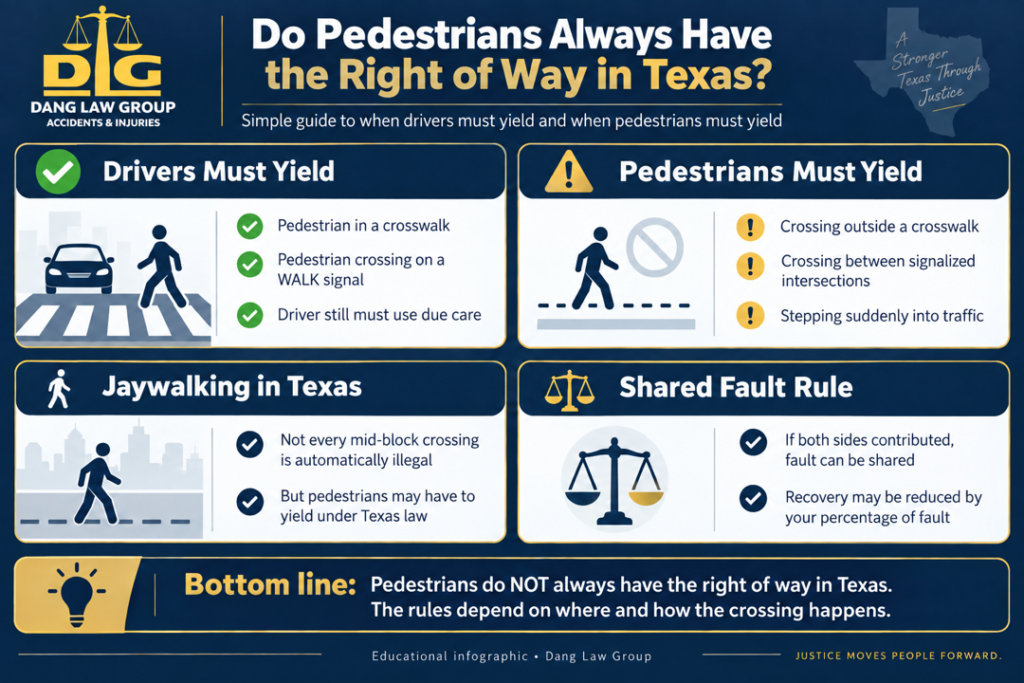
Most pedestrian collisions involve ordinary driving situations rather than reckless behaviour. Slowing near crosswalks, checking for people on foot before turning, and accounting for reduced visibility at dusk and at night address the majority of the risk. A pedestrian in dark clothing is far harder to see than most drivers assume.
Confusion about who must yield is a recurring factor. Drivers and walkers alike often misread the rules, and it is worth understanding how Texas law assigns the right of way between drivers and pedestrians at marked crosswalks, unmarked intersections and mid-block crossings.
The Takeaway
A pedestrian collision is a full-body event, not a single point of injury, and its consequences often take days to become clear. Whether you were struck while walking or were the driver involved, prompt medical evaluation and an accurate record of what happened protect everyone involved.
About the Contributor
Loc T. Dang is the founder of Dang Law Group in Austin, Texas, and is licensed by the State Bar of Texas. He represents people injured in motor vehicle, pedestrian and commercial trucking collisions, work that brings him into regular contact with the medical realities of recovery after a serious impact. He writes for a general audience on injury, recovery and the practical decisions people face in the days after an accident.
Other Articles You May Find of Interest...
- The Most Common Car Accident Injuries in Houston and What to Watch For
- The Real Medical Cost of a Car Accident in Houston Texas
- 5 Top Causes of Birth Injuries in Maryland and Their Malpractice Claim Value
- Why Pedestrian Injuries Are Often More Severe Than Drivers Expect
- The Three Elements Behind a Medical Malpractice Case
- When a Car Accident Causes Burns or Smoke-Related Injuries
- Comparative Fault in Washington: What Spokane Victims Can Recover