






More Pain Management & Rehabilitation Articles
Choosing a Trigger Thumb Splint That Actually Supports Healing
By Your Health Magazine Health Information Team
Your thumb clicks when you open a jar, catches while you button a shirt, or wakes up stiff and bent. You may be able to straighten it only after a painful pop. A splint seems like a simple solution, but choosing the wrong style—or wearing it incorrectly—can add pressure, restrict more movement than necessary, or make daily tasks unnecessarily difficult.
The best trigger thumb splint is not necessarily the biggest or firmest option. It should comfortably limit the specific movement that causes catching while protecting your skin and allowing the rest of your hand to function. Because thumb anatomy and symptom severity vary, professional fitting can be especially helpful.
What a Trigger Thumb Splint Is Supposed to Do
Trigger thumb develops when the flexor tendon that bends the thumb no longer glides smoothly through its surrounding sheath and pulley near the base of the thumb. This can cause tenderness in the palm, stiffness, clicking, catching, or locking. Symptoms are often noticeable in the morning or after gripping and pinching activities.
A splint does not physically remove a tendon nodule or guarantee that the condition will resolve. Its purpose is to reduce repeated tendon movement through the irritated area. By preventing the thumb from repeatedly bending into the position that triggers catching, the splint may give irritation an opportunity to settle and make everyday movement less painful.
Splinting is generally considered a conservative option for mild or relatively recent symptoms. Clinical studies of trigger digits have used several joint-blocking designs, often for approximately six weeks or longer. Results vary, and research specifically focused on adult trigger thumb is less extensive than research covering trigger fingers overall.
Which Splint Design Makes Sense?
Thumb Interphalangeal Joint-Blocking Splint
The interphalangeal, or IP, joint is the joint near the tip of the thumb. A small ring-style or custom-molded splint can hold this joint straight while leaving the wrist, palm, and other thumb joints relatively free. This low-profile design may be easier to wear during light activities, but it must fit securely without cutting into the skin.
Thumb MCP-Blocking or Hand-Based Splint
The metacarpophalangeal, or MCP, joint is where the thumb meets the hand. A hand-based splint may limit movement at this joint and reduce flexor tendon excursion. It can provide more stability than a small finger-style device, although it may interfere more with writing, typing, dressing, and gripping.
Thumb Spica Brace
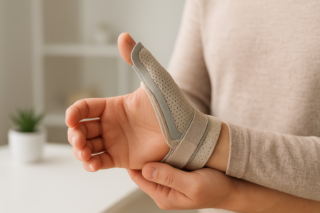
A thumb spica brace typically supports several joints and may also extend around the wrist. These braces are commonly used for a range of thumb and wrist problems, but they are not automatically the best choice for trigger thumb. A bulky brace may immobilize more of the hand than necessary if the goal is simply to block one triggering movement.
The right design depends on where the thumb catches, which joint needs to be limited, whether symptoms occur mainly at night or during activity, and how well the device stays in place. An occupational therapist, physical therapist, or certified hand therapist can fabricate or adjust an orthosis for the individual thumb.
How to Recognize a Supportive Fit
When comparing options advertised as the best trigger thumb splint, focus on function and fit rather than marketing claims. A suitable splint should:
- Keep the targeted thumb joint in a comfortable, neutral or nearly straight position.
- Prevent the movement that produces clicking or locking without forcing the thumb backward.
- Stay in place without straps being pulled excessively tight.
- Avoid direct, hard pressure over the tender area at the base of the thumb.
- Have smooth edges that do not rub the web space or create pressure points.
- Allow circulation and normal movement in joints that do not need immobilization.
- Be practical to clean and durable enough for the prescribed wearing schedule.
Check the skin every time the splint is removed. Persistent redness, swelling, blisters, increasing pain, coldness, color changes, burning, tingling, or numbness can indicate excessive pressure or poor positioning. Loosen or remove the splint and contact a healthcare professional if these symptoms do not promptly improve.
How Long Should You Wear It?
There is no single wearing schedule that is appropriate for everyone. Research protocols have included nighttime wear, use during aggravating activities, and near-continuous wear for several weeks. The schedule should reflect symptom severity, the splint design, skin tolerance, and a clinician’s treatment plan.
Some people need protection primarily while sleeping because the thumb is especially stiff or locked in the morning. Others may benefit from wearing the splint during repetitive gripping or pinching. Continuous immobilization is not always necessary and can contribute to stiffness if continued without guidance.
Remove the device as directed for hygiene, skin inspection, and any approved exercises. Do not repeatedly bend the thumb to test whether it still clicks; this can continue irritating the tendon. If a thermoplastic splint becomes warped, cracked, loose, or painful, have it adjusted instead of reshaping it with heat at home.
Reduce Strain During Everyday Activities
A splint works best when it is paired with sensible activity changes. Temporarily reduce forceful pinching, prolonged gripping, and repeated thumb motions that clearly reproduce symptoms. Use larger handles, open containers with assistive tools, carry objects with two hands, and alternate tasks when possible.
Do not assume every thumb problem requires the same brace. Pain from thumb arthritis, for example, may be centered around a different joint and may call for another type of support. Readers can review general information about arthritis symptoms and treatment. Pain along the thumb side of the wrist may have another cause, while numbness or tingling can suggest nerve involvement. Wrist-focused braces serve a different purpose, as explained in this overview of wrist splints and support braces for carpal tunnel syndrome.
When to Seek Care
Arrange an evaluation if the thumb repeatedly locks, cannot be fully straightened, becomes progressively more painful, or continues interfering with sleep and daily activities despite rest and appropriate splint use. Prompt medical attention is appropriate when the thumb becomes hot, markedly red, or swollen; symptoms follow an injury; or numbness, weakness, fever, or significant color changes develop.
A primary care clinician, sports medicine physician, orthopedist, or hand specialist can confirm whether the problem is trigger thumb and discuss treatments such as activity modification, therapy, injection, or surgery when appropriate. A hand therapist can help identify the joint that should be blocked, improve splint comfort, and provide safe movement guidance.
The Bottom Line
The best trigger thumb splint is the one that blocks the troublesome motion, fits without pressure, and can be worn consistently according to an appropriate plan. Look for targeted support rather than maximum immobilization. If the diagnosis is uncertain, the thumb is locked, or the splint causes new symptoms, professional assessment is safer than continuing to experiment with different braces.
Other Articles You May Find of Interest...
- Choosing a Trigger Thumb Splint That Actually Supports Healing
- Can Tendons Heal on Their Own? What Recovery Requires
- How Chronic Knee Pain Can Be Treated Without Joint Replacement
- What ‘Gnawing Pain’ Tells Your Doctor
- Why Does Pain Continue After an Injury? When to Consider Seeing a Pain Management Doctor
- Pain Under Your Shoulder Blade: Muscle or Referred?
- What a Fractured Kneecap Looks Like




