Your Health Magazine Contributor
4201 Northview Drive
Suite 102
Bowie, MD 20716
More Supplements Articles
Mushroom Coffee and Cortisol: What the Research Actually Shows
Cortisol has become one of the most discussed hormones in wellness marketing, and mushroom coffee is often sold directly into that conversation: change the morning cup, calm the stress hormone. The claim sounds testable, so it is worth examining. Has anyone measured cortisol in people drinking these blends, and what did the measurements actually show?
This review looks at the four ingredients that carry many of the category’s stress-related claims — ashwagandha, Rhodiola rosea, reishi, and lion’s mane — and compares the doses used in human trials with the doses that reach an actual cup. Formulas that disclose per-ingredient amounts, such as the one from HabitONE (https://habitone.co/), make it easier to compare stated doses with those used in published studies; proprietary blends can make that comparison more difficult. Where the evidence is thin or absent, this article says so.
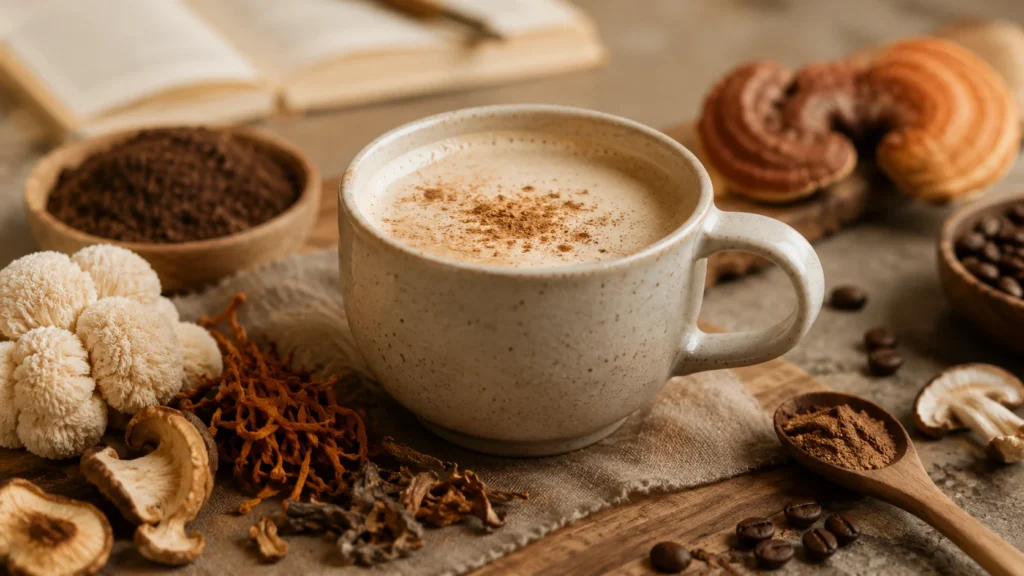
Why the Hormone Is a Difficult Endpoint to Claim
Cortisol follows a daily rhythm: it peaks 30–45 minutes after waking and declines toward evening. A single morning blood draw, a salivary awakening curve, a 24-hour urine collection, and a hair sample therefore describe different things. Trials reporting a reduction may be reporting any one of them.
Two consequences follow. A product cannot reasonably be described as lowering cortisol without specifying which measure changed. Symptoms alone also identify nothing: fatigue, weight change, or broken sleep have many causes, while genuine endocrine conditions are diagnosed by a clinician rather than by a supplement label.
Ashwagandha: The Strongest Numbers, and Not a Mushroom
The figure behind much of this marketing traces to one trial. Chandrasekhar and colleagues, writing in the Indian Journal of Psychological Medicine in 2012, gave 64 chronically stressed adults 300 mg of a full-spectrum root extract twice daily for 60 days. Serum cortisol levels fell 27.9% against 7.9% in placebo, and scores on the Perceived Stress Scale improved more sharply as well.
Replication is reasonable by supplement standards. Salve and colleagues in Cureus in 2019 and Lopresti and colleagues in Medicine in 2019 also reported reductions at doses ranging from 240–600 mg per day. The preparation matters, though. A root-and-leaf extract standardized to 35% withanolides produced no reduction in healthy overweight men, which means results belong to specific extracts rather than to the plant as a whole.
Three caveats belong beside the 27.9% figure. The trials are small and single-center. Ashwagandha is a root, not a mushroom, and it appears in few mushroom coffee blends, usually well below 600 mg. Case reports of liver injury have also been published, making casual daily use a poor idea alongside prescription medication, during pregnancy, or with thyroid conditions.
Rhodiola Rosea: Fatigue First, Hormones Second
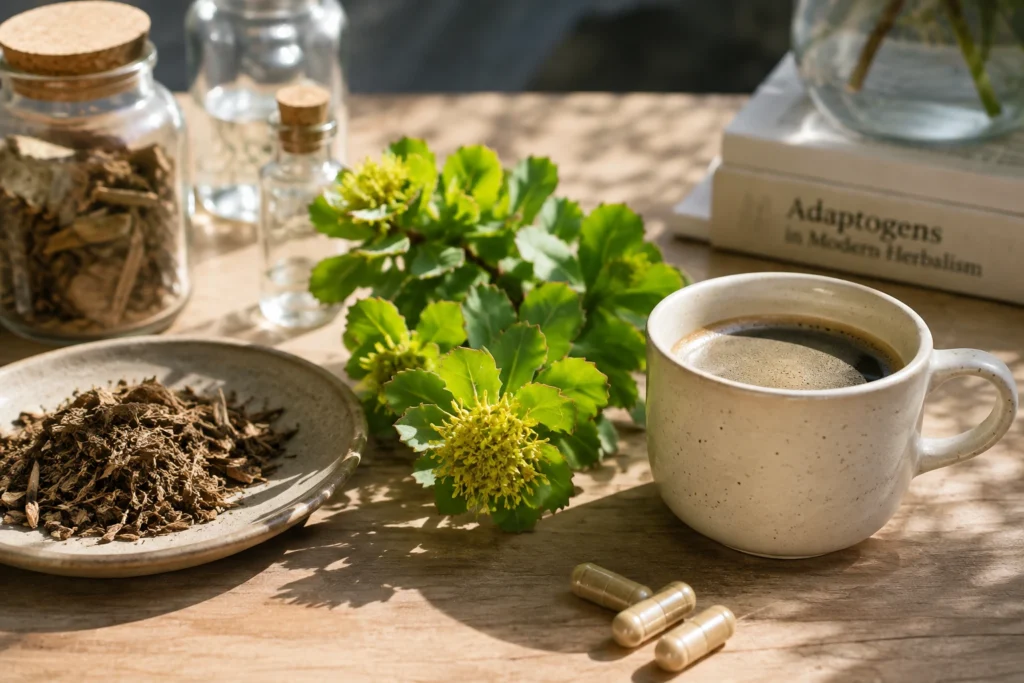
Olsson, von Schéele, and Panossian, writing in Planta Medica in 2009, randomized 60 adults diagnosed with stress-related fatigue to 576 mg per day of the standardized extract SHR-5 or placebo for 28 days. The extract group improved significantly on the Pines burnout scale and on attention tasks, and the salivary awakening response differed significantly from the control group after treatment.
The cautious reading includes what the authors themselves noted: both groups improved on several measures, which they attributed to placebo effects or regression toward the mean. Earlier work by Darbinyan and colleagues in 2000 on physicians during night duty used roughly 170 mg and measured mental performance rather than hormones. The studied range across the literature is roughly 288–680 mg per day, mostly with one standardized extract.
For a coffee blend, the arithmetic matters. A serving containing 100–150 mg is well below the dose that changed the awakening response, and that response is not the same thing as total daily cortisol output.
Reishi: Traditional Calm, Absent Hormone Data
Reishi carries a long reputation for calm and a much thinner clinical file. A Cochrane review by Jin and colleagues in 2016 found five randomized trials of Ganoderma lucidum in cancer patients and rated the evidence very low quality, with inconclusive results on immune function and quality of life.
Some recent data sit elsewhere. Mitra and colleagues in the International Journal of Medicinal Mushrooms in 2024 gave 78 female students 500 or 1,000 mg daily for 30 days and reported dose-dependent improvements in anxiety and depression scores, vitality, and physical work capacity. A crossover trial in patients with Gulf War illness found the reverse at a higher dose, with symptom severity increasing.
No published human trial reports cortisol as an outcome for reishi. Claims that it regulates the HPA axis rest on animal and mechanistic work — a reason to stay curious, not a reason to print a hormonal promise on a package.
Lion’s Mane: Measured for Cognition, Not for Stress Hormones

Mori and colleagues in Phytotherapy Research in 2009 gave 30 Japanese adults aged 50–80 with mild cognitive impairment 3 g of dried powder daily for 16 weeks. Scores improved during treatment and drifted back toward baseline four weeks after it stopped. Nagano and colleagues in Biomedical Research in 2010 found lower anxiety and depression scores in 30 women after four weeks.
The most relevant trial for stress is also the most cautious. Docherty, Doughty, and Smith in Nutrients in 2023 tested 1.8 g daily in 41 healthy adults. Stroop task performance improved 60 minutes after a single dose, while reduced subjective stress after 28 days reached only p = 0.051 — a trend, not a statistically significant result. Most cognitive measures did not move, and some improved on placebo.
Cortisol was not measured in any of these studies. The doses, 1.8 to 3 g of powder daily, also sit several times above the roughly 500 mg commonly found in functional coffee products.
The Evidence at a Glance
Placing the four ingredients side by side makes the gap between marketing and measurement easier to see.
| Ingredient | Dose in human trials | Measured hormonal effect | What the data does not show | Typical dose per cup |
|---|---|---|---|---|
| Ashwagandha | 240–600 mg/day, 30–60 days | Serum cortisol down up to 27.9% vs placebo | That every extract works; safety in long daily use | Rarely included; usually under 300 mg |
| Rhodiola rosea | 288–680 mg/day, 28 days | Salivary awakening response altered vs placebo | Change in total daily output | 100–150 mg |
| Reishi | 500–1,800 mg/day, 30 days to 8 weeks | Not measured in published trials | Any hormonal claim; benefit in cancer care | Often undisclosed inside a blend |
| Lion’s mane | 1.8–3 g/day, 4–16 weeks | Not measured in published trials | Stress reduction at statistical significance; effect after stopping | 375–500 mg |
Read down that third column and the pattern is plain. One ingredient has direct hormonal data, one has a partial signal on a single morning measure, and two have none at all.
Does Mushroom Coffee Lower Cortisol? The Caffeine Problem

One ingredient in the cup has a well-documented effect on cortisol, and it is the coffee. Lovallo and colleagues in Psychosomatic Medicine in 2005 tested 96 adults across four weeks. Caffeine stimulated cortisol secretion, and five days of intake at 300–600 mg per day reduced the response to a 9 a.m. dose, yet levels rose again after a second dose at 1 p.m. Their conclusion was that the response is reduced but not eliminated in daily consumers. Follow-up work in Pharmacology Biochemistry and Behavior in 2006 showed the effect could be amplified when caffeine was combined with mental stress or exercise.
This is the central weakness in the question of mushroom coffee and cortisol. A blend delivering 100–150 mg of caffeine pushes the hormone one way while a smaller amount of Rhodiola may push weakly the other, and no trial has measured the net result for a finished mushroom coffee product.
One practical distinction among functional coffee products is caffeine dose. Blends with less caffeine simply provide less of a stimulant known to affect cortisol responses.
What the Data Does Not Support
Five claims circulate in this market without solid clinical backing:
- No randomized trial has tested a finished mushroom coffee, caffeine included, against a cortisol endpoint.
- No human study reports cortisol as an outcome for reishi or lion’s mane.
- Doses in a cup often run below trial doses, and the one ingredient with the strongest cortisol data is usually absent entirely.
- A lower cortisol number does not automatically mean feeling calmer.
- “Adaptogen” is a traditional and marketing category, not a regulatory or clinical one.
What survives that filter is still worth noting: lower burnout and fatigue scores with Rhodiola at trial doses, better subjective wellbeing with reishi in small studies, faster cognitive performance with lion’s mane, and a smaller caffeine load than strong drip coffee. These are observations about questionnaires and tasks, not evidence that a drink regulates an endocrine axis.
Best Coffee for Anxiety: What the Evidence Allows
Here, the more useful variable is caffeine dose rather than mushroom content. Doses above 400 mg can provoke panic attacks in some people with panic disorder, while a controlled crossover trial of 150 mg found no rise in subjective anxiety in either patients or healthy controls, even though physiological arousal and avoidance behavior increased in both groups.
So the practical variables are caffeine dose, timing, and individual sensitivity. Lower-caffeine products may reduce total caffeine exposure, but they should not be considered treatments for anxiety or cortisol-related conditions. Anxiety disorders themselves need clinical care; no coffee, functional or ordinary, is a treatment for one.
What a Label Lets You Verify
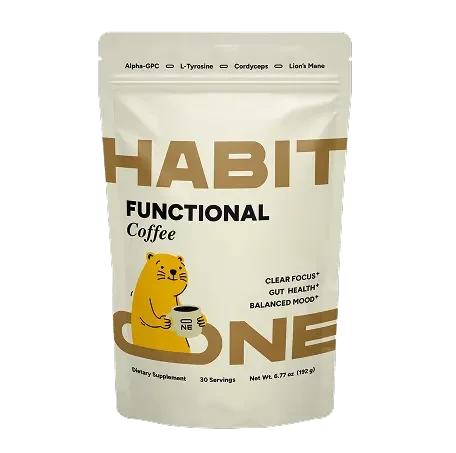
Example of a Fully Disclosed Functional Coffee Label
A fully disclosed label makes it possible to compare stated ingredient amounts with doses used in published studies. The HabitONE blend states each amount per serving:
- lion’s mane fruiting body — 500 mg
- cordyceps fruiting body — 500 mg
- chaga and reishi fruiting body extracts
- L-tyrosine — 500 mg
- alpha-GPC — 200 mg
- Rhodiola rosea — 150 mg
- caffeine from Arabica — 85 mg
- vitamins B3 and B12
Read against the trials, the example label illustrates why dose matters. The 150 mg of Rhodiola is below the 576 mg used in the Olsson trial, the 500 mg of lion’s mane is below the doses used in the cited cognitive studies, and the formula contains no ashwagandha, so the 27.9% figure from the ashwagandha trial would not apply to this product.
The useful test for any brand follows from this: a package claiming a hormonal effect without per-ingredient doses cannot be meaningfully compared with a published study.
Reading the Label After Reading the Trials
The evidence on mushroom coffee and cortisol fits into three lines. Ashwagandha has direct cortisol data at doses rarely present in coffee. Rhodiola has one credible signal on the awakening response at a dose substantially above what is commonly found in a cup. Reishi and lion’s mane have not been tested against cortisol in humans.
That does not mean functional coffee has no relevant characteristics. Caffeine dose and transparent ingredient labeling can be compared with published research, but consumers should not assume that a finished mushroom coffee product has been shown to regulate cortisol or treat an endocrine condition.
These statements have not been evaluated by the Food and Drug Administration. These products are not intended to diagnose, treat, cure, or prevent any disease.
Other Articles You May Find of Interest...
- How to Choose the Best Probiotic Supplements for Your Needs
- Essential Vitamins and Supplements for a Healthier Everyday Lifestyle
- What Do Nootropics Do to Your Brain?
- 5 Ingredients to Look for in a Quality Antioxidant Supplement
- NAD Patches: Potential Benefits, Limits, and Safety
- ParaPurge Gut Cleanse: What Is It and Does It Work?
- Renovate Gut Detox: Ingredients, Claims, and Safety Questions