Your Health Magazine Contributor
4201 Northview Drive
Suite 102
Bowie, MD 20716
More Weight Control, Nutrition & Exercise Articles
Retatrutide vs Tirzepatide: Key Differences & Comparison
Retatrutide and tirzepatide are frequently compared because both have been studied for substantial weight loss, but they currently occupy very different regulatory positions. Tirzepatide is an FDA-approved prescription medication sold as Zepbound for chronic weight management and Mounjaro for type 2 diabetes. Retatrutide remains investigational and is being evaluated in clinical trials.

Recent trials have reported substantial average weight loss with both compounds. However, the results come from separate studies with different participants, durations, and protocols, so the percentages should not be treated as a direct head-to-head comparison.
Here is how the two compare on mechanism, clinical-trial findings, side effects, dosing, and regulatory status.
Key Takeaways
- Retatrutide acts on three hormone receptors: GLP-1, GIP, and glucagon. Tirzepatide acts on GLP-1 and GIP.
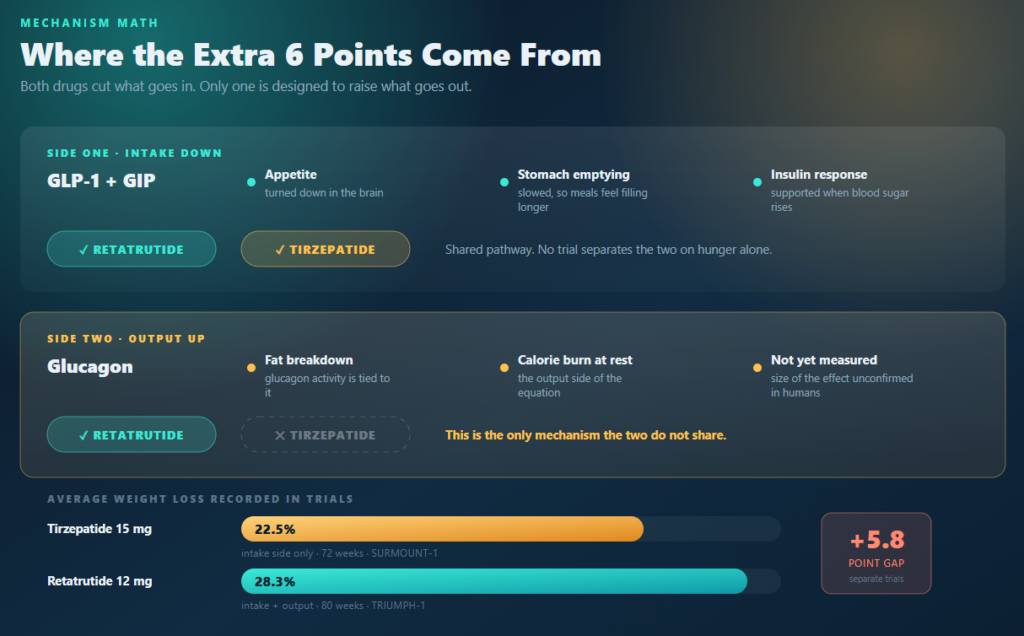
- In separate clinical trials, retatrutide produced average body-weight reductions of 28.3% at 80 weeks at the 12 mg dose, while tirzepatide produced an average reduction of 22.5% at 72 weeks at the 15 mg dose. These results are not directly comparable.
- Tirzepatide is an FDA-approved active pharmaceutical ingredient used in prescription medicines including Zepbound and Mounjaro. Retatrutide has not been approved for medical use.
- Both have been associated with gastrointestinal adverse effects in clinical trials. Retatrutide’s long-term safety profile remains under investigation.
Retatrutide vs Tirzepatide at a Glance
| Feature | Retatrutide | Tirzepatide |
|---|---|---|
| Drug type | Triple hormone receptor agonist | Dual hormone receptor agonist |
| Receptors targeted | GLP-1, GIP, glucagon | GLP-1, GIP |
| Approval status | Investigational, not approved | FDA approved |
| Brand names | None | Zepbound, Mounjaro |
| Administration | Weekly injection in trials | Weekly injection |
| Average weight loss in cited trials | 28.3% at 80 weeks (12 mg) | 22.5% at 72 weeks (15 mg) |
| Blood sugar effects | Improvements observed in trials | Approved for type 2 diabetes as Mounjaro |
| Common side effects | Nausea, diarrhea, constipation, vomiting | Nausea, diarrhea, constipation, vomiting |
| Availability for medical use | Clinical trials only | Prescription |
What Is Retatrutide?
Retatrutide is an investigational medication being developed by Eli Lilly for obesity and related conditions. It acts on three hormone receptors at once: GLP-1, GIP, and glucagon.
It has progressed into Phase 3 clinical development, but no regulator has approved retatrutide for medical use.
How Retatrutide Works as a Triple Agonist
An agonist activates a biological receptor. Retatrutide activates three different receptors involved in metabolism.
Two of them, GLP-1 and GIP, are also targeted by tirzepatide. They influence appetite, insulin secretion, and blood glucose regulation. Retatrutide additionally activates the glucagon receptor.
What Makes Retatrutide Different From Other GLP-1 Drugs
Many medications studied or approved for weight loss act partly by reducing appetite and food intake. Retatrutide is being investigated for its combined effects on appetite and energy metabolism.
Glucagon receptor activity has been associated with effects on energy expenditure and fat metabolism. Researchers are continuing to investigate how much this mechanism contributes to the weight reductions observed in human trials.
Where Retatrutide Stands in Clinical Development
Retatrutide has progressed from Phase 2 into a large Phase 3 clinical-development program.
Phase 3 findings can provide important evidence about efficacy and safety, but completion of late-stage trials is not equivalent to regulatory approval. Regulators must review the complete evidence before determining whether a medication should be approved and under what conditions.
Who Retatrutide Is Being Studied In
Clinical trials have enrolled adults with obesity, including populations with conditions such as type 2 diabetes and knee osteoarthritis.
Those trial populations define the groups for which researchers currently have evidence. Because retatrutide remains investigational, there is no approved patient population for the drug.
Who Is Excluded From Retatrutide Trials
Eligibility and exclusion criteria differ among studies. Current requirements can be found on ClinicalTrials.gov in the record for each individual study.
What Is Tirzepatide?
Tirzepatide is a prescription medication that activates two hormone receptors: GLP-1 and GIP. It is marketed as Zepbound for chronic weight management and Mounjaro for type 2 diabetes.
Unlike retatrutide, tirzepatide has undergone regulatory review and has an established prescribing label describing approved uses, dosing, contraindications, warnings, and known adverse effects.
How Tirzepatide Works as a Dual Agonist
Tirzepatide activates the GLP-1 and GIP receptors simultaneously.
GLP-1 affects appetite, insulin secretion, and gastric emptying. GIP also contributes to glucose-dependent insulin secretion and other metabolic processes.
What Makes Tirzepatide Different
Its regulatory status and evidence base are major distinctions. Tirzepatide has completed large clinical trials in obesity and diabetes and has been evaluated by regulators for approved medical uses.
That provides substantially more information about clinical use and safety than is available for an investigational compound.
Tirzepatide’s Approval History and Evidence Base
Tirzepatide was first approved for type 2 diabetes as Mounjaro and subsequently for chronic weight management as Zepbound. It has since added an approval for moderate-to-severe obstructive sleep apnea in adults with obesity.
Who Tirzepatide Is Approved For
Zepbound is approved for chronic weight management in certain adults with obesity or overweight and at least one weight-related condition. Mounjaro is approved for improving glycemic control in patients with type 2 diabetes within its labeled population.
Eligibility and treatment decisions should be determined by a licensed healthcare professional.
Who Should Avoid Tirzepatide
Tirzepatide carries important contraindications and warnings. For example, its prescribing information includes a boxed warning concerning thyroid C-cell tumors observed in animal studies and contraindications involving a personal or family history of medullary thyroid carcinoma or multiple endocrine neoplasia syndrome type 2.
Patients should discuss their medical history, medications, and individual risk factors with their healthcare provider.
Retatrutide Findings in Research
Clinical trials of retatrutide have reported substantial average weight reductions, including 28.3% at 80 weeks in a Phase 3 study at the 12 mg dose.
Research has also examined:
- Weight reduction across different doses and treatment durations
- Effects on glucose-related markers
- Changes in body composition
- Outcomes among participants with obesity and knee osteoarthritis
These remain clinical-trial findings. Retatrutide has no approved medical indication, and its long-term benefit-risk profile remains under evaluation.
Tirzepatide Findings in Research and Clinical Use
Tirzepatide has produced substantial weight reductions in clinical trials and is approved for several medical uses.
Research findings include:
- 22.5% average weight reduction at 72 weeks at the 15 mg dose in SURMOUNT-1
- Significant effects on HbA1c in type 2 diabetes studies
- FDA-approved indications involving type 2 diabetes, chronic weight management, and obstructive sleep apnea in specified populations
- An established prescribing framework that includes healthcare-provider oversight
How Do Retatrutide and Tirzepatide Work in the Body?
Retatrutide and tirzepatide act on receptors involved in appetite, glucose regulation, digestion, and metabolism.
The principal mechanistic difference is that retatrutide activates three receptors while tirzepatide activates two.
What GLP-1 Does
GLP-1 is a naturally occurring hormone involved in appetite and blood glucose regulation.
Among other effects, GLP-1 signaling can reduce appetite, slow gastric emptying, and stimulate glucose-dependent insulin secretion.
What GIP Does
GIP is another naturally occurring hormone involved in glucose-dependent insulin secretion and metabolism.
Researchers continue to study its broader metabolic effects and its interaction with GLP-1 receptor activation.
Why Retatrutide Adds Glucagon
Glucagon is best known for its role in blood glucose regulation, but glucagon-receptor activity also affects energy metabolism.
Retatrutide’s simultaneous activation of GLP-1, GIP, and glucagon receptors is intended to influence several metabolic pathways at once. The precise contribution of each mechanism to its clinical effects continues to be studied.
| Receptor | General role | Retatrutide | Tirzepatide |
|---|---|---|---|
| GLP-1 | Appetite, gastric emptying, glucose regulation | Yes | Yes |
| GIP | Insulin secretion and metabolism | Yes | Yes |
| Glucagon | Glucose and energy metabolism | Yes | No |
Retatrutide vs Tirzepatide: The Key Differences
Several practical differences separate retatrutide and tirzepatide, but the most important is regulatory status.
Number of Hormones Targeted
Retatrutide is a triple agonist targeting GLP-1, GIP, and glucagon receptors. Tirzepatide is a dual agonist targeting GLP-1 and GIP receptors.
Appetite Effects
Both compounds act on pathways involved in appetite regulation.
There is no head-to-head trial establishing that one suppresses appetite more effectively than the other.
Metabolic and Energy Expenditure Effects
The addition of glucagon-receptor activity gives retatrutide a different metabolic mechanism from tirzepatide.
Researchers continue to investigate how much this additional activity contributes to energy expenditure and observed weight reduction in humans.
Blood Sugar Control
Tirzepatide has approved and documented effects on glycemic control. In the SURPASS-2 trial, it lowered HbA1c by 2.01 to 2.30 percentage points across the studied doses.
Retatrutide has also produced improvements in glucose-related measures during trials, but it has no approved indication for diabetes.
Weight-Loss Findings
Across separate trials, higher-dose retatrutide has produced larger average weight reductions than those reported in major tirzepatide trials.
That observation should not be interpreted as proof that retatrutide is more effective for an individual patient because the drugs have not been directly compared in a randomized head-to-head trial.
Muscle Preservation
Body-composition evidence remains limited. DEXA analysis from a retatrutide trial reported that 74% of the weight lost was fat and 26% was lean mass.
No clinical trial has directly established whether retatrutide or tirzepatide preserves more lean mass.
Injection Schedule
Both have been administered as once-weekly subcutaneous injections in their respective clinical settings.
Tirzepatide has an FDA-approved dosing schedule. Retatrutide does not have an approved dose or dosing schedule.
Investigational Compound vs Approved Therapy
This is the most consequential distinction.
Tirzepatide has regulator-reviewed prescribing information, approved indications, and an established prescription supply chain. Retatrutide remains an investigational medication available for human use only through authorized clinical research.
Clinical Trial Results Compared

Recent trials provide useful information about each compound, but comparisons between separate studies require caution.
| Study | Duration | Participants | Reported weight reduction | Selected finding |
|---|---|---|---|---|
| TRIUMPH-1 (retatrutide 12 mg) | 80 weeks | 2,339 | 28.3% | Dysesthesia reported in some participants |
| TRIUMPH-1 (retatrutide 12 mg) | 104 weeks | Same cohort | 30.3% among reported continuing-treatment results | Longer-term trial finding |
| TRIUMPH-4 (retatrutide 12 mg) | 68 weeks | 445 | 28.7% | Included adults with knee osteoarthritis |
| Phase 2 (retatrutide 12 mg) | 48 weeks | 338 | 24.2% | Body-composition data reported |
| SURMOUNT-1 (tirzepatide 15 mg) | 72 weeks | 2,539 | 22.5% | Placebo group lost 2.4% |
| SURPASS-2 (tirzepatide 15 mg) | 40 weeks | 1,879 | Weight was not the primary endpoint | HbA1c reduction reported |
Retatrutide Trial Results: TRIUMPH-1 and TRIUMPH-4
TRIUMPH-1 randomized participants to different retatrutide doses or placebo. The 12 mg group averaged 28.3% weight loss at 80 weeks.
TRIUMPH-4 studied participants with obesity or overweight and knee osteoarthritis. The study reported substantial weight reduction as well as improvements in knee-pain measures.
These findings remain part of an investigational clinical-development program.
Tirzepatide Trial Results: SURMOUNT and SURPASS
SURMOUNT-1 included 2,539 adults with obesity or overweight and at least one weight-related complication. At 72 weeks, participants receiving the 15 mg dose averaged 22.5%, against 2.4% for placebo.
The study also reported substantial proportions of participants reaching different weight-reduction thresholds.
Why These Trials Cannot Be Compared Directly
No randomized head-to-head trial has directly compared retatrutide with tirzepatide.
The studies differed in duration, participant characteristics, protocols, and other factors. Consequently, comparing percentages across trials can identify interesting differences but cannot establish that one treatment is clinically superior to the other.
Which Peptide Has Produced More Weight Loss in Trials?
Retatrutide leads to weight loss results reported in some separate clinical-trial comparisons, including the 28.3% average reduction reported at 80 weeks in a Phase 3 trial compared with 22.5% at 72 weeks in SURMOUNT-1 for tirzepatide.
However, this is an indirect comparison, not evidence from a head-to-head trial.
A network meta-analysis available through PubMed Central reported estimated reductions of 23.77% compared with Tirzepatide’s 16.79%.
The authors also reported a higher frequency of adverse events with retatrutide.
These findings should therefore be interpreted cautiously:
- The compounds were studied in different trials and populations.
- Treatment duration differed among studies.
- Retatrutide remains investigational.
- Long-term real-world effectiveness and safety data for retatrutide do not yet exist.
Trial averages describe populations and cannot predict an individual patient’s outcome.
Retatrutide vs Tirzepatide Side Effects Compared
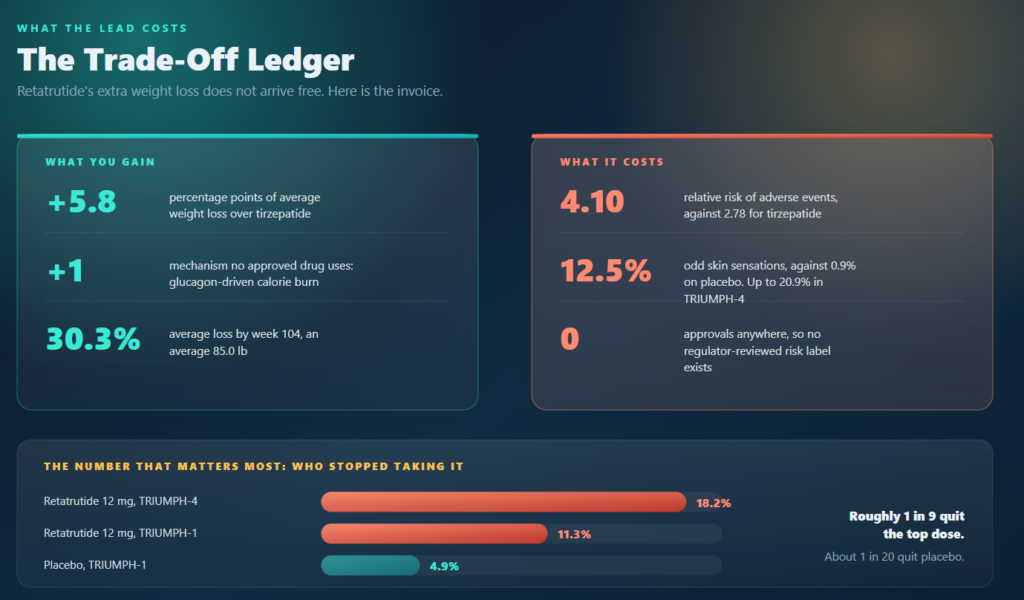
Retatrutide and tirzepatide have shown overlapping gastrointestinal adverse effects in clinical studies, including nausea, diarrhea, constipation, and vomiting.
Retatrutide trials have additionally reported dysesthesia, which can include unusual skin sensations such as tingling or burning.
Discontinuation because of adverse events occurred among some participants receiving higher retatrutide doses.
Because retatrutide remains investigational, its complete long-term safety profile is not known.
Serious Warnings to Know
Tirzepatide’s FDA-approved prescribing information contains contraindications, warnings, and precautions that patients and prescribers should review.
These include a boxed warning concerning thyroid C-cell tumors observed in animal studies and warnings or precautions involving pancreatitis, gallbladder disease, hypoglycemia in certain circumstances, kidney injury related to dehydration, gastrointestinal adverse reactions, hypersensitivity, and other risks.
For example, acute pancreatitis occurred in 0.2% of Zepbound patients and 0.2% of placebo patients in the referenced clinical-trial data.
Retatrutide does not yet have regulator-approved prescribing information. Its long-term safety profile remains under investigation.
Retatrutide vs Tirzepatide Dosage and Administration
Tirzepatide dosing follows FDA-approved prescribing information and should be determined by a healthcare professional.
Retatrutide has no approved medical dose. Doses discussed in research publications describe clinical-trial protocols and should not be interpreted as instructions for personal use.
| Parameter | Retatrutide (investigational) | Tirzepatide (approved label) |
|---|---|---|
| Starting dose | No approved dose exists | Defined by prescribing information |
| Escalation | Determined by clinical-trial protocol | Defined by prescribing information |
| Doses | Multiple doses studied in trials | Multiple approved dosage strengths |
| Frequency | Once weekly in cited trials | Once weekly |
Retatrutide vs Tirzepatide: Availability and Approval Status
Tirzepatide is available by prescription for its approved indications.
Retatrutide is not approved for medical use. For patients, access to investigational retatrutide is through authorized clinical research rather than commercial research-chemical products.
Tirzepatide: Approved and Prescription-Only
FDA-approved tirzepatide products are dispensed under brand names including Zepbound and Mounjaro and require a prescription.
A licensed healthcare professional determines whether treatment is appropriate based on the approved indication, prescribing information, and individual patient’s health.
Retatrutide: Investigational and Trial-Only
Retatrutide has no marketing approval for medical use.
People interested in participating in research involving retatrutide should look for registered clinical trials and discuss potential participation with qualified healthcare professionals.
What “Research Use Only” Actually Means
“Research use only” generally refers to material intended for laboratory research rather than administration to people or animals. It should not be interpreted as an alternative route to obtaining an investigational medication for personal treatment.
For consumers seeking weight-loss treatment, a research-use product is not a substitute for an approved prescription medicine. The FDA has warned about unapproved products containing or claiming to contain active pharmaceutical ingredients that may be marketed with research-related labeling.
For qualified researchers obtaining material for legitimate laboratory work, supplier documentation is a separate consideration. Researchers may evaluate factors such as analytical methods, lot identification, certificates of analysis, storage requirements, and the laboratory methods used to assess identity and purity.
Research suppliers, such as Kylo Peptides, provide materials labeled for research use rather than for human or veterinary administration. Such materials should remain within the laboratory context specified by their labeling and applicable requirements.
Research-use compounds and prescription medicines therefore belong to fundamentally different supply chains. Research materials are for laboratory work; medical treatment should involve appropriately approved products and qualified healthcare professionals.
Retatrutide vs Tirzepatide Cost Comparison
Because retatrutide is not an approved commercial medicine, it does not have a legitimate retail prescription price comparable with tirzepatide.
Tirzepatide costs vary substantially according to indication, insurance coverage, dosage form, manufacturer programs, and other factors.
Consumers should obtain current pricing information from legitimate pharmacies, insurers, manufacturers, or healthcare providers rather than comparing an approved prescription medicine with research-use compounds sold online.
Retatrutide vs Tirzepatide: Pros and Cons
| Peptide | Potential advantages | Limitations |
|---|---|---|
| Retatrutide | Substantial weight reduction reported in clinical trials; triple-receptor mechanism; being studied for several metabolic outcomes | Not approved; long-term safety remains uncertain; adverse effects and treatment discontinuations occurred in trials; no approved consumer availability |
| Tirzepatide | FDA-approved; extensive clinical-trial evidence; approved medical indications; established prescribing information and healthcare-provider oversight | Gastrointestinal adverse effects are common; important warnings and contraindications apply; cost and coverage can be significant concerns |
Can You Switch Between Tirzepatide and Retatrutide?
There is no approved clinical protocol for switching from tirzepatide to retatrutide because retatrutide remains investigational.
- No established transition protocol exists. The compounds have not been approved as interchangeable treatments.
- Doses are not equivalent. Clinical-trial doses of retatrutide should not be converted into tirzepatide doses or vice versa.
- Combined use has not been established as safe or effective. Both compounds act on overlapping receptors.
Anyone considering a change in prescription weight-management treatment should discuss approved alternatives with a licensed healthcare professional.
Frequently Asked Questions
Has retatrutide produced greater weight loss than tirzepatide in trials?
Separate studies have reported a higher average percentage of weight reduction with higher-dose retatrutide than with tirzepatide. However, no head-to-head trial has established that retatrutide is more effective.
Is retatrutide FDA-approved?
No. Retatrutide remains an investigational medication and has not been approved for medical use.
Which has produced more weight loss in the cited studies?
The cited trials reported 28.3% average weight reduction with retatrutide at 80 weeks and 22.5% with tirzepatide at 72 weeks at the respective doses discussed above.
Because these came from different studies, the difference should not be treated as a direct measurement of superiority.
Is retatrutide safer?
That has not been established. Retatrutide remains investigational, and its long-term safety profile is still being studied.
Tirzepatide has regulator-reviewed prescribing information based on completed clinical development and post-approval use.
Why does retatrutide target glucagon?
Adding glucagon-receptor activity is intended to influence metabolic pathways beyond those affected by GLP-1 and GIP alone, including energy metabolism. Researchers continue to investigate the clinical significance of this mechanism.
Can you take retatrutide and tirzepatide together?
There is no established evidence supporting combined use. Retatrutide remains investigational, and both compounds act on overlapping receptors.
Which is an approved option for obesity?
Tirzepatide, sold as Zepbound, is FDA-approved for chronic weight management in qualifying patients. Retatrutide remains an investigational drug.
Conclusion
Retatrutide and tirzepatide represent different stages of drug development.
Retatrutide has produced substantial weight reductions in clinical trials and has a distinctive triple-receptor mechanism, but it remains investigational. Its trial results should not be interpreted as proof that it is superior to tirzepatide, particularly because no direct head-to-head trial has established that conclusion.
Tirzepatide is an FDA-approved prescription medication with regulator-reviewed prescribing information and a substantially larger body of clinical and real-world evidence.
For people seeking weight-management treatment today, the relevant discussion is with a licensed healthcare professional about approved treatment options. Investigational or research-use compounds sold outside authorized clinical research should not be treated as substitutes for approved prescription medications.
Medical disclaimer. This article is for informational purposes only and is not medical advice. It does not diagnose, treat, or recommend treatment for any condition. Retatrutide is an investigational compound with no regulatory approval, and nothing here should be read as guidance on obtaining or using it. Tirzepatide is a prescription medicine that requires assessment by a licensed clinician. Always consult a qualified healthcare professional before starting, stopping, or changing any medication.
Other Articles You May Find of Interest...
- What Does a Balanced Diet Really Look Like in Everyday Life?
- How to Judge an Online Weight Loss Program Before Signing Up
- How Busy Professionals Can Make Fitness and Wellness Part of Their Everyday Routine
- Pilates and Health: How Controlled, Mindful Movement Builds Strength, Posture, and Long-Term Wellness
- How Muscles Recover After Exercise: The Science of Repair, Adaptation, and Growth
- How to Calculate Your Target Heart Rate Zones for Fat Burning and Cardio Fitness
- How to Choose the Best Weight Loss Medication for You