More Kratom Education Articles
Green Hulu Kapuas Kratom: What You Should Know Before You Buy

Many people assume that all green vein kratom strains are essentially the same. This assumption can lead to confusion.
Green Hulu Kapuas kratom is sourced from a remote region along the Kapuas River in West Kalimantan, Borneo. The region is remote and difficult to access, and kratom is harvested from only certain areas within it. Much of the kratom sold commercially comes from farms or more accessible areas, whereas Hulu Kapuas is associated with a different growing environment. Soil composition, humidity, and biodiversity vary by region, though the extent to which this affects any particular batch is difficult to verify from the outside.
This strain is recognized as a regional kratom variety. While the name reflects a real geographic region, product quality still depends on sourcing and processing. Understanding where a strain comes from can help provide context for evaluating alkaloid content, vein classification, and comparisons to other options.
This article summarizes available botanical research and reported consumer observations.
What Is the Origin of the Name?
Names can offer some insight into a product’s background. “Hulu” is a Malay and Indonesian word meaning “upriver” or “upstream.” The Kapuas River is the longest river in Indonesia, running through Borneo, an island roughly 1,100 kilometers long. The Hulu Kapuas region — the upper river area — is described as a densely forested area with limited development.
The “green” designation refers to the color of the leaf veins at harvest. Green vein leaves are generally harvested at a mid-maturation stage, between the earlier white-vein stage and the later red-vein stage. Vein color is associated with harvest timing, although alkaloid content is also influenced by genetics, growing conditions, and processing. This is the general basis for the vein color classification system used across the kratom market.
The Alkaloid Profile: What Research Has Shown So Far
Kratom leaves contain a group of indole alkaloids. Mitragynine is the most abundant compound in this group. 7-hydroxymitragynine, though present in smaller concentrations, has drawn significant research interest. Other alkaloids found in kratom include speciociliatine, paynantheine, and speciogynine.
The relative concentrations of these compounds can vary depending on several factors:
- Leaf maturity at harvest
- Regional soil composition
- Drying and curing methods
- Post-harvest storage conditions
Environmental factors such as soil, climate, harvest timing, and processing may contribute to differences in alkaloid composition. No peer-reviewed studies have established an alkaloid profile that is unique to Hulu Kapuas specifically. Some consumer reports describe patterns that differentiate Hulu Kapuas green from other green strains, though these are anecdotal rather than clinical findings.
Green Hulu Kapuas Compared to Other Green Strains
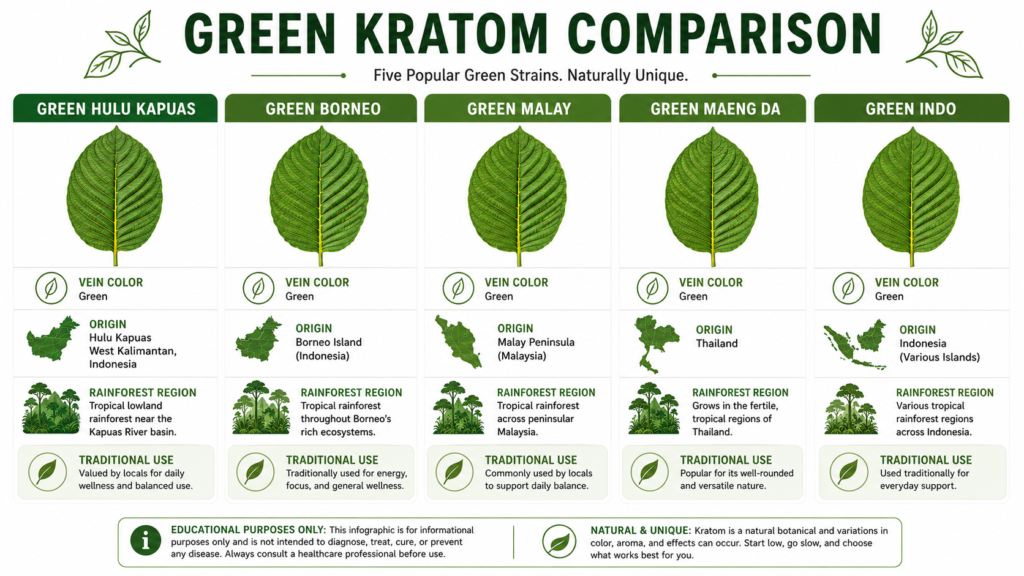
Green vein kratom is one of the commonly discussed kratom categories. The table below outlines how Hulu Kapuas is generally described relative to other commonly referenced strains.
| Strain | Common Description | Key Characteristics | Important Limitation |
|---|---|---|---|
| Green Hulu Kapuas | Wild-harvested jungle variety | Regional green vein variety marketed as originating from the Hulu Kapuas area | Many products are mislabeled or blended |
| Green Maeng Da | Widely farmed, high-potency | Widely available; often marketed for potency | Heavy cultivation can lead to significant batch variation |
| Green Malay | Long-duration effects reported by users | Often described by users as mild | Product sourcing varies by vendor |
| Green Borneo | General Borneo-region harvest | Reviews describe it as accessible and moderate | The term “Borneo” is often vague, and the specific source location is frequently unspecified |
| Green Indo | Broad Indonesian origin | Widely available, entry-level option | Not regionally specific |
Hulu Kapuas green is often marketed based on regional specificity and wild-harvesting claims. This distinction may be meaningful for research purposes, but only when the sourcing can actually be verified.
Harvesting and Processing in a Remote Region
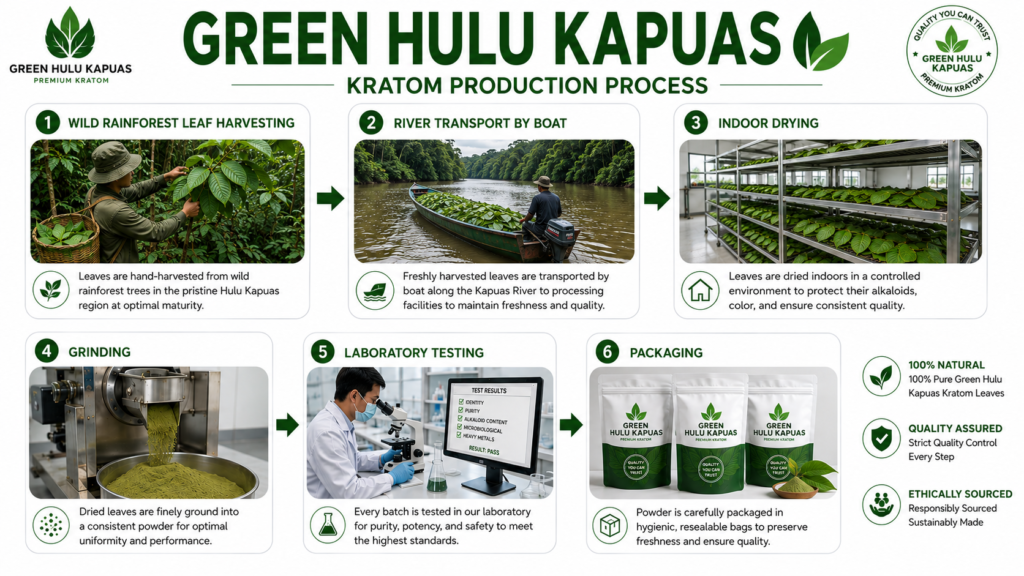
Sourcing kratom from the Hulu Kapuas region differs from operating a conventional farm. According to vendor accounts, harvesters travel by boat along river tributaries to locate wild Mitragyna trees. Leaves are hand-selected and brought back to a processing area, where standard kratom processing steps are typically applied:
- Washing — Leaves are cleaned before processing.
- Drying — Methods vary; some batches are sun-dried, while others are dried indoors or with low heat.
- Grinding — Dried leaves are milled into a fine powder.
- Screening — The powder is sifted to a consistent particle size.
- Packaging — The finished product is typically sealed in heat-sealed mylar bags.
Drying and processing methods may influence the final alkaloid profile. This remains an active area of botanical research rather than settled science.
What Consumers Have Reported Observing
Consumer observations of green Hulu Kapuas kratom show some recurring patterns, though these accounts are anecdotal. Some users describe it as falling between commonly described green and red vein profiles. Other commonly reported observations include:
- A smoother onset compared to some other green strains
- Some users compare its taste with other green vein varieties
- A moderate duration before effects are reported to diminish
These are self-reported accounts from kratom users and enthusiasts. They are not medical data and should not be treated as such. They may, however, offer some general context for how this strain is discussed within the broader green vein category.
How to Spot Low-Quality or Mislabeled Products
This is where things get more complicated. Because authentic Hulu Kapuas kratom can be difficult to source, some vendors reportedly use the name to market other green strains. When evaluating a product, consider the following:
- Third-party lab testing — Look for a Certificate of Analysis (COA) from an independent laboratory confirming mitragynine content and the absence of heavy metals and microbial contamination.
- Alkaloid percentages — Reputable vendors typically publish specific percentages rather than simple presence/absence results.
- Disclosed country of origin — Look for vendors who specify Indonesia, and ideally Kalimantan, as the sourcing region.
- AKA GMP certification — The American Kratom Association’s Good Manufacturing Practices program requires participating vendors to undergo regular audits.
- Batch-specific documentation — Lab results should be linked to a specific lot number rather than displayed as a generic page.
The kratom market is not regulated at the federal level in the United States. Consumers should review third-party testing and vendor documentation before purchasing.
The Legal and Regulatory Landscape
Kratom remains the subject of ongoing scientific and regulatory debate in the United States. It is not currently classified as a controlled substance at the federal level; however, individual states and municipalities have enacted their own restrictions.
As of recent reporting, kratom has been banned or restricted in:
- Alabama
- Arkansas
- Indiana
- Rhode Island
- Vermont
- Wisconsin
Additional local bans exist in various counties and cities, even within states that otherwise permit kratom sales. Internationally, several Southeast Asian countries — including Malaysia, Thailand, and Indonesia (where policy has been evolving) — have regulated or restricted kratom.
Before purchasing or researching green Hulu Kapuas kratom, it’s worth confirming the current legal status in your specific location, as laws can change.
Common Myths and Misconceptions
Myth: Only kratom labeled “Hulu Kapuas” authentically comes from the Kapuas River region.
Reality: Regional names on labels cannot be independently verified without accompanying COA documentation or origin disclosure.
Myth: Red vein kratom is milder than green vein kratom.
Reality: Vein color reflects harvest timing rather than a reliable potency ranking. Alkaloid levels are influenced by tree age, soil conditions, and processing methods, not vein color alone.
Myth: Wild-harvested kratom is always superior to farmed kratom.
Reality: Wild harvesting tends to increase variability rather than reduce it. Farm-grown kratom can, in some cases, offer more consistent alkaloid profiles. Wild-harvested claims should be verified rather than assumed to indicate higher quality.
Myth: Kratom is regulated like a dietary supplement or vitamin.
Reality: Kratom’s regulatory status in the United States is complex and varies by jurisdiction. It does not fall under the FDA’s standard dietary supplement framework, which is one reason independent third-party testing and AKA GMP certification are considered important for consumer safety.
FAQs
Q1: What makes green Hulu Kapuas different from other green vein kratom strains?
Green Hulu Kapuas is distinguished primarily by its claimed geographic origin — the upper Kapuas River Basin in West Kalimantan, Borneo. Wild-growing trees in this environment are said to differ from farmed kratom, though this is difficult to verify without documentation. Consumers often describe it as falling between white and red vein characteristics. Because sourcing claims can be difficult to confirm and vary significantly between vendors, third-party documentation confirming regional origin and alkaloid content is important.
Q2: How can I tell if a green Hulu Kapuas kratom product is genuine?
Authenticity is best established through documentation rather than assumption. Look for a batch-specific Certificate of Analysis from an accredited third-party laboratory confirming mitragynine content, the absence of heavy metals such as arsenic and lead, and clean microbial test results. AKA GMP-certified vendors undergo external audits that help verify sourcing and manufacturing practices. A product page without linked lab results and batch numbers represents a meaningful transparency gap.
Q3: Is green Hulu Kapuas kratom legal in the United States?
Kratom is not classified as a controlled substance at the federal level. However, legality varies significantly by state and municipality. States including Alabama, Arkansas, Indiana, Rhode Island, Vermont, and Wisconsin have banned or restricted kratom, and various counties and cities within otherwise permissive states have enacted their own local bans. Confirm your local legal status before purchasing, and check periodically, as laws are subject to change.
Q4: What alkaloids are found in green Hulu Kapuas kratom?
Like other kratom varieties, green Hulu Kapuas contains mitragynine as its primary alkaloid, along with smaller amounts of 7-hydroxymitragynine, speciociliatine, paynantheine, and speciogynine. The relative ratios in any given batch depend on leaf maturity, soil conditions, and drying methods. No peer-reviewed research has established an alkaloid profile unique to the Hulu Kapuas variety specifically. Third-party lab COAs remain the most reliable source of alkaloid information for a given product.
Q5: How does drying affect green Hulu Kapuas kratom?
Drying method is one of the more significant post-harvest variables in kratom processing. High-temperature sun-drying may degrade certain alkaloids more quickly, while indoor drying under controlled temperature and humidity may help preserve a broader alkaloid range. Some producers reportedly use UV light exposure as part of processing, which may affect the ratio of mitragynine to 7-hydroxymitragynine. Green vein classification generally indicates the leaves were not subjected to the extended fermentation more commonly associated with red vein processing. Vendors who are transparent about their processing methods typically document them.
Conclusion
Green Hulu Kapuas kratom is marketed as one of the more regionally specific kratom varieties available. Its claimed origin — the upper Kapuas River Basin in West Kalimantan, Borneo, Indonesia — represents a different growing environment than more widely cultivated or farmed strains, though verifying these claims can be difficult.
This regional specialization is both a selling point and a sourcing challenge. Third-party lab documentation and AKA GMP certification remain among the most reliable indicators of quality available to consumers. Alkaloid science in this area continues to develop, consumer observation patterns are consistent but remain anecdotal rather than clinical, and the legal landscape remains fragmented both in the U.S. and internationally.
Other Articles You May Find of Interest...
- Kratom Legality in 2026: Why the Rules Vary by Location
- 7 Things to Know About Split Kilo Kratom Before a Bulk Order
- Red Thai Kratom: The Strain With a Complicated History and a Loyal Following
- Red Sumatra Kratom: What Makes This Strain Stand Apart
- Red Indo Kratom: The Strain That Built the Modern Kratom Market
- Red Hulu Kapuas Kratom: What Makes This Rare Strain So Talked About?
- Red Borneo Kratom: The Strain That Built the Modern Kratom Market