






More Kratom Education Articles
Red Horn Kratom: What It Actually Is and Why So Many People Get It Wrong

Many people assume that red horn kratom is simply another red vein variety. That assumption is incomplete in several important ways.
Red horn kratom differs from other types in ways that go beyond vein color. The “horn” portion of the name refers to a specific physical characteristic of the leaf, and that fact changes how the product is understood, sourced, and evaluated.
People searching for information about this variety often encounter a fragmented picture. Forum posts and product descriptions offer partial explanations, but a clear, well-organized account of what red horn kratom actually is remains difficult to find. This article addresses that gap.
The following sections cover the alkaloid profile, harvesting context, and market realities of red horn kratom. Several common misconceptions are also addressed. Whether encountering kratom for the first time or researching it in more depth, understanding the source of a plant-based product and how it differs from similar varieties is a useful starting point.
Important Notice: Kratom is not approved by the U.S. Food and Drug Administration (FDA) for any medical use. Regular use may lead to physical dependence and withdrawal symptoms. Kratom may interact with prescription medications, over-the-counter drugs, and other substances. Individuals with pre-existing health conditions, those taking medications, or those who are pregnant or nursing should consult a qualified healthcare provider before using kratom.
What Red Horn Kratom Actually Is
Red horn kratom originates from Mitragyna speciosa, a kratom tree native to Southeast Asia.
What distinguishes it is the shape of the leaf. Most kratom leaves have smooth edges with no sharp projections. Horn kratom leaves have small, pointed projections along the edges — hence the term “horn.” This physical characteristic is uncommon and is not something every kratom tree produces consistently.
The “red” designation refers to the color of the veins running through the leaf. As a kratom plant matures, vein color progresses through stages. The timing of harvest determines which color is present at the collection. Red-veined leaves are harvested later in the growth cycle than green or white vein varieties.
Red horn kratom is specifically a horn-shaped leaf with red veins, harvested at a particular stage of maturity. This is a more precise definition than most sources provide.
Why the Naming Can Confuse Buyers
The kratom market operates on naming conventions that are not standardized.
“Red horn” is a descriptive term, but vendors use it inconsistently. Some products labeled as red horn may not originate from leaves with a visually distinct horn morphology. Others may blend horn-leaf material with more typical red-veined leaves.
This is a recognized problem across the kratom industry and is not limited to red horn — it affects many varieties, from Maeng Da to Borneo products. Buyers should understand that kratom strain names are general category labels and do not guarantee a homogeneous product.
Third-party testing can verify alkaloid content but cannot always confirm leaf morphology. Sourcing transparency and vendor reputation are therefore more meaningful indicators than the label alone.
Key Physical and Botanical Characteristics
Red horn kratom has several characteristics worth examining:
- Leaf morphology: The distinct pointed edges are the primary physical feature that sets it apart from other varieties.
- Vein color: Red veins indicate a later harvest stage compared to green-veined leaves.
- Geographic origin: Authentic horn kratom is most commonly associated with Borneo, particularly the Kalimantan region of Indonesia.
- Supply: Horn-leaf trees are less common, meaning supply is naturally more limited than standard smooth-leaf varieties.
- Powder color: Processed red horn kratom typically yields a medium to dark brownish-green powder.
These characteristics make red horn kratom distinctive, but they do not inherently make it superior or inferior to other varieties.
Alkaloid Composition and What It Means
Kratom’s properties stem from its alkaloid composition. The two primary alkaloids are mitragynine and 7-hydroxymitragynine. Both interact with receptors in the body, though the full pharmacology is still being studied.
Red vein kratom varieties, including red horn, are generally associated with higher concentrations of 7-hydroxymitragynine compared to younger green-veined leaves. This is likely related to the later stage of harvest.
Alkaloid levels vary considerably between farms, batches, and growing conditions. A red horn product from one vendor may have a significantly different alkaloid profile than a product from another vendor sold under the same name.
This is why independent laboratory testing is critical. Without verifiable alkaloid data, purchasing decisions are based on incomplete information.
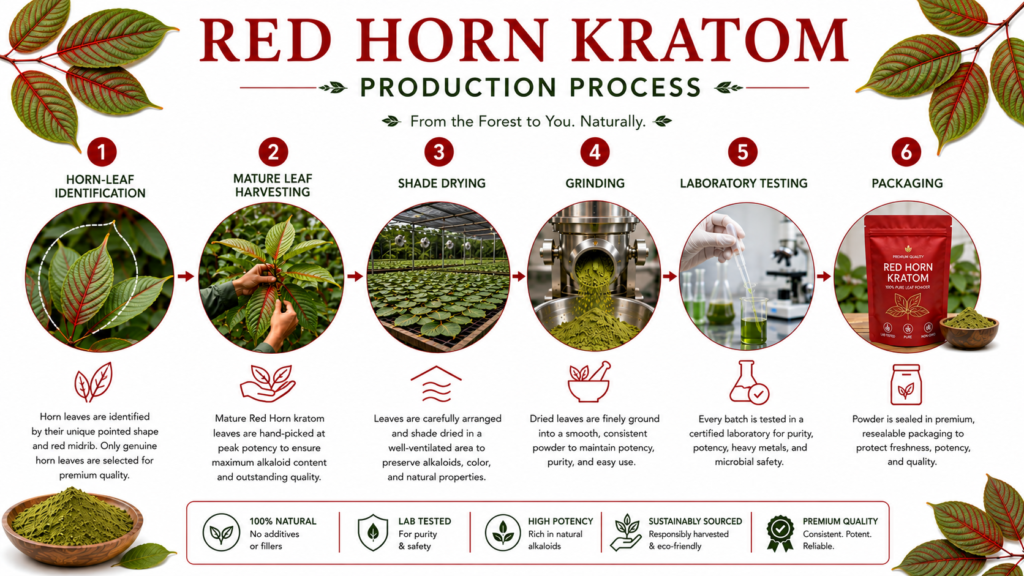
How Red Horn Kratom Is Harvested and Processed
Understanding the supply chain provides useful context for quality differences.
Harvesting begins with identifying mature trees that produce horn-shaped leaves. Experienced harvesters select leaves at their peak maturity, when the veins are visibly red. The drying method has a significant effect on the final product. Red horn kratom may be shade-dried or sun-dried, depending on the producer. Drying methods can influence the final alkaloid profile and other product characteristics. Sun drying and shade drying produce different results in terms of alkaloid concentration.
Processing involves washing, drying, and grinding leaves into a fine powder. Contamination can occur at any point in this process if sanitation standards are not followed. Shipping and storage conditions also affect potency and shelf life — moisture, heat, and UV exposure can degrade alkaloids before the product reaches the consumer.
The quality of red horn kratom depends on the integrity of each step in this process, not only the selection of the correct leaf morphology.
Red Horn vs Other Popular Kratom Strains
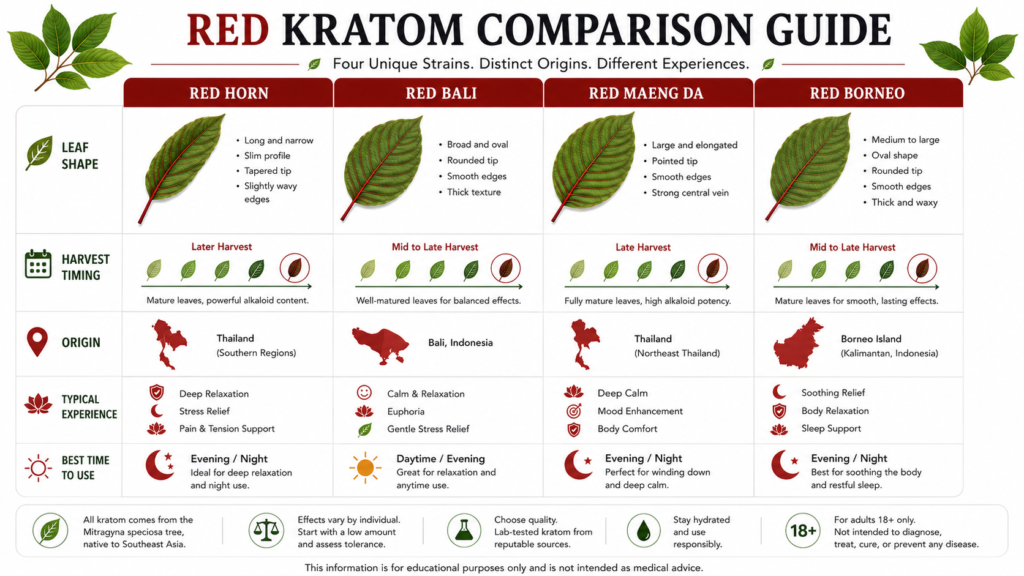
| Strain | Common Description | Key Characteristics | Important Limitation |
| Red Horn Kratom | Rarer red-veined variety from Borneo with a distinctive leaf shape | Horn-shaped leaves, later harvest stage, distinct alkaloid ratios | Limited supply; labeling inconsistencies are common in the market |
| Red Bali Kratom | One of the most widely available red vein varieties | Broad leaf, typically with smooth edges; common in large-scale production | High availability can mean variable quality across vendors |
| Red Maeng Da | Popular high-alkaloid variety, often blended or selectively processed | Frequently marketed as potent; often a blend rather than a single-origin strain | “Maeng Da” is not a geographic name — it is a quality designation without a standardized definition |
| Green Malay Kratom | Mid-cycle harvest of green-veined leaves from Malaysia | Often described as having an intermediate profile | “Malaysian” sourcing is broadly applied; true origin is often unverified |
| White Borneo Kratom | Early-harvest white-veined leaf from Borneo | Earlier harvest yields lower 7-hydroxymitragynine and a different alkaloid profile | White vein characteristics can also result from processing, not only from natural harvest timing |
Background and Current Market Context
Kratom has been used for centuries in Southeast Asia. In countries such as Thailand, Malaysia, and Indonesia, people traditionally chewed fresh kratom leaves as part of cultural and working life in rural communities.
Red horn kratom, as a Borneo variety, has its roots in Indonesian kratom culture. Borneo — particularly the Kalimantan region — is one of the most significant kratom-producing areas in the world.
In contemporary Western markets, kratom came to wider public awareness in the early 2000s. It is now available in powder, capsule, extract, and tea forms across the United States and parts of Europe.
The American Kratom Association (AKA) has worked to establish Good Manufacturing Practice (GMP) guidelines for vendors. These standards are voluntary rather than legally required, but they represent the most structured quality framework currently available in an otherwise unregulated market.
What Consumers Have Reported
Consumer information about red horn kratom is largely anecdotal. However, patterns do emerge across review communities and user forums.
Red horn is commonly described as a more complex red vein product. Consumer reports frequently distinguish it from more widely available reds such as Red Bali. Common themes in these accounts include:
- A perceived onset that differs from other red vein varieties
- An alkaloid experience described as distinct from more common red vein products
- Batch-to-batch consistency frequently noted as variable
These reports do not constitute medical evidence. They reflect what a segment of users has reported publicly. Individual responses to kratom vary considerably based on tolerance, body composition, product quality, and the specific batch being used.
Safety and Regulatory Considerations
Health and Safety Risks: Kratom is not FDA-approved for any medical use. Regular use may lead to physical dependence and withdrawal symptoms. Kratom may interact with prescription medications, over-the-counter drugs, and other substances. Pregnant or nursing individuals and those managing pre-existing health conditions should not use kratom without first consulting a qualified healthcare provider.
Kratom occupies a complex regulatory space. Within the United States, kratom is federally legal as of this writing. However, several states have prohibited or restricted its sale, including Alabama, Arkansas, Indiana, Rhode Island, Vermont, and Wisconsin. Local laws also vary, and confirming both state and municipal regulations before purchasing is advisable.
The FDA has not approved kratom for any medical purpose and has issued warnings regarding kratom-related products. The agency continues to examine the substance.
Third-party testing is among the most important quality measures currently available to consumers. Reputable vendors publish Certificates of Analysis (COAs) from independent laboratories. These documents should include:
- Alkaloid content and ratios
- Heavy metal screening (lead, arsenic, cadmium, mercury)
- Microbial contamination testing (Salmonella, E. coli)
- Pesticide residue analysis
AKA GMP certification indicates that a vendor has been audited for cleanliness in manufacturing, labeling accuracy, and storage practices. It is not a government-issued certification, but it is the most reliable third-party quality standard currently available in this market.
Label transparency is essential. Products should clearly display net weight, batch number, and testing references. Products without this information cannot be independently verified.
Common Misconceptions About Red Horn Kratom
Myth: All red horn kratom comes from a single species of tree.
In reality: Red horn leaves are found on Mitragyna speciosa — the same species as every other kratom variety. The horn shape is a morphological variation, not a distinct species or subspecies.
Myth: The horn shape of the leaf directly determines potency.
In reality: Leaf shape alone does not determine alkaloid concentration. Soil quality, climate, harvest timing, and drying methods all have a greater influence on the final alkaloid profile than physical leaf shape.
Myth: Red horn kratom is more potent than standard red vein kratom.
In reality: Alkaloid content varies by batch and producer. There is no established evidence that horn-leaf kratom consistently contains higher alkaloid levels than smooth-leaf varieties produced under comparable conditions.
Myth: Because red horn kratom is rare, it is automatically of higher quality.
In reality: Rarity reflects leaf morphology, not quality. Red horn kratom that is poorly grown or improperly processed can be lower in quality than a well-produced standard red vein variety.
Myth: The name “red horn” guarantees a consistent product across different sellers.
In reality: Kratom strain names are neither regulated nor standardized. The same name may refer to different products depending on a vendor’s sourcing, processing method, or blending practices.
Frequently Asked Questions
Where does red horn kratom come from?
The majority of red horn kratom is produced in Borneo, particularly the Kalimantan region of Indonesia. Borneo is one of the most productive kratom-growing regions in the world, with a climate and ecosystem well-suited to Mitragyna speciosa cultivation. The horn leaf morphology appears more frequently in certain growing regions, though it is not exclusive to any single area. Indonesian kratom farmers who cultivate for export often identify horn-leaf trees separately due to market demand for this variety. Availability is lower than standard smooth-leaf varieties because the horn characteristic does not appear in all trees.
What makes red horn kratom different from Red Borneo kratom?
Both originate from the Borneo region and both are red-veined varieties. The primary difference lies in leaf shape. Red Borneo is a broad category covering any red-veined kratom harvested from Borneo. Red horn specifically refers to leaves with the distinctive pointed-edge horn morphology. In practice, some vendors use both names interchangeably, which creates confusion for consumers. Those seeking genuine red horn kratom should look for vendors who can identify their source and provide lab documentation that includes harvest origin and alkaloid testing.
Does the drying method affect the quality of red horn kratom?
Yes, significantly. Drying is one of the most consequential steps in kratom processing. Shade drying or indoor drying is generally preferred to preserve alkaloid content, particularly 7-hydroxymitragynine. Direct sun exposure and heat can degrade alkaloids, resulting in a lower-potency final product. Fermentation methods — such as those used in producing Bentuangie varieties — alter the alkaloid balance differently. Red horn kratom is typically shade-dried, but buyers should seek transparency regarding a vendor’s drying process. A vendor that clearly communicates their processing methods is generally more reliable than one that provides no information.
Is red horn kratom legal to purchase?
Kratom, including red horn, is federally legal in the United States under current regulations. However, it is restricted or prohibited in several states, including Alabama, Arkansas, Indiana, Rhode Island, Vermont, and Wisconsin. Certain cities and counties also maintain local restrictions even in states where kratom is otherwise legal. Internationally, kratom is prohibited in several countries. Always verify the legal status in your specific location before purchasing, as laws are subject to change.
What should I look for when evaluating red horn kratom vendors?
The most important factor is third-party laboratory testing with publicly accessible Certificates of Analysis. These should include alkaloid content, heavy metal screening, and microbial testing results. AKA GMP certification indicates that a vendor has met voluntary manufacturing standards. Look for clearly labeled products with batch numbers and sourcing details. Vendors who provide information about their supply chain — including where their product is sourced and how it is processed — demonstrate greater transparency. Responsive customer service, clear return policies, and comprehensive product information on a vendor’s website are also reliable indicators of overall professionalism.
The Bottom Line
Red horn kratom is a specific botanical product distinguished by its leaf morphology and harvest timing. It originates from Borneo, features leaves with distinctive horn-like edges, and is processed similarly to other red vein varieties — with its own particular set of quality considerations.
The strain name is straightforward, but the real-world picture is more complex. Naming inconsistencies, variable supply, and the absence of regulatory oversight make consumer education more valuable than any product label.
Third-party testing, vendor transparency, and a clear understanding of kratom sourcing are the most effective tools available to anyone researching this product. Red horn kratom is neither a mysterious rarity nor an exceptional product by definition. It is a plant-derived product with a documented history, a genuine but inconsistently defined market identity, and the same quality considerations that apply to any agricultural product. Understanding that context is where informed decision-making begins.
Disclaimer: Kratom is not approved by the FDA for any medical use and is not intended to diagnose, treat, cure, or prevent any disease or condition. Kratom may cause physical dependence with regular use and may interact with medications. Always consult a qualified healthcare provider before using kratom, particularly if you have a pre-existing health condition or take prescription medications.
Other Articles You May Find of Interest...
- Kratom Legality in 2026: Why the Rules Vary by Location
- 7 Things to Know About Split Kilo Kratom Before a Bulk Order
- Red Thai Kratom: The Strain With a Complicated History and a Loyal Following
- Red Sumatra Kratom: What Makes This Strain Stand Apart
- Red Indo Kratom: The Strain That Built the Modern Kratom Market
- Red Hulu Kapuas Kratom: What Makes This Rare Strain So Talked About?
- Red Borneo Kratom: The Strain That Built the Modern Kratom Market





