More Kratom Education Articles
Red Maeng Da Kratom: What the Label Actually Tells You

Red Maeng Da Kratom is among the most sought-after kratom products in the United States.
It consistently ranks near the top of vendor sales charts, search volume statistics, and consumer surveys across the market. For anyone who has explored kratom products, Red Maeng Da is likely a familiar name.
However, most consumers do not fully understand what the name actually means — where it comes from, how the product is made, or why two items bearing identical labels can behave completely differently.
That gap matters. The kratom market has grown rapidly, bringing more suppliers, more products, and more confusing information. Red Maeng Da sits at the center of it — heavily promoted, often misunderstood, and rarely presented in a way that helps buyers evaluate what they are actually purchasing.
This article explains what Red Maeng Da kratom is, what drives product variation, what science indicates about its alkaloid composition, and what quality indicators matter when evaluating any product carrying this name.
Important Notice: Kratom is not approved by the FDA. It may cause physical dependence, may interact with prescription and over-the-counter medications, and carries health risks that are not yet fully understood. Anyone considering kratom use should consult a qualified healthcare provider before doing so.
Defining Red Maeng Da: Beyond the Brand Name
Red Maeng Da kratom is a red vein product sold under the “Maeng Da” label — a Thai phrase that loosely translates to “premium grade.”
The botanical origin is Mitragyna speciosa, the same tree that underlies every commercially available kratom product. It is native to Southeast Asia and closely related to the coffee plant. The majority of kratom sold in the U.S. market is now sourced from Indonesia.
“Red” refers to the vein color classification, which is linked to leaf maturity and post-harvest drying method. Red vein leaves are typically harvested from more mature trees and dried in sunlight with UV exposure. “Maeng Da” is a premium designation applied on top of this classification. Unlike regional labels such as Borneo or Bali, it does not point to a specific growing region. No industry body defines or regulates its use.
Why “Maeng Da” Raises More Questions Than It Answers
The name appears specific. In practice, it is not.
There is no standard that defines what qualifies as Maeng Da versus any other red vein product. There is no third-party verification process. There is no alkaloid threshold requirement. Vendors may apply the label according to their own internal criteria or in response to market demand.
Research has shown that alkaloid content varies more between vendors selling the same strain name than between different strain names offered by a single vendor. This finding directly contradicts the assumption that “Red Maeng Da” describes a consistent product across brands.
The product name indicates that the vendor considers it a premium red vein product. It does not confirm mitragynine content, geographic origin, or specific processing details.
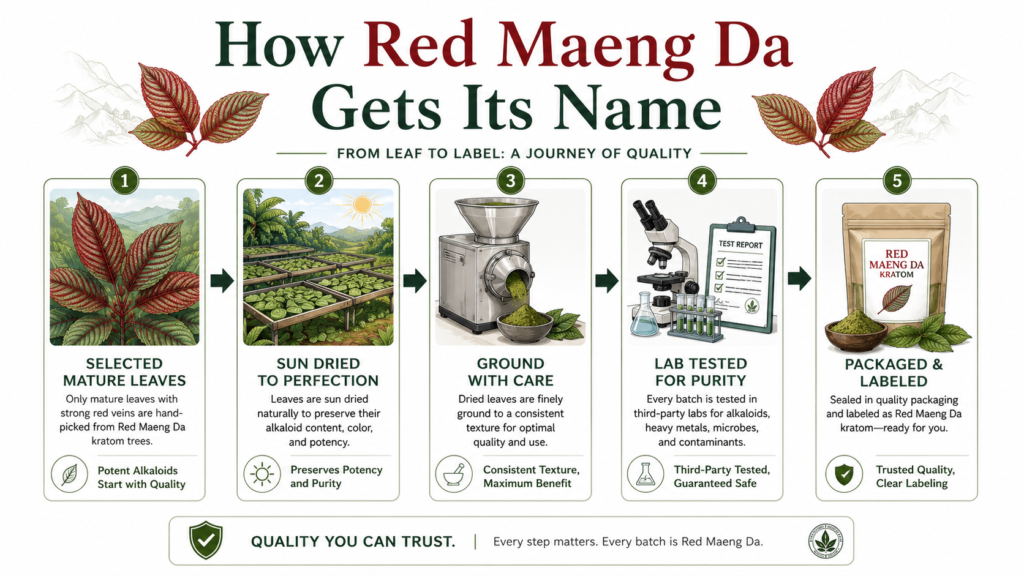
What Genuinely Distinguishes Red Maeng Da Products
Beyond the branding, the following factors are what actually define product quality:
- Red vein classification — Mature leaf harvest using outdoor UV drying, which influences the alkaloid ratio compared to younger leaf material.
- Mitragynine percentage — Reliable products are tested and results documented. Mitragynine content varies considerably between manufacturers.
- Powder consistency — Quality powder is uniformly fine-ground, without clumping or discoloration from moisture exposure.
- Batch-specific COA — The most important quality signal available. Without current lab documentation, no valid quality assessment is possible.
The strain name alone is the least informative indicator of product quality.
The Alkaloid Profile Behind Every Red Maeng Da Product
Red Maeng Da products share the same alkaloid structure as all kratom products. Concentration is where they differ.
Mitragynine is the dominant compound, typically comprising 60–70% of total alkaloid content. It is the most researched kratom compound and the primary subject of pharmacological investigation.
7-Hydroxymitragynine (7-OH) is present in smaller quantities — typically less than 0.1% of dry weight in natural leaf — but is considered significantly more potent per unit. Both compounds interact with mu-opioid receptors. This distinguishes kratom’s pharmacological profile from most botanicals and is a central reason for the FDA’s ongoing safety review.
More than 40 alkaloids have been identified in Mitragyna speciosa. The majority have been studied only in limited contexts. How these compounds interact within a whole-plant product is not yet well understood.
Supply Chain: Farm to Label
Most Red Maeng Da products follow a consistent production process. Mature leaves are harvested in Indonesia, dried, ground into powder, and exported in bulk quantities. The drying phase is where the red vein distinction emerges — outdoor sun drying and UV exposure affect both the color and the alkaloid ratio. This represents a genuine chemical distinction, not merely a visual one.
After import, U.S. vendors repackage the powder and apply their own Maeng Da labeling based on internal standards or market demand. Quality vendors maintain harvest documentation, batch numbers, and third-party lab results that link the finished product to its source. Vendors who do not provide these records cannot substantiate the claims made on their labels.
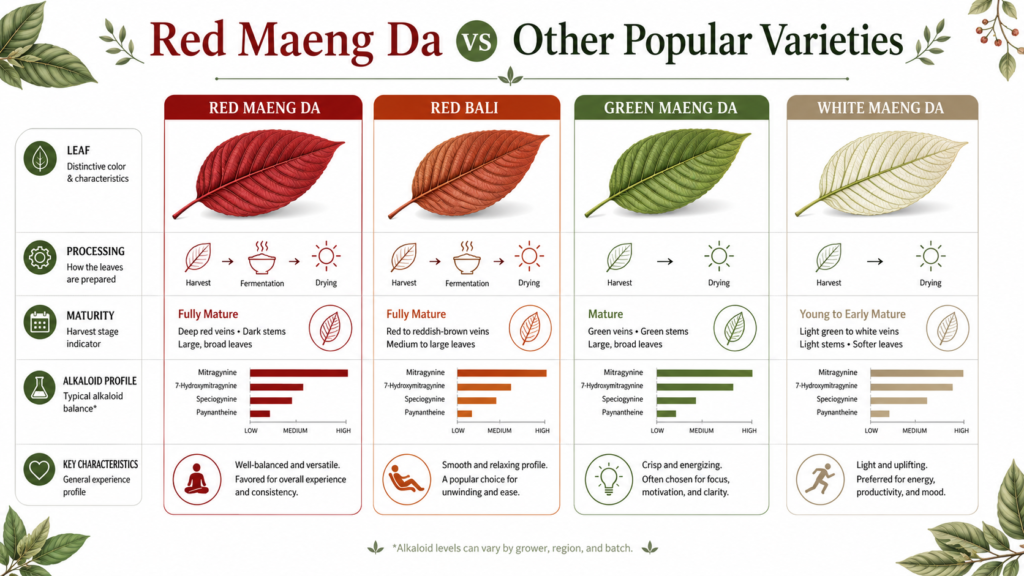
Red Maeng Da vs. Other Common Varieties
| Strain | Common Description | Key Characteristics | Important Limitation |
| Red Maeng Da | Premium red vein; top U.S. seller | Mature leaf, outdoor drying, high market visibility | No standardized definition for “Maeng Da” exists |
| Red Bali | Widely available red vein variety | Earthy profile, broadly stocked | Alkaloid content varies significantly between vendors |
| Green Maeng Da | Green vein product under the Maeng Da label | Younger leaves, indoor drying, variable alkaloid content | Subject to the same labeling limitations as Red Maeng Da |
| White Maeng Da | White vein product under the Maeng Da label | Youngest leaf harvest, minimal UV drying | Vein color is influenced by processing, not leaf age alone |
Origins and Market Evolution
The term Maeng Da originated in Thailand, where kratom has a long history of traditional use. Agricultural workers traditionally chewed leaves or brewed them as tea. The term entered local use as a descriptor for higher-potency material.
Thailand banned kratom in 1943, a prohibition that remained in effect until 2021. During that period, Indonesian supply filled the gap and came to dominate global exports. Red Maeng Da grew into a leading U.S. product through online word-of-mouth, not through clinical endorsement or formal advertising. The name carried an implied quality designation that vendors widely leveraged.
The FDA has not endorsed any kratom product and continues its safety review. Kratom remains unscheduled at the federal level as of 2025.
What Consistent Buyers Tend to Notice
Consumer reports about Red Maeng Da show consistent enough patterns to suggest real trends, even without clinical validation.
Red vein varieties are frequently described in particular ways within user communities and informal surveys, reflecting the possibility that mature leaf harvests influence alkaloid ratios. However, subjective experience is shaped by product quality, individual biology, and tolerance level. Two individuals using the same product may report entirely different experiences.
Physical dependence with regular kratom use has been documented in clinical literature. Withdrawal symptoms following prolonged use — including muscle discomfort, insomnia, and irritability — have been reported in both research and consumer accounts.
Safety, Testing, and the Regulatory Gap
Third-Party Lab Testing
A batch-specific COA is the baseline standard. It should include mitragynine and 7-OH percentages, heavy metal screening, microbial testing, and pesticide residue analysis, conducted by an independently accredited laboratory.
AKA GMP Standards
The American Kratom Association’s Good Manufacturing Practice program is the primary voluntary quality standard available in this industry. Certified vendors undergo audits covering testing, manufacturing, and labeling practices.
Label Transparency
Products should clearly indicate vein color, country of origin, batch number, and COA reference. Incomplete or vague labeling is a quality concern regardless of brand recognition.
Contaminant Screening
Past industry recalls have included undisclosed pharmaceutical additives such as synthetic opioids. Thorough contaminant screening on every batch — not only periodic checks — reflects responsible vendor practice.
Legal Status
Kratom is prohibited in Alabama, Arkansas, Indiana, Rhode Island, Vermont, and Wisconsin. Additional restrictions exist at the municipal level in other states. Current local laws should be verified before purchasing.
Four Myths That Follow Red Maeng Da Everywhere
Myth: Red Maeng Da is a genetically distinct plant variety.
Fact: All commercially sold kratom is Mitragyna speciosa. No Red Maeng Da cultivar has been botanically verified. The name reflects a marketing and processing classification, not a distinct botanical origin.
Myth: Higher prices indicate higher alkaloid content.
Fact: In an unregulated market, pricing reflects brand recognition, not chemistry. Only batch-specific COA data provides accurate mitragynine percentages.
Myth: Red Maeng Da is inherently more potent than standard red vein products.
Fact: Potency depends on the alkaloid concentration of each specific batch and supplier. A standard red vein product from a rigorous vendor may test higher than a Maeng Da-labeled product from a less careful one.
Myth: Buying the same brand guarantees consistent results.
Fact: Alkaloid content varies between batches, even within the same vendor’s inventory. Reviewing the COA for each batch — not brand loyalty — is the only available means of assessing consistency.
Frequently Asked Questions
What does “Maeng Da” mean and where did it originate?
Maeng Da is a Thai term that loosely translates to “premium grade” — an informal expression for higher-quality kratom material. U.S. vendors adopted it as a marketing term as the American market developed. No regulatory body defines or oversees its use, meaning any vendor may apply it to any product. It reflects a vendor-assigned status designation, not a certified botanical or chemical standard. Two products labeled Maeng Da from different suppliers may have significantly different alkaloid profiles.
What distinguishes Red Maeng Da from other red vein products?
The Maeng Da label theoretically signals a premium red vein product. In practice, the distinction depends entirely on each vendor’s sourcing and processing criteria. Some vendors apply stricter internal standards. Others apply the label to standard red vein stock. Without comparing batch-specific COAs showing mitragynine percentages across products, there is no objective way to determine whether a Red Maeng Da product differs meaningfully from other red vein options.
What mitragynine content should a quality Red Maeng Da show?
Standard leaf powder generally tests within the range documented on batch COAs. Products claiming significantly elevated 7-OH levels warrant scrutiny, as this may indicate adulteration. Always review the COA specific to the batch being purchased, not a general test from a previous production run.
Does Red Maeng Da carry a risk of dependence?
Yes. Physical dependence resulting from regular kratom use has been confirmed in peer-reviewed research across all kratom varieties. Mitragynine and 7-OH both act on opioid receptors. Consistent use can lead to tolerance and dependence. Discontinuation following heavy use has been associated with withdrawal-like symptoms including muscle discomfort, insomnia, mood changes, and gastrointestinal disturbance. These risks apply to Red Maeng Da in the same way they apply to any other kratom product.
Is Red Maeng Da legal across the United States?
Kratom is not federally scheduled as of 2025. State-level prohibitions are in effect in Alabama, Arkansas, Indiana, Rhode Island, Vermont, and Wisconsin. Certain cities and counties in other states have independent restrictions. Regulations continue to evolve as the FDA’s review proceeds. Current local and state laws should always be verified before purchasing or using any kratom product.
The Bottom Line
Red Maeng Da kratom is one of the most prominent products in a market that lacks standardization at nearly every level.
The name signals a vendor-designated premium quality. Without supporting documentation, it does not convey consistent alkaloid content, verifiable authenticity, or confirmed potency. The “red vein” component reflects genuine processing variables linked to leaf maturity and drying method. The “Maeng Da” component reflects market positioning.
The active compounds are real and pharmacologically significant. The risk of dependence with regular use is established in the clinical literature. The FDA continues to review the safety profile of kratom without having formally approved any kratom product for any use.
Batch-specific COAs, AKA GMP certification, and transparent origin records remain the most reliable quality filters available in this unregulated market.
Kratom is not FDA-approved. It may cause dependence, may interact with medications, and carries risks that are not yet fully understood by medical science. Readers are strongly encouraged to consult a qualified healthcare provider before using kratom in any form.
Other Articles You May Find of Interest...
- Kratom Legality in 2026: Why the Rules Vary by Location
- 7 Things to Know About Split Kilo Kratom Before a Bulk Order
- Red Thai Kratom: The Strain With a Complicated History and a Loyal Following
- Red Sumatra Kratom: What Makes This Strain Stand Apart
- Red Indo Kratom: The Strain That Built the Modern Kratom Market
- Red Hulu Kapuas Kratom: What Makes This Rare Strain So Talked About?
- Red Borneo Kratom: The Strain That Built the Modern Kratom Market