More Kratom Education Articles
Kratom Gummies: What You Actually Need to Know

Most people treat kratom gummies like ordinary candy with an added ingredient. That perception is where problems begin.
Kratom gummies are among the most complex kratom products available today. They go through multiple manufacturing stages before reaching store shelves. Because they resemble regular gummy candy, consumers often skip the due diligence they would normally apply to kratom powders or capsules.
The gummy format may affect how quickly kratom is absorbed compared with some other forms, although individual experiences can vary.. The key alkaloids — mitragynine and 7-hydroxymitragynine — must survive extraction, formulation, and the binding process before absorption even begins. Each stage is an opportunity for quality to break down.
Kratom gummies have grown significantly in popularity over the past several years. They are now widely available in smoke shops and through online vendors, with a large range of products to choose from. The problem is that most consumers do not know how to distinguish a quality product from a poor one, or what characteristics to look for.
This article offers a factual overview of what kratom gummies are, how they are made, and what matters when evaluating them.
Important: Kratom is not FDA-approved for any use. It may cause dependency with regular use, may interact with prescription and over-the-counter medications, and carries other health risks. Anyone considering kratom use should speak with a licensed healthcare provider before doing so.
What Are Kratom Gummies?
Kratom gummies are edible products made with kratom extract or kratom powder.
Kratom originates from Mitragyna speciosa, a tropical tree native to Southeast Asia. The plant’s leaves contain alkaloids that have been used in traditional practices in that region for centuries.
Unlike capsules or raw powders, gummies require additional manufacturing steps. The kratom substance — typically in extract form — is blended into a base composed of gelatin or pectin, sweeteners, flavoring agents, and binding substances.
Kratom gummies are generally produced using one of the following:
- Full-spectrum kratom extract
- Isolated mitragynine concentrate
- Leaf powder incorporated directly into the gummy matrix
Each method produces a different end product. Full-spectrum options retain a broader alkaloid profile. Isolated compounds may offer higher concentrations of specific alkaloids, but reduce the complexity found in whole-plant preparations.
Why the Gummy Format Can Be Misleading
The candy-like appearance creates a real gap in how consumers perceive the product.
When something looks and smells like gummy candy, people tend not to approach it the same way they would a capsule or powder. Consumption becomes more casual. Serving sizes get misjudged. In some cases, products have been consumed by individuals who were not fully aware of what they contained.
Regulators and consumer safety organizations have raised this concern repeatedly.
Labeling is another area of concern. Some gummies do not clearly state the amount of kratom per piece. Others provide ratios — such as “10x extract” — without explaining what that means in practical terms. A concentration ratio without a known baseline provides no meaningful information about actual alkaloid content per serving. Clear, specific labeling is more important for gummies than for almost any other kratom format.
Key Characteristics of Kratom Gummies
Kratom gummies vary considerably across brands and product lines. The following characteristics define this category:
Alkaloid content: The primary active compounds are mitragynine and 7-hydroxymitragynine. Meaningful quality assessment requires knowing the amount per individual gummy, not just per package.
Extract-based formulation: Most gummies use concentrated kratom extract rather than raw powder. Common formats include percentage-based mitragynine extract and full-spectrum liquid extract.
Absorption and onset: Edible kratom products are digested differently from powder. Onset generally takes longer than consuming powder mixed into a liquid.
Flavor masking: The gummy base conceals the bitter, earthy taste of kratom. This is the primary reason consumers prefer this format.
Shelf stability: Gummies are shelf-stable but degrade faster when exposed to moisture, heat, or light. Storage conditions directly affect alkaloid integrity over time.
Understanding Alkaloids and Composition
The kratom plant contains more than 40 identified alkaloids.
Mitragynine and 7-hydroxymitragynine receive the most attention. Mitragynine makes up the largest proportion of alkaloid content in most Mitragyna speciosa preparations. It interacts with opioid receptors, though its mechanism differs from that of conventional opioids.
7-hydroxymitragynine (7-OH) is present in small quantities in the raw leaf. Certain extraction processes concentrate it further. This compound has drawn significant regulatory scrutiny due to concerns about its potency and potential for harm.
Other alkaloids present in the plant include speciociliatine, speciogynine, mitraphylline, and corynantheidine. The ratios of these compounds vary depending on vein color, geographic origin, and leaf maturity at the time of harvest.
A gummy made from a red vein extract carries a different alkaloid profile than one made from a white vein variety. These are meaningful differences, even within the gummy format.
Processing, Harvesting, and Quality Factors
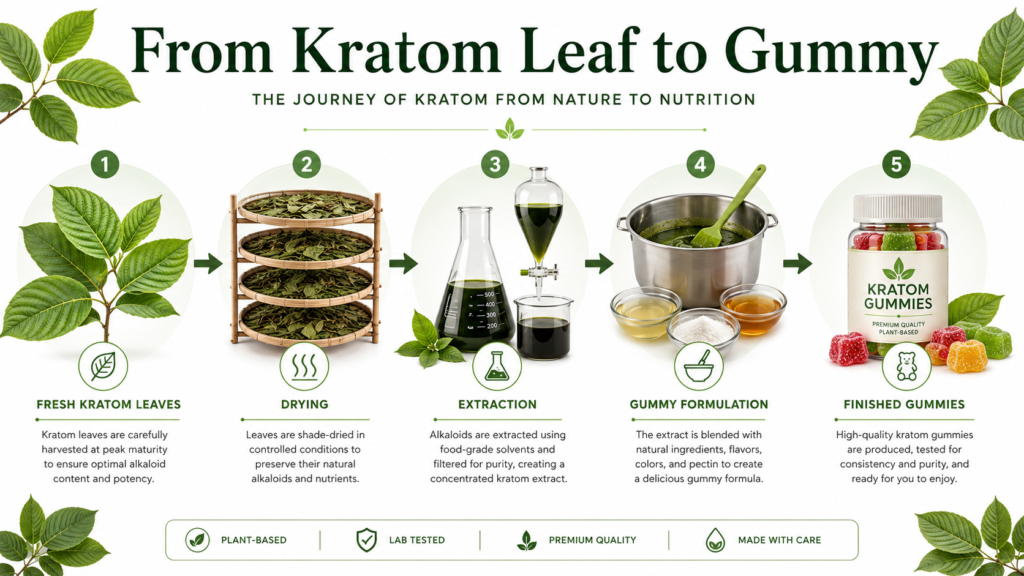
The path from raw leaf to finished gummy involves multiple stages, each of which can either preserve or compromise quality.
Harvesting: Leaves are harvested by hand in countries such as Indonesia, Thailand, and Malaysia. Leaf maturity at the time of harvest affects the alkaloid concentration of the finished product.
Drying: After harvest, leaves are dried using sunlight, indoor air circulation, or controlled fermentation. These methods produce the vein color classifications seen in the market — red, green, white, and yellow.
Extraction: For gummies, dried leaves undergo a concentration process. Ethanol and water-based extraction are the most common methods. The goal is to isolate alkaloids into a concentrated, usable form.
Gummy manufacturing: The extract is blended into the gummy base. Temperature control during this stage is critical. Excessive heat can damage alkaloids and reduce the potency of the final product.
Laboratory testing: Responsible producers test finished products through independent laboratories to confirm alkaloid levels and screen for pesticides, heavy metals, and microbial contamination.
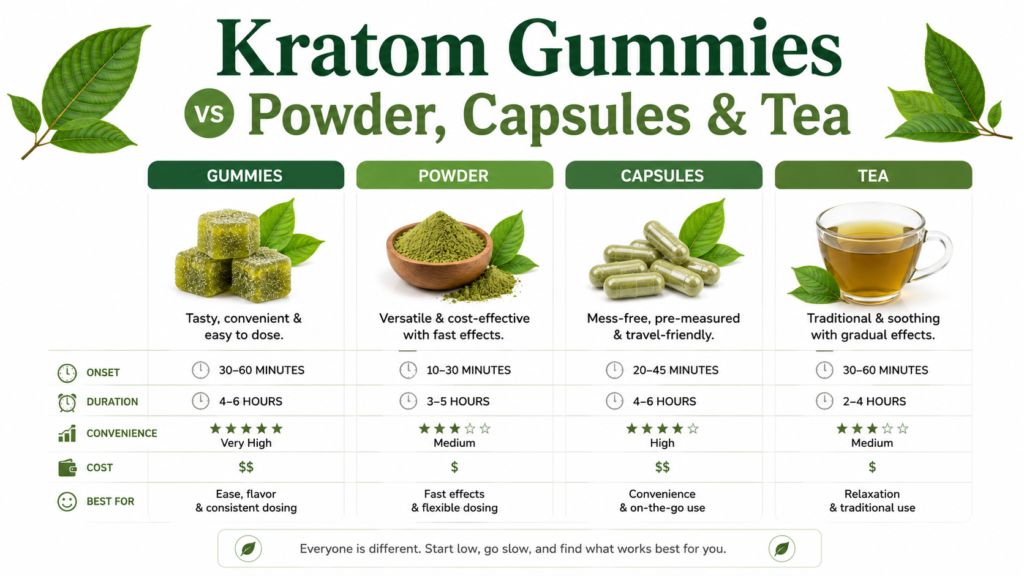
Kratom Gummies vs. Other Common Kratom Formats
| Format | Description | Key Characteristics | Notable Limitation |
| Kratom Gummies | Edible, extract-infused | Pre-dosed, taste-masked, convenient | Slower onset; casual format may lead to misjudged serving sizes |
| Kratom Powder | Ground leaf, loose or mixed | Widest strain variety, full plant profile | Bitter taste; requires preparation |
| Kratom Capsules | Powder in gelatin or vegetable shell | Pre-measured, portable, no taste | Digestion delay; multiple capsules typically needed per serving |
| Kratom Tea | Brewed from powder or leaf | Traditional preparation method | Variable strength; time-consuming to prepare |
Traditional Background and Modern Market Usage
Kratom has a documented history of use throughout Southeast Asia.
In countries such as Malaysia and Thailand, workers historically chewed fresh kratom leaves during physically demanding labor. It was a regional practice with cultural context, not a consumer product.
Kratom gummies have no connection to that tradition. They are a product of Western consumer markets and emerged alongside the broader growth of kratom’s commercial availability in the United States, particularly after 2015.
The American Kratom Association (AKA) has developed Good Manufacturing Practice (GMP) standards aimed at bringing consistency to the industry. Vendors that obtain AKA GMP certification undergo documented audits and are required to maintain batch-level quality controls.
Third-party testing: Every legitimate kratom gummy product should include a Certificate of Analysis (COA) from an independent laboratory. The COA should verify alkaloid concentration, heavy metal levels, microbial safety, and pesticide screening. Vendors that do not provide accessible COAs should be treated with caution.
Manufacturing standards: AKA GMP certification is currently the closest equivalent to a formal quality standard in the kratom industry. Certified vendors follow documented procedures covering staff training, manufacturing practices, and batch testing.
Label transparency: A responsible kratom product label should include the milligrams of powder or extract per gummy, the total quantity per package, alkaloid content if measured, a lot number for traceability, and contact information for the manufacturer.
Contamination risks: Kratom is an imported agricultural product. Heavy metals, salmonella, and pesticide contamination are all documented risks in the supply chain. Independent testing is the only reliable way to confirm product safety.
Health risks: Kratom is not FDA-approved. Regular use may lead to physical dependence. Kratom may interact with prescription medications, including those affecting the central nervous system. Adverse effects have been reported and documented. Anyone with existing health conditions or taking medications should consult a healthcare provider before using any kratom product.
Legal status: Kratom is federally legal in the United States but is banned in several states, including Alabama, Arkansas, Indiana, Rhode Island, Vermont, and Wisconsin. Additional restrictions exist in certain municipalities. Legal status is subject to change. Verify the applicable laws in your location before purchasing.
Common Misconceptions About Kratom Gummies
Misconception: Kratom gummies are simply a more convenient form of kratom.
Fact: The extraction and formulation process alters the alkaloid profile. A gummy made from concentrated extract is not equivalent to consuming raw powder in a capsule.
Misconception: Higher extract ratios mean stronger gummies.
Fact: Ratios such as “10x” or “50x” describe the concentration of source material, not the alkaloid quantity per serving. Two products with the same ratio label may differ substantially in actual potency.
Misconception: Kratom gummies are FDA-approved.
Fact: No kratom product has received FDA authorization for any use. The FDA has issued warnings about kratom and continues to monitor the market.
Misconception: All kratom gummies are comparable in quality.
Fact: Quality varies significantly between manufacturers. Sourcing practices, extraction methods, testing protocols, and manufacturing standards differ widely across brands.
Frequently Asked Questions
What is the difference between kratom gummies and kratom extract?
Kratom extract is a concentrated form of alkaloids derived from dried leaves. Kratom gummies are finished edible products that incorporate extract as one ingredient among several. The gummy format introduces additional manufacturing complexity — including flavoring agents and binding substances — each of which may affect how alkaloids are absorbed compared to consuming extract in powder or liquid form. The two terms are often used interchangeably, but they represent different points in the production chain.
How should I evaluate kratom gummy quality before purchasing?
Request or locate a third-party Certificate of Analysis for the specific product. It should confirm alkaloid concentration and include screening results for heavy metals, microbial contaminants, and pesticides. Check whether the vendor holds AKA GMP certification, which requires documented procedures and regular audits. Look for clear per-gummy content information on the label, along with a lot number for traceability. Vendors that do not make this information readily available warrant skepticism.
Are kratom gummies legal throughout the United States?
No. While kratom is legal at the federal level, it is prohibited in several states, including Alabama, Arkansas, Indiana, Rhode Island, Vermont, and Wisconsin. Some municipalities impose additional local restrictions. Legal status may change as new legislation is enacted at the state or local level. Always confirm the current legal status in your location before purchasing. Receiving a kratom shipment in a jurisdiction where it is prohibited may carry legal risk.
Do kratom gummies work differently from kratom powder?
Many consumers and vendors report that gummies produce a slower onset compared to powder mixed into liquid. The digestion required to break down the gummy base delays alkaloid absorption. This does not necessarily change the total alkaloid amount consumed, but the timing and character of onset may differ. Individual factors such as metabolism, body composition, and prior use history also affect how any kratom product is experienced.
Can kratom gummies lose potency over time?
Yes. Kratom alkaloids degrade when exposed to humidity, heat, oxygen, or light. A gummy stored in poor conditions may lose potency before its printed expiration date. Responsible manufacturers use airtight, opaque packaging to minimize degradation. Always check manufacturing and expiration dates on labels. If a gummy has changed noticeably in texture, color, or smell since purchase, its alkaloid content may already be compromised.
Final Words
Kratom gummies are a modern commercial product built around a plant with a long traditional history in Southeast Asia. The format offers convenience and eliminates the taste barrier associated with raw powder. However, the manufacturing complexity involved in producing gummies means that quality variation between brands is significant — and often not visible to the consumer.
Kratom is not FDA-approved, carries documented health risks including the potential for dependence, and may interact with medications. Anyone considering its use should consult a licensed healthcare provider.
Third-party laboratory testing, AKA GMP certification, and transparent labeling are the most reliable indicators of product quality. Legal status varies by location and is subject to change.
Approaching kratom gummies with the same scrutiny applied to any supplement — verifying laboratory results, confirming legal status, and reading labels carefully — puts consumers in a significantly better position than those who do not.
Other Articles You May Find of Interest...
- Kratom Legality in 2026: Why the Rules Vary by Location
- 7 Things to Know About Split Kilo Kratom Before a Bulk Order
- Red Thai Kratom: The Strain With a Complicated History and a Loyal Following
- Red Sumatra Kratom: What Makes This Strain Stand Apart
- Red Indo Kratom: The Strain That Built the Modern Kratom Market
- Red Hulu Kapuas Kratom: What Makes This Rare Strain So Talked About?
- Red Borneo Kratom: The Strain That Built the Modern Kratom Market