More Hair Care Articles
How to Spot Ethical vs Unethical Hair Transplant Practices in Mumbai
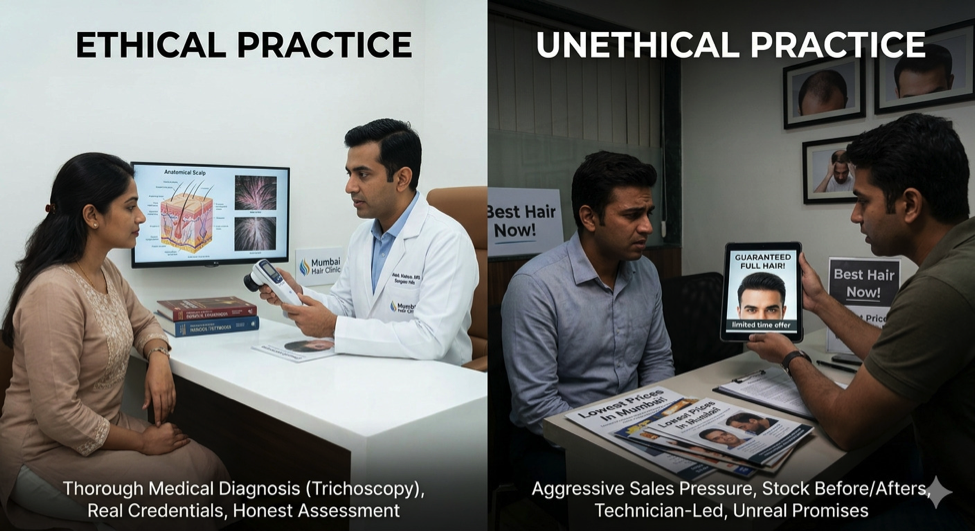
Choosing a clinic for a hair transplant is not a small decision. It involves real money, real risk, and results you will live with for years. In a city like Mumbai, where hundreds of clinics offer hair restoration services, patients often find it difficult to tell which ones follow proper medical standards and which ones are cutting corners. Knowing what to look for — and what to watch out for — can make a significant difference in both your safety and your outcome.
What Ethical Hair Transplant Practice Actually Looks Like
A responsible clinic starts with a thorough evaluation before recommending any procedure. This means assessing the cause of your hair loss, understanding how far it has progressed, and checking whether you are even a suitable candidate for a transplant at this stage.
An ethical practitioner will:
- Review your medical history and any medications you are taking
- Discuss non-surgical options where appropriate
- Explain realistic outcomes based on your donor hair density
- Be honest if a transplant is unlikely to meet your expectations
The conversation should feel informative, not rushed. If a clinic moves from your first visit to a surgery booking within the same hour, that is worth pausing over.
Warning Signs of Unethical Practices
Some red flags are easy to identify once you know what to look for. Others are more subtle but equally important.
Obvious warning signs include:
- No in-person consultation with a qualified doctor before the procedure
- Pricing that seems far too low without any clear explanation of what is included
- Pressure to book immediately, often framed around limited-time offers
- Guarantees of a specific number of grafts or final density outcomes
More subtle signs include a clinic that cannot clearly explain who will be performing the procedure. In India, hair transplant surgery must be performed by a licensed medical professional. In some setups, trained technicians handle significant portions of the procedure without adequate supervision. This is not only an ethical issue — it may also carry legal implications.
Understanding Graft Count and Why It Is Often Misused
One of the most common areas where patients are misled is graft count. Clinics sometimes advertise high graft numbers at low prices to attract bookings. However, the number of grafts required depends entirely on the area of baldness, the hair characteristics of the individual, and the available donor supply.
A high graft count is not always better. Overharvesting from the donor zone can leave permanent thinning at the back of the scalp. An ethical clinic will prioritise long-term donor health over maximising the number quoted in a package.
Ask specifically: who is counting the grafts, and how is that figure being verified during the procedure?
The Role of Transparency in Technique and Technology
Two main techniques are used in hair transplantation today — FUT (Follicular Unit Transplantation) and FUE (Follicular Unit Extraction). Neither is universally better. The right choice depends on the individual patient’s hair type, extent of loss, and lifestyle.
An ethical clinic will explain both options clearly, including their limitations. Be cautious of any clinic that only promotes one technique without explaining why it suits your specific case. Similarly, be aware of branded or trademarked technique names that are often marketing terms rather than genuinely distinct medical procedures.
How Aftercare Reflects Clinical Standards
What happens after the procedure is just as important as the procedure itself. Responsible clinics provide:
- Detailed post-operative care instructions in writing
- A clear point of contact for questions or concerns after discharge
- A follow-up schedule to monitor healing and early growth
Poor aftercare is often where unethical clinics fall short. If a clinic’s involvement ends the moment you leave the facility, that is a meaningful indicator of how seriously it takes patient outcomes.
Clinics like Kibo Clinics approach hair restoration by evaluating the underlying cause of hair loss first, considering the full range of treatment options, and maintaining structured follow-up care as part of the overall process — rather than treating the transplant as a one-time transaction.
Final Thoughts
Hair transplant surgery in Mumbai ranges from genuinely skilled, medically supervised care to setups that prioritise volume over patient welfare. The difference is not always obvious in advertising, but it becomes clearer when you ask the right questions and take time to assess how a clinic communicates.
You are entitled to understand exactly what will be done, by whom, with what technique, and what the realistic outcome looks like. A clinic that supports that process is likely operating with the right priorities. One that resists or rushes it may not be.
Other Articles You May Find of Interest...
- How Many Inches Does Hair Grow in a Year?
- Hair Transplants Explained: What to Know Before Considering Surgery
- What Scalp Micropigmentation Can and Cannot Do for Visible Scalp and Hair Loss
- How Long Does Rosemary Oil Take to Grow Hair?
- How Alopecia Areata, Totalis, and Universalis Differ in Progression and Unpredictability
- Is a Hair Transplant Worth the Cost? What to Consider First
- Why Leg Hair Can Grow Curly, Kinked, or Suddenly Different