






More Pain Management & Rehabilitation Articles
Learning to Look Up Again: My Safe Rehabilitation Journey from Neck Surgery to Normalcy
The “Tin Man” Effect
It didn’t happen overnight. I didn’t wake up one morning unable to move. It was a slow, creeping process, like rust forming on a hinge.
I spent five years prioritizing my career over my body. I sat in ergonomic chairs that weren’t actually saving me. I skipped the gym because I was “too busy.” I ordered takeout because I was “too tired.”
Eventually, I reached a state I call the “Tin Man” effect.
I wasn’t injured in a dramatic accident. I was just… frozen. My shoulders felt glued to my ears. My spine felt like a fused rod rather than a chain of flexible joints. When I dropped a pen on the floor, I didn’t bend over to pick it up; I performed an awkward, stiff-legged lunge because my back refused to articulate.
The problem wasn’t pain, exactly. It was a profound lack of trust.
I had lost confidence in my own structural integrity. I felt heavy, weak, and fragile. The idea of “working out” felt impossible because I couldn’t imagine my body performing dynamic movements without snapping something. I wasn’t fighting an injury; I was fighting the cumulative weight of gravity and inactivity.
I knew I needed to move. But I also knew that if I tried to jump into a high-intensity boot camp, I would quit on day one—or worse, I would actually hurt myself.
The Fear of Bodyweight Training
I read everywhere that “calisthenics” (bodyweight training) was the answer. It sounded perfect. No equipment, natural movement, primal strength.
So, I tried to do a pull-up.
It was a humbling disaster. I hung from a doorframe bar, strained with everything I had, and moved maybe half an inch. My shoulders screamed. My grip failed instantly. I dropped to the floor, feeling not just weak, but humiliated.
This is the dirty secret of bodyweight training: Gravity is a harsh teacher.
When you are out of shape, your body weight is often too heavy for your deconditioned muscles to handle. It’s not “beginner-friendly.” It’s actually incredibly advanced.
I realized that “just hanging” wasn’t enough. I needed a bridge. I needed a way to perform these natural, decompressing movements without having to lift 100% of my “Tin Man” body weight from day one.
Finding the Middle Ground: The Assisted Approach
I needed equipment that met me where I was. I wasn’t ready to be a gymnast, but I was done being a statue.
I started looking for tools that offered scalability. I didn’t want a machine that did the work for me (like a gym selectorized machine), but I needed something that would assist the movement.
This search for a “middle ground” led me to the concept of a power tower with assist.
In the past, I viewed “assisted” machines as cheating. I thought they were for people who couldn’t “do it for real.” But with my new mindset, I saw the genius in it. It wasn’t cheating; it was regression. It was a way to take a difficult movement pattern (the vertical pull) and make it accessible.
It allowed me to get into the position, feel the stretch, and engage the muscles, without the crushing failure of trying to lift my entire body dead-weight.
The Stability Factor (Why “Tank-Like” Matters)
When you are rebuilding trust in your body, the last thing you want is equipment that wobbles.
If I was going to hang my body weight (even partially) from a frame in my living room, that frame needed to feel like a part of the architecture.
I chose my specific setup because it was over-engineered. The 440 lbs weight capacity wasn’t just a number on a spec sheet; it was peace of mind. It meant the unit felt planted. It felt like a tank.
When I stepped onto the footplates, there was no rattle. No shifting. That solidity was crucial. It allowed my nervous system to relax. Instead of bracing myself against a wobbly piece of cheap metal, I could focus entirely on the movement.
I wasn’t fighting the machine; I was using it as a stable platform to fight gravity.
The “Assisted” Experience
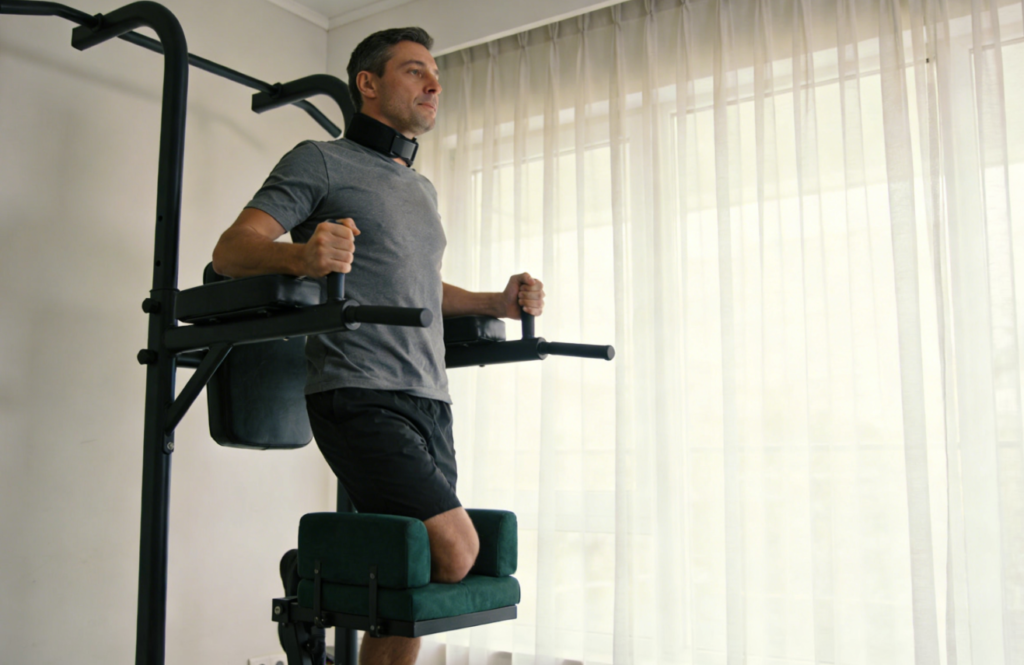
The game-changer for me was the knee assistance pad.
This is the feature that bridges the gap between “impossible” and “doable.”
Here is my routine: I step up, place my knees on the padded platform, and grip the bar. As I lower myself, the counter-weight mechanism gently pushes back. It absorbs a portion of my weight—maybe 30%, maybe 50%, depending on how I set it.
Suddenly, a pull-up isn’t a max-effort struggle. It becomes a smooth, controlled motion.
I can hang at the bottom and feel my spine decompress—a feeling of pure relief for anyone who sits at a desk all day. I can pull myself up and actually feel my back muscles engaging, rather than just feeling my arms failing.
It turns a frantic, high-intensity exercise into a slow, deliberate strength builder.
Integrating “Stability” into Home Life
One of the biggest hurdles to consistency is the environment. If your gear feels like an intrusion, you’ll resent it.
I expected a piece of equipment this substantial to feel like an eyesore. But the FED Fitness power tower with assist surprised me.
Because it focuses on verticality, it has a relatively compact footprint. It fits into the corner of my home office, utilizing the vertical space rather than eating up floor space.
It has become my “reset station.”
Now, when I’ve been typing for three hours and I feel that familiar “Tin Man” stiffness creeping into my neck and shoulders, I don’t just sit there and suffer. I stand up. I take two steps to the corner. I step onto the machine.
I do five slow, assisted reps. I let my spine hang for ten seconds.
Then I sit back down.
The whole process takes less than two minutes. But those two minutes break the cycle of sedentary stiffness. They remind my body that it can move, that it is strong, and that it is fluid.
Conclusion: Progression Over Perfection
I am still not a gymnast. I am not doing muscle-ups or one-armed hangs.
But I am no longer frozen.
The fear of movement is gone because I found a way to scale the challenge to my ability level. I stopped trying to force my body to do things it wasn’t ready for, and I started giving it the support it needed to grow.
Breaking the cycle of a sedentary life doesn’t require a miracle. It requires the right tools. It requires stability. And sometimes, it requires a little bit of assistance to help you pull yourself up.
Other Articles You May Find of Interest...
- Effective Pain Relief: Discover the Benefits of Combining Pain Relievers with Muscle Relaxers
- Managing Pain Effectively with 800 mg Naproxen: Benefits and Considerations
- A New Era of Care: Understanding the Benefits of Regenerative Medicine
- Exploring Alternatives: What Are the Options Stronger Than Loperamide?
- Navigating the Side Effects of Flexeril 5 mg for Safer Use
- Choosing the Right Muscle Relaxant for Sciatica: Robaxin or Flexeril?
- Is Robaxin the Solution for Your Back Pain Relief?



