More Weight Control, Nutrition & Exercise Articles
20-Minute Dumbbell Workouts for Total Body Fitness
A well-designed dumbbell workout can transform your fitness routine without demanding hours at the gym. In just 20 minutes, you can engage multiple muscle groups through compound movements that build strength, improve coordination, and boost cardiovascular endurance. This efficiency makes dumbbell training particularly valuable for professionals, parents, and anyone balancing fitness with a demanding schedule.
Unlike fixed-path machines, dumbbells require stabilizer muscles to work throughout each movement, developing functional strength that translates to everyday activities. This free-weight approach also allows for natural movement patterns that reduce joint stress while maximizing muscle engagement across your arms, legs, core, and back.
Why Choose Dumbbell Workouts?
Dumbbells remain one of the most versatile training tools available, suitable for beginners learning basic movement patterns and advanced athletes pursuing progressive overload. Their effectiveness stems from several key advantages:
- Versatility: A single pair of dumbbells enables hundreds of exercises targeting every major muscle group, from isolation movements to complex full-body patterns.
- Accessibility: Compact and affordable, dumbbells fit in small spaces and require no special setup, making home workouts genuinely practical.
- Balance and Coordination: Unilateral training with dumbbells exposes and corrects strength imbalances while developing proprioception and core stability.
- Range of Motion: Free weights allow natural movement arcs that accommodate individual biomechanics, often leading to better muscle activation than fixed machines.
Research from the American Council on Exercise confirms that dumbbell training effectively builds both strength and muscular endurance when programmed appropriately. The adaptability of these tools makes them suitable for rehabilitation, general fitness, and athletic performance training alike.
Essentials of a 20-Minute Full Body Dumbbell Workout
Structuring an efficient full-body session requires strategic exercise selection and time management. The goal is maximizing muscle recruitment while maintaining workout intensity throughout the brief training window.
- Warm-up: Spend 3-5 minutes on dynamic movements like arm circles, leg swings, and bodyweight squats to elevate heart rate and prepare joints for loaded exercises.
- Exercise Selection: Prioritize compound movements that engage multiple joints and muscle groups simultaneously—squats, presses, rows, and hinges form the foundation.
- Set Structure: Work intervals of 40-50 seconds followed by 10-20 second transitions keep intensity high while allowing brief recovery between exercises.
- Balance: Alternate between upper and lower body movements to distribute fatigue and maintain performance throughout the circuit.
- Cool Down: Finish with 2-3 minutes of static stretching, focusing on muscles worked during the session to support recovery and maintain mobility.
This framework allows you to complete a comprehensive training session during a lunch break or before morning commitments, eliminating the “no time” barrier that derails many fitness routines.
Total Body Dumbbell Workout Routine
This circuit-style routine targets all major muscle groups through functional movement patterns. Perform each exercise with controlled form, selecting weights that challenge you while allowing proper technique throughout the work interval.
- Goblet Squat: Hold a dumbbell vertically at chest height, elbows pointing down. Descend until thighs reach parallel, keeping your torso upright and weight centered over mid-foot. This foundational pattern builds leg and glute strength while reinforcing proper squat mechanics.
- Dumbbell Bench Press: Lying on a bench or stability ball, press dumbbells from chest level to full arm extension. This horizontal pressing movement develops chest, shoulders, and triceps while requiring core stabilization.
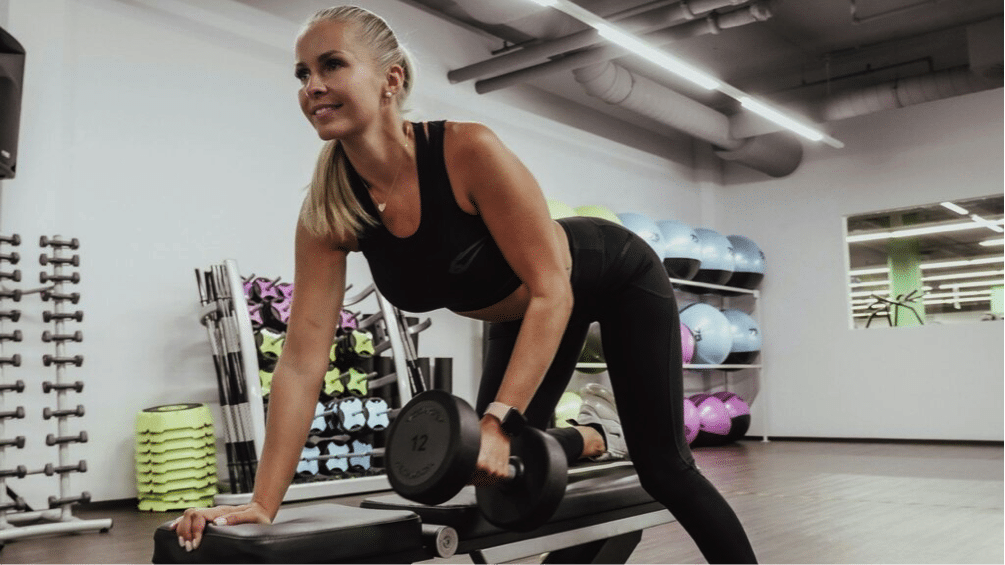
- Single-Arm Dumbbell Row: Hinge forward with one hand supported, pulling the dumbbell toward your hip while keeping your torso stable. This unilateral pulling exercise strengthens the back and biceps while challenging anti-rotation core strength.
- Dumbbell Shoulder Press: From shoulder height, press dumbbells overhead until arms are fully extended. This vertical pressing pattern targets deltoids and triceps while engaging the core for stability.
- Romanian Deadlift: With dumbbells at thigh level, hinge at the hips while maintaining a neutral spine, lowering weights along your legs until you feel a hamstring stretch. This hip-hinge pattern develops posterior chain strength critical for athletic performance and injury prevention.
- Russian Twist: Seated with knees bent and feet elevated, rotate a dumbbell side to side while maintaining a stable lower body. This rotational core exercise builds oblique strength and anti-rotation stability.
Perform each exercise for 45 seconds, moving quickly between movements to maintain intensity. After completing all six exercises, rest for 60–90 seconds before repeating the circuit two or three times, depending on your conditioning level. For those looking to upgrade their training setup, retailers such as Dumbbells.com offer adjustable dumbbells that provide space-efficient versatility for progressive resistance training. Comparable companies like Bowflex and PowerBlock also produce compact strength-training equipment designed for home and professional gym use.
Dumbbell Circuit Workout for Strength and Fitness
Circuit training combines resistance work with cardiovascular conditioning, creating a metabolic demand that builds strength while improving work capacity. This training style proves particularly effective for those seeking body composition changes alongside performance improvements.
According to research published in the Journal of Strength and Conditioning Research, circuit-based resistance training elevates post-exercise oxygen consumption, extending calorie burn well beyond the workout itself. Here’s an intermediate-level circuit that demonstrates these principles:
- Dumbbell Front Squat: Hold dumbbells at shoulder height and perform squats, emphasizing upright torso position. Complete 12-15 controlled repetitions, focusing on depth and stability.
- Incline Dumbbell Press: On an inclined bench, press dumbbells from chest to full extension, targeting upper chest and shoulders. Aim for 10-12 repetitions with challenging but manageable weight.
- Bent-Over Dumbbell Row: Hinge forward at the hips and pull both dumbbells toward your lower ribs, squeezing shoulder blades together. Perform 10-12 repetitions per set.
- Arnold Press: Starting with palms facing you at shoulder height, rotate and press dumbbells overhead in one fluid motion. This variation increases shoulder activation through a greater range of motion. Complete 10-12 repetitions.
- Walking Lunges: Step forward into lunges while holding dumbbells at your sides, alternating legs with each step. Perform 10 repetitions per leg, maintaining an upright torso throughout.
Complete this circuit 2-3 times with minimal rest between exercises and 90 seconds between rounds. Proper form remains paramount—compromising technique for speed or heavier weights increases injury risk while reducing training effectiveness.
Nutrition and Recovery for Muscle Gain
Training stimulus alone doesn’t build muscle; adaptation occurs during recovery when proper nutrition supports tissue repair and growth. Your post-workout nutrition strategy significantly influences whether your efforts translate into measurable strength and physique improvements.
The National Library of Medicine emphasizes that nutrient timing and composition both matter for optimizing recovery. Consider these evidence-based nutritional strategies:
- Protein Intake: Consume 0.7-1 gram of protein per pound of body weight daily, distributed across 3-5 meals. Leucine-rich sources like chicken, fish, eggs, and Greek yogurt optimize muscle protein synthesis.
- Carbohydrates: Replenish glycogen stores with complex carbohydrates—sweet potatoes, oats, quinoa, and brown rice provide sustained energy for subsequent training sessions.
- Hydration: Maintain fluid balance by drinking water consistently throughout the day, not just during workouts. Dehydration impairs both performance and recovery processes.
- Healthy Fats: Include omega-3 fatty acids from salmon, walnuts, and flaxseed to support inflammation management and hormone production essential for muscle building.
Sleep quality deserves equal attention—muscle protein synthesis peaks during deep sleep stages, making 7-9 hours of quality rest non-negotiable for serious strength development. Managing stress through adequate recovery between sessions prevents overtraining while allowing progressive overload to drive continued adaptations.
Tips for Maximizing Your Dumbbell Workouts
Consistent progress requires more than showing up—strategic programming and mindful execution separate those who achieve their goals from those who plateau. These evidence-based practices will help you extract maximum benefit from every training session:
- Progressive Overload: Systematically increase training demands by adding weight, repetitions, or sets every 2-3 weeks. Muscle growth requires progressively greater stimulus over time.
- Movement Quality: Prioritize controlled eccentric (lowering) phases and full range of motion over heavy weights with compromised form. Time under tension drives hypertrophy more effectively than ego lifting.
- Training Variation: Rotate exercises every 4-6 weeks to prevent adaptation plateaus while maintaining focus on fundamental movement patterns.
- Recovery Monitoring: Track subjective markers like sleep quality, energy levels, and muscle soreness to identify when you need additional rest versus when you can push harder.
- Realistic Goal Setting: Establish specific, measurable objectives with defined timelines. Strength gains of 5-10% monthly represent excellent progress for most intermediate trainees.
Building a Sustainable Fitness Practice
The most effective workout program is the one you’ll actually maintain long-term. Dumbbell training offers the flexibility and efficiency that supports adherence even during life’s busiest periods. Whether you’re training at home, in a hotel gym, or at a commercial facility, a pair of dumbbells provides everything needed for comprehensive strength development.
Before beginning any new training program, particularly if you have pre-existing health conditions or haven’t exercised recently, consulting with healthcare professionals ensures your approach aligns with your individual needs and limitations. For additional guidance on structuring effective home workouts, Your Health Magazine offers evidence-based resources connecting readers with qualified fitness and medical professionals.
Start with manageable weights and conservative volume, focusing on movement mastery before pursuing aggressive progression. Consistency over weeks and months produces far better results than sporadic intense efforts followed by extended breaks. The journey toward improved strength and fitness rewards patience, intelligent programming, and sustainable habits that integrate seamlessly into your lifestyle.
Other Articles You May Find of Interest...
- What a Weight Loss Clinic in Melbourne Can Do Before and After Your Surgery
- Cold Plunge or Sauna? What the Recovery Research Actually Shows
- How Personalized Weight Loss Programs Help Achieve Sustainable, Long-Term Results
- High-Fructose Foods to Limit and Lower-Sugar Alternatives
- Best High-Fiber Foods Chart for Better Digestive Health
- How Many Carbs Are in Turkey Bacon?
- 9 Healthiest Mushrooms to Eat