






More Vision & Eye Care Articles
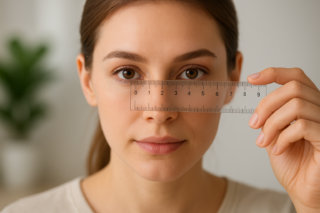
How to Measure Your Pupillary Distance With a Ruler
By Your Health Magazine Health Information Team
You have your eyeglass prescription and have found frames you like online, but the order form asks for a number that may not appear on your prescription: PD. If you are wondering how to measure PD with a ruler, the basic process is straightforward. Accuracy matters, however, because even a small measuring error can affect how your lenses line up with your eyes.
What Is Pupillary Distance?
Pupillary distance, or PD, is the distance in millimeters between the centers of your pupils. Eyeglass makers use this measurement to position each lens’s optical center in front of the corresponding eye. Proper alignment helps your eyes look through the intended part of the lenses.
An incorrect PD may create unwanted optical effects. Depending on the lens prescription and size of the error, this can contribute to blurry vision, visual discomfort, eye strain, headaches, or difficulty adapting to new glasses. Strong prescriptions and progressive or multifocal lenses generally require especially careful measurements.
PD is not the same as your eyeglass prescription. A prescription identifies the lens power needed to correct a refractive error, while PD helps position those lenses. For general information about vision and other health concerns, readers can explore the MedlinePlus health topics library.
What You Need to Measure PD
- A straight ruler marked clearly in millimeters
- A well-lit room
- A mirror if you are measuring yourself
- Ideally, another person to help
- Paper or a phone to record each result
Use a rigid ruler if possible. Avoid a flexible measuring tape, which can curve across the face. Check where the ruler’s zero mark begins because the physical edge of some rulers extends beyond zero.
How to Measure PD With a Ruler and a Helper
Having someone else take the measurement is usually easier than trying to hold and read a ruler in a mirror. The person helping should follow these steps:
- Sit or stand directly in front of the person being measured, at the same eye level and about an arm’s length away.
- Place the millimeter ruler horizontally across the bridge of the nose. Keep it straight rather than tilted.
- Close your right eye and ask the person to look directly at your open left eye.
- Align the ruler’s zero mark with the center of the person’s right pupil.
- Without moving the ruler, close your left eye and open your right eye. Ask the person to look at your open right eye.
- Read the millimeter mark that lines up with the center of the person’s left pupil.
- Record the number and repeat the process at least two more times.
The repeated measurements should be close to one another. If the numbers vary, reposition both people, confirm that the ruler is level, and try again. Do not simply choose the highest or lowest result. A consistent measurement is more useful than a single rushed attempt.
How to Measure Your Own PD in a Mirror
If no one is available to help, you can attempt a self-measurement. Be aware that research has found self-measured PD to be less accurate and less repeatable than measurements taken by a trained examiner.
- Stand in front of a well-lit mirror with your head upright and facing straight ahead.
- Hold the millimeter ruler horizontally against your brow or securely across the bridge of your nose.
- Close your right eye and use your open left eye to align the zero mark with the center of your left pupil.
- Keep your head and ruler completely still.
- Close your left eye and open your right eye.
- Read the number directly over the center of your right pupil.
- Write down the result and repeat the entire process three times.
Avoid sliding the ruler after setting the zero mark. Looking downward to read it, turning your head, or allowing the ruler to tilt can change the result. If possible, take a clear, straight-on photograph while the ruler is in position and have another person check the pupil centers.
Single PD Versus Dual PD
A single, or binocular, PD is one number representing the total distance from the center of one pupil to the center of the other. It may be written as a number such as 63 millimeters.
A dual, or monocular, PD provides two measurements: the distance from the center of the nose to the center of the right pupil and the distance from the center of the nose to the center of the left pupil. It may appear as two numbers, such as 31/32. The right-eye number is normally recorded first.
Do not automatically divide a single PD in half to create a dual PD. Many faces are not perfectly symmetrical, so the right and left measurements may differ. If dual PD is required, it is better to have each eye measured separately by an optician or another trained eye care professional.
Distance PD and Near PD Are Different
Distance PD is measured while the eyes are directed toward a faraway target. Near PD applies to reading or other close work. Because the eyes turn slightly inward when focusing up close, near PD is typically smaller than distance PD.
Check whether the eyewear seller is requesting distance PD, near PD, or separate monocular measurements. Do not estimate one measurement from another unless your eye care professional or the optical provider gives you specific instructions. Reading glasses, occupational lenses, bifocals, and progressive lenses may require additional fitting information beyond a basic PD.
Common Measuring Mistakes
- Using inches and converting the result instead of reading millimeters directly
- Measuring from the ruler’s edge rather than its zero mark
- Holding the ruler at an angle
- Measuring between the edges of the pupils instead of their centers
- Moving the eyes to follow the ruler
- Turning or lowering the head during the measurement
- Taking only one reading
- Confusing distance PD with near PD
If the pupil is difficult to distinguish from a dark iris, use bright, even room lighting without shining an intense light directly into the eyes. Do not rely on a blurry photograph or guess where the pupil center is located.
When Professional Measurement Is the Better Choice
A do-it-yourself ruler measurement may be adequate for some simple, low-power single-vision glasses, but it does not replace a professional fitting. Ask an optician, optometrist, or ophthalmologist to confirm your PD if measurements are inconsistent, the eyewear company requests unfamiliar fitting numbers, or you need progressive, multifocal, prism, or high-prescription lenses. Frame size, lens height, frame angle, and how the glasses sit on your face can also affect lens positioning.
When to Seek Care
Contact an optometrist or ophthalmologist if new glasses cause persistent blur, double vision, headaches, significant eye strain, dizziness, or difficulty focusing after an appropriate adjustment period. The glasses may need to be checked for prescription accuracy, optical-center placement, frame fit, or another vision problem.
PD measurement itself should not cause eye pain or physical symptoms. Prompt evaluation is appropriate for sudden vision loss, new double vision, severe eye pain, an eye injury, light sensitivity, or marked redness. For additional general guidance, read about safe approaches to eye redness and pain. Measuring PD can help glasses fit your visual needs, but unexplained symptoms require an eye care professional rather than another home measurement.
Other Articles You May Find of Interest...
- Can Blepharoplasty Improve Peripheral Vision? What Patients Should Know
- What Causes Blood Clots in the Eye?
- Can You Have Laser Eye Surgery With Glaucoma?
- Why Are Contact Lens Users Asked to Stop Wearing Lenses before Laser Eye Surgery Tests?
- What Credentials to Look for When Searching for the Right Eye Doctor in New York
- New Flashes, Floaters, or a Shadow in Your Vision: When to Seek Prompt Eye Care
- Still wearing contacts every day? When it may be worth asking about LASIK





