More Practice Management Articles
How AI Receptionists Help Health Practices Manage Appointment Calls
It was a Tuesday afternoon. Dr. Karen’s front desk phone rang eleven times between 2 and 4 PM. Her receptionist was checking in patients, managing paperwork, and answering questions at the front window. She couldn’t get to the phone.
By the end of the day, seven of those calls had gone to voicemail. Three people never called back.
Those weren’t just missed calls. Those were missed appointments — missed revenue, missed patient relationships, missed chances to help someone who actually needed care.
This isn’t a rare story. It plays out every day in dental offices, chiropractic clinics, and therapy practices across the country. And the fix isn’t hiring another front desk person. It’s something simpler.
The Phone Problem Nobody Talks About in Healthcare
Health practices run on appointments. No booking, no revenue.
But here’s what most clinic owners don’t think about: the phone is still the #1 way patients book appointments. Not online forms. Not patient portals. The phone.
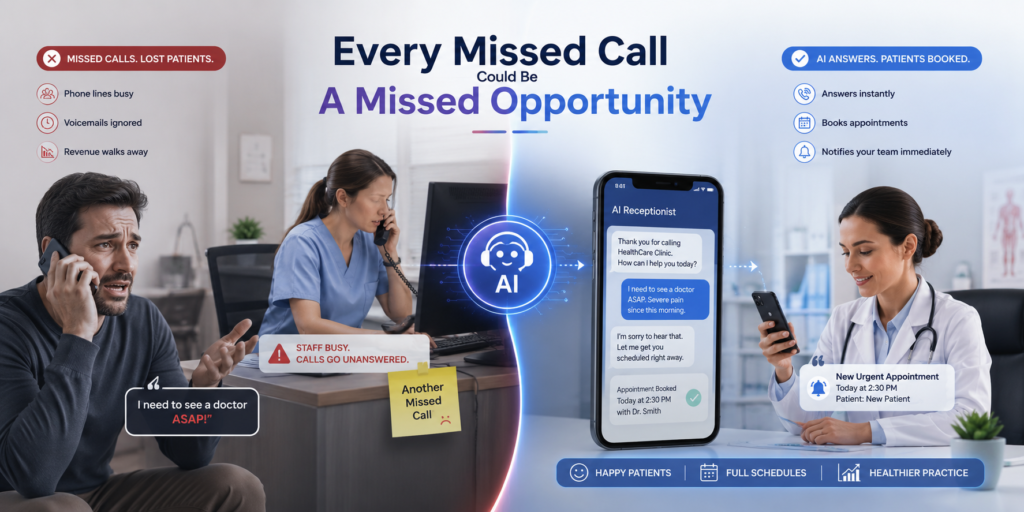
According to Invoca’s 2023 Healthcare Consumer Experience Report, over 60% of patients still prefer to call a healthcare provider when booking for the first time. That means your phone line isn’t just a communication tool — it’s your front door.
When that door stays locked because nobody picked up, patients don’t wait. They call the next clinic on Google.
One missed call. One lost patient. Multiply that by a full week.
Many practices experience missed calls during busy periods, particularly when front-desk staff are assisting patients in person.
What Is an AI Receptionist for Appointment Booking?
An AI Receptionist for appointment booking is a phone answering system that picks up calls automatically, talks with patients in natural language, and books appointments directly into your calendar, without a human doing any of it.
It works around the clock. When your office closes at 6 PM, it keeps going. When your front desk is slammed at Monday morning intake, it handles the overflow. When a patient calls at 11 PM with a toothache and wants to schedule for the next morning, it books them in.
An AI Receptionist can answer calls 24/7 and help reduce missed-call volume.
This isn’t a phone tree or an old-school automated menu. Patients don’t press “1 for appointments” and wait on hold. They speak naturally — “I’d like to book a cleaning for next Thursday”, and the system books it, confirms it, and even sends a reminder text.
Why This Matters Specifically for Therapy, Chiropractic, and Dental Practices
These three types of practices share the same core problem: high call volume, high patient sensitivity, and limited front desk bandwidth.
Therapy Offices
Someone calling a therapy office is already doing something hard. They’ve decided to ask for help. If they call and hit voicemail, many won’t call back. A study from Harvard Business Review found that the odds of reaching a lead drop by over 80% if you don’t respond within five minutes. For therapy practices, that missed call might mean a patient waits weeks longer than necessary to get care.
An AI calling system picks up immediately. It collects the patient’s name, preferred therapist (if they have one), insurance type, and preferred time — and books them in. No hold music. No callback tag.
Chiropractic Clinics
Chiropractic patients often call in pain. They want answers fast. They want to know if you have a same-day slot. A virtual receptionist can check availability in real time and confirm an appointment before the patient hangs up.
Chiropractic offices also deal with recurring appointments — weekly adjustments, follow-up visits, care plans. An automated receptionist handles rebooking just as well as first-time scheduling. Patients love the consistency.
Dental Offices
Dental offices might be the highest-stakes environment for missed calls. A person with a dental emergency who can’t get through to your office will find someone else — and they might not come back even after the emergency passes.
After-hours call answering is one of the biggest shifts dental practices are making right now. Patients with pain don’t keep business hours. A 24/7 call answering system captures those late-night calls and locks in the morning appointment before any competing office even opens.
What Happens to Calls Right Now — and What Changes
| Situation | Without AI Receptionist | With AI Receptionist |
| Busy front desk at 9 AM | Call goes to voicemail | Call answered immediately |
| Patient calls at 7 PM | Rings, no answer | Appointment booked on the spot |
| New patient calling for therapy | Leaves a message, maybe calls back | Scheduled in under 3 minutes |
| Chiropractic rebooking | Front desk calls back next day | Rebooked during the original call |
| Dental emergency after hours | No answer | Appointment confirmed for morning |
Can an AI Receptionist Handle Appointment Booking Without Human Help?
Yes — and for many routine appointment types, it can handle scheduling efficiently without requiring staff intervention.
Many AI receptionist platforms offer integrations with common scheduling systems. When a patient calls, it checks your real-time availability, offers open slots, confirms the time, and logs the appointment. It also sends a confirmationtext or email to the patient automatically.
No double-booking. No “let me check and call you back.” No appointment slipping through the cracks because someone forgot to write it down.
The front desk still handles complex situations — insurance disputes, clinical questions, billing. But the routine booking calls? Those run on autopilot.
What About Patients Who Prefer Talking to a Human?
This is the most common concern practice managers bring up — and it’s fair.
Most AI voice systems today are trained to sound natural and conversational. Patients frequently don’t realize they’re speaking with an automated receptionist. But more importantly, the system can transfer to a human at any point. If a patient says “I’d like to speak with someone,” the call transfers to your team immediately.
The goal isn’t to replace your staff. It’s to make sure no call goes unanswered when your staff is busy or unavailable.
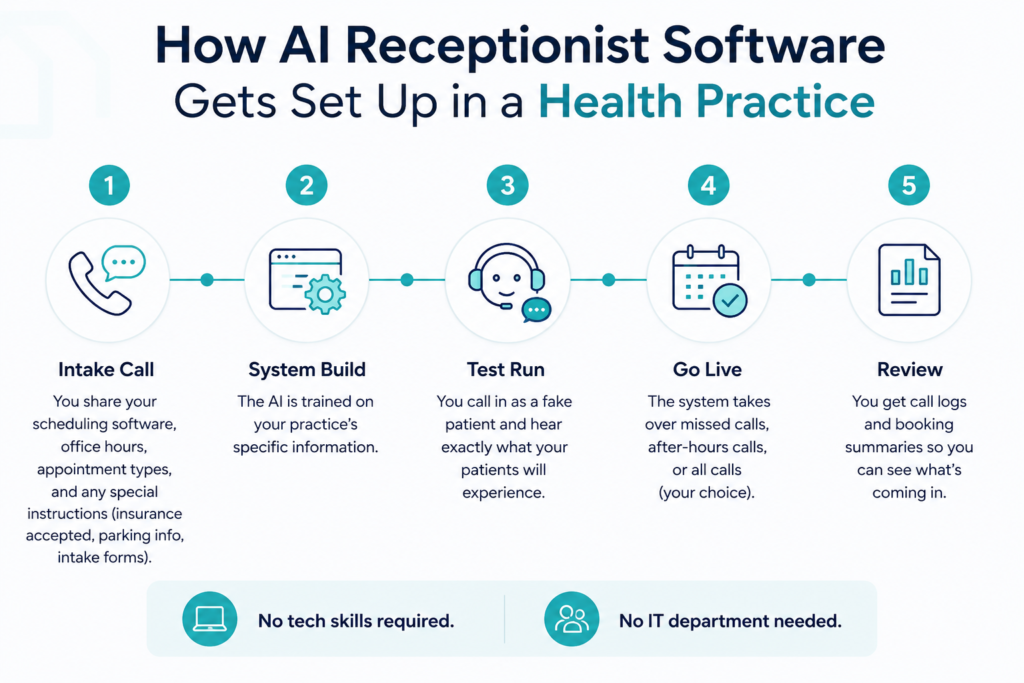
How AI Receptionist Software Gets Set Up in a Health Practice
Implementation timelines vary by vendor, scheduling platform, and practice requirements. Here’s how it typically goes:
1. Intake call — You share your scheduling software, office hours, appointment types, and any special instructions (insurance accepted, parking info, intake forms).
2. System build — The AI is trained on your practice’s specific information.
3. Test run — You call in as a fake patient and hear exactly what your patients will experience.
4. Go live — The system takes over missed calls, after-hours calls, or all calls (your choice).
5. Review — You get call logs and booking summaries so you can see what’s coming in.
No tech skills required. No IT department needed.
Frequently Asked Questions
Q: Can an AI Receptionist book appointments into my existing scheduling system?
Yes. Most AI receptionist software connects directly with common healthcare scheduling platforms. When a patient books, it appears in your calendar just like any other appointment — no manual entry needed.
Q: What if a patient has a medical question the AI can’t answer?
The system is set up to handle automated appointment booking and general practice information only. For clinical questions, it tells the patient a team member will follow up, or transfers the call to your staff right away.
Q: Is this HIPAA-compliant?
Most healthcare-grade AI receptionist systems are built with HIPAA compliance in mind, including encrypted call recordings and secure data handling. Always confirm this with your specific vendor before going live.
Q: Will patients notice they’re talking to an AI?
Some will, some won’t. But the more important question is: do they get what they called for? If they hang up with an appointment booked, most patients don’t mind how it happened.
Q: How is this different from an answering service?
A traditional answering service has human operators who take messages and relay them to your staff. An AI Receptionist for appointment booking does the whole job — it answers, collects info, and schedules the appointment without any message relay or callback needed.
The Bottom Line: Your Phone Line Is a Revenue Line
After implementing an automated receptionist, practices may reduce missed calls and improve appointment scheduling efficiency, depending on factors such as call volume, staffing, and implementation.
The calls that used to disappear into voicemail now turn into confirmed appointments. The patients who used to call back “if they felt like it” now have bookings locked in before they hang up.
For therapy clinics, chiropractic offices, and dental practices where every appointment is someone’s health need, not just a transaction, that’s the difference between a full schedule and a half empty one.
Your front desk is the first impression your practice makes. When no one answers, that impression is silence.
An AI Receptionist makes sure silence never happens.
Want to learn more about how health practices are growing through smarter patient communication? Explore more articles on Your Health Magazine’s Health Marketing Blog.
Other Articles You May Find of Interest...
- Pre-Employment Testing Tools for Healthcare Hiring: What to Consider
- How Custom EHR Systems Are Reducing Physician Burnout
- A Beginner’s Guide to Revenue Cycle Management for Oral Surgery Practices
- Adding Branded Body Care to Your Practice: Aerosol Foam or Pump Foamer?
- How Concierge Billing Management Simplifies Practice Operations
- Branded Merchandise for Healthcare Practices: Corporate Mugs and How to Find a Promotional Products Distributor
- Adding Reformer Pilates to a Physical Therapy or Chiropractic Practice