More Neurology Articles
Persistent Cushing’s Disease After Surgery: Understanding the Two Most Common Failure Patterns
A detailed analysis by Dr. Raghvendra Ramdasi, a brain tumor surgeon in Mumbai, India

The human brain is one of the most complex organs in the world, hence its unpredictability poses some of the biggest challenge for neurosurgeons and neurologists – like recurring diseases post brain tumor surgery.
One such disease is recurring Cushing’s disease. Cushing’s disease is a hormonal disorder caused by a pituitary tumor that triggers excessive cortisol production. It is often treated by performing transsphenoidal pituitary surgery, a minimally invasive procedure performed through the nose to remove the tumour.
In most cases, patients see a successful drop in cortisol levels. However, some cases may see elevated cortisol even after surgery. This condition is known as ‘persistent Cushing’s disease’.
This blog discusses how recurring brain diseases like Cushing’s disease occur and affect the brain and how patients can still achieve a cure with proper care.
Why Does Cushing’s Disease Recur Even After Surgery?
Cushing’s disease usually persists when tiny portions of the brain tumor get left behind after the operation. In such cases, MRIs can provide useful information on the condition of the brain, but doctors have seen that postoperative cortisol levels are good indicators to see how the brain is faring. High cortisol levels, despite the surgery, show that the tumor hasn’t gone away completely.
Neurosurgeons generally observe two common patterns to determine tumor failure.
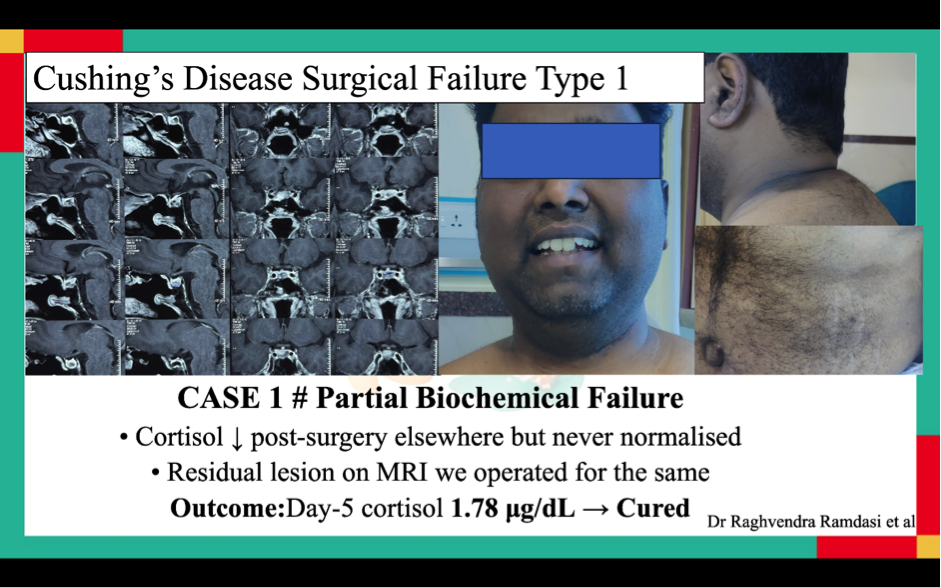
Pattern 1: Cortisol Levels Can Reduce But Fail To Reach Normal Levels
A 39-year-old man underwent transsphenoidal surgery for Cushing’s disease. He recovered after the surgery, but symptoms were stubborn. When he consulted Dr. Raghvendra Ramdasi for a second opinion, his reports showed a different story.
Cortisol levels can decrease after surgery, but can stay above the normal levels. This can create a false sense of success because symptoms may improve temporarily. Issues such as weight gain, diabetes, high blood pressure, fatigue or muscle weakness can continue and even grow overtime.
Key indicators of this:
- Cortisol decreases but remains elevated
- Symptoms refuse to improve
- Partial biochemical failure
- Residual tumor may not always be the obviously visible
After undergoing a second surgery, the 39-year-old patient recovered completely under the care and evaluation of Dr. Ramdasi.
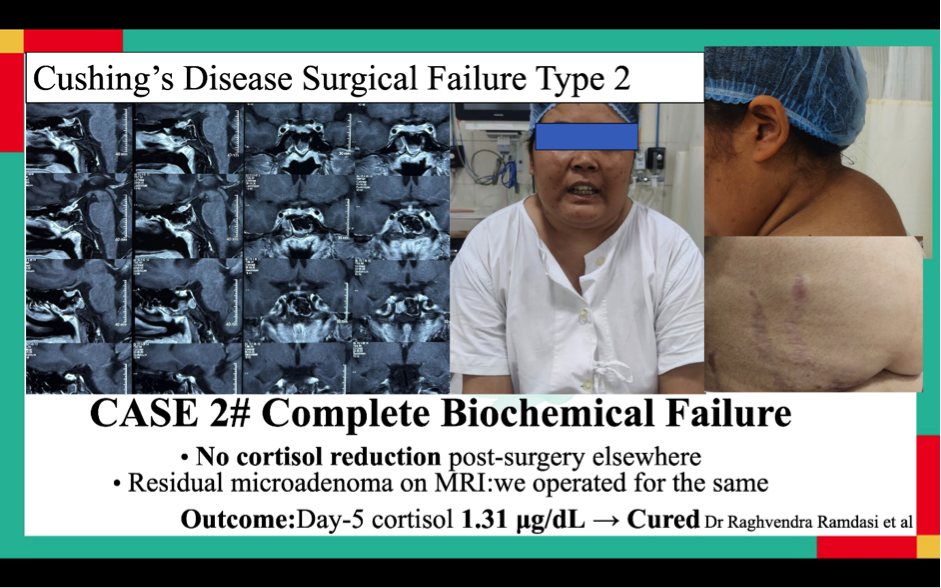
Pattern 2: Cortisol Does Not Fall After Surgery
A 32-year-old woman from Nepal with pituitary adenoma underwent surgery. Her pre-operative cortisol levels were 33.18 ug/dL and did not change at all after surgery.
This typically suggests that the tumor was not removed or treated properly. MRI scans can help decipher this better as residual lesion may be visible on post-operative imaging.
Key indicators:
- Negligible change in cortisol levels
- No improvements in symptoms
- MRI scans show residual tumor
The woman underwent a second surgery and recovered fully under the supervision of Dr. Ramdasi.
What Causes These Failures?
Brain tumor cases are very unique and may behave differently based on the body of the patient. However, the common cause of persistent Cushing’s disease is often incomplete tumor exposure or removal during the first surgery.
Patients searching for the “best neurosurgeon in Mumbai” often look for a specialist with the following skills and resources to properly diagnose it:
- Adequate experience handling brain tumor
- Clear visualisation of the tumor-gland interface using advanced technology
- Careful exploration of the pituitary gland
- Preservation of normal pituitary tissue while removing the tumor
When these principles are applied with wisdom and consideration, the tumor can be removed fully and the patient’s quality of life can be changed.
Can A Second Surgery Cure Persistent Cushing’s Disease?
Yes.
In many cases, patients with persistent Cushing’s disease have seen visible improvements from Minimally Invasive Pituitary Surgery, particularly when biochemical testing suggests residual tumor activity.
A repeat transsphenoidal endoscopic procedure helps doctors re-explore the pituitary region and identify remaining tumor tissue while preserving normal gland functions. When the tumor is removed completely, the patient can be put on a recovery plan to achieve hormonal remission.
Key Takeaways
One of the most important takeaways in managing persistent Cushing’s disease is that cortisol levels often provide more reliable information than MRI imaging alone.
It’s important that a surgeon rely on both to diagnose this issue and restore cortisol levels. In the above cases, we could see the two predictable patterns in which a patient could experience post-surgery symptoms. In both cases, a combination of MRI scans and hormonal testing became key indicators in deciphering the best treatment options. Early postoperative low cortisol remains one of the strongest predictors of long-term remission.
If you are suffering from persistent Cushing’s disease and looking for Endoscopic Pituitary Surgery Mumbai for this issue then minimally invasive endoscopic surgery may be an appropriate treatment option, depending on your condition and your neurosurgeon’s evaluation.
Other Articles You May Find of Interest...
- How to Read a Nerve Conduction Study Report
- Can a Tissue Paper Test Detect a CSF Leak?
- What Does Cerebrospinal Fluid Taste Like During a CSF Leak?
- Cervical Laminectomy: A Complete Guide to This Spinal Decompression Surgery
- Why Concussion Symptoms Can Look Different From Person to Person
- The Crushing Fatigue of ALS
- Complex Partial Seizures: Managing Focal Awareness Loss