






Your Health Magazine
4201 Northview Drive
Suite #102
Bowie, MD 20716
301-805-6805
More Mental Health Articles
Questions to Ask Before Choosing a Teen Mental Health Program
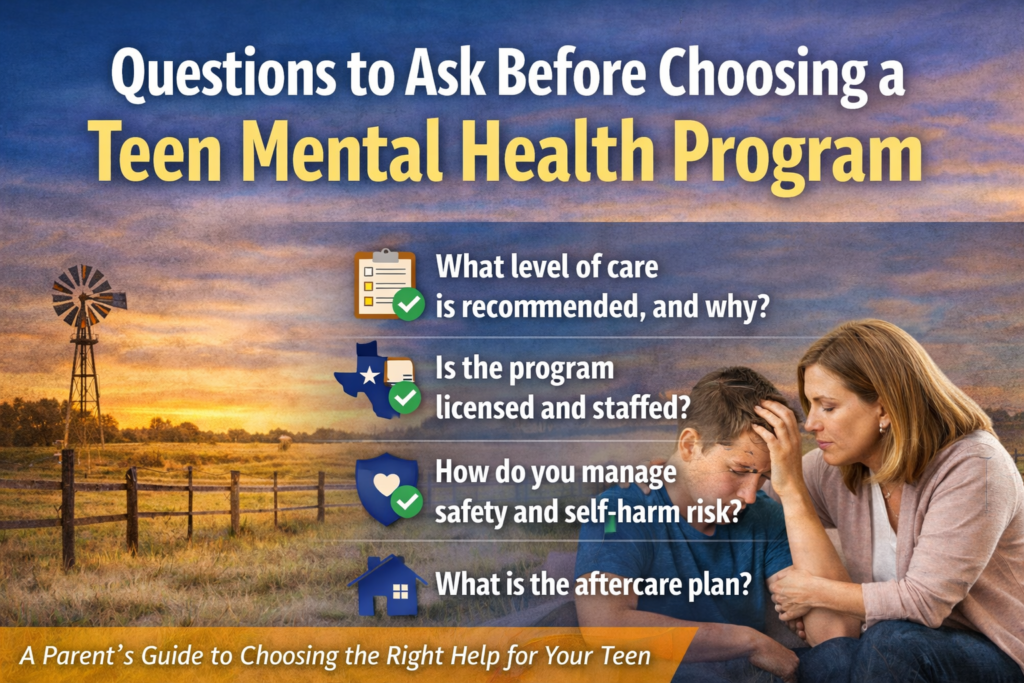
If you’re searching for how to choose a teen mental health program, you’re probably not doing it casually. Most parents end up here because something feels urgent, confusing, or bigger than what they can handle at home. Maybe your teen is dealing with anxiety or depression. Maybe it’s panic, anger, withdrawal, risky behavior, substance use, self-harm, or a sudden drop in school performance and friendships. Whatever your situation is, you deserve straight answers—and a way to compare options without feeling pressured.
It may help to know that you’re not alone. National child health data (HRSA, National Survey of Children’s Health) shows adolescent mental and behavioral health challenges are common, and many families report barriers to accessing the right care.
Important safety note: This article is educational and not medical advice. If your teen is in immediate danger, call 911 (or your local emergency number). In the U.S., you can also call or text 988 to reach the Suicide & Crisis Lifeline.
A simple starting point: understand “levels of care”
One reason this decision feels overwhelming is that “teen mental health program” can mean several different things. Before you compare programs, get clear on what level of care is being recommended and why. The American Academy of Child and Adolescent Psychiatry (AACAP) describes youth care as a continuum and encourages matching a teen to the least restrictive setting that can still meet clinical needs safely.
Here are the most common levels:
- Outpatient therapy
Weekly sessions (sometimes more). Your teen lives at home and continues school. - IOP (Intensive Outpatient Program)
Several days per week, often after school. Your teen still lives at home. - PHP (Partial Hospitalization Program)
More structured day programming, often 5 days per week. Your teen lives at home. - Residential treatment
Your teen lives onsite with structured treatment, supervision, and a consistent routine. - Inpatient hospitalization
Short-term stabilization when there’s immediate safety risk.
There is no “best” level of care for every teen. The goal is right-sized care: enough structure and support to be safe and effective, without being more restrictive than necessary.
A quick parent checklist (read this if your brain feels overloaded)
When you’re comparing programs, you’re really trying to answer a few practical questions:
- What level of care is being recommended, and why?
- Is the program licensed and properly staffed?
- How do they handle safety risk (self-harm, suicidal thoughts, aggression, substance use)?
- What treatment do they actually provide each week?
- How are parents involved while still respecting teen privacy?
- What happens with school and credits?
- What is the step-down plan after discharge?
Now let’s turn those into specific questions you can ask on admissions calls, tours, or intake assessments.
11 questions to ask before choosing a teen mental health program
- What level of care are you recommending—and why?
This is the first question because everything else depends on it. A reputable provider should be able to explain the “why” in plain language.
Helpful follow-ups:
- What symptoms or behaviors led you to this recommendation?
- What would make a lower level of care (like outpatient or IOP) not enough right now?
- What progress would allow my teen to step down later?
What you’re listening for: clarity and clinical reasoning, not pressure.
Red flag: “This is what we recommend for everyone.”
- How do you assess and manage safety, especially self-harm or suicidal thoughts?
Ask this directly. You are not being dramatic—you are being responsible.
AACAP’s family guidance on self-injury emphasizes that self-harm in adolescents should be taken seriously and assessed carefully. A quality program should be able to explain what they do at intake and what they do if risk increases.
Ask:
- How do you assess self-harm and suicide risk at intake and throughout treatment?
- What happens if my teen shares suicidal thoughts or urges to self-harm?
- What does supervision look like when risk is higher?
- How do you keep group environments emotionally safe (including preventing triggering conversations)?
Red flag: vague reassurance like “Don’t worry, we keep them safe,” without specific protocols.
- Are you licensed, and what oversight do you operate under?
Licensing and oversight are basic protections. Good programs are usually transparent about them.
Ask:
- Are you licensed by the state for the level of care you provide?
- What clinical leadership oversees treatment decisions?
- How do you handle incident reporting and quality review?
Red flag: dodging the question, getting defensive, or being unclear.
- Who will actually be treating my teen—and what are their credentials?
Parents often assume “a therapist will be with my teen all the time,” but programs vary. AACAP’s Principles of Care for Residential Treatment Centers highlights the importance of appropriate staffing, credentials, and clinical oversight.
Ask:
- Who provides individual therapy (credentials such as LPC, LCSW, LMFT, psychologist)?
- Is psychiatric evaluation and medication management available if needed?
- How often does the treatment team review progress?
- What is the staff-to-teen ratio?
Red flag: therapy is unclear, infrequent, or mostly delivered by unlicensed staff.
- How do you create and update an individualized treatment plan?
Your teen shouldn’t be placed into a generic track and left there. Strong programs build a plan, review it, and adjust it. AACAP’s residential principles emphasize structured treatment planning and ongoing review.
Ask:
- What assessments inform the treatment plan?
- Are goals measurable (not just “feel better”)?
- How often is the plan reviewed and updated?
Red flag: a one-size-fits-all plan that never changes.
- What therapies do you use, and what will my teen learn to do differently?
Many programs list therapy names online. The real question is: what does treatment look like in practice, week after week?
Ask:
- Which evidence-based approaches do you use most often?
- How often will my teen receive individual therapy?
- What coping and communication skills will they practice regularly?
- How do you measure progress beyond “time in program”?
Red flag: big promises, vague methods.
- How do you handle co-occurring issues like substance use, trauma, or eating concerns?
Teens often don’t struggle in just one category. Anxiety, depression, trauma, substance use, and self-harm can overlap. You want a program that screens for co-occurring concerns and can coordinate care.
Ask:
- Do you screen for co-occurring issues at intake?
- If substance use is disclosed or discovered, what happens next?
- How do you approach trauma history in a safe, teen-appropriate way?
- What happens if my teen needs a different level of care?
Red flag: “We only treat X. Everything else is separate.”
- How are parents involved—and how does communication work?
Most teens do better when parents are involved in a structured, healthy way. At the same time, confidentiality matters for trust. A quality program can balance both.
Ask:
- Is family therapy included? How often?
- Do you offer parent education or coaching?
- How do you update parents while respecting teen privacy?
- What happens if my teen refuses family sessions?
Red flag: “We don’t involve parents at all,” or the opposite extreme, “We tell parents everything your teen says.”
- What happens with school and academics?
For many teens, school stress is part of the picture. Falling behind can increase anxiety and hopelessness. If a program is designed for adolescents, academics should not be an afterthought.
Ask:
- Is there structured academic time?
- Who supervises or teaches academics?
- Do credits transfer, and do you coordinate with the home school?
- Can you support IEP/504 needs if applicable?
Red flag: no clear academic plan for a teen program.
If you’re comparing teen programs in Texas and want to see an example of how a teen-focused provider explains its approach, you can review the program overview and information from Clearfork Academy here: Youth Mental Health Treatment by Clearfork Academy
This is intentionally not a “best program” claim. It’s a simple example of what parents can look for when reading program information online
- What does a typical week look like in real life?
Ask for a sample weekly schedule. This question cuts through marketing language quickly.
Ask:
- How much individual therapy vs. group therapy?
- What does skill practice look like outside sessions?
- Is there movement/recreation and healthy routine support?
- What are the phone and social media policies, and why?
Red flag: the program won’t share a schedule, or the schedule is mostly unstructured time.
- What happens after discharge—what is the step-down plan and aftercare support?
Treatment should not end abruptly. AACAP’s residential principles emphasize discharge planning and continuity of care.
Ask:
- What step-down level of care is usually recommended afterward (IOP, PHP, outpatient)?
- Do you help coordinate outpatient providers and appointments?
- What does relapse-prevention planning or safety planning look like at home?
- How are parents supported after discharge?
Red flag: “We’ll talk about aftercare later,” with no specific plan.
Choose transparency, not pressure When your child is struggling, it’s easy to be pulled toward fast decisions and big promises. In mental health care, the strongest sign of a quality program is usually much simpler. They welcome your questions. They explain the “why” clearly. They can describe safety processes without getting defensive. They show what treatment looks like week to week. And they plan carefully for what happens after discharge.
If you’re getting vague answers, pressure tactics, or guarantees that sound too good to be true, it’s okay to pause, get a second opinion, and keep looking.
If you need help now (U.S.),
For Immediate danger: Call 911 or go to the nearest emergency room
988 Suicide & Crisis Lifeline: Call or text 988 (24/7)
SAMHSA National Helpline (treatment referrals): 1-800-662-HELP (4357)
Sources (used for the in-text attribution in this article)
Health Resources & Services Administration (HRSA). National Survey of Children’s Health (NSCH), 2023 adolescent mental and behavioral health data brief:
https://mchb.hrsa.gov/sites/default/files/mchb/data-research/nsch-data-brief-adolescent-mental-behavioral-health-2023.pdf
American Academy of Child and Adolescent Psychiatry (AACAP). Inpatient and Residential Health Care (continuum of care / least restrictive setting):
https://www.aacap.org/AACAP/Member_Resources/Practice_Information/Inpatient_and_Residential_Health_Care.aspx
AACAP. Principles of Care for Treatment of Children and Adolescents in Residential Treatment Centers (PDF):
https://www.aacap.org/App_Themes/AACAP/docs/clinical_practice_center/principles_of_care_for_children_in_residential_treatment_centers.pdf
AACAP. Self-Injury in Adolescents (Facts for Families):
https://www.aacap.org/AACAP/Families_and_Youth/Facts_for_Families/FFF-Guide/Self-Injury-In-Adolescents-073.aspx
988 Suicide & Crisis Lifeline:
https://988lifeline.org/
SAMHSA National Helpline:
https://www.samhsa.gov/find-help/helplines/national-helpline
Other Articles You May Find of Interest...
- Can You Trust an Online Emotional Support Animal Letter? RealESAletter.com 2026 Guide
- The Benefits of Evidence-Based Counselling and Mental Wellness Support in Toronto
- When Sadness Becomes Something More: Understanding Persistent Depressive Disorder
- Navigating the Complexities of Mental Status Alteration
- Citalopram for Anxiety Disorder: Is It the Right Choice for You?
- Can Wellbutrin Help Manage Anxiety Disorder Symptoms?
- Unlocking the Benefits of Integrative Health Services for Your Well-Being




