






More Mental Health Articles
Social Media Addiction in Teens: What Meta’s $18 Billion Settlement Means for Parents

Meta’s landmark agreement to pay up to $18 billion over claims involving children’s use of Facebook and Instagram has turned social media addiction in teens into national news. The case focused on allegations that Meta used design features that kept young users engaged while failing to adequately protect them from harm. Meta denied wrongdoing, but agreed to substantial payments and new safeguards for users under 18.
For parents, the central question is not whether every teenager who spends hours online is “addicted.” It is whether social media use has become difficult to control and is interfering with sleep, school, relationships, physical activity or emotional health. Time matters, but functioning, content and the child’s response to being online usually reveal more than a screen-time total alone.
What parents need to know: Social media addiction is not currently a formal DSM-5-TR diagnosis. Clinicians often use the term problematic social media use to describe compulsive use that causes distress or interferes with everyday life. Warning signs include loss of control, repeated failed attempts to cut back and continued use despite clear consequences.
What Meta’s $18 Billion Settlement Changes for Teens
On August 26, 2026, Meta reached agreements resolving claims brought by dozens of states, Washington, D.C. and U.S. territories. The states alleged that Facebook and Instagram were designed to keep children engaged, that Meta misrepresented risks to young users and that it collected data from children under 13 without proper parental consent. Meta denied wrongdoing. A federal judge approved the main settlement after it was announced.
The widely reported $18 billion Meta settlement is a maximum, not one guaranteed lump-sum payment. Reuters reported that approximately $12.7 billion is guaranteed over ten years and about $5 billion more is contingent on Snapchat, TikTok and YouTube adopting comparable child-safety measures and, for the larger platforms, agreeing to comparable payments. Texas reached a separate settlement worth more than $1 billion. (Reuters)
Meta also agreed to change the experience for users under 18. The safeguards include:
- A default combined limit of two hours per day across Facebook and Instagram, which a parent can change
- “Productive pauses” after 15 minutes of continuous use and additional prompts after 60 and 90 minutes of daily use
- Restrictions on feed access from midnight to 6 a.m., with direct messaging remaining available
- Notifications silenced overnight and most push notifications disabled during school hours
- Like and reaction counts hidden from teens by default
- Limits involving beauty filters and stronger protections against content related to bullying, eating disorders, suicide and self-harm
- Stronger parental controls and systems intended to identify users who misrepresent their age
- Options involving a non-personalized feed and turning off autoplay
- Independent auditing of Meta’s compliance
The changes will be phased in. Reuters reported that a non-personalized feed is due within four months of the settlement taking effect, broader compliance measures within six months and major age-assurance requirements within one year. The Office of the Attorney General for the District of Columbia provides additional details about the safeguards and the states’ allegations.
These changes matter because they recognize that product design—not only a child’s willpower or a parent’s supervision—can influence behavior. Infinite scroll, autoplay, personalized recommendations, visible popularity metrics and carefully timed notifications can make disengaging harder. A teenager who struggles to stop is not necessarily lazy or defiant; the digital environment is designed to hold attention.
The settlement does not establish that Instagram or Facebook caused any particular child’s depression, anxiety or other condition. Mental health is shaped by many interacting factors, including genetics, temperament, family stress, friendships, bullying, discrimination, sleep and existing psychiatric symptoms. The settlement supports greater caution and accountability, not panic or a one-size-fits-all ban.
What Social Media Addiction in Teens Means
Parents commonly use the word “addiction,” but clinicians often prefer problematic social media use. Social media addiction is not currently included as a formal diagnosis in the Diagnostic and Statistical Manual of Mental Disorders, Fifth Edition, Text Revision (DSM-5-TR), according to the American Psychiatric Association.
That does not mean compulsive social media use is imaginary. It means there is no universally accepted diagnostic test or number of hours that proves a teenager has an addiction. The more useful questions are:
- Can the teenager stop or reduce use when they intend to?
- Does being unable to check an app cause unusual distress or agitation?
- Is social media displacing sleep, schoolwork, exercise or in-person relationships?
- Does the teenager continue using it even when they recognize that it is making them feel or function worse?
A teen may spend considerable time online while maintaining healthy routines and supportive relationships. Another may spend fewer hours online but become caught in cyberbullying, appearance comparisons, self-harm content or compulsive checking. Loss of control and impairment matter more than one isolated habit.
Signs of Social Media Addiction in Teenagers
Frequent phone use alone is not proof of a disorder. Teenagers naturally place great importance on peer communication, and much of that communication now happens online. Parents should look for persistent patterns and changes from the child’s usual behavior.
Possible signs of social media addiction in teenagers include:
- Repeatedly trying and failing to reduce social media use
- Staying online much longer than intended or checking automatically throughout the day
- Becoming unusually irritable, anxious or distressed when access is interrupted
- Hiding accounts, lying about screen time or repeatedly bypassing agreed limits
- Losing sleep because of late-night scrolling, messaging or notifications
- Declining grades, missed assignments, lateness or difficulty concentrating
- Withdrawing from hobbies, sports, family activities or in-person friendships
- Neglecting meals, hygiene, movement or other basic routines
- Using social media primarily to escape sadness, anxiety, loneliness or stress
- Showing marked changes in mood after going online
- Continuing to use a platform despite cyberbullying, conflict or worsening emotional health
- Becoming preoccupied with likes, comments, follower counts or the fear of missing out
The American Academy of Pediatrics identifies withdrawal from friendships and hobbies, constant arguments about media and interference with physical activity, healthy eating or bedtime as warning signs of problematic media use.
None of these signs, by itself, diagnoses an addiction. Concern increases when several persist, intensify or interfere with everyday functioning. Parents should also consider what is driving the behavior. Compulsive scrolling may be a problem in itself, but it may also be a coping strategy for depression, anxiety, ADHD, bullying, loneliness or problems at school.
Social Media and Teen Mental Health: What the Evidence Shows
The evidence does not support the claim that social media is always harmful or that screen time inevitably causes mental illness. Much of the research is observational, making cause and effect difficult to separate. A teenager experiencing depression may use social media more, even as certain online experiences may then worsen that teen’s symptoms.
The 2024 National Academies report Social Media and Adolescent Health found that associations between general social media use and mental health are often small, mixed and highly variable. Research is more concerning when it examines problematic or compulsive use rather than time alone. Reviews cited in the report found a moderate correlation between problematic social media use and depression, anxiety and stress, while evidence linking general screen time to later depression was mixed. (National Academies of Sciences, Engineering, and Medicine)
The U.S. Surgeon General has reported that children and adolescents who spend more than three hours per day on social media face about double the risk of poor mental health outcomes, including symptoms of depression and anxiety. That is a population-level association—not a diagnostic cutoff or proof of what caused an individual child’s symptoms. (U.S. Department of Health and Human Services)
Teenagers themselves describe a similarly mixed picture. In a 2025 Pew Research Center survey, 45% said they spent too much time on social media and 45% said it hurt their sleep. Nineteen percent said social media hurt their mental health. At the same time, 74% said it helped them feel more connected to friends, and 63% said it provided a place to show their creative side. (Pew Research Center)
For parents asking how social media affects children’s mental health, several pathways deserve particular attention.
Sleep disruption
Late-night use can delay bedtime, while alerts and the urge to check messages may fragment sleep. Reviews have linked nighttime digital media use with poorer sleep quality and shorter sleep duration. Sleep loss can then affect mood, attention, impulse control and resilience. The AAP reports that having a portable screen near bedtime or in the bedroom is associated with less sleep, poorer-quality sleep and excessive daytime sleepiness. (American Academy of Pediatrics)
Social comparison and body image
Highly edited images, beauty filters and carefully curated lives can make an ordinary appearance or experience seem inadequate. Appearance-focused comparison may be especially difficult for teenagers who already struggle with self-esteem, perfectionism, eating concerns or body dissatisfaction. In the Surgeon General’s advisory, 46% of adolescents ages 13 to 17 said social media made them feel worse about their body image.
Cyberbullying and social pressure
Digital harassment can follow a child home and continue around the clock. Public popularity metrics, group chats and disappearing content can intensify exclusion, humiliation and pressure to respond. Sudden reluctance to attend school, friendship changes, unexplained distress after notifications, or repeatedly deleting and recreating accounts deserve attention.
Harmful and repetitive content
Recommendation systems may repeatedly surface material related to self-harm, eating disorders, violence, risky challenges or hopelessness after a teenager pauses on or engages with similar content. Repetition may normalize dangerous behavior or deepen rumination in a vulnerable young person. Parents need to ask not only, “How long were you online?” but also, “What were you seeing, and how did it make you feel?”
Lost time for protective activities
Social media may affect mental health indirectly when it crowds out sleep, movement, schoolwork, face-to-face connection and unstructured time. Two hours of supportive conversation with friends is not psychologically equivalent to two hours of hostile comments and appearance comparisons, even though a screen-time report counts them the same way.
Connection, creativity and support
The benefits are real, too. Social platforms can help teenagers maintain friendships, express creativity, find health information and connect with people who share an illness, disability, identity or uncommon experience. The goal is to preserve valuable connections while reducing the features, accounts and experiences that cause harm.
How Much Social Media Is Too Much for a Teenager?
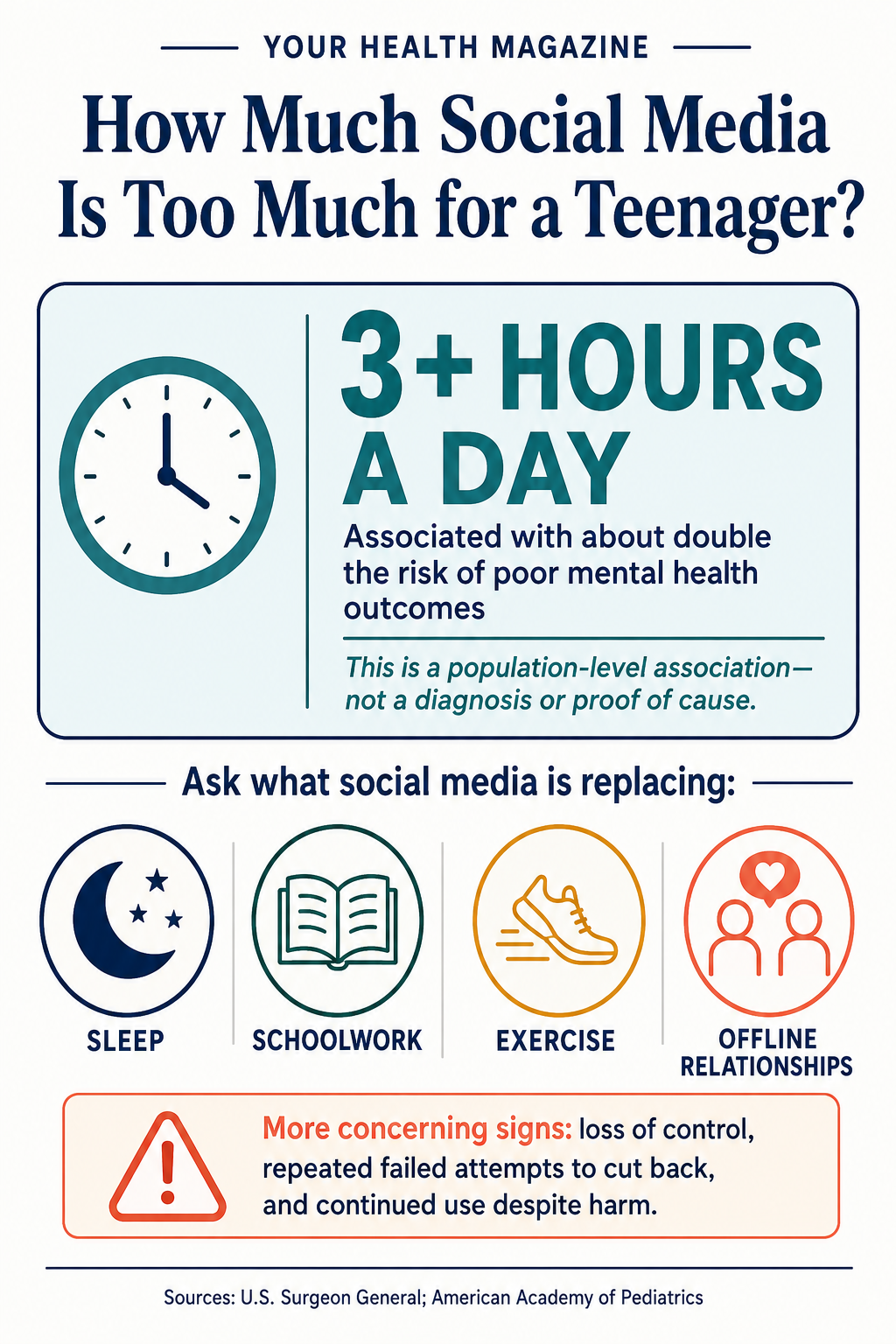
There is no universal number that separates healthy use from addiction. The Surgeon General’s three-hour figure is an important risk marker, but it is not a diagnosis. A two-hour limit is also not automatically healthy if the time is spent being bullied, compulsively comparing appearances or viewing dangerous content.
A more useful assessment considers what social media is replacing and what happens afterward. Use may be excessive when it repeatedly:
- Delays or interrupts adequate sleep
- Prevents homework, chores or other responsibilities from being completed
- Replaces exercise, hobbies and face-to-face relationships
- Leaves the teenager anxious, ashamed, angry or emotionally depleted
- Creates conflict the teenager cannot control despite wanting to cut back
Parents can review device reports together for one or two weeks without treating every minute as misconduct. Look for timing, apps, repeated late-night use and connections between online experiences and mood. YHM’s guide to teen screen time and healthy boundaries offers additional ways to think about balance.
Is Instagram Addictive for Teens?
Instagram can encourage habitual or compulsive use, but saying it is addictive for every teenager would go beyond the evidence. The platform combines an endless personalized feed, short-form video, autoplay, notifications, social feedback and unpredictable rewards. Those features can make checking automatic and stopping difficult, particularly during adolescence, when peer approval carries unusual weight and self-regulation is still developing.
Whether Instagram becomes harmful depends on the teenager, the content and the pattern of use. Warning signs include loss of control, repeated failed attempts to cut back, sleep disruption, distress without access and continued use despite emotional or social consequences.
Parents may learn more from a calm conversation than from the daily total alone. Useful questions include:
- Which parts of Instagram do you enjoy most?
- Are there accounts that regularly make you feel worse about yourself?
- Do you feel pressure to reply immediately or maintain a certain image?
- Have you seen posts about self-harm, extreme dieting or other content that worries you?
- If you wanted to stop for an hour, what would make that difficult?
Curiosity makes disclosure more likely. Interrogation and immediate punishment may encourage secrecy.
How to Help a Teenager Addicted to Social Media
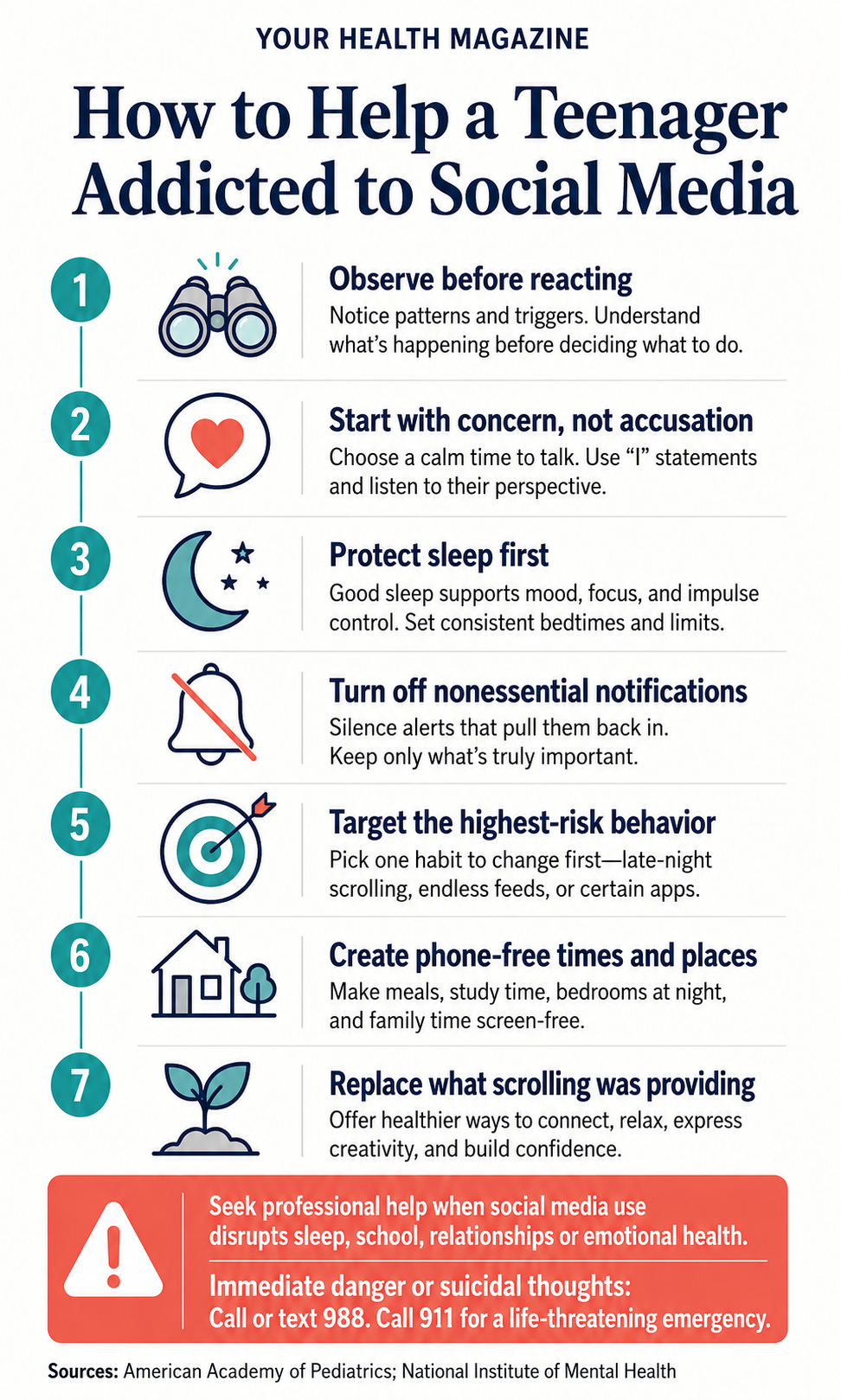
When social media is disrupting a teenager’s life, an indefinite phone ban is not always the most constructive first response unless there is an immediate safety threat. Removing every online connection may increase isolation and prevent parents from learning what is happening. A better plan is collaborative, specific and tied to observable health goals.
1. Observe before reacting
For several days, note sleep, mood, school functioning and when the most problematic use occurs. Is the teenager scrolling after midnight, checking throughout homework, responding to harassment or repeatedly viewing upsetting content? Identifying the pattern makes it possible to choose the right intervention.
2. Start with the concern, not the accusation
Choose a calm time and describe what you have observed: “You have been sleeping about five hours and missing first period,” or “You seem upset whenever that group chat becomes active.” Avoid beginning with “You are addicted.” Ask what the teenager has noticed and what they would like to change. YHM has additional guidance on having open conversations with teens facing intense emotional challenges.
3. Protect sleep first
Create a family charging location outside bedrooms and establish a screen-free period before bed. Turn on “Do Not Disturb,” silence nonessential notifications and use nighttime settings. When practical, adults should follow the same household rule so the teenager is not being singled out.
4. Target the highest-risk behavior
Do not try to change everything at once. Decide whether the immediate concern is sleep loss, compulsive checking during schoolwork, cyberbullying, harmful content, risky contact or appearance-related distress. A specific change is easier to follow and evaluate than a vague instruction to “use your phone less.”
5. Make the environment do some of the work
Willpower is unreliable against constant cues. Remove social apps from the home screen, turn off autoplay and unnecessary notifications, log out after each session, unfollow distressing accounts and use built-in app limits. A teenager who needs an app for friends may still agree to remove it on school nights or access it only from a shared device.
6. Create a written family media plan
Agree on phone-free times and places, such as meals, homework blocks and bedrooms overnight. Define what happens if a limit is exceeded and when the plan will be reviewed. The AAP offers a customizable Family Media Plan, and YHM’s digital wellness guide for parents provides additional household strategies.
7. Replace what scrolling was providing
Removing an app leaves a gap. If social media provides belonging, protect lower-risk ways to connect with friends. If scrolling relieves stress, build other accessible options such as music, walking, sports, art, pet care or calling someone. If the teenager is escaping anxiety or depression, address the underlying condition rather than treating the phone as the entire problem.
8. Review the plan together
After one or two weeks, review sleep, mood, school functioning and device reports. Ask what improved and what was unrealistic. The purpose is to build self-regulation, not conduct endless surveillance. Some teenagers initially need tighter external limits; others respond better when they help design and revise the plan.
9. Involve a health professional when functioning is impaired
Contact the teenager’s pediatrician or a licensed mental health professional if compulsive use continues despite repeated attempts to reduce it, or if it occurs alongside persistent sadness, anxiety, panic, severe sleep disruption, eating changes, school refusal, self-harm, substance use or significant social withdrawal. A clinician can screen for underlying conditions and recommend an appropriate level of care.
Families can also review signs that a teen may need more structured mental health support and questions to ask when evaluating a teen mental health program.
When Social Media Concerns Become Urgent
Do not dismiss alarming posts or statements as “online drama.” Warning signs requiring immediate attention include talking about wanting to die, feeling hopeless or trapped, saying they are a burden, searching for ways to die, giving away important possessions, severe mood swings or new self-harm. The National Institute of Mental Health advises taking these signs seriously.
Ask directly whether the teenager is thinking about suicide. Asking does not put the idea into someone’s head. Stay with the child, reduce access to lethal means and seek immediate help. In the United States, call or text the 988 Suicide & Crisis Lifeline at 988. In a life-threatening emergency, call 911 or go to the nearest emergency department. (NIMH)
Frequently Asked Questions About Teen Social Media Addiction
How do I know if my teenager is addicted to social media?
Look for loss of control and consequences rather than screen time alone. Warning signs include failed attempts to cut back, sleep loss, declining school performance, withdrawal from offline activities, unusual distress when access is interrupted and continued use despite obvious harm.
Is social media addiction an official mental health diagnosis?
No. Social media addiction is not currently a formal DSM-5-TR diagnosis. A clinician may instead evaluate problematic or compulsive social media use and determine whether it is impairing the teenager’s sleep, emotional health, relationships, education or other areas of functioning.
Should I take my teenager’s phone away?
Not automatically. Unless there is an immediate safety threat, targeted and collaborative limits may be more useful than an indefinite ban. Begin with the behavior causing the greatest harm, such as overnight use, cyberbullying, dangerous content or checking during schoolwork.
Are parental controls enough to prevent social media addiction?
Parental controls can reduce exposure and make limits easier to follow, but they cannot replace conversation and observation. Parents still need to understand what the teenager sees online, how it affects them and whether social media is interfering with everyday life.
When should a parent seek professional help?
Seek professional guidance when compulsive use persists despite reasonable limits or appears alongside depression, anxiety, eating problems, major sleep disruption, school refusal, self-harm, substance use or severe withdrawal from family and friends. Immediate safety concerns require urgent help.
The Bottom Line for Parents
Meta’s settlement shifts some responsibility from families to the companies that design social platforms. Default time limits, nighttime restrictions and fewer notifications may help, but automated safeguards cannot determine whether a particular teenager is being bullied, losing sleep, comparing their body with filtered images or finding genuine support from a trusted community.
Parents do not need perfect control of every app. They need an ongoing understanding of the child’s functioning: Is the teenager sleeping, learning, moving, maintaining relationships and able to put the phone down? Does being online usually leave them connected and energized, or anxious, ashamed and depleted?
The healthiest response is neither indifference nor panic. It is steady involvement, realistic boundaries, honest conversation and prompt professional help when digital life begins to interfere with everyday life.
This article is for general educational purposes and is not a substitute for medical or mental health care. If you are concerned about a child’s behavior or safety, contact a qualified healthcare professional.
Other Articles You May Find of Interest...
- Breaking the Stigma Around Mental Health and Seeking Professional Support
- Complex PTSD vs. PTSD: The Differences That Can Change Your Treatment
- When Talk Therapy Isn’t Enough: Understanding More Intensive Treatment for OCD
- Waiting Weeks for Mental Health Care? 6 Ways Communities Are Shortening the Line
- Couples Counselling: What to Expect and How It Can Strengthen Your Relationship
- When Is It Time to Consider Seeing an Anxiety Therapist in Texas?
- Understanding Psychiatry and the Importance of Personalized Mental Health Care





