More Men's Health Articles
Why More Men Are Turning to Telehealth for Erectile Dysfunction Treatment

Key takeaways
- Erectile dysfunction (ED) is far more common than most men assume. Healthdirect, the Australian Government’s health information service, puts it at more than 1 in 10 males, rising sharply with age.
- Embarrassment, long GP wait times, and discomfort with face-to-face conversations are among the biggest reasons men delay treatment, sometimes for years.
- Telehealth doesn’t replace good medical care, it changes how it’s delivered. A proper online consultation still involves a real, AHPRA-registered doctor reviewing your history in real time, not just a form.
- Regulators have tightened the rules around online prescribing, which is a good thing for patients, it means the providers left standing are the ones doing it properly.
- ED can be an early warning sign of cardiovascular disease, which is exactly why a genuine medical consultation (not just a script) matters.
For a long time, erectile dysfunction sat in an odd place in men’s health: common, well understood by medicine, and yet one of the conditions men were least likely to bring up with a doctor. Platforms built specifically for men’s health are part of why that’s starting to shift and a lot of it comes down to how the appointment itself works.
Telehealth has not just reduced some of the embarrassment associated with seeking care. What it’s done is remove several of the practical and psychological barriers that used to stand between a man noticing a problem and actually doing something about it. That shift is worth understanding, both because ED is more common than most people think, and because how men get treated for it says something about how men’s health is evolving more broadly. DirectMeds is one of the clearer examples of that shift in practice.
How Common Is Erectile Dysfunction, Really?
The numbers are higher than most people expect. Healthdirect puts it plainly: more than 1 in 10 males live with ED, and it gets more common with age. That single stat is why dedicated ED care has become its own category in Australian telehealth. It’s not just an add-on to a regular GP visit anymore.
Dig into the research and the picture gets sharper. A population study of Western Australian men found that roughly a quarter of adult men experience some degree of ED. Severe ED affects close to 1 in 12 (Chew et al., 2008).
Age matters most. The 45 and Up Study, one of the largest health datasets in the country, found the odds of developing ED climb by around 11% for every extra year past 45. Smoking or heavy drinking pushes that risk up further, by around 26% (Healthy Male).
But don’t assume this is only an older man’s problem. Healthdirect notes that performance anxiety, stress, and relationship strain can trigger ED well before midlife. The stereotype doesn’t really hold up.
And yet most men never get diagnosed. That gap, between how many men live with ED and how many actually ask for help, is really the story here.
Why Men Wait So Long to Get Help
Reluctance to seek medical care is not unique to sexual health, but it shows up especially hard here. Embarrassment gets in the way. So does discomfort talking about anything personal face to face. Most men would rather stay quiet until the problem feels serious enough to force the issue, a pattern that’s well documented across men’s healthcare more broadly.
Then there are the practical barriers. After-hours GP appointments are limited. Wait times run long. Men in rural or regional areas often don’t have many local options at all. Put it together and it’s easy to see why ED goes unaddressed for years, not months.
None of this is about vanity or stubbornness. Men rationally avoid a system that turns a private problem into a very public conversation. That’s exactly the gap online-first ED services were built to close.
What’s Actually Changed With Telehealth
The core service has not changed. A consultation for ED still needs a qualified doctor, a proper clinical history, and an assessment of whether medication is appropriate and safe given a patient’s health background. What telehealth changes is the setting.
Instead of booking time off work, sitting in a waiting room, and having a rushed conversation with a GP who may not focus on men’s health, a telehealth doctor men’s health consultation can happen from home, on a lunch break, or in the evening. For a lot of men, that’s the difference between actually making the appointment and putting it off another six months.
This is really the appeal of erectile dysfunction treatment online. It’s not a shortcut. It removes the parts of the process that were never medically necessary in the first place, like a waiting room, and keeps the part that actually matters: a doctor properly assessing your situation.
Is Online ED Treatment Properly Regulated?
This is worth addressing directly, because it’s a fair question. The Australian Health Practitioner Regulation Agency (AHPRA) has, in recent years, tightened its telehealth guidance. The concern was straightforward: some providers were issuing prescriptions off the back of a questionnaire alone, with no real-time consultation involved. AHPRA’s position is unambiguous. Prescribing without a genuine, real-time consultation, whether by video or phone, is not good practice.
The Australian Medical Association reported on this shift in October 2025. It noted the update was a direct response to “poor practice concerns” around single-issue online providers prescribing on the basis of text, email, or online questionnaires rather than a real consultation.
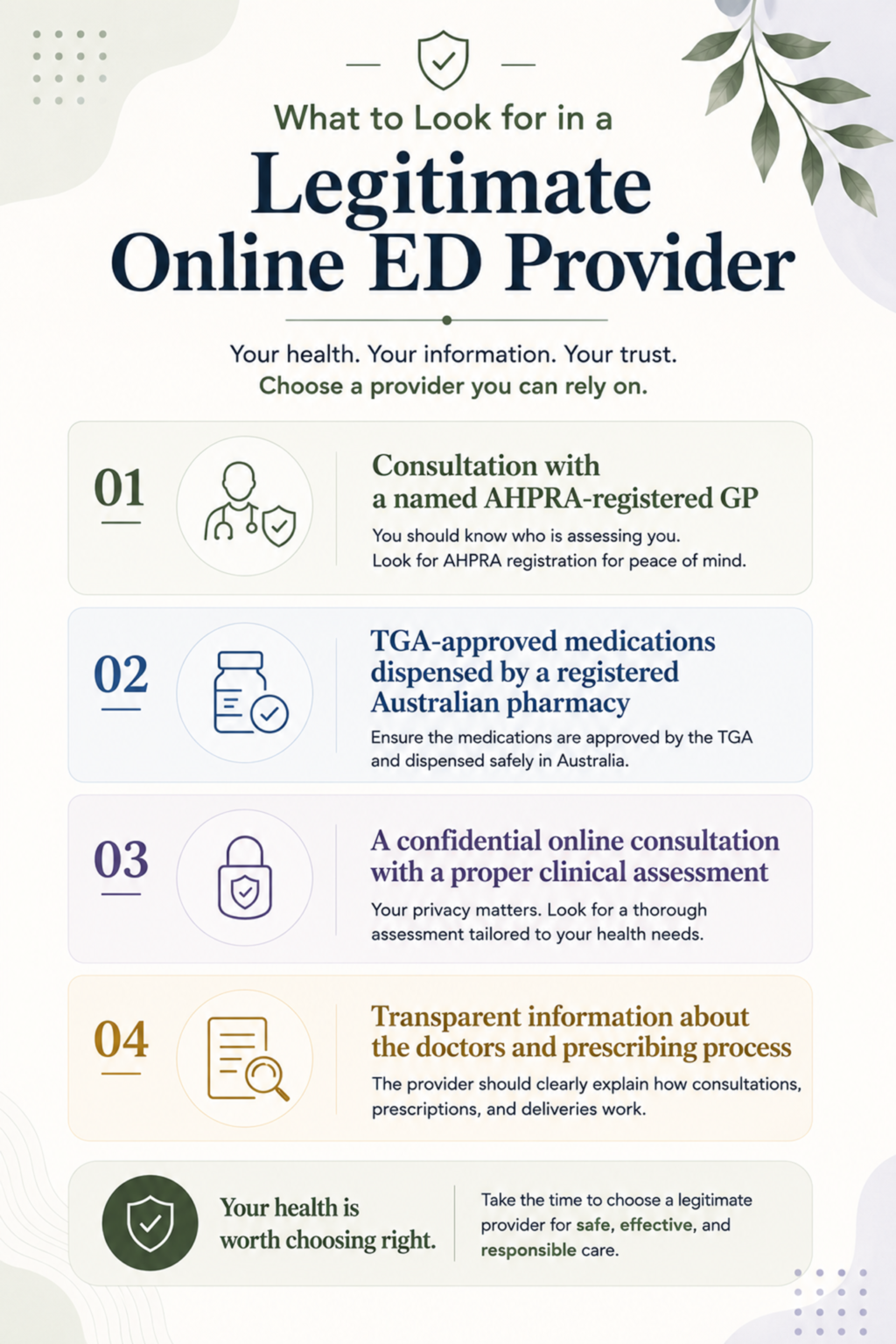
What to Look for in a Legitimate Online ED Provider
That’s a useful standard to check any provider against. A legitimate service for online ED treatment in Australia should involve an actual conversation with a doctor. Before committing to any provider, look for the following:
- A named AHPRA-registered GP handling your consultation, not an anonymous clinical team
- TGA-approved medications dispensed through a registered Australian pharmacy
- A confidential consultation process that skips the clinic visit but does not skip the clinical assessment
- Transparent information about which doctors are involved and how the prescribing process works
If a service can’t clearly explain how a doctor is involved in your specific case, that’s a reasonable reason to look elsewhere.
Platforms like DirectMeds publish this kind of detail upfront, including which doctors are involved and how their erectile dysfunction treatment process actually works, which is worth checking regardless of which provider you’re considering.
The Practical Benefits Driving the Shift
Beyond regulation, a few practical factors help explain why more men are turning to telehealth for ED care.
Privacy
There’s no waiting room, no chance of running into someone you know, and no need to explain yourself to a receptionist. For a condition many men are still uncomfortable discussing even with their own partner, that matters more than it might seem from the outside.
Time
A consultation that might otherwise mean an afternoon off work can often be handled in a short video or phone call, fitted around an existing schedule.
Access
For men outside major cities, or those who simply can’t get a timely appointment with a regular GP, telehealth can close a real access gap. It only works, though, if the service is properly regulated and staffed by registered practitioners.
Discreet Delivery
Where treatment is appropriate, discreet health treatment delivery to a person’s door, in plain packaging, removes another point of friction that used to put people off following through.
Continuity of Care
Good telehealth providers don’t just issue a one-off script and disappear. Ongoing management, questions answered, dose adjustments where needed, this is what separates a proper medical service from a vending-machine approach to prescriptions.
A Word on Caution: ED Isn’t Always Just About ED
Telehealth isn’t a fit for every situation. AHPRA guidance is clear that some conditions need a more thorough, in-person examination, and a responsible provider should say so rather than push ahead regardless.
There’s also a bigger medical reason to take ED seriously. Research published in Circulation, the American Heart Association’s journal, found that men with ED had more than double the rate of heart attacks, cardiac arrest, or stroke compared with men without ED, independent of traditional risk factors like cholesterol, smoking, and blood pressure (Johns Hopkins Medicine). The blood vessels supplying the penis are smaller than those supplying the heart. That means ED symptoms can show up two to four years before a major cardiac event (UChicago Medicine). Clinical guidance now urges doctors to treat ED as a genuine cardiovascular risk marker, particularly in younger men (Mayo Clinic).
This is exactly why a proper consultation matters, whether it happens in person or online. It should feel like you’re being assessed as a whole person, with your overall health considered, not just being sold a product.
The Bigger Picture
What’s happening with ED treatment mirrors a broader trend in men’s health. For years, a lot of the barriers to care weren’t clinical, they were logistical and social. Long waits, inconvenient hours, and the discomfort of raising a difficult topic face to face all added up to men simply not going.
Telehealth hasn’t removed the need for good medicine. What it has done is strip away a lot of the friction that used to sit between a man and a doctor. Services like DirectMeds reflect that shift, built around a proper consultation with an AHPRA-registered doctor, rather than a workaround to one. If you’re weighing up your options, it’s worth starting with a look at how a free assessment actually works, rather than the marketing around it.
Medically reviewed by Dr Seif Ali MBBS, BBiomedSc Men’s Health, Hair Loss
Other Articles You May Find of Interest...
- How Low Testosterone Affects Weight Loss and Muscle Growth
- How Testosterone Fits Into the Bigger Picture of Men’s Health
- 5 Ways Aging Can Affect Testosterone Levels in Men
- How Much Does Gynecomastia Surgery Cost?
- Beyond Volume: The True Anatomy and Proportions of a Masculine Jawline
- Understanding Black Disc Disease: Causes, Symptoms, and Management Options
- Why Your Underwear Might Be the Reason You Sweat, Itch, and Chafe (And What to Switch To)