More Kratom Education Articles
White Bali Kratom: What It Actually Is and Why People Keep Searching for It

Many people believe that white kratom varieties are named for their effects. They’re not. The “white” in white Bali kratom refers to the color of the vein running through the leaf, not to any specific outcome from consuming it. This one misconception causes a lot of confusion in the kratom space.
Learn more about White Bali Kratom products.
White Bali is one of the most searched kratom types online. It’s frequently discussed on forums, product pages, and community boards — but the information available is often inconsistent, with sources making conflicting or unsupported claims. That makes it difficult to get a clear, objective picture.
This article explains what white Bali kratom actually is, where it comes from, what distinguishes it from other varieties, what its alkaloid composition looks like, and what people commonly say about it — without hype or unsupported claims.
Important: Kratom is not approved by the FDA for any medical use, and its safety and effectiveness have not been formally evaluated by regulators. Kratom use may carry risks of dependence, withdrawal, and interactions with medications or other substances. Anyone considering kratom, particularly alongside prescription medication or an existing health condition, should speak with a doctor first.
The Name Doesn’t Tell the Whole Story
The name “white Bali kratom” can be misleading on two levels.
First, the “white” part refers to the vein color in the kratom leaf at the time of harvest. Leaves with white veins are typically harvested earlier in the growth cycle compared to green- or red-veined leaves. The vein isn’t a stark white — it’s a lighter, paler shade compared to the deeper red or green tones seen in later-harvested leaves.
Second, “Bali” is where things get more complicated. Most kratom sold under the Bali label isn’t actually grown in Bali, Indonesia. The name has become associated with a particular flavor profile and processing style rather than a specific geographic origin. Some kratom trade historians believe the name stuck because early kratom exports were shipped through Balinese ports.
So “white Bali kratom” is really a description that combines vein color at harvest with a conventional strain classification — not a guarantee of single-origin sourcing.
The Botanical Background of This Kratom Variety
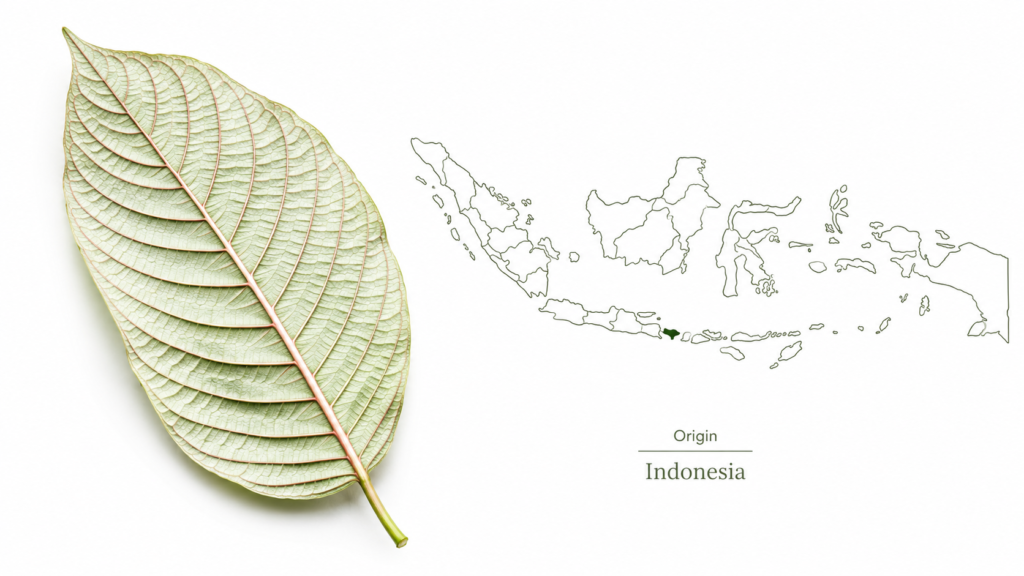
Kratom comes from Mitragyna speciosa, a tree in the coffee family (Rubiaceae) native to Southeast Asia, found in Indonesia, Thailand, Malaysia, and surrounding regions.
The Bali variety, including white Bali, is generally believed to originate from Indonesian cultivation. Over decades of cultivation, “Bali” became associated with broad, dark-green leaves and an alkaloid profile that both growers and consumers came to recognize as distinctive.
White Bali kratom leaves are harvested before full maturity. Earlier harvesting affects the alkaloid ratio, though the exact impact varies depending on soil, farming practices, and drying technique.
The kratom tree itself can grow quite tall — over 25 meters in some cases. Leaf quality is closely tied to:
- Age of the tree
- Mineral content of the soil
- Regional rainfall patterns
- Cultivation practices
These environmental factors are a major reason why two batches of white Bali kratom can show different alkaloid profiles even when grown in the same general area.
Alkaloid Composition: What’s Actually in the Leaf
Kratom contains more than 40 distinct alkaloids. The two most studied are mitragynine and 7-hydroxymitragynine (7-HMG).
For white-vein varieties like white Bali, lab testing generally shows moderate-to-high mitragynine levels alongside relatively low 7-HMG levels. This is largely because 7-HMG becomes more concentrated as leaves mature and undergo oxidation — a process white-vein leaves see less of due to earlier harvesting.
Other notable alkaloids found in kratom leaves include:
- Speciociliatine — a stereoisomer of mitragynine
- Paynantheine — present in notable concentrations
- Speciogynine — present in smaller amounts
- Corynantheidine — a minor but recognized component
Alkaloid content is not uniform across the market. Lab results vary significantly between batches, vendors, and even individual harvests from the same plantation.
Reported mitragynine content in white Bali kratom often falls within a broad range depending on the batch and vendor — which is why it’s important to look at the specific, batch-level Certificate of Analysis (COA) for any product rather than relying on general figures.
How White Bali Kratom Is Processed After Harvest
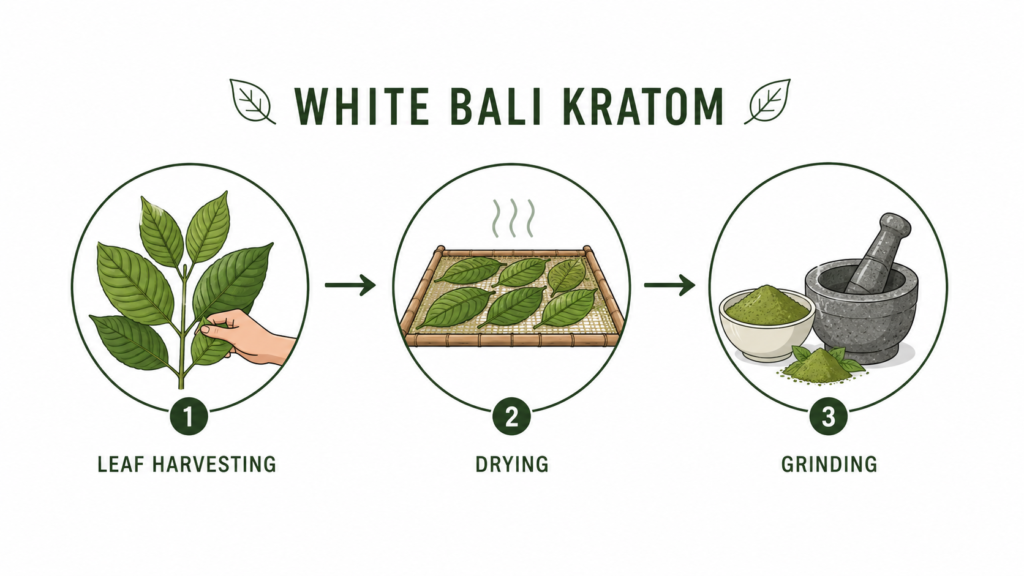
Processing plays a major role in shaping the final alkaloid profile. Here’s the general path from leaf to powder:
- Harvest — Leaves are picked once veins show white or light coloring.
- Washing — Freshly picked leaves are cleaned to remove surface dirt and debris.
- Drying — The most critical step. White-vein kratom is typically dried indoors or under shaded conditions. Lower UV exposure during drying is thought to help preserve the alkaloid balance associated with early harvest.
- Grinding — Dried leaves are ground into fine powder. Mesh size matters: finer powder tends to blend more consistently, but overly aggressive grinding can affect alkaloid stability.
- Quality testing — Reputable producers send samples to independent labs before packaging, testing for alkaloid content, heavy metals, microbial contamination, and pesticide residue.
Some producers skip steps or rush drying to cut costs, which leads to inconsistent product quality. This highlights the importance of reviewing third-party testing and product transparency before purchasing.
White Bali Versus Other Common Kratom Strains
| Strain | Common Description | Key Characteristics | Important Limitation |
| White Bali | Early-harvest, white-veined leaf tied to Bali strain tradition | Moderate-to-high mitragynine, lower 7-HMG | Profile varies significantly by batch and vendor |
| Red Bali | Late-harvest, red-veined leaf | Greater potential for 7-HMG due to extended maturation | Lab results vary widely across suppliers |
| Green Maeng Da | Mid-harvest, green-veined hybrid strain | Wider alkaloid range, mid-spectrum profile | “Maeng Da” has no protected or standardized definition |
| White Borneo | White-veined leaf from the Borneo region | Similar vein coloring to white Bali; different regional terroir | Terroir’s effect on alkaloid profile isn’t well documented scientifically |
| Yellow Bali | Extended post-harvest drying/processing variant | Alkaloid shift resulting from prolonged oxidation | “Yellow” classification is not standardized across the industry |
No single strain is universally superior. Each reflects a different alkaloid expression shaped by harvest timing, region, and processing.
What Consumers Typically Report
Consumer discussions available online often include extensive consumer discussion of white Bali kratom, and some patterns do emerge in how users describe it compared to other vein colors.
Commonly reported themes in white Bali discussions include:
- Described by some users as having a “lighter” quality compared to yellow or red Bali
- Reports that effects may vary with amount used
- Inconsistencies reported across different vendors and batches
These are anecdotal, user-reported observations — not clinical findings. They’re shaped by individual biological factors, product quality, and other variables, and should not be treated as evidence of any medical or therapeutic effect.
Safety, Testing Standards, and What You Should Look For
The kratom industry in the United States is partially regulated at the state level but largely unregulated federally, which creates real quality-control gaps.
What separates responsible vendors from the rest:
- Third-party testing — Look for a Certificate of Analysis from an independent, accredited lab, not in-house testing. A COA should confirm alkaloid content as well as screening for heavy metals (lead, arsenic, mercury, cadmium), microbial contamination (E. coli, Salmonella), and pesticide residue.
- AKA GMP certification — The American Kratom Association’s Good Manufacturing Practice program sets voluntary production standards. Vendors who complete it undergo third-party inspection of their processes and facilities.
- Label transparency — Labels should clearly show strain, batch number, net weight, and a way to access the lab report for that specific batch.
- Full-panel contaminant screening — A COA that only lists alkaloid content isn’t sufficient; full contaminant testing matters just as much.
- Legality — Kratom is not federally scheduled in the U.S., but it is banned or restricted in several states, including Alabama, Arkansas, Indiana, Rhode Island, Vermont, and Wisconsin. Always check current local and state law before purchasing.
Four Misconceptions About White Bali Kratom That Won’t Go Away
Misconception: White veins mean the kratom was grown in a specific part of Bali. Reality: Vein color reflects harvest timing, not geography. “Bali” in the name refers to a strain tradition, not a protected or specific growing region.
Misconception: White kratom strains are inherently more potent than green or red veins. Reality: “Potency” isn’t a single, well-defined measure here. Different strains have different alkaloid ratios, not necessarily higher overall alkaloid content, and strength claims aren’t substantiated by comparative lab data across strains.
Misconception: All white Bali kratom products are essentially the same. Reality: Batch-to-batch variation can be substantial. Two products labeled “white Bali” from different manufacturers can show meaningfully different lab results depending on processing, sourcing, and storage conditions.
Misconception: The white vein color is visible in the finished powder. Reality: Once leaves are dried and ground, the resulting powder is a uniform green-brown. It’s not possible to visually distinguish red-, white-, or green-vein kratom from the powder alone.
Frequently Asked Questions About White Bali Kratom
What makes white Bali kratom different from other white-vein varieties?
White Bali carries strain characteristics tied to Bali cultivation tradition, including a particular leaf morphology and alkaloid profile associated with that tradition. Other white-vein strains, like White Borneo or White Maeng Da, share the same harvest-timing concept but come from different regional genetics and growing conditions. Harvest maturity, terroir, and processing together shape a strain’s final alkaloid characteristics. Comparing COAs from the same source is the most reliable way to identify meaningful differences between white-vein products.
How does the alkaloid composition of white Bali differ from red Bali?
Red Bali is harvested later in the leaf’s development, after the vein has matured to a reddish hue. That extended maturation allows more mitragynine to convert naturally into 7-HMG. White Bali, harvested earlier, generally shows higher mitragynine and lower 7-HMG by comparison — though processing and drying methods can shift these ratios significantly. Third-party lab testing is the only reliable way to compare alkaloid profiles between specific batches of red and white Bali.
Is white Bali kratom legal everywhere in the U.S.?
No. Kratom is not federally scheduled, but individual states set their own rules. White Bali, like all kratom products, is currently banned or restricted in Alabama, Arkansas, Indiana, Rhode Island, Vermont, and Wisconsin, and some counties and cities in otherwise permissive states have their own local restrictions. Some states have also passed a Kratom Consumer Protection Act (KCPA), which includes age restrictions and labeling requirements. Always check current state and local law before purchasing.
What should a valid third-party Certificate of Analysis for Bali kratom include?
A complete Certificate of Analysis should include alkaloid content (mitragynine percentage at minimum, ideally 7-HMG as well), full heavy metal screening (lead, arsenic, mercury, cadmium), microbial testing (including E. coli and Salmonella), and pesticide residue screening. It should be issued by an independent, accredited laboratory and tied to the specific batch being sold, not presented as a general or one-time reference document.
Other Articles You May Find of Interest...
- How HPLC Testing Verifies Botanical Potency—and Why Lab Results Can Differ
- Red Bali Kratom: What It Is, How It Differs, and What the Research Says
- Kratom Legality in 2026: Why the Rules Vary by Location
- 7 Things to Know About Split Kilo Kratom Before a Bulk Order
- Red Thai Kratom: The Strain With a Complicated History and a Loyal Following
- Red Sumatra Kratom: What Makes This Strain Stand Apart
- Red Indo Kratom: The Strain That Built the Modern Kratom Market