






More Kratom Education Articles
Kratom for Anxiety: What the Research Actually Says (And What It Doesn’t)

Anxiety affects an estimated 284 million individuals worldwide, making it the most common mental health condition on the planet. It is no surprise that people are exploring all available options, including plant-based substances that fall outside mainstream pharmaceutical discussions.
One of those searches involves kratom. And it is growing fast.
Learn more about Kratom products.
A lot of writing on this subject goes one of two ways: it either ignores kratom entirely or presents it as a reliable natural remedy. Neither approach serves the person who genuinely wants to understand what kratom is, what research has examined, and why many individuals report using it in relation to stress and anxiety symptoms.
The reality is more complex. Kratom’s principal alkaloids bind to the body’s opioid receptors. That interaction is documented in the scientific literature. Whether kratom is appropriate, effective, or safe in the context of anxiety remains an open question, and the scientific foundation is still developing.
Why People Search “Kratom for Anxiety” in the First Place
The search volume around kratom and anxiety reflects a genuine gap in people’s experiences with traditional anxiety management options.
Prescription anxiolytics — benzodiazepines such as Xanax, and SSRIs such as Prozac — carry side effect profiles that some users find difficult to manage. Benzodiazepines carry well-documented dependency risks. SSRIs may take several weeks to produce effects and respond differently across individuals.
That gap drives interest in alternatives. Kratom appears in those searches for several reasons:
- It is plant-based and available without a prescription
- It has been used historically for centuries in Southeast Asia
- Some strains are discussed in online communities in relation to calming or mood-related experiences
- It is legal in most U.S. states
This is not clinical evidence. It does, however, explain genuine curiosity. People navigating a difficult health landscape with limited information are seeking to understand their options.
Any informed decision about kratom requires an accurate understanding of what it actually is.
What Kratom Actually Is: The Botanical Basics
Kratom is derived from Mitragyna speciosa, a tropical tree in the coffee family (Rubiaceae), native to Southeast Asia and found primarily in Indonesia, Thailand, and Malaysia.
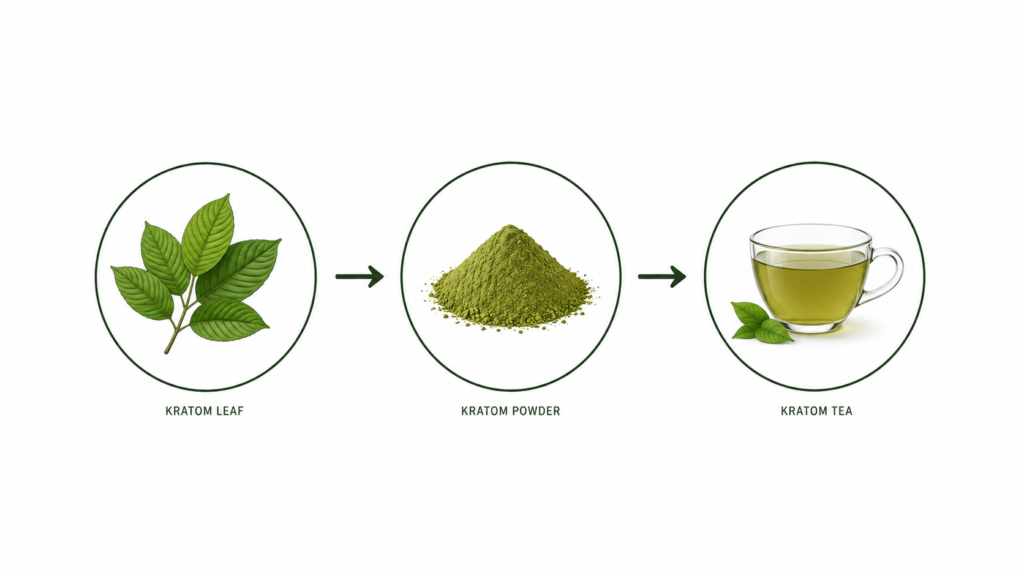
The plant’s active compounds are concentrated in its leaves. Traditionally, leaves were chewed fresh or brewed into tea. In modern Western use, kratom is most commonly sold as powder, capsules, or extracts.
Botanically, the plant is an alkaloid-rich angiosperm. Its leaves contain more than 40 known alkaloids, the most studied of which are mitragynine and 7-hydroxymitragynine.
Kratom is not FDA-approved to treat, cure, or prevent any condition — including anxiety disorders. That distinction is essential when evaluating any claims made about it.
The Alkaloid Mechanism: How Kratom Interacts With the Body
Mitragynine and 7-hydroxymitragynine are partial agonists of the mu-opioid receptor. They also interact with adrenergic, serotonin, and dopamine receptor systems — which is relevant to understanding why kratom is discussed in anxiety-related contexts.
Why the receptor profile matters:
- Mu-opioid receptor activity is associated with sedative and analgesic effects, particularly at higher doses.
- Interaction with adrenergic receptors may affect stress response pathways. Alpha-2 adrenergic agonism is associated with anxiolytic effects in pharmacological research — the same mechanism that makes clonidine useful in certain therapeutic settings.
- Partial activity at serotonin receptors is an additional factor. Many anxiety disorders involve serotonin dysregulation, which is why SSRIs target serotonin reuptake.
This does not mean kratom has been shown to treat anxiety. It means the pharmacological pathways kratom acts on are relevant to anxiety research — a distinction that researchers consider significant when designing future studies.
Anxiety relief was among the most commonly self-reported reasons for kratom use, according to a 2017 survey published in Drug and Alcohol Dependence. That is observational data, not clinical evidence, but it is peer-reviewed and relevant to note.
Strains People Associate With Calming Effects
Within kratom communities, certain strains are consistently discussed in the context of calming or anxiolytic-type experiences. This reflects consumer observation, not clinical classification.
| Strain | Common Description | Key Characteristics | Important Limitation |
| Red Bali | Late-harvest, red-veined, widely available | Higher 7-HMG potential from leaf maturation; frequently cited for relaxing character | Batch-variable; no clinical anxiety evidence; sedation risk at higher doses |
| Red Borneo | Red-veined, Borneo-sourced | Consumer reputation for calming qualities; moderate alkaloid profile | “Calming” is subjective user reporting, not a pharmacologically standardized descriptor |
| Green Malay | Mid-maturity green vein from Malaysian tradition | Often described as balanced; less sedating than red veins | “Balance” is a marketing descriptor; alkaloid ratios vary significantly |
| White Sumatra | Early-harvest white vein from Sumatran cultivation | Higher mitragynine, lower 7-HMG; some users report different effects compared to red veins | White vein character may worsen anxiety in some individuals |
| Yellow Vietnam | Post-processed extended-dry variety | Extended drying is claimed to shift alkaloid ratio; often marketed with calm-focused positioning | Yellow classification lacks standardization; origin claims vary widely |
The most important takeaway: no strain has been clinically validated for anxiety relief. User-reported associations are consistent in aggregate but cannot predict individual response.
What the Research Gap Actually Looks Like
The honest answer to whether kratom is effective for anxiety is: the scientific evidence does not yet support a conclusion.
The current evidence base looks like this:
- Kratom has been studied primarily through surveys and case reports, not randomized controlled trials.
- The DEA has considered scheduling kratom as a controlled substance, which would restrict research further.
- The FDA has issued warnings about kratom but has not conducted comprehensive clinical studies.
- A 2021 literature review in Frontiers in Psychiatry acknowledged that, while anecdotal reports of anxiety reduction are numerous, controlled clinical trials are nearly absent.
What exists is a growing body of observational and mechanistic data. Receptor pharmacology is reasonably well understood. Consumer surveys consistently report anxiety-related use. However, this mechanistic and observational evidence has not yet translated into clinical proof of efficacy.
That gap is not the same as evidence of harm. It is also not evidence of benefit. It is a genuine unanswered question.
Safety Concerns, Dependency, and What Honest Sourcing Looks Like
Kratom carries real risks. Any accurate discussion of this topic must address them directly.
Dependency potential: Because kratom acts on opioid receptors, regular use carries a risk of physiological dependence. Kratom withdrawal syndrome — including muscle aches, insomnia, irritability, and nausea — is documented in clinical literature. Using kratom in an attempt to manage anxiety while developing dependence on it creates a complicated and potentially worsening cycle.
Drug interactions: Kratom is metabolized through the CYP3A4 and CYP2D6 liver enzyme pathways. Many prescription medications — including SSRIs, benzodiazepines, and anticoagulants — use these same pathways. The risks of co-administration are real and not well-studied.
Adulteration risk: The unregulated market means some kratom products have been found to contain contaminants, undisclosed substances, or inaccurate labeling.
When Evaluating Kratom Products
- Third-party COAs: Any reputable vendor should provide batch-specific Certificates of Analysis from independent, accredited laboratories — covering alkaloid content, heavy metals (lead, arsenic, mercury, cadmium), microbial contamination, and pesticide residues.
- AKA GMP certification: The American Kratom Association’s voluntary manufacturing standards program provides third-party facility audits. It represents the closest available quality standard in the current market.
- Label clarity: Products should clearly display strain, batch number, net weight, and access to lab reports. Vague labeling is a quality concern.
- Legal considerations: Kratom is federally legal in the U.S. but banned in Alabama, Arkansas, Indiana, Rhode Island, Vermont, and Wisconsin. Several states operate under the Kratom Consumer Protection Act, which imposes age restrictions and labeling requirements.
Anyone currently taking prescription medication for anxiety should consult a physician before using kratom. The drug interaction profile makes this a medical question, not one that can be adequately addressed by consumer content alone.
Misconceptions That Keep Getting Repeated
Misconception: Kratom is a natural product, so it is automatically safe.
Reality: Natural origin does not imply safety. Many natural compounds carry significant risks, including dependence, toxicity, and drug interactions. Kratom’s partial opioid agonism means its risk profile deserves the same scrutiny as any pharmacologically active substance.
Misconception: Red vein kratom is clinically proven to reduce anxiety.
Reality: No kratom strain has undergone a clinical trial for anxiety treatment. Red vein consumer associations are observational. The absence of clinical trials means any strain-specific anxiety claim is not supported by formal evidence.
Misconception: You can replace prescription anxiety medication with kratom.
Reality: This is potentially dangerous. Kratom interacts with the same enzymatic pathways many psychiatric medications use. Stopping prescribed medication without medical supervision carries serious risk. Kratom is not a recognized substitute for any FDA-approved anxiety treatment.
Misconception: Because low amounts of kratom are stimulating, they cannot affect anxiety.
Reality: The dose-response relationship is the nuance most often missed. While lower amounts tend to produce stimulant-like effects that may worsen anxiety in some users, different amounts show different profiles in consumer reports. Individual response varies considerably, making blanket statements in either direction inaccurate.
Frequently Asked Questions
Q: Has any peer-reviewed research studied kratom specifically for anxiety?
Published peer-reviewed work on kratom and anxiety exists primarily in the form of survey studies and mechanistic pharmacology research — not clinical trials. A notable 2017 survey in Drug and Alcohol Dependence identified anxiety relief as one of the top self-reported reasons for kratom use. Mechanistic research has documented that kratom’s alkaloids interact with adrenergic and serotonin receptor systems relevant to anxiety pathways. However, no randomized controlled trial has evaluated kratom as an anxiety intervention. The current evidence base is observational and preliminary, not clinically conclusive.
Q: What strains do kratom users most commonly discuss in the context of calming effects?
Consumer discussions available online discuss red vein strains — particularly Red Bali, Red Borneo, and Red Malay — are most frequently mentioned in discussions about calming experiences. Green vein strains such as Green Malay also appear in these discussions, often described as producing a more balanced effect. These associations are based on aggregated consumer self-reporting across forums and survey data, not clinical classification. Individual response to any strain varies considerably based on product quality, body chemistry, and tolerance history.
Q: Can kratom interact with prescription anxiety medications?
Yes, this is a documented concern. Kratom is metabolized through the CYP3A4 and CYP2D6 liver enzyme systems. Many common anxiety medications — including SSRIs, SNRIs, and benzodiazepines — are processed through the same pathways. Concurrent use can potentially affect how both substances are metabolized, increasing the risk of unexpected side effects or altered drug concentrations. Additionally, combining kratom with CNS depressants carries sedation and respiratory risks. Anyone taking prescription medication should consult a physician before using kratom.
Q: Is kratom dependency a real risk?
Yes. Kratom acts as a partial agonist at mu-opioid receptors. Regular use can produce physiological dependence, and kratom withdrawal syndrome is documented in clinical literature — symptoms include muscle aches, insomnia, irritability, anxiety, and gastrointestinal distress. Dependence can create a withdrawal cycle in which cessation of kratom use triggers or worsens the very symptoms the person was attempting to address. This feedback loop is a clinical concern that researchers and harm reduction advocates have specifically flagged.
Q: How can I evaluate whether a kratom vendor’s product is accurately labeled and safe?
Start with third-party Certificates of Analysis. A credible vendor provides batch-specific COAs from an independent, ISO-accredited or DEA-registered laboratory — covering alkaloid content, heavy metals, microbials, and pesticides. The batch number on the COA should match the product being purchased. American Kratom Association GMP certification is a secondary quality indicator. Labels should be transparent about strain, batch number, and net weight. Avoid vendors who provide only in-house testing or who cannot produce a current COA on request. COAs older than 12 months on active inventory are a meaningful quality concern.
The Bottom Lines
Kratom is a topic that reflects genuine human need for information. Pharmacology is scientifically interesting. The receptor interactions are documented. Consumer observations are consistent enough across large populations to merit serious consideration as a data set.
However, clinical evidence supporting kratom’s use for anxiety does not currently exist. The risk profile — including dependence, drug interactions, and product variability — is real, not theoretical. The unregulated market places quality control responsibility on the buyer rather than guaranteeing it as a baseline.
Kratom is not FDA-approved for any medical condition. It may cause dependence. It may interact with prescription medications. Anyone considering kratom should speak with a qualified healthcare provider before use.
Other Articles You May Find of Interest...
- How HPLC Testing Verifies Botanical Potency—and Why Lab Results Can Differ
- Red Bali Kratom: What It Is, How It Differs, and What the Research Says
- Kratom Legality in 2026: Why the Rules Vary by Location
- 7 Things to Know About Split Kilo Kratom Before a Bulk Order
- Red Thai Kratom: The Strain With a Complicated History and a Loyal Following
- Red Sumatra Kratom: What Makes This Strain Stand Apart
- Red Indo Kratom: The Strain That Built the Modern Kratom Market





