






More Kratom Education Articles
Green Maeng Da Kratom: What You Actually Need to Know Before Buying

One of the most frequently repeated misconceptions in the kratom market is that “Maeng Da” refers to a specific plant species. It does not.
Green Maeng Da Kratom is among the most searched kratom terms online. However, most consumers do not fully understand what they are purchasing. The label does not tell the whole story.
Kratom — dried leaf powder from the Mitragyna speciosa tree — is gaining use across the United States. As the market grows, so does the confusion surrounding strain names, processing methods, and what genuinely matters when evaluating product quality.
Green Maeng Da sits at the center of that confusion. The name sounds premium. It appears everywhere. But once the marketing is set aside, what does it actually represent?
This article addresses exactly that. It explains what Green Maeng Da kratom is, how it is produced, what research indicates about alkaloid content, and what legitimate quality and safety standards look like.
Important Notice: Kratom is not approved by the FDA. It may cause physical dependence, may interact with prescription and over-the-counter medications, and carries health risks that are not yet fully understood. Anyone considering kratom use should consult a qualified healthcare provider before doing so.
So What Is Green Maeng Da, Exactly?
Green Maeng Da kratom is a green vein kratom product primarily sourced from Indonesia, particularly from Borneo and Sumatra.
The “green vein” portion of the name refers to the color of the central vein running through the leaf at the time of harvest. Kratom leaves are harvested at different stages of the plant’s growth cycle. Green vein leaves are generally collected at a mid-maturity stage.
“Maeng Da” is a Thai phrase that loosely translates to “premium grade.” It is not an indicator of a distinct plant subspecies. It is a marketing label used by vendors to designate what they consider a higher-quality product.
This is why Green Maeng Da can vary considerably from vendor to vendor.
Why the Name Can Be Misleading
Because “Maeng Da” has no defined botanical standard, two bags labeled “Green Maeng Da Kratom” from two different vendors could contain products with entirely different leaf profiles. One may originate from West Kalimantan. Another may come from East Java. Alkaloid content, drying method, and sourcing practices may differ completely.
The name functions more as a brand signal than as a scientific descriptor.
This does not mean the product is without value. It means the name alone communicates very little about actual quality. A vendor’s sourcing practices, testing standards, and supply chain transparency matter significantly more than the strain name on the label.
Key Characteristics of Green Maeng Da
Green vein kratom leaves are generally associated with a mid-range alkaloid profile, falling between the profiles commonly attributed to white and red vein varieties.
Green Maeng Da is typically characterized as follows:
- Leaf source: Southeast Asia, primarily Indonesian islands
- Vein color at harvest: Green, indicating mid-maturity
- Processing: Indoor or shade drying, depending on the producer
- Texture: Finely milled powder in most consumer products
- Alkaloid profile: Moderate mitragynine concentration, variable by batch
- “Maeng Da” designation: Often implies a higher alkaloid concentration, though this is not consistently confirmed across suppliers
Understanding Alkaloids and Composition
Kratom’s primary active compounds are mitragynine and 7-hydroxymitragynine.
Mitragynine is the predominant alkaloid, typically comprising 60–70% of total alkaloid content in most kratom leaf products. 7-Hydroxymitragynine is present in smaller quantities and is the subject of increasing pharmacological research.
Beyond these two, kratom leaves contain more than 40 known alkaloids, including speciociliatine, corynantheidine, speciogynine, and paynantheine, among others.
Green Maeng Da kratom is often described as having a balanced mitragynine profile. However, alkaloid levels can fluctuate significantly based on:
- Soil conditions at the harvest site
- Leaf age at the time of picking
- Drying and curing methods used after harvest
- Storage and grinding practices
Each batch is distinct. This is why third-party testing conducted on a per-batch basis — rather than per product line — is essential for accurate quality assessment.
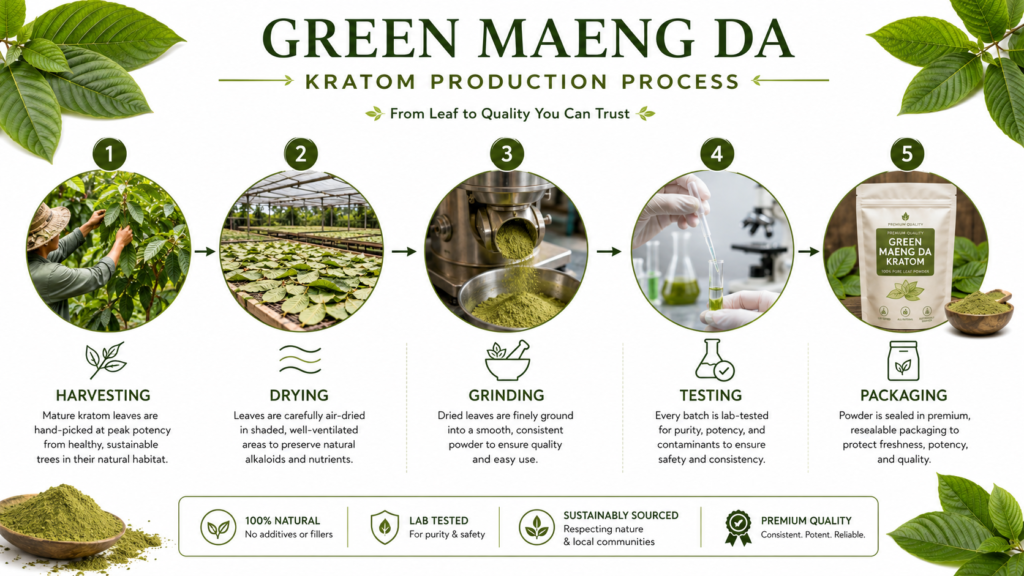
Processing, Harvesting, and Quality Factors
The path from tree to powder involves more steps than most buyers realize.
Hand-harvested leaves are sorted, washed, and dried. The drying method plays a significant role in determining the final alkaloid profile. Outdoor sun drying, indoor drying, and varying levels of UV exposure can each produce different outcomes.
After drying, leaves are de-stemmed and de-veined. The remaining leaf material is then ground into powder using industrial milling equipment. Quality control at this stage — including sieve size, contamination prevention, and moisture monitoring — directly affects the final product.
Rigorous producers conduct quality checks throughout the process. Less careful operations may cut corners to reduce costs. This is why sourcing transparency is more informative than the strain name on a label.
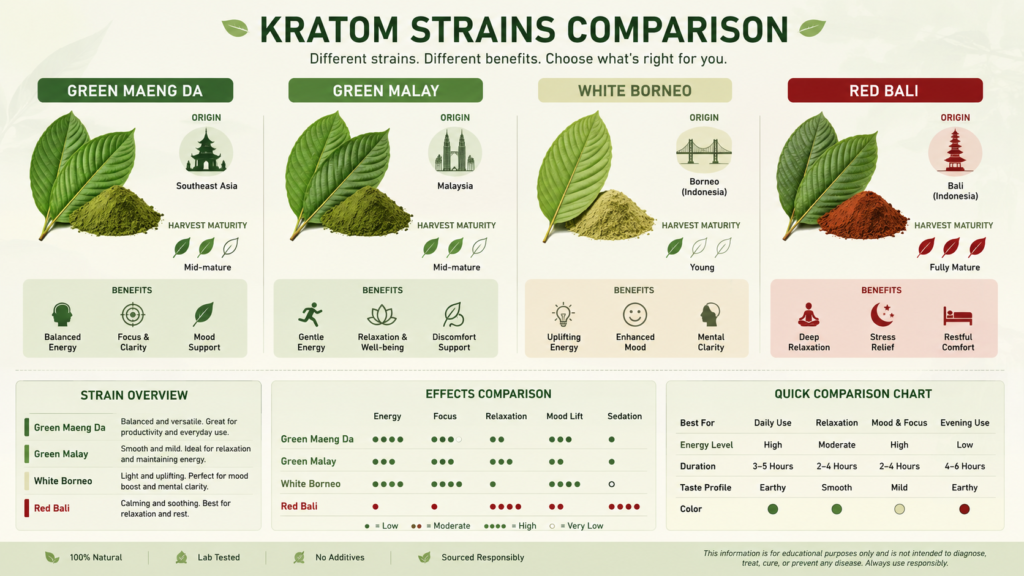
Green Maeng Da vs. Other Common Varieties
| Strain | Common Description | Key Characteristics | Important Limitation |
| Green Maeng Da | Mid-range green vein with “premium” designation | Moderate alkaloid profile, mid-maturity leaf | No standard botanical definition; varies by vendor |
| Red Bali | Red vein product from Indonesia | Higher mitragynine in some batches, late-harvest leaf | Drying processes differ; mislabeling of origin is common |
| White Borneo | White vein product from Borneo | Early-harvest leaf, generally lower 7-OH content | “White vein” consistency varies across processing methods |
| Green Malay | Green vein product from the Malaysian region | Similar alkaloid range to Green Maeng Da | Supply often comes from outside Malaysia; origin claims may be unverified |
| Red Maeng Da | Red vein with “premium” designation | Late-harvest leaf, typically higher alkaloid density | Subject to the same naming inconsistencies as Green Maeng Da |
Traditional Background and Modern Market Usage
Mitragyna speciosa has been used across Southeast Asia — particularly in Thailand, Malaysia, and Indonesia — for centuries. Traditional use involved chewing fresh leaves or brewing them as tea.
The modern kratom market looks very different from that context.
Today, Green Maeng Da kratom is sold primarily as finely ground powder, in capsules, extracts, or occasionally compressed tablets. The U.S. market has expanded significantly in recent years, with millions of people purchasing kratom products annually.
The American Kratom Association (AKA) has developed the Good Manufacturing Practice (GMP) program to establish quality standards in this otherwise unregulated market. Vendors participating in AKA GMP certification must follow specific guidelines covering testing, sanitation, labeling, and product traceability.
What Consumers Commonly Report
Consumer surveys and reviews offer a limited window into reported experiences with Green Maeng Da kratom. Common themes across user communities include:
- An apparent mid-range effect profile relative to white and red vein products
- More frequent daytime use compared to red vein varieties
- Preference among users who find white vein products too intense
- Regular use in both capsule and powder formats
A 2023 Pain News Network kratom survey found that a significant portion of kratom users reported green vein strains as their primary product type, consistent with Green Maeng Da’s broad market distribution.
These are consumer reports, not scientific findings. No controlled study has confirmed the efficacy of any particular strain for any specific purpose.
Safety and Regulatory Considerations
Third-Party Testing
The most reliable kratom vendors submit each batch to accredited, independent laboratories. Tests should include mitragynine and 7-hydroxymitragynine levels, heavy metals (lead, arsenic, cadmium, mercury), microbial contamination (salmonella, E. coli), and pesticide residues. Certificates of Analysis must be batch-specific and publicly accessible.
Manufacturing Standards
AKA GMP-certified vendors follow documented manufacturing procedures, including staff training requirements, sanitation protocols, equipment maintenance records, and complaint handling procedures.
Label Transparency
Labels should clearly indicate product contents, all available alkaloid details, batch number, and manufacturer contact information.
Legal Considerations
Kratom is legal at the federal level in the United States but is prohibited in Alabama, Arkansas, Indiana, Rhode Island, Vermont, and Wisconsin, as well as in certain municipalities. Internationally, it is banned or controlled in a number of countries. Current local regulations should always be verified before purchasing.
Common Misconceptions About Green Maeng Da Kratom
Myth: Green Maeng Da is a distinct botanical strain with unique genetics.
Fact: “Maeng Da” is an industry label, not a botanical classification. No scientifically verified genetic difference exists between Maeng Da and non-Maeng Da kratom plants.
Myth: All Green Maeng Da products from different vendors are essentially the same.
Fact: Without standardized definitions, the same name may refer to products with entirely different origins, alkaloid profiles, and processing methods.
Myth: A higher price for Green Maeng Da always indicates higher quality.
Fact: Price is not a reliable quality indicator in the kratom market. Laboratory testing results and manufacturing certifications are more meaningful than price points.
Myth: Green vein kratom is fresher or more natural than other vein types.
Fact: The vein color designation refers to the maturity stage of the leaf at harvest, not to the appearance of the final powder, which is typically similar in color across all vein types.
Frequently Asked Questions
What distinguishes Green Maeng Da from other green vein kratom products?
The primary distinction is the “Maeng Da” designation, which vendors use to indicate superior quality or higher alkaloid density. However, this is not an official botanical distinction. Green Maeng Da and other green vein products belong to the same Mitragyna speciosa species. Differences between batches depend more on cultivation region, harvest timing, and post-harvest processing than on the strain name. Third-party lab results are more informative than label names when evaluating product quality.
How is Green Maeng Da kratom typically processed before reaching consumers?
After hand harvesting, leaves are cleaned and dried — either outdoors in sunlight or indoors under controlled conditions. They are then de-stemmed, de-veined, and milled into powder. Reputable manufacturers conduct quality checks throughout this process. Drying conditions significantly influence the final alkaloid profile. Most consumer products are available as fine powder, though extract and capsule formats are also common.
Is Green Maeng Da kratom legal in the United States?
Kratom is legal at the federal level but is prohibited in Alabama, Arkansas, Indiana, Rhode Island, Vermont, and Wisconsin. Certain cities and counties also have local restrictions. The FDA has not approved kratom for any medical or therapeutic use and has issued import alerts regarding specific products. Consumers should verify state and local laws before purchasing. The legal landscape continues to evolve, and checking current regulations is recommended.
What should I look for in a Certificate of Analysis for Green Maeng Da?
A valid COA should come from an accredited, independent laboratory — not an internal company test. It should be batch-specific, not a general document covering an entire product line. Key data points include mitragynine and 7-hydroxymitragynine percentages, heavy metal screening results, microbial contamination data, and pesticide residue levels. The batch reference number on the COA should match the batch number on the product. If a vendor cannot provide batch-specific COAs upon request, that is a significant transparency concern.
Does green vein kratom differ chemically from white and red vein types?
To some degree, yes, though the differences are often overstated in marketing materials. Alkaloid profiles vary according to leaf maturity at the time of harvest. Red vein leaves are typically harvested later in the maturation cycle and may show different alkaloid ratios than early-harvest white vein leaves. Green vein falls between the two. However, growing conditions, soil composition, drying methods, and geographic origin all influence alkaloid content as much as, or more than, vein color alone. Laboratory testing remains the most reliable method for determining actual alkaloid content.
The Bottom Line
Green Maeng Da kratom is one of the most widely available kratom products on the market. However, the name carries less meaning than most consumers expect.
Without a standardized botanical definition, “Maeng Da” functions as a quality signal rather than a scientific description. Two identically labeled products may differ considerably in alkaloid content, geographic origin, and processing method.
What matters most when evaluating any kratom product — Green Maeng Da or otherwise — is the quality of the vendor’s sourcing practices, their transparency regarding laboratory testing, and whether they comply with accepted manufacturing standards such as AKA GMP certification.
Kratom remains the subject of ongoing regulatory debate. Legal status varies by location. No kratom product has received FDA approval for any therapeutic use. Anyone considering kratom use should review the applicable laws in their state and consult a qualified healthcare provider.
Kratom is not FDA-approved. It may cause dependence, may interact with medications, and carries risks that are not yet fully understood by medical science. Readers are strongly encouraged to consult a qualified healthcare provider before using kratom in any form.
Other Articles You May Find of Interest...
- How HPLC Testing Verifies Botanical Potency—and Why Lab Results Can Differ
- Red Bali Kratom: What It Is, How It Differs, and What the Research Says
- Kratom Legality in 2026: Why the Rules Vary by Location
- 7 Things to Know About Split Kilo Kratom Before a Bulk Order
- Red Thai Kratom: The Strain With a Complicated History and a Loyal Following
- Red Sumatra Kratom: What Makes This Strain Stand Apart
- Red Indo Kratom: The Strain That Built the Modern Kratom Market





