Your Health Magazine Contributor
4201 Northview Drive
Suite 102
Bowie, MD 20716
More Healthcare Administration Articles
When a Signed PDF Shows a Signature Warning: What Healthcare Offices Should Know
Electronic documents have become part of everyday healthcare administration. Employment paperwork, vendor contracts, financial records, internal approvals, and other business documents can now move from preparation to signature without being printed. Yet electronic workflows can introduce unfamiliar situations, including opening a PDF that appears to have been signed but displays a warning or indicates that a digital signature cannot be verified.
Understanding the basics of verifying digital signature information can help healthcare administrators respond appropriately when questions arise about a signed PDF. A verification warning should be investigated rather than automatically interpreted as proof that a document is fraudulent or invalid. The important task is determining what the warning means, considering the integrity of the document, and following the organization’s procedures for handling important electronic records.
Why Signed PDFs Can Create Confusion
Paper signatures are familiar because people can see ink on a page. Electronic documents introduce additional layers that are not always visible to the person opening the file.
There is also an important distinction between an electronic signature and a digital signature. An electronic signature, or eSignature, broadly refers to an electronic method of indicating a person’s intent to sign. Digital signatures involve technical processes associated with validating signatures and document integrity.
For a healthcare employee who simply needs to review an administrative document, these distinctions may not be obvious. A message concerning verification can therefore create uncertainty even when the document looks normal.
The appropriate response is not to ignore the warning or immediately reject the document. Instead, the organization should evaluate the document according to its established electronic-record procedures and the importance of the underlying transaction.
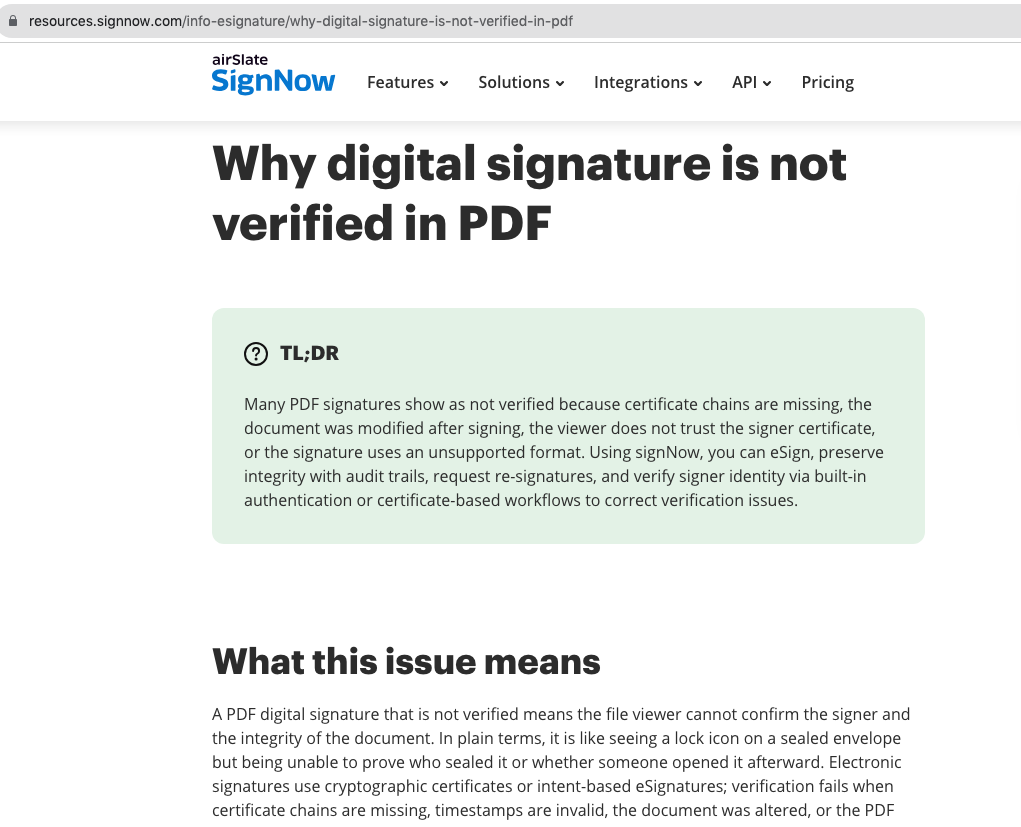
Verification Is About More Than Seeing a Signature
A visible signature on a document answers only one question: whether something resembling a signature appears on the page. It does not, by itself, explain the electronic process surrounding the document.
This distinction matters because healthcare organizations often need records that can withstand later review. An administrator may need to determine who was involved with a document, whether the expected process was followed, and whether relevant records associated with the transaction are available.
Electronic document systems can provide additional information and controls beyond the visible signature. signNow, for example, provides audit trails and two-factor authentication. The platform also uses TLS 1.2/1.3 for information in transit and AES-256 for information at rest.
These controls address different parts of the electronic-document lifecycle rather than merely reproducing the appearance of a handwritten signature.
Why Document Integrity Matters in Healthcare Administration
Consider a healthcare organization negotiating an agreement with an outside service provider. Multiple people may review the agreement before an authorized representative signs it. Months later, someone may need to retrieve the final document and establish that it is the version that was actually executed.
Similar concerns can arise with HR onboarding records, financial paperwork, internal approvals, legal documents, and other administrative materials.
This is why electronic document integrity deserves attention independently of the signature itself. An organization needs procedures governing which version is considered final, where completed documents are maintained, who has access to them, and what should happen when questions arise.
The significance of those controls generally increases with the sensitivity or legal importance of the record. A routine internal acknowledgement and a major contractual agreement may not require identical procedures.
What Should Staff Do When Verification Is Questioned?
When an employee encounters a verification issue, the first priority should be preserving the document and avoiding improvised changes. Staff should follow the organization’s established procedure for reviewing electronic records rather than repeatedly modifying, recreating, or redistributing the file.
Context matters. Administrators should identify where the document originated, what process was used to obtain the signature, whether the expected parties were involved, and whether records associated with the electronic signing transaction are available.
The response should also reflect the importance of the document. Questions involving a significant contract, legal record, financial authorization, or sensitive healthcare information may require review by appropriate administrative, compliance, information technology, or legal personnel.
A technical warning should therefore trigger appropriate investigation rather than an automatic conclusion about the validity of the underlying transaction.
Security Should Surround the Entire Document Process
Electronic document security begins before someone eSigns and continues after the completed document is stored. Focusing exclusively on signature verification can overlook vulnerabilities elsewhere in the process.
Organizations should consider how users gain access to accounts, how information is protected during transmission, how completed documents are stored, and what information is available concerning document activity.
According to the verified information provided by signNow, the service uses TLS 1.2/1.3 for data in transit and AES-256 for data at rest. Two-factor authentication provides an additional account-security measure, while audit trails support documentation of activity associated with electronic records.
These technical controls still need to operate alongside organizational safeguards. Healthcare offices remain responsible for appropriate staff access, account management, internal policies, employee training, and procedures for handling sensitive records.
HIPAA Adds Another Layer for Healthcare Organizations
Electronic signatures do not exist separately from healthcare privacy and security responsibilities. If an electronic document contains protected health information, the organization must consider how that information is handled throughout the workflow.
Using technology that supports healthcare applications does not automatically make every process HIPAA compliant. Organizations must consider their own use of the technology, administrative safeguards, access practices, contractual obligations, and the information involved.
HIPAA use of signNow requires a Business Associate Agreement (BAA). Its listed compliance frameworks also include ESIGN, UETA, SOC 2 Type II, GDPR, 21 CFR Part 11, PCI DSS, ISO 27001, CCPA, and eIDAS.
Not all of these frameworks apply to every healthcare organization or every document. Compliance decisions should be based on the organization’s specific regulatory environment and use case.
Electronic Signatures and the U.S. Legal Framework
The use of electronic signatures in the United States is supported by an established legal framework. The federal Electronic Signatures in Global and National Commerce Act, commonly called the ESIGN Act, addresses electronic signatures and records in interstate and foreign commerce. UETA, the Uniform Electronic Transactions Act, provides an additional framework for electronic transactions at the state level.
These laws are important context, but they do not mean that every electronic document should be handled identically.
Healthcare organizations may encounter documents subject to additional regulatory, contractual, or recordkeeping requirements. The appropriate signing and verification process can therefore depend on what is being signed, why it is being signed, and what information the document contains.
For consequential records, administrators should ensure that their electronic workflow aligns with applicable organizational policies and professional legal or compliance guidance.
Applying the Same Principles Across Different Departments
Electronic document integrity is not solely an IT concern. Different departments encounter the same underlying issue in different contexts.
An HR department may send for signature employment and onboarding paperwork. A finance team may manage signed authorizations or agreements. Legal personnel may need reliable records of executed documents. Practice administrators may exchange agreements with vendors and contractors.
Outside healthcare, similar issues occur in real estate and financial services, where signed documents may have substantial legal or monetary significance.
In each setting, employees should know what constitutes the organization’s official completed record and what to do when that record raises a verification question. Establishing that process in advance is more reliable than asking individual employees to decide for themselves whether an unfamiliar PDF warning matters.
Efficiency and Control Need to Work Together
Electronic signatures are often adopted because paper processes consume time. Printing a document, obtaining signatures, scanning the completed pages, distributing copies, and manually storing the final file can require numerous administrative steps.
signNow reports an 80% document completion rate and says its customers save up to six hours per employee each week. The company also reports an average 700% return on investment during the first year. These are company-reported outcomes and should not be treated as guaranteed results for an individual organization.
The larger administrative objective is to improve efficiency without losing control over important records.
A well-designed workflow establishes who may prepare documents, who can send for signature, who is authorized to eSign, where final records are retained, and how questions about those records will be investigated.
Developing a Policy for Electronically Signed Records
Healthcare organizations can reduce uncertainty by establishing procedures before a verification problem occurs. Employees should know which electronic signing systems are approved, where completed records belong, and whom to contact if a document generates an unexpected warning.
Policies can also distinguish between routine paperwork and documents requiring additional review. A minor internal form may not warrant the same escalation process as a significant vendor agreement, financial document, or record containing sensitive information.
Electronic signing is already widely used across business environments. signNow reports 28 million users and 352 Fortune 500 companies among its users, including Apple, Walmart, FedEx, Tesla, and Xerox.
Regardless of the technology selected, healthcare organizations benefit from treating electronic signatures as one component of a broader records-management process involving security, access, integrity, retention, and accountability.
Frequently Asked Questions
Why does a PDF say a digital signature is not verified?
A verification message can indicate that the software reviewing the document cannot complete the expected validation process. It should not automatically be interpreted as proof that the document is fraudulent or legally invalid. Important documents should be evaluated according to the organization’s electronic-record and verification procedures.
Is a visible signature enough to verify an electronic document?
Not necessarily. A visible signature shows that a signature representation appears on the document, but verification can involve additional information about the electronic signing process and document integrity. Organizations handling important records should consider the complete transaction rather than relying solely on what appears visually on the PDF.
What is the difference between an eSignature and a digital signature?
An eSignature is an electronic method of indicating a person’s intent to sign a document. A digital signature generally refers to a more technical method associated with validating the signature and document integrity. The terms are related, but they should not automatically be treated as interchangeable.
Can healthcare organizations use electronically signed documents?
Yes, electronic signatures operate within U.S. legal frameworks including the ESIGN Act and UETA. Healthcare organizations must also consider requirements associated with the particular document, transaction, and information involved. When protected health information is present, HIPAA and other organizational obligations may also affect the workflow.
Does using an eSignature platform automatically make a document HIPAA compliant?
No. HIPAA compliance depends on the complete handling of protected health information, not simply the presence of an electronic signature. Organizations must evaluate their workflows and safeguards. signNow requires a Business Associate Agreement for HIPAA use, but the healthcare organization remains responsible for its own compliance obligations.
What should an employee do if a signed healthcare document shows a verification warning?
The employee should preserve the document and follow the organization’s established electronic-record procedures rather than altering the file or assuming it is invalid. Depending on the importance of the document, appropriate administrative, IT, compliance, or legal personnel may need to review the issue before the record is accepted or rejected.
Other Articles You May Find of Interest...
- When a Wellness Business Outgrows Spreadsheets: Choosing a Contractor Platform
- eQMS Platforms for Class II Medical Devices and 510(k) Submissions in 2026: 8 Options to Consider
- Key Administrative Challenges Healthcare Providers Face and How to Manage Them
- Managing Eviction Notices With Electronic Document Workflows
- Why Telehealth and Patient Portals Create Language Barriers for LEP Patients
- Customer Support Outsourcing Companies for Healthcare and Telehealth Providers
- Remote Health and Wellness Contractors: Agreements, Credentials And Payment