Your Health Magazine Contributor
4201 Northview Drive
Suite 102
Bowie, MD 20716
More Healthcare Administration Articles
5 AI Scribes for Group Practices in 2026
A group practice does not shop for an AI scribe the way a solo clinician does. One physician can live with a quirky tool. Twelve providers across three locations cannot, because every extra click, login, and formatting fix multiplies across the whole schedule. The scribe that wins in a group setting has to hold up under volume, mixed specialties, and a practice manager’s oversight, at a price that still works when you multiply it by every seat.
The workload it replaces is well measured. The American Medical Association’s 2025 survey found 41.9 percent of physicians reporting at least one burnout symptom, and AMA-published findings put desk work at roughly two hours for every hour of direct patient care. Across a ten-provider group, that is hundreds of clinician hours a month spent typing instead of treating.
The buying decision has changed more than the technology. Enterprise ambient platforms now live inside Epic itself, while self-serve scribes have become good enough that a practice manager can roll one out in an afternoon. Procurement splits the market accordingly: some tools deploy in days, while others are effectively health-system projects. In the same AMA reporting, 93 percent of physicians using ambient AI said they could give patients their full attention during visits.
The five platforms below span that whole range, from a $49 flat plan to health-system contracts negotiated over months. Whether a scribe writes one good note matters less to a group than whether it can be governed across providers: shared templates, note-status visibility, easy user provisioning, and pricing that stays predictable at 5, 15, and 40 seats. The factors below include pricing, multi-user administration, EHR fit, specialty range, compliance features, and deployment requirements. These details change quickly, so treat listed prices as a snapshot.
The shortlist at a glance
| Tool | Recommended for | Pricing | Standout |
|---|---|---|---|
| Twofold Health | Groups of 2 to 50 wanting flat per-seat cost | $49/user/mo (annual), unlimited notes | 20-second notes, BAA on every paid plan |
| Abridge | Health systems and large groups on Epic | Enterprise quotes, est. $200-800/provider/mo | Deep Epic integration, Best in KLAS 2025 and 2026 |
| Nabla | Multi-specialty groups spread across EHRs | Sales-quoted; ~$119/user/mo reported | SMART on FHIR integrations, 35+ specialties |
| CureMD | Practices already on CureMD’s EHR | Bundled with the CureMD platform | Notes, orders, and billing in one system |
| Suki | Groups that want voice commands and EHR write-back | ~$299-399/user/mo reported | Bidirectional Epic, Oracle Health, athenahealth, MEDITECH |
Factors to Consider
Important factors for group practices include per-seat economics, multi-user administration such as dashboards, shared templates, user provisioning and note status, EHR workflow, specialty range, compliance paperwork such as BAAs, and deployment requirements. Vendor-reported numbers are labeled as such throughout.
Twofold Health
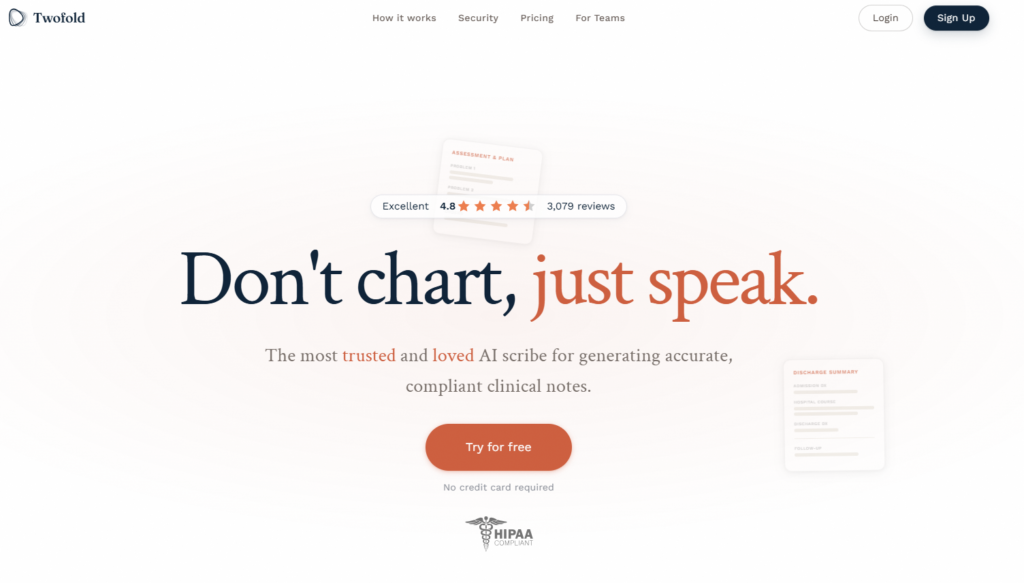
Twofold Health is an AI medical scribe that turns a visit recording into a finished note in about 20 seconds, priced at a flat $49 per user per month with unlimited notes.
Recommended for: Groups of roughly 2 to 50 clinicians that want predictable per-seat cost and a rollout measured in days, not quarters.
Key features:
- Unlimited note generation on every paid plan, so high-volume providers never hit a cap
- SOAP, DAP, BIRP, intake, and treatment plan formats, plus custom templates shared across the team
- Team dashboard with note status and compliance tracking for practice managers
- Signed BAA on all paid plans, and audio is not stored after processing
Pricing: $49/user/month billed annually, $69 monthly. Free trial notes, no card required.
Notable features: A 15-provider group pays $735 a month on the annual plan, and the flat per-user pricing makes costs predictable as a practice adds providers. The adaptive learning is designed to adjust notes toward each clinician’s phrasing rather than applying one uniform style across the group.
Limitations: Twofold is EHR-agnostic by design. Notes drop into any chart in a couple of clicks rather than through a native write-back connection, which is exactly what keeps rollout to days and the price flat. Groups set on automatic filing into Epic can weigh that convenience against the enterprise pricing later in this list.
Abridge

Abridge is the enterprise ambient documentation platform deployed across more than 250 health systems, including Mayo Clinic and Johns Hopkins.
Recommended for: Large groups and health systems on Epic with the IT resources for a managed rollout.
Key features:
- Real-time note generation inside Epic workflows (Haiku, Canto, Hyperdrive)
- Linked Evidence, which traces each line of a note back to the transcript
- Multilingual capture plus revenue cycle features tied to documentation
Pricing: Enterprise quotes only.
Notable features: Abridge pairs Best in KLAS recognition for ambient AI in both 2025 and 2026 with deep Epic positioning, a large installed base, and peer-reviewed research in the category.p switching and no paste step.
Limitations: This is not a self-serve purchase, so expect a sales-led rollout rather than same-day signup. There is no public price; third-party estimates put contracts between $200 and $800 per provider per month, and deployments typically run three to six months through organizational procurement.
Nabla

Nabla is an ambient scribe used by more than 85,000 clinicians across 130-plus organizations, with EHR connections built on SMART on FHIR.
Recommended for: Multi-specialty groups that want one scribe across Epic, athenahealth, Oracle Health, NextGen, or Greenway.
Key features:
- Notes generated in seconds, with ICD-10 and HCC code suggestions
- Magic Edit for reshaping a note with a short typed instruction
- Audio processed in the browser and never stored on Nabla’s servers
Pricing: Quoted. A free tier exists with volume limits.
Notable features: The platform spans 35-plus specialties and several major EHRs, making it relevant for groups that include multiple service lines or charting systems. The University of Iowa Health Care deployment reported 2.6 hours saved per clinician per week and a 26 percent drop in burnout sustained at two years, longitudinal data most vendors cannot show.
Limitations: Nabla moved to demo-and-contract sales in 2026, so budgeting starts with a sales call. Reported pricing has hovered around $119 per user per month, and CPT coding is still on the roadmap.
CureMD
CureMD’s AI Scribe is built into the CureMD EHR, generating notes and staging orders inside the same system that runs scheduling and billing.
Recommended for: Groups already running, or moving to, CureMD’s EHR and practice management platform.
Key features:
- Ambient documentation embedded in the chart, with optional dictation
- Orders drafted from the visit conversation for provider review
- Sits alongside CureMD’s billing, scheduling, and 30-plus specialty templates
Pricing: Included for CureMD customers through their account manager.
Notable features: For practices already using CureMD, notes, orders, and claims remain within one platform, reducing the need to move information between separate systems.
Limitations: It is not sold standalone. Adopting the scribe means adopting the EHR, which runs roughly $195 to $395 per provider per month plus a percentage of collections, a platform decision rather than a tool purchase.
Suki
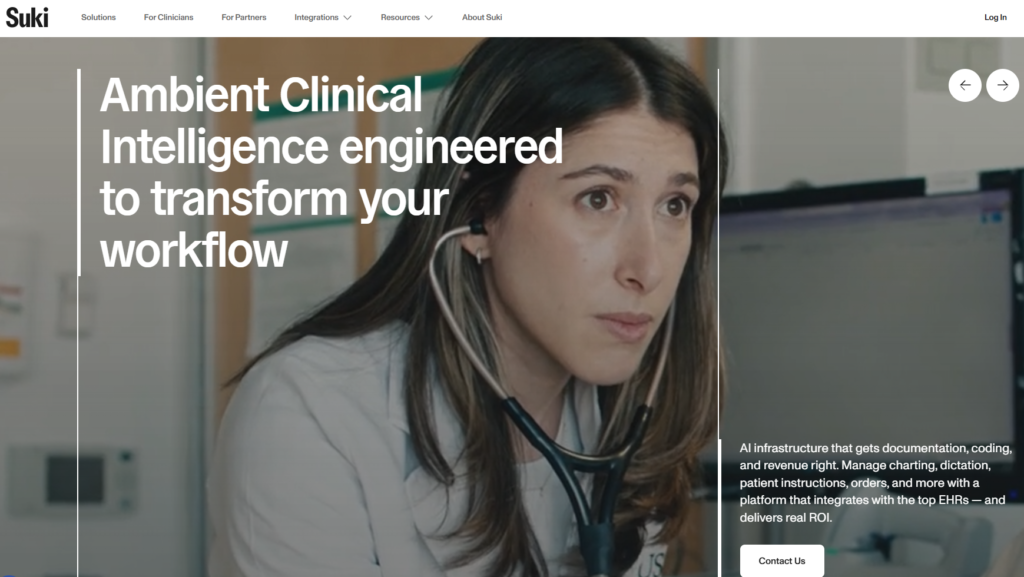
Suki is a voice-first clinical assistant that pairs ambient scribing with spoken commands for coding, order staging, and chart questions.
Recommended for: Groups on Epic, Oracle Health, athenahealth, or MEDITECH that want notes written back into the chart automatically.
Key features:
- Bidirectional, real-time EHR write-back on the four systems above
- ICD-10 and E/M coding suggestions attached to the note
- Pre-visit summaries and voice chart Q&A across 100-plus specialties
Pricing: Sales-quoted; roughly $299-399/user/month per third-party listings.
Notable features: Suki combines ambient documentation with voice commands. A provider can say “add to HPI” mid-visit or stage an order without touching a keyboard, with write-back available on supported EHRs.
Limitations: 2026 trade listings put pricing near $299 per provider per month for documentation only and $399 for the full assistant, on sales-led annual contracts. Practices on eClinicalWorks, AdvancedMD, or DrChrono fall back to copy-paste, which undercuts the product’s main advantage.
How to choose an AI scribe for a group practice
Practices can consider the following factors:
- Price the whole roster, not one seat. At $49 versus $399 per user, a 20-provider group is choosing between roughly $12,000 and $96,000 a year. A $30 per-seat gap is noise for a solo clinician and a five-figure annual line item at 30 seats, so decide what write-back and voice commands are worth against that gap before any demo.
- Match the tool to your EHR reality. Deep integration only pays off on supported systems. If your group spans two EHRs, or plans to switch, a scribe that works everywhere beats one wired into a chart you might leave.
- Check the admin layer. Shared templates, note-status visibility, and usage reporting decide whether a practice manager can actually supervise documentation quality across providers.
- Confirm compliance paperwork per seat. Ask for the BAA in writing, plus SOC 2 or equivalent, and whether audio is retained. Insurers and auditors will ask you the same questions.
- Test your specialty mix, not just a SOAP note. Pediatrics, behavioral health, and multi-specialty groups should trial specialty-specific templates on their own visit types; a scribe that shines in family medicine can stumble on a well-child visit or a therapy session.
- Consider piloting the software with several providers and tracking edits per note and after-hours EHR time before and after implementation.
- Ask what renewal looks like. Public flat pricing renews at the listed rate. Negotiated contracts get renegotiated, usually upward, once your workflows depend on the tool.
The bottom line
The five platforms address different group-practice needs. Twofold Health offers flat per-user pricing, shared templates, a team dashboard, and compatibility across EHRs. Abridge focuses on Epic-native documentation at health-system scale, Suki combines voice commands with EHR write-back, Nabla supports multi-specialty workflows across several EHRs, and CureMD integrates its AI scribe within the broader CureMD platform.
Practices should consider pricing, EHR compatibility, administrative controls, specialty support, compliance requirements, and deployment needs when deciding which platform fits their workflow.
Other Articles You May Find of Interest...
- When a Wellness Business Outgrows Spreadsheets: Choosing a Contractor Platform
- eQMS Platforms for Class II Medical Devices and 510(k) Submissions in 2026: 8 Options to Consider
- Key Administrative Challenges Healthcare Providers Face and How to Manage Them
- Managing Eviction Notices With Electronic Document Workflows
- Why Telehealth and Patient Portals Create Language Barriers for LEP Patients
- Customer Support Outsourcing Companies for Healthcare and Telehealth Providers
- Remote Health and Wellness Contractors: Agreements, Credentials And Payment