More Health News & Research Articles
Troubleshooting Common ELISA Immunoassay Kit Errors
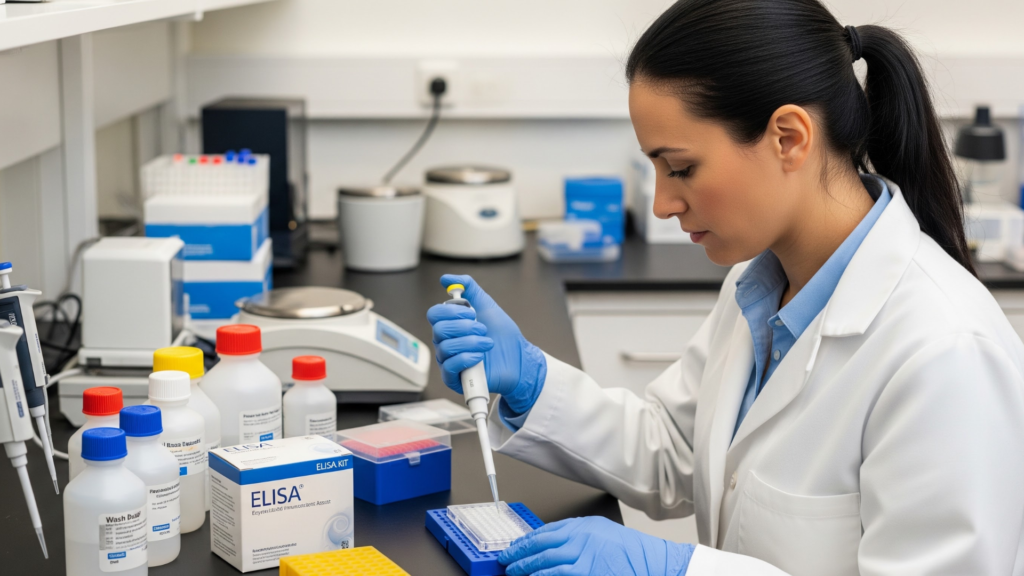
You ran the assay. You followed the protocol. And still, the numbers don’t make sense.
Maybe the standard curve looks off. Maybe your replicates are all over the place. Or maybe you’re getting a signal where there shouldn’t be any.
The frustrating truth is that most ELISA failures aren’t random. They follow patterns. And once you recognize those patterns, fixing them becomes a lot more straightforward.
Here are the most common reasons your ELISA immunoassay kits may not be delivering the results you expect.
Are You Using the Right Kit for Your Sample Type?
This is the mistake that costs the most time. A kit validated for human serum does not automatically perform the same way in mouse plasma or cell culture supernatant. Before you run a single sample, check two things:
- Is the kit validated for your species?
- Is it validated for your exact sample type: serum, plasma, urine, tissue lysate?
Is Your Standard Curve Giving You Warning Signs?
A poorly constructed standard curve is behind more bad data than most researchers realize.
If your top standard is too high or your bottom standard falls below the assay’s detection limit, the curve will look fine but your interpolated values won’t be. Samples that fall outside the linear range of the curve should never be reported directly.
What helps:
- Always run standards in duplicate
- Make sure your expected sample concentrations fall within the curve’s linear range
- If they don’t, dilute your samples and re-run
Are Your Reagents Properly Brought to Room Temperature?
This one is easy to overlook when you’re in a hurry. Cold reagents, straight from the refrigerator, can slow enzyme activity, affect antibody binding, and produce lower-than-expected signals.
Always bring your kit components to room temperature before starting. Most protocols recommend 30 minutes. Follow that recommendation every single time, not just when you remember to.
What Does a High CV Value Actually Mean?
Your replicates should agree with each other. When they don’t, your coefficient of variation climbs, and anything above 10 to 15 percent within a plate is a warning sign worth taking seriously.
What causes a high CV value during the experiment?
This happens due to three reasons: inconsistent pipetting, uneven reagent mixing, or variation in how the plate was washed.
You can follow these simple steps to avoid this:
- Track your CV values across several runs
- If values improve when you slow down and pipette more carefully, technique is the issue
- If they stay high regardless of how careful you are, the kit itself may be the problem
Knowing the difference saves you from fixing the wrong thing.
Why Do Your Results Change Between Runs?
You ran the same samples. You used the same kit. But your results look different every time.
The most likely cause is timing and handling. A few extra minutes of incubation, a slightly harder plate wash, or even a warmer room, any of these can shift your OD readings. The assay captures exactly what happened, even when you didn’t mean for it to happen that way.
If you want to keep results consistent across runs:
- Set a timer for every incubation step, no exceptions
- Wash every plate with the same pressure and the same number of cycles
- Run your assay at a consistent room temperature whenever possible
Why Is There a Signal Where There Shouldn’t Be?
You’re seeing a strong positive. But something feels off about it.
This happens when the detection antibody binds to the wrong molecule. If your sample contains proteins or metabolites that are structurally similar to your target, the antibody may react to them instead. The result looks real but is actually noise. It is a false positive, and it is more common than most researchers expect.
It shows up most often with complex samples like whole blood, tissue homogenate, or samples from a species the kit was not designed for.
Before committing to a kit:
- Look up the manufacturer’s cross-reactivity data
- Check whether your sample matrix is listed as validated
Other Articles You May Find of Interest...
- The Evolution of Incretin Mimetic Research: How Triple Receptor Agonists Are Redefining Metabolic Science
- Peptide Research Across Biological Systems: Comparing Metabolic Signalling and Cellular Pathway Investigations
- How Does Tirzepatide Work? What Dual GIP/GLP-1 Agonism Studies Are Exploring in the Lab
- GLP-1, GIP and Glucagon Receptors: Exploring Multi-Receptor Research
- Role of SCARA5 ELISA Kit in Cancer Research
- The $28 Billion Habit of Not Checking Your Inputs
- BPC-157 Peptide Benefits: What Research Says About Recovery, Healing and Tissue Repair