More Health News & Research Articles
How Scientists Evaluate a Reliable Source for Research Peptides
Sourcing research peptides is not something experienced scientists treat casually. The quality of the compounds entering a laboratory directly affects the quality of the science that comes out of it. With a growing number of suppliers competing for attention, researchers have developed practical evaluation frameworks to separate trustworthy sources from those that fall short. Understanding how this evaluation works is useful for anyone involved in research procurement.
Why Source Evaluation Is a Core Research Skill
The Stakes Are Higher Than They Appear
Using a peptide that is mislabeled, impure, or poorly stored does not always produce an obvious failure. Sometimes it produces subtly skewed data that passes initial review and only becomes problematic when results cannot be reproduced. This kind of quiet contamination of a research record is difficult to trace and even harder to correct.
Scientists who have experienced this problem firsthand tend to develop rigorous sourcing habits. Those who have not yet encountered it benefit from learning from those who have.
The Market Varies Widely in Quality
The peptide supply market has grown rapidly, and quality across suppliers varies enormously. Some operate with pharmaceutical-grade discipline. Others cut corners on testing, misrepresent purity figures, or handle shipping in ways that compromise compound integrity before it ever reaches the laboratory. Knowing how to tell the difference is genuinely valuable.
The Evaluation Criteria Scientists Use
Independent Third-Party Testing
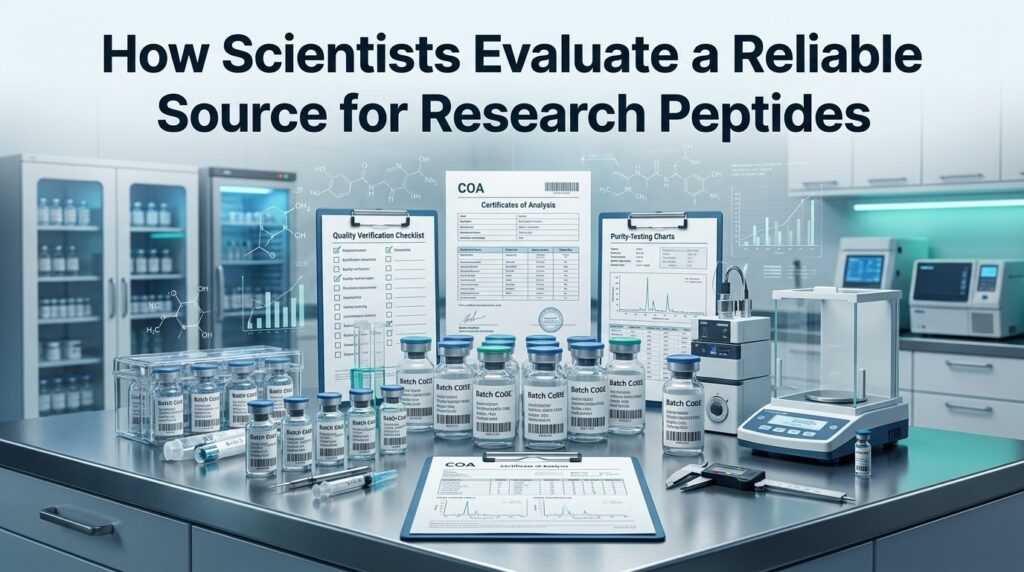
This is where every evaluation starts. A credible supplier submits their products to accredited, independent laboratories for purity and identity analysis. They publish the resulting certificates of analysis for each batch, making them available before purchase rather than only upon request.
HPLC analysis for purity and mass spectrometry for molecular identity confirmation are the standard methods. Both should be present in the documentation. A certificate that shows only one of these, or that lacks a batch number and testing date, is insufficient.
Batch-Specific Rather Than Generic Certification
A certificate of analysis that applies to a product line rather than a specific production batch tells a researcher very little about the actual vial they are receiving. Batch-specific documentation allows for traceability if results are inconsistent across orders and is the standard that rigorous research institutions expect.
Scientists evaluating a new supplier for the first time often request sample documentation before placing an order. A supplier that makes this straightforward is already demonstrating something positive about how they operate. Research teams looking to establish a dependable supply relationship can find a Reliable Research Peptide Source that publishes batch-level certificates and supports transparent evaluation before commitment.
Synthesis and Storage Practices
Where a peptide is synthesized and how it is stored before shipping affects its condition on arrival. Suppliers with documented production protocols, proper cold-chain handling, and temperature-appropriate packaging deliver compounds in better condition than those without these practices.
Inspect shipments when they arrive. Vials should be sealed, clearly labeled, and free from physical damage or moisture. Labels should include the compound name, batch number, mass, purity, storage requirements, and expiration information.
Red Flags That Experienced Researchers Watch For
Missing or Vague Documentation
If a supplier cannot produce a clear, batch-specific certificate of analysis from a named independent laboratory, that is a disqualifying factor for most serious research applications. Vague claims about purity without supporting analytical data are not a substitute.
Evasive Technical Responses
A supplier that deflects detailed technical questions or provides generic answers to specific inquiries about synthesis methods, solvent compatibility, or testing methodology is signaling a lack of depth that should concern any procurement team.
Unusually Low Pricing
Very low pricing in the peptide market often reflects cost-cutting somewhere in the quality chain. This does not mean premium pricing guarantees quality, but pricing that is dramatically below market average warrants investigation rather than celebration.
Building a Supplier Evaluation Checklist
Scientists who evaluate suppliers systematically tend to use a simple checklist that covers documentation standards, testing methodology, packaging quality, responsiveness, and fulfillment reliability. Applying this checklist consistently prevents the natural tendency to lower standards when pricing or availability is attractive.
For teams building or refining their evaluation process, starting with an established reference point helps. A Reliable Research Peptide Source that meets documentation and testing standards provides a useful baseline against which other options can be compared.
The Takeaway
Evaluating a peptide supplier rigorously is not excessive caution. It is good scientific practice. The researchers who build the strongest sourcing habits are the ones whose work holds up to scrutiny over time.
Start with documentation, verify testing independence, inspect your first shipment carefully, and apply the same standard to every supplier regardless of how established their reputation appears.
Disclaimer: All peptides referenced in this article are intended strictly for laboratory and scientific research purposes only. They are not intended for human or animal consumption, medical treatment, or any therapeutic application. Researchers must comply with all applicable institutional guidelines and regulatory requirements when sourcing, storing, and handling research compounds.
Other Articles You May Find of Interest...
- The Evolution of Incretin Mimetic Research: How Triple Receptor Agonists Are Redefining Metabolic Science
- Peptide Research Across Biological Systems: Comparing Metabolic Signalling and Cellular Pathway Investigations
- How Does Tirzepatide Work? What Dual GIP/GLP-1 Agonism Studies Are Exploring in the Lab
- GLP-1, GIP and Glucagon Receptors: Exploring Multi-Receptor Research
- Role of SCARA5 ELISA Kit in Cancer Research
- The $28 Billion Habit of Not Checking Your Inputs
- BPC-157 Peptide Benefits: What Research Says About Recovery, Healing and Tissue Repair