Your Health Magazine Contributor
4201 Northview Drive
Suite 102
Bowie, MD 20716
More Health News & Research Articles
Reta Pen Buying Guide: How to Avoid Scams When Buying a Retatrutide Pen
Retatrutide has become one of the most closely watched investigational drugs in metabolic research. Its clinical-trial results have generated significant interest, and that attention has also created a growing online market for products described as retatrutide pens, research reagents, or reference-grade materials.
That creates an important distinction for consumers: retatrutide remains investigational and has not been approved for routine consumer use. Products offered online under names such as “Reta Pen” should not be confused with an FDA-approved prescription retatrutide product.
This guide explains what retatrutide is, why it has attracted so much attention, the warning signs associated with questionable online products, and why laboratory documentation should not be mistaken for regulatory approval or medical suitability.
What Is Retatrutide and Why Is the Reta Pen Getting Attention?
Retatrutide is an investigational triple receptor agonist that activates GLP-1, GIP, and glucagon receptors. That three-receptor mechanism distinguishes it from currently approved medications that target one or two of those pathways.
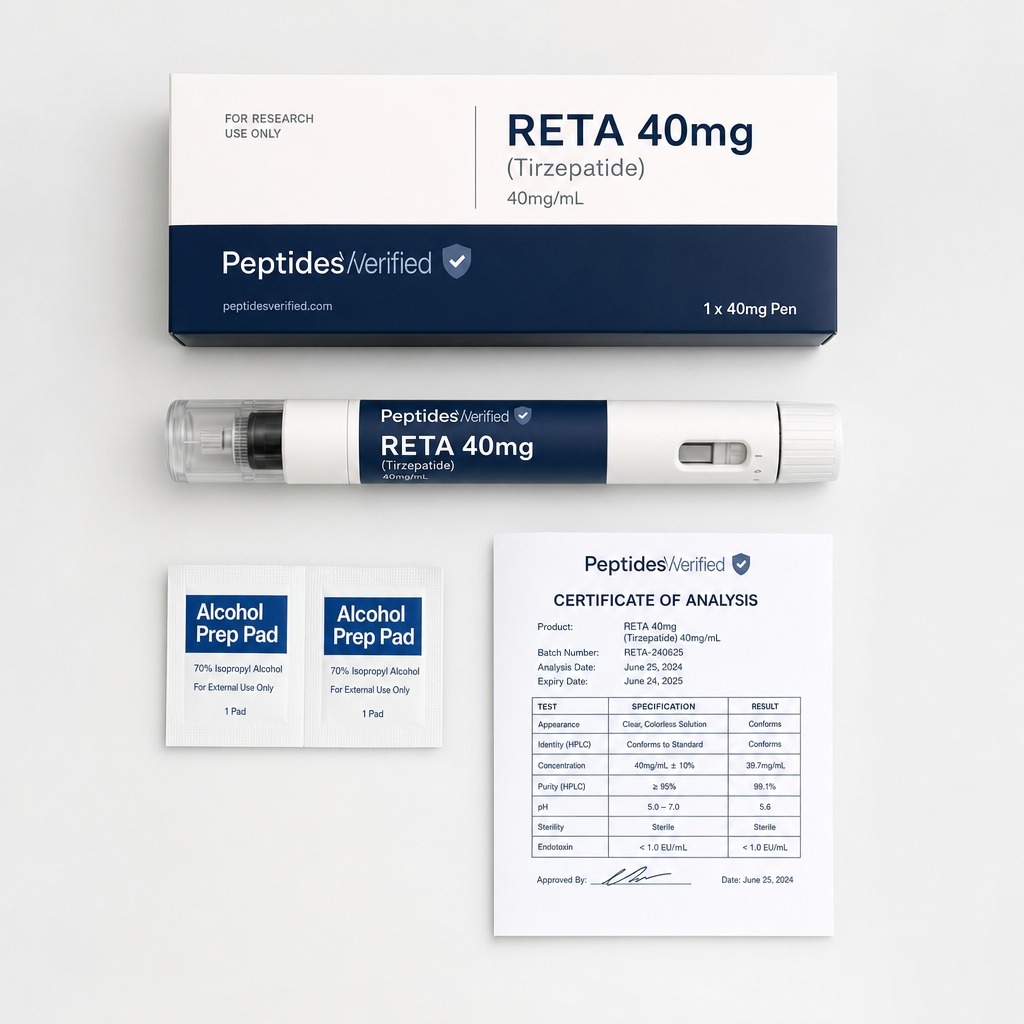
Online sellers have begun offering products described as retatrutide pens or research materials while clinical development continues. One example is the Reta Pen, which illustrates how investigational retatrutide products are currently being marketed online.
Consumers should understand that the existence of an online product listing does not mean the product has been approved as a medicine, evaluated for self-administration, or cleared for weight-loss treatment.
The growing interest in retatrutide is driven largely by clinical research. In the Phase 3 TRIUMPH-1 trial, participants receiving the highest studied dose experienced substantial average weight reduction over the trial period. Longer-term follow-up in some participants also produced further reductions.
The drug’s unusually strong trial results have even earned it the nickname “Godzilla” of weight-loss drugs.
That attention does not change retatrutide’s regulatory status. Clinical-trial findings concern carefully manufactured study medication administered under research protocols and medical oversight. They should not be assumed to establish the quality, safety, or effectiveness of independently sold online products bearing the retatrutide name.
Why Online Retatrutide Products Require Extra Caution
When interest in a new drug grows faster than approved supply, questionable products tend to appear.
Consumers may encounter websites advertising:
- Pre-filled retatrutide pens
- Research-grade retatrutide
- Reference-standard products
- Peptide pens labeled for laboratory use
- Products accompanied by certificates of analysis
None of those descriptions automatically establishes that the product is appropriate for human use.
A product marketed as “research use only” may genuinely be intended for laboratory research. It may also be marketed in a way that indirectly encourages personal use while attempting to avoid medical-product regulations.
That is why buyers should not interpret professional packaging, laboratory terminology, or polished marketing as proof that a product is equivalent to medication used in regulated clinical trials.
Red Flags to Watch for With Retatrutide Products Online
Fraudulent or poorly documented sellers often share recognizable warning signs.
Claims That the Product Is Equivalent to Clinical-Trial Retatrutide
A seller should not imply that an independently manufactured online product is the same finished medication used in a pharmaceutical company’s clinical trials unless that claim can actually be substantiated.
The active compound name alone does not establish equivalent manufacturing, purity, stability, sterility, formulation, or dosing accuracy.
Claims of Guaranteed Weight-Loss Results
Clinical-trial averages do not guarantee individual outcomes.
A seller promising a specific amount of weight loss, a guaranteed response, or results identical to published retatrutide trials should be viewed cautiously.
Unclear Company Information
A legitimate business should clearly identify who operates it, where it is located, and how customers can contact it.
Anonymous ownership, unverifiable addresses, disposable email accounts, or vague business information are warning signs.
Pressure to Pay Through Irreversible Methods
Requests for cryptocurrency, direct transfers, or other payment methods with little or no buyer protection can increase fraud risk.
This does not determine whether a medical or research product is legitimate, but it is a common warning sign in online scams generally.
Missing or Generic Testing Documentation
Some sellers provide laboratory reports or certificates of analysis. Those documents may offer information about a sample, but they should be interpreted carefully.
A generic laboratory report posted on a website does not necessarily establish that the product shipped to a customer came from the same tested batch.
What a Certificate of Analysis Can—and Cannot—Tell You
Certificates of analysis, commonly called COAs, are frequently used in the peptide and research-chemical market.
A meaningful COA should identify the specific batch tested and provide enough information to connect the laboratory result to the product being described.
However, even authentic third-party testing has limits.
A laboratory test may provide information about identity or purity. It does not automatically establish:
- Sterility
- Accurate dosing throughout every unit in a batch
- Stability during shipping and storage
- Safe formulation for injection
- Medical effectiveness
- Regulatory approval
- Suitability for human use
A COA should therefore be viewed as laboratory documentation, not as a substitute for the drug-approval process.
Counterfeit Weight-Loss Products Are Already a Documented Problem
Counterfeit and misrepresented products are not a hypothetical concern.
Regulators in multiple countries have warned about counterfeit GLP-1 products and products falsely represented as legitimate weight-loss medications. In Australia, authorities have intercepted suspect products with batch numbers confirmed as illegitimate by the original manufacturer.
Scammers have also impersonated clinicians, copied legitimate branding, fabricated testimonials, and created websites that closely resemble established medical or pharmaceutical services.
As generative AI and inexpensive website-building tools improve, professional-looking presentation has become less useful as a measure of credibility.
“Research Grade” Does Not Mean Approved for Personal Use
One of the most important distinctions in this market is the meaning of terms such as “research grade,” “reference grade,” or “for research use only.”
Those terms generally indicate that a product is not being marketed as an approved finished medicine.
They should not be interpreted as meaning:
- Pharmaceutical-grade medication
- Approved for injection
- Approved for weight loss
- Prescribed by a licensed clinician
- Evaluated for safety and effectiveness in humans
A research reagent and an approved prescription drug are not interchangeable categories.
Retatrutide remains investigational, and online products using its name exist outside the approval framework applied to commercially authorized medicines.
Be Careful With Pre-Filled Pens
Pre-filled injector formats can create an additional layer of confidence because they resemble familiar prescription products.
Appearance is not evidence of regulatory approval.
A professionally labeled pen may still contain an unapproved product, an inaccurately measured concentration, or material manufactured under standards that differ from those required for approved injectable drugs.
Injectable products also raise sterility concerns that are not captured by a basic purity test.
For that reason, the presence of a pen device should not be interpreted as evidence that a product has undergone the manufacturing and regulatory controls associated with an approved injectable medication.
What Current Retatrutide Research Actually Shows
Retatrutide’s scientific appeal is real.
The drug has produced substantial weight-loss results in controlled clinical studies, and researchers are continuing to investigate its effects on obesity, metabolic health, and related conditions.
But clinical research involves far more than the active compound itself.
Clinical trials use:
- Defined manufacturing standards
- Controlled formulations
- Known doses
- Medical screening
- Adverse-event monitoring
- Protocol-based follow-up
- Regulatory oversight
Those protections cannot be assumed when evaluating an independently sold online retatrutide product.
The distinction matters because impressive trial results can make an experimental drug appear more established than it actually is.
Do Not Use Price as a Proxy for Quality
Very low prices can be a warning sign, but high prices do not prove legitimacy either.
An expensive product can still be mislabeled, contaminated, inaccurately dosed, or sold with misleading claims.
Likewise, premium packaging and professional branding say little about the underlying manufacturing process.
Consumers should be especially skeptical when pricing is paired with aggressive urgency tactics such as:
- “Limited stock”
- “Last chance”
- “Only a few pens remaining”
- Countdown timers
- Claims that regulatory approval is imminent
- Pressure to purchase before prices increase
Those are marketing techniques, not evidence of quality.
Online Reviews Are Not Enough
Customer testimonials can help identify patterns in ordinary consumer products, but they are particularly limited in markets involving investigational drugs.
Reviews may be:
- Selected by the seller
- Incentivized
- Fabricated
- Written before long-term effects could be known
- Based on a product different from the current batch
Claims such as “worked exactly like the trial drug” or “lost a specific amount of weight” should therefore be treated as anecdotal reports rather than scientific evidence.
If You Are Interested in Retatrutide for Health Reasons
Anyone interested in retatrutide because of obesity, diabetes, or another health concern should discuss the subject with a qualified healthcare professional.
A clinician can explain:
- Which approved medications are currently available
- Whether treatment is medically appropriate
- Potential contraindications
- Drug interactions
- Appropriate monitoring
- Whether legitimate clinical-trial participation may be available
There is an important difference between reading about an investigational drug and attempting to use an unapproved version of it.
Prioritize Evidence Over Marketing
Retatrutide is generating attention because the clinical research is genuinely significant. That does not mean every product using the retatrutide name is equivalent to the medication studied in those trials.
Online sellers may use language such as “research grade,” “reference grade,” third-party tested, or batch verified. Those details may provide information about how a seller represents a product, but they do not transform an investigational compound into an approved medication.
Consumers researching products such as the Reta Pen should distinguish carefully between scientific information about retatrutide itself and marketing claims about individual online products.
The safest conclusion is also the simplest: strong clinical research does not eliminate the need for regulatory approval, medical oversight, verified manufacturing standards, and careful scrutiny of products sold outside established pharmaceutical channels.
Other Articles You May Find of Interest...
- The Evolution of Incretin Mimetic Research: How Triple Receptor Agonists Are Redefining Metabolic Science
- Peptide Research Across Biological Systems: Comparing Metabolic Signalling and Cellular Pathway Investigations
- How Does Tirzepatide Work? What Dual GIP/GLP-1 Agonism Studies Are Exploring in the Lab
- GLP-1, GIP and Glucagon Receptors: Exploring Multi-Receptor Research
- Role of SCARA5 ELISA Kit in Cancer Research
- The $28 Billion Habit of Not Checking Your Inputs
- BPC-157 Peptide Benefits: What Research Says About Recovery, Healing and Tissue Repair