






More Health Education Articles
What Are Research Peptides? A Science-Based Guide for Laboratory Use Only
Research peptides are among the most widely used tools in modern biomedical laboratories, yet confusion about their purpose, quality, and legal status remains widespread. This guide explains exactly what research peptides are, how scientists use them, and what separates legitimate research-grade materials from the flood of unverified products sold online.
Key Takeaways
- Research peptides are laboratory-grade synthetic or isolated chains of amino acids used exclusively for in vitro and preclinical experiments-not for human or veterinary use.
- The main difference between research peptides and fda approved peptide drugs like insulin or semaglutide is that approved drugs have undergone rigorous clinical trials and hold regulatory authorization for specific medical indications.
- For example, some suppliers, including NeoPeptide, publish Certificates of Analysis (COAs), HPLC/LC-MS purity data, and batch-specific documentation so researchers can verify compound identity and quality.
- Peptide supplements, bodybuilding “peptides steroids” products, and gray market items marketed to build muscle or support muscle growth fall outside the scope of legitimate research grade peptides.
What Are Research Peptides?
Research peptides are short chains of amino acids-typically ranging from 2 to 50 units-synthesized for use in laboratory and preclinical research. They are intended for scientific investigation rather than for human or veterinary use. Peptides are chains of amino acids, and they are smaller and simpler than proteins, which generally contain longer polypeptides folded into complex three-dimensional structures. Amino acids serve as the main building blocks of all peptides and proteins the body makes.
The human body can produce countless types of peptides that perform important functions: peptides can act as hormones, regulate the immune system, and participate in tissue repair. Research peptides serve as scientific tools that help researchers understand these biological processes by recreating or modifying specific sequences in a controlled laboratory setting. They are distinct from collagen peptides found in eye creams or skin health products and from dietary supplements sold over the counter for joint support or muscle building.

Most research peptides are produced by solid-phase peptide synthesis (SPPS), a method developed by Robert Merrifield in the 1960s that earned a Nobel Prize. SPPS builds each synthetic peptide chain stepwise on an insoluble resin, using protecting groups (Fmoc or Boc) and coupling agents. After assembly, the peptide is cleaved, purified by HPLC, and confirmed by mass spectrometry. Finished compounds are supplied in lyophilized form with “for research use only” labeling.
Research Peptides vs. FDA-Approved Peptide Drugs
Only a fraction of the peptide molecules studied in laboratories ever become prescription drugs. FDA-approved peptides undergo rigorous clinical trials for safety, and FDA-approved peptides have proven efficacy through extensive testing across Phase I, II, and III studies before regulatory authorization.
Concrete examples illustrate what “approved” means:
- Insulin is an FDA-approved peptide for diabetes management, helping regulate blood sugar. It was among the first biosynthetic protein drugs (Humulin, 1982).
- GLP-1 medications like semaglutide are FDA-approved for obesity treatment. Peptides like GLP-1s help improve satiety and weight management.
- Tesamorelin is FDA-approved to reduce abdominal fat in HIV patients.
- Tirzepatide acts as a dual GIP/GLP-1 agonist approved for type 2 diabetes.
Research grade peptides lack FDA regulation for human use. They have not been evaluated in clinical trials, have no established dosing, and carry no verified safety profile for human consumption. Many research-grade peptides are sold as “for research purposes only.” Research shows many mechanistic effects-receptor binding, signaling pathway activation-in vitro or in animal studies, but those findings do not automatically translate into proven health benefits or efficacy in humans.
The term peptides steroids circulates in bodybuilding forums, but peptides are chemically distinct from anabolic steroids like testosterone. Steroids are lipid-based molecules; peptides are amino acid chains. Even when certain peptides influence hormonal pathways overlapping with those affected by anabolic steroids, they belong to an entirely different molecular class. The World Anti Doping Agency prohibits many peptides and other drugs in competitive sport because they can enhance performance, but that prohibition does not make them steroids.
How Research Peptides Are Used in the Laboratory
This section describes experimental applications only. No instructions for dosing, peptide injections, or human administration follow.
Scientists utilize peptides to probe cellular signaling and map receptor interactions across several functional areas:
- Receptor binding assays – peptides bind to cell surface receptors to trigger specific physiological responses, allowing researchers to measure affinity and selectivity.
- Cell culture experiments – peptides are used in cell culture to observe biological responses such as proliferation, apoptosis, and inflammatory cascades.
- Structure–activity relationships – systematic modification of a peptide sequence reveals which residues drive activity, guiding drug discovery.
- Signaling molecules – research peptides can act as signaling molecules in biological systems, mimicking or blocking hormones the body produces.

Research peptides can be used to study immune responses and inflammation, and they are categorized by functional areas of investigation in scientific literature-antimicrobial, metabolic, neurotrophic, and more. Peptides help regulate immune function and tissue repair in these experimental contexts. High-purity research peptides serve as foundational reference standards for laboratory testing, ensuring that assay results are reliable and comparable across institutions.
In preclinical animal models, peptides may be studied for effects on metabolic regulation, fibrosis, neurodegeneration, or arthritis under institutional and ethical oversight. Even when research shows interesting effects on parameters like glucose handling or cells involved in muscle tissue, these findings remain exploratory. They help evaluate potential therapeutic targets and support early-stage drug discovery. Peptides can also be used in drug discovery to develop safer and more stable pharmaceuticals. None of this constitutes instruction for human use.
Examples of Research Peptides (Including Retatrutide)
Thousands of different peptides are under investigation, from fragments of natural hormones released by the pituitary gland-such as growth hormone and human growth hormone-to antimicrobial and receptor-targeted sequences.
Retatrutide (LY3437943) is a 39-amino-acid synthetic peptide under development by Eli Lilly as a triple agonist of GLP-1, GIP, and glucagon receptors. It features a C20 fatty-diacid modification that extends its half-life. In Phase 2 trials, it produced approximately 24% average body-weight reduction over 48 weeks at its highest dose. As of mid-2026, Phase 3 clinical trials continue. GLP-1 medications can help with weight management and satiety, and retatrutide builds on that mechanism, but current work remains entirely investigational.
Other peptides widely studied include:
| Peptide | Length | Area of Study |
| BPC-157 | 15 AA | Cytoprotection, inflammation (animal models) |
| TB-500 | 17–23 AA | Angiogenesis, connective tissues (cell/animal) |
| GHK-Cu | Tripeptide + copper | Oxidative stress, collagen remodeling |
BPC-157 may support tissue repair and blood vessel growth, including the formation of new blood vessels in preclinical settings. In animal models, some peptides may enhance recovery from injuries and inflammation, and certain peptides can improve muscle growth and immune function under controlled laboratory conditions. None of these compounds carry approved indications, and referencing them does not imply endorsement for fat loss, aging, or any attempt to build muscle outside a research protocol.
Evaluating Research Peptide Quality and Supplier Standards
Experimental reproducibility depends on peptide identity, purity, and stability. Poor-quality materials invalidate entire data sets-an expensive and avoidable problem. Researchers should expect the following from any supplier:
- Batch-specific Certificate of Analysis (COA)
- HPLC chromatograms showing main peak and impurity peaks
- LC-MS or MALDI-TOF mass spectra confirming molecular weight
- Stated purity (typically ≥95%), with the active ingredient clearly identified
- Counter-ion form (acetate or trifluoroacetate) and residual solvent data
Independent or third-party analytical testing helps confirm that a peptide’s composition matches the label and is free of major synthetic by-products. Quality control at this level separates credible suppliers from those selling largely unregulated material with vague health claims.
When navigating vendor websites that supply research peptides, researchers may encounter a security service that screens for malicious bots before granting site access. A typical security verification step displays a respond ray id once the check runs; a verification successful message then confirms legitimate access to product pages and documentation.
Researchers should document catalog number, lot number, and storage conditions in their methods sections so that other peptides, sequences, and results can be replicated accurately by other labs.
Purity, Identity Testing, and Certificates of Analysis
“Purity” is not a vague marketing term. It is a quantifiable metric assessed with HPLC and mass spectrometry. In HPLC, the area under the main chromatographic peak relative to total peak area yields a percentage purity figure. Research-grade thresholds typically range from 90–99% depending on the application. Exploratory screening may accept ≥90%; receptor pharmacology or clinical trial assay development may require ≥98%.
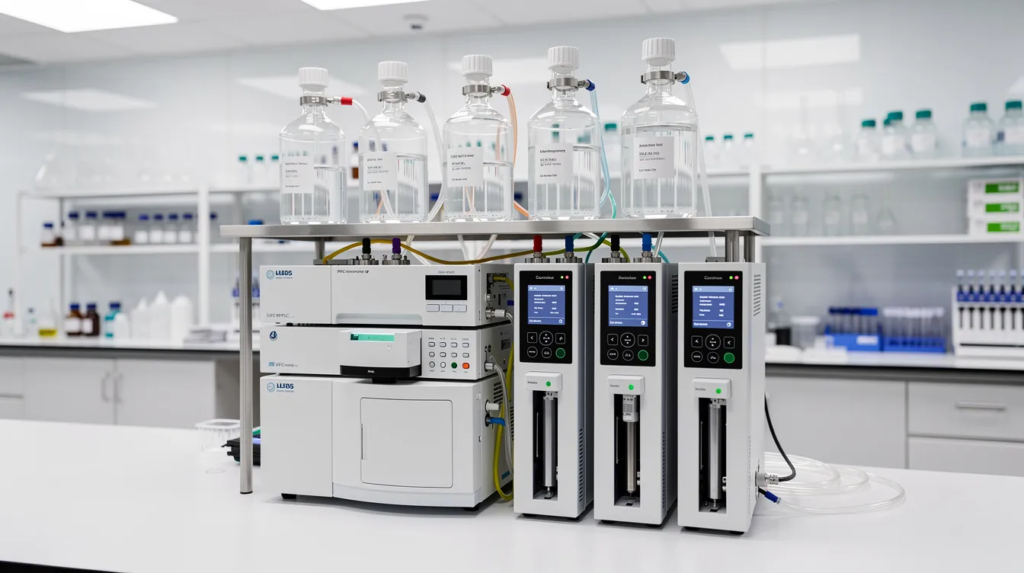
LC-MS or MALDI-TOF confirms that the main peak has the expected molecular mass, ruling out major sequence errors, deletions, or substitutions. A robust COA should include:
- Peptide name and exact amino acid sequence
- Molecular weight (monoisotopic and average)
- Purity percentage by HPLC
- Identity confirmation by MS
- Residual solvent and counter-ion data
- Lot number, date of analysis, and storage conditions
Researchers working with sensitive assays may also need endotoxin values (<0.50 EU/mg is common) and detailed impurity profiling beyond standard certificates.
Handling, Storage, and Stability in Research Settings
Peptides are chemically fragile. Hydrolysis at peptide bonds, oxidation of methionine or cysteine residues, and aggregation can all destroy biological activity. Proper handling protocols directly affect data quality.
Standard laboratory practices include:
- Store lyophilized powder at −20 °C (short-term) or −80 °C (long-term)
- Protect light-sensitive peptides from UV exposure
- Reconstitute only immediately before experiments, in appropriate buffer at controlled pH
- Aliquot reconstituted solutions to minimize freeze–thaw cycles
Buffer composition, pH, and the presence of proteases in biological matrices such as serum all affect peptide stability over time. These variables should be controlled and reported in methods sections. Deviations in reconstitution solvent choice between labs can produce divergent results even when using the same peptide sequence and lot.
Research Peptides, Muscle Growth, and the “Gray Market”
Many websites and forums promote peptides for muscle growth, fat loss, or “anti-aging,” blurring the line between legitimate research chemicals and consumer-facing products. Some sellers position unregulated peptides alongside supplements or other drugs as a cure all for body composition-this framing has no scientific basis.
Research peptides are not the same as peptide supplements sold to support muscle growth. They are not peptide injections marketed in bodybuilding circles or products described as “peptides steroids.” They are not evaluated, regulated, or approved for such uses. Gray market products labeled “for research only” but advertised with health claims may lack reliable quality control, clinical data, or regulatory oversight. The FDA has issued warnings about unapproved compounded peptides marketed for weight loss, citing dose inconsistencies and safety risks.
The risks are concrete:
- Unregulated peptides may contain harmful contaminants
- Injecting unregulated peptides can trigger severe allergic reactions
- Many peptides sold online lack FDA oversight and safety data
- Some peptides may accelerate the growth of undiagnosed cancer cells
- The FDA lists certain peptides as having significant safety concerns
No dosing instructions, cycles, or stacking strategies belong in a scientific context. Athletic performance enhancement through self-administered research chemicals carries unknown safety and legal risks.
Ethical, Regulatory, and Safety Considerations
Peptide research must comply with institutional review, animal welfare regulations, and chemical safety standards. Research peptides used in animal or ex vivo human tissue studies are handled under Institutional Animal Care and Use Committee (IACUC) or Institutional Review Board (IRB) protocols, depending on jurisdiction and study design.
Because most research peptides are not fda approved, they are not authorized for dispensing to patients, self-experimentation, or unsupervised human exposure. Labs should maintain safety data sheets (SDS), follow appropriate PPE and waste-disposal procedures, and treat unknown peptides as potentially bioactive even at low concentrations.
Over 80 peptide drugs are approved globally for prescribed therapeutic uses. Separating exploratory laboratory research from consumer health claims protects both scientific integrity and public safety.
Frequently Asked Questions About Research Peptides
Are research peptides the same as peptide supplements sold online?
No. Research peptides are produced and documented for laboratory experiments, while commercial peptide supplements-including collagen peptides in skin or joint formulas-are formulated as ingestible products for consumers. Research-grade materials carry “for research use only” labels and are not evaluated by regulators for safety or efficacy in humans. Any product marketed for ingestion should fall under dietary supplement or drug regulations. Some vendors blur this distinction, which is one reason scientists examine documentation, testing methods, and regulatory disclosures carefully before purchasing.
Can research peptides be used to build muscle or improve athletic performance?
Research peptides are not intended, tested, or authorized for muscle building, athletic enhancement, or any performance goal in humans. Although some experimental peptides act on hormonal pathways relevant to muscle growth in cell or animal models-including pathways involving growth hormone released by the pituitary gland-translating those findings into real-world outcomes and safe dosing would require extensive clinical trials. Using research-grade materials outside controlled lab environments introduces unknown health and legal risks.
How do researchers choose a trustworthy peptide supplier?
Scientists typically look for transparent publication of COAs, HPLC and LC-MS data, clear lot tracking, and responsive technical support. Consistent batch quality, reasonable lead times, and the ability to provide custom synthesis or modified peptides are additional factors. Peer recommendations, published methods sections citing a supplier’s materials, and institutional purchasing policies often guide selection.
Are any research peptides currently in clinical trials?
Yes. Many peptide candidates move from basic research into formal clinical trials evaluating them under strict protocols for conditions such as metabolic disease, autoimmune disorders, or oncology. Once a peptide enters human trials, it becomes an investigational drug candidate governed by regulatory agencies-no longer a generic “research peptide.” Trial status, endpoints, and outcomes are registered through formal clinical trial registries, not commercial retail sites.
What is the role of Roambit in relation to research peptides?
Roambit is a travel eSIM provider focused on international mobile data connectivity and does not sell or distribute research peptides, peptide supplements, or any pharmaceutical products. Roambit’s interest in this educational content is to provide clear, evidence-based information for readers who may encounter peptide-related claims while browsing online, not to promote any specific peptide use.
Other Articles You May Find of Interest...
- Your COA Says “Pass.” Here’s How to Check the Lab Agrees.
- How to Make a Nutrition Facts Label for Your Food Product: A Step-by-Step Guide
- How to Count Respirations in 15 Seconds
- Are There Lymph Nodes in the Lower Leg?
- Why Blood Plasma Is Yellow
- How to Measure Respiration Rate Accurately
- Where Are the Pores of Sweat Glands Located?





