




Your Health Magazine Contributor
4201 Northview Drive
Suite 102
Bowie, MD 20716
More Health Education Articles
How to Make a Nutrition Facts Label for Your Food Product: A Step-by-Step Guide
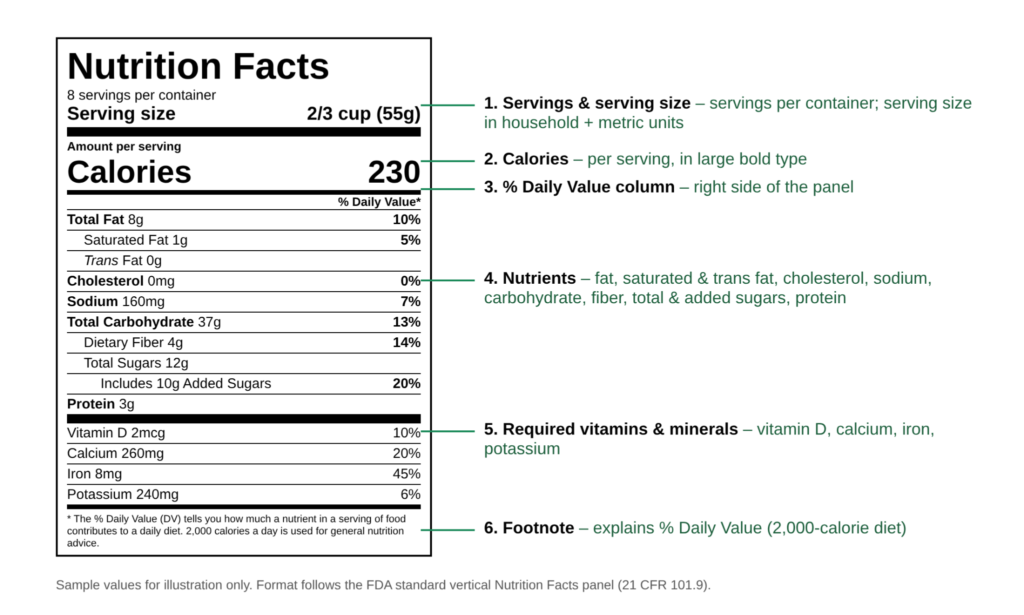
A Nutrition Facts label is often the first thing a careful shopper reads, and for most packaged foods sold in the U.S., it’s a legal requirement. Whether you’re launching a protein snack, bottling a sauce or selling meal-prep bowls, getting the label right protects your customers and your business.
This guide shows you exactly how to make a nutrition facts label, from weighing your recipe to printing a panel that meets FDA requirements.
Quick tip: If you’d rather not do all this math by hand, a nutrition facts label generator can handle it for you. You add your ingredients and serving size, and it works out the nutrients, FDA rounding, and % Daily Values, then lays everything out in the standard panel format.
Key takeaways
- Most packaged foods need a Nutrition Facts label. Small-business exemptions disappear the moment you make a nutrient or health claim.
- Serving size must follow the FDA’s Reference Amounts Customarily Consumed (RACCs), not a portion you choose.
- Calculate nutrients from the finished, cooked weight of your recipe.
- Every value must be rounded using FDA rules, and added sugars must be listed separately.
- The panel’s layout, order and type styles are regulated. Use an approved format.
Do You Need a Nutrition Facts Label?
Most packaged foods sold in the U.S. do. The main exemptions are:
- Low-volume products: businesses with fewer than 100 full-time-equivalent employees selling fewer than 100,000 units of a product per year in the U.S. These businesses must file an annual exemption notice with the FDA.
- Very small businesses: those with annual gross sales of $500,000 or less, or food sales of $50,000 or less.
- Foods made and sold on-site, such as bakery bread sold over the counter, and foods with insignificant nutrition, such as plain coffee, tea or spices.
The exception that catches most small brands: if your packaging or marketing makes a nutrient or health claim, such as “low fat,” “high protein,” “sugar free” or “good source of fiber,” the exemption no longer applies, and you need a full panel.
Home-based cottage food sellers are regulated by their state. Many states don’t require a nutrition panel, but they do require an ingredient list, allergen statement, and other details.
What the Label Must Show
Under 21 CFR 101.9, a standard Nutrition Facts panel lists, in this order:
- Servings per container and serving size
- Calories
- Total fat, saturated fat and trans fat
- Cholesterol
- Sodium
- Total carbohydrate, dietary fiber, total sugars and added sugars
- Protein
- Vitamin D, calcium, iron and potassium
- % Daily Value for each nutrient that has one, plus the standard footnote
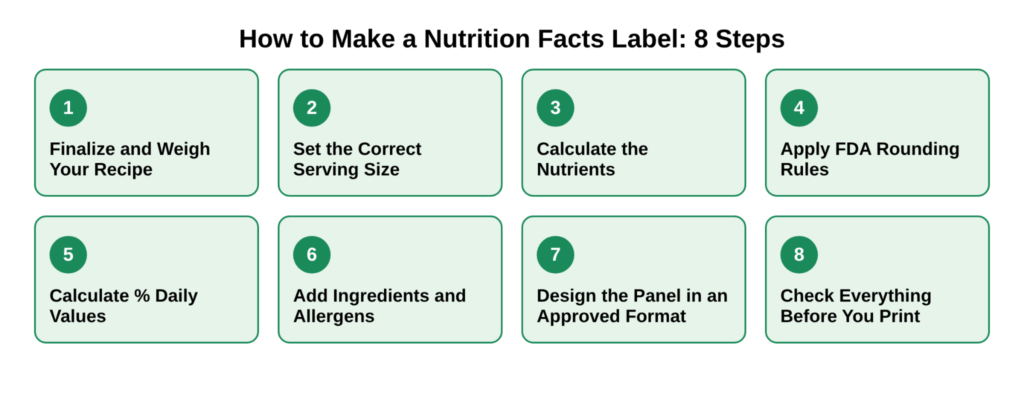
Step 1: Finalize and Weigh Your Recipe
Accuracy starts in the kitchen. Before you calculate anything:
- List every ingredient, including oils, coatings, toppings and glazes.
- Weigh each one in grams. Cups and spoons are too inconsistent.
- Weigh the finished batch after cooking or baking.
That last step matters more than most people expect. Cooking can change the finished weight through moisture loss or gain, so a batch that goes into the oven at 1,000 g might come out at 850 g. Finished weight is important for determining nutrients per serving, but recipe-based calculations should also account for nutrient changes that occur during processing when applicable.
Step 2: Set the Correct Serving Size
The FDA doesn’t let you choose any portion you like. Serving sizes are based on Reference Amounts Customarily Consumed (RACCs), which are standard amounts for each food category listed in 21 CFR 101.12. For example, cookies have a reference amount of 30 g, and most beverages 360 mL (12 fl oz).
- Find your product’s category and its RACC.
- Express it as a household measure plus a metric weight, such as “2 cookies (30g).”
- Divide the net package weight by the serving size to get servings per container.
A package holding less than 200% of the reference amount is generally labeled as one serving. Larger packages that could reasonably be eaten in one sitting may need a dual-column label showing values per serving and per package.
Step 3: Calculate the Nutrients
Option A: Database analysis
This is the method most small brands use. Look up each ingredient in the USDA’s FoodData Central database, or use your supplier’s specification sheets for branded ingredients. Then:
- Multiply each ingredient’s nutrient values by the grams used.
- Total each nutrient for the whole batch.
- Divide by the finished batch weight to get nutrients per gram.
- Multiply by your serving size in grams.
Example: a finished 900 g batch of granola contains 180 g of total sugars. That’s 0.2 g per gram, so a 45 g serving has 9 g of total sugars.
Option B: Laboratory analysis
A food lab tests your actual product. It costs more, but it’s the most accurate option, and it’s worth the expense when cooking or fermentation significantly changes nutrients, or when you plan to make nutrient claims.
Calories and added sugars
If you calculate calories from macronutrients, the general factors are 9 calories per gram of fat and 4 calories per gram of carbohydrate or protein. Some components, including certain fibers, sugar alcohols and alcohol, use different calorie factors under FDA rules, so use the applicable factor for the product.
Track added sugars separately from the start. These include table sugar, honey, syrups, and concentrated fruit juices added during processing. Sugars naturally present in whole fruit or milk count toward total sugars only.
Step 4: Apply FDA Rounding Rules
Raw figures like “137.4 calories” can’t go on a label. Round each value as follows:
- Calories: Under 5 = 0 · 5–50 = nearest 5 · over 50 = nearest 10
- Total, saturated and trans fat: Under 0.5 g = 0 · 0.5–5 g = nearest 0.5 g · over 5 g = nearest 1 g
- Cholesterol: Under 2 mg = 0 · 2–5 mg = “less than 5 mg” · over 5 mg = nearest 5 mg
- Sodium: Under 5 mg = 0 · 5–140 mg = nearest 5 mg · over 140 mg = nearest 10 mg
- Carbohydrate, fiber, sugars, protein: Under 0.5 g = 0 · under 1 g = “less than 1 g” · 1 g or more = nearest 1 g
So 137.4 calories becomes 140, and 3.2 g of fat becomes 3 g.
Step 5: Calculate % Daily Values
% Daily Value shows how much one serving contributes to a 2,000-calorie daily diet:
%DV = (amount per serving ÷ Daily Value) × 100
- Total fat: 78 g
- Added sugars: 50 g
- Saturated fat: 20 g
- Protein: 50 g
- Cholesterol: 300 mg
- Vitamin D: 20 mcg
- Sodium: 2,300 mg
- Calcium: 1,300 mg
- Total carbohydrate: 275 g
- Iron: 18 mg
- Dietary fiber: 28 g
- Potassium: 4,700 mg
Example: 460 mg sodium ÷ 2,300 mg × 100 = 20% DV.
Total sugars and trans fat have no %DV. Protein %DV is optional unless you make a protein claim or the food is intended for children under 4.
Worked Example: A Granola Label
Here’s how the finished numbers might look for one 45 g serving of the granola above. These values are illustrative, not data for a real product.
- Calories: 200
- Total fat: 8 g (10% DV)
- Saturated fat: 1.5 g (8% DV)
- Trans fat: 0 g
- Cholesterol: 0 mg (0% DV)
- Sodium: 85 mg (4% DV)
- Total carbohydrate: 28 g (10% DV)
- Dietary fiber: 3 g (11% DV)
- Total sugars: 9 g
- Includes added sugars: 7 g (14% DV)
- Protein: 5 g
- Calcium: 26 mg (2% DV)
- Iron: 1.6 mg (8% DV)
- Potassium: 180 mg (4% DV)
The calories check out: (8 × 9) + (28 × 4) + (5 × 4) = 204, which rounds to 200.
Step 6: Add Ingredients and Allergens
The Nutrition Facts panel is only one part of a compliant label. You’ll also need:
- An ingredient list in descending order by weight.
- An allergen statement covering the nine major food allergens: milk, eggs, fish, crustacean shellfish, tree nuts, peanuts, wheat, soybeans and sesame, which was added in 2023.
- The product name, net quantity, and the manufacturer’s or distributor’s name and address.
Step 7: Design the Panel in an Approved Format
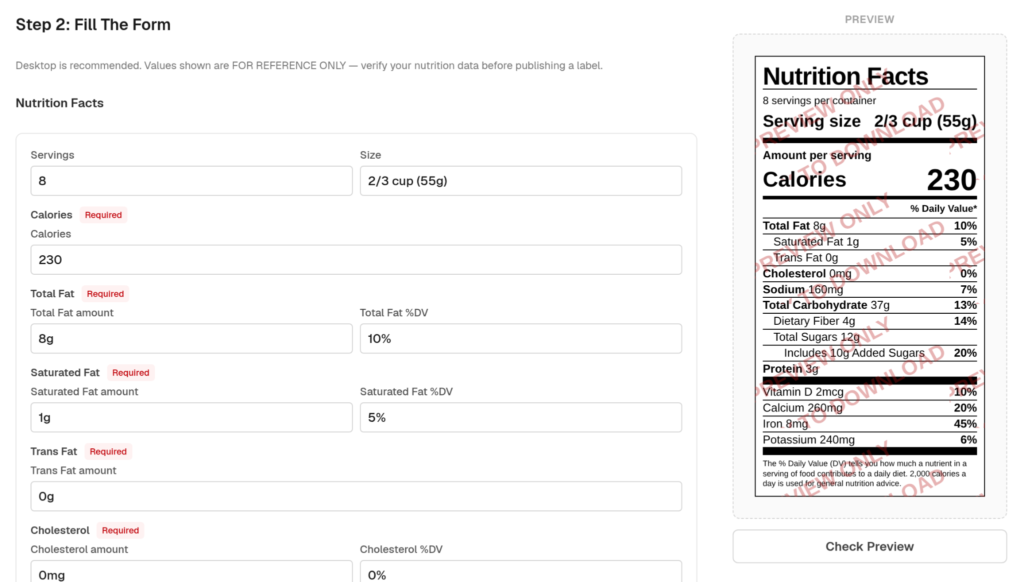
The FDA regulates how the panel looks and what it says. The rules cover a bold “Nutrition Facts” heading, enlarged calorie type, specific heavy and light dividing rules, and a fixed nutrient order. Approved formats include:
- Standard vertical, the most common format
- Tabular, for packages without enough height
- Linear, for very small packages
- Dual-column, for per-serving and per-package values
You can build this by hand in design software, but spacing, line weights, and type sizes are easy to get wrong. Most small brands save time with a nutrition facts label maker. You enter your ingredients and serving size, and it calculates the values, applies FDA rounding and %DV, and produces a correctly formatted panel ready for your packaging.
Step 8: Check Everything Before You Print
- Do the serving size and servings per container match the real package?
- Are added sugars listed separately?
- Is rounding correct, especially for small values?
- Is every allergen declared?
- Does each claim you make (“low sodium,” “high fiber”) meet the FDA definition?
- Is the label legible at its final printed size?
Keep your recipe sheets and calculations on file. Retailers and inspectors may ask how you reached your numbers.
Common Mistakes to Avoid
- Calculating from raw ingredient weights instead of the finished weight
- Choosing a serving size that doesn’t follow the RACC
- Leaving out added sugars, or counting fruit sugar as added
- Forgetting small ingredients like cooking oil, which can shift calories and fat
- Making a health claim while relying on a small-business exemption
- Not updating the label after a recipe, supplier or package change
Frequently Asked Questions
Can I make a nutrition facts label myself?
Yes. Many small food businesses create their own labels using USDA nutrient data and FDA rounding rules, either by hand or with an online label tool.
Is database analysis accurate enough?
For most products it is, as long as your recipe weights and ingredient data are accurate. For heavily processed or cooked products, or when you make nutrient claims, lab testing is the safer choice.
Do home bakers need a nutrition facts label?
Under most state cottage food laws they don’t, unless they make a nutrient or health claim. Ingredient and allergen labeling is still usually required.
How often should I update my label?
Update it whenever you change a recipe, ingredient, supplier or package size.
What’s the difference between total sugars and added sugars?
Total sugars include everything, both naturally occurring and added. Added sugars are only those introduced during processing, and they carry a %DV based on 50 g per day.
The Bottom Line
Making a nutrition facts label comes down to four things: accurate recipe weights, a correct serving size, careful math with FDA rounding, and an approved layout. Get those right, declare your allergens, and check everything before you print, and you’ll have a label that’s compliant and genuinely helpful to the people choosing your food.
Editor’s note: figures follow FDA regulations (21 CFR 101.9, 101.12) and current reference Daily Values. Please verify against the latest FDA guidance before publishing.
Other Articles You May Find of Interest...
- How to Make a Nutrition Facts Label for Your Food Product: A Step-by-Step Guide
- How to Count Respirations in 15 Seconds
- Are There Lymph Nodes in the Lower Leg?
- Why Blood Plasma Is Yellow
- How to Measure Respiration Rate Accurately
- Where Are the Pores of Sweat Glands Located?
- Why Event Medical Planning Matters More Than Most Organizers Expect





