






More Family/Primary Care Articles
Why Is Christina Applegate Trending in 2026? Her MS and Hospitalization Update

Updated August 22, 2026, by the Your Health Magazine Health Information Team.
Christina Applegate is trending in 2026 because of reports that she spent nearly four months in a Los Angeles hospital, news that she has since returned home, and her candid new disclosures about living with multiple sclerosis (MD). The 54-year-old actress is alive, and a source close to her told People in early August that she was “doing very well” after being discharged.
One important detail remains private: Applegate and her representatives have not disclosed why she was hospitalized. Although many headlines connect the hospital stay to her ongoing struggle with multiple sclerosis, no public statement has confirmed that MS was the cause.
Christina Applegate’s 2026 Health Update at a Glance
- Why she is trending: Her memoir, severe MS symptoms and reported months-long hospitalization have generated renewed attention.
- Current condition: She was reportedly discharged and returned home in early August 2026. A source close to her said she was doing well.
- Reason for hospitalization: Not publicly disclosed.
- MS diagnosis: Applegate announced in August 2021 that she had been diagnosed several months earlier.
- Reported symptoms: Tingling, numbness, leg weakness, balance problems, tremor, fatigue, severe pain and substantial mobility limitations.
- Type of MS: She has not publicly identified her specific MS disease course.
- Treatment: Her current medications and complete treatment plan remain private.
- Cancer history: She was treated for breast cancer in 2008. There is no credible public report that the cancer has returned.
Why Is Christina Applegate Trending Right Now?
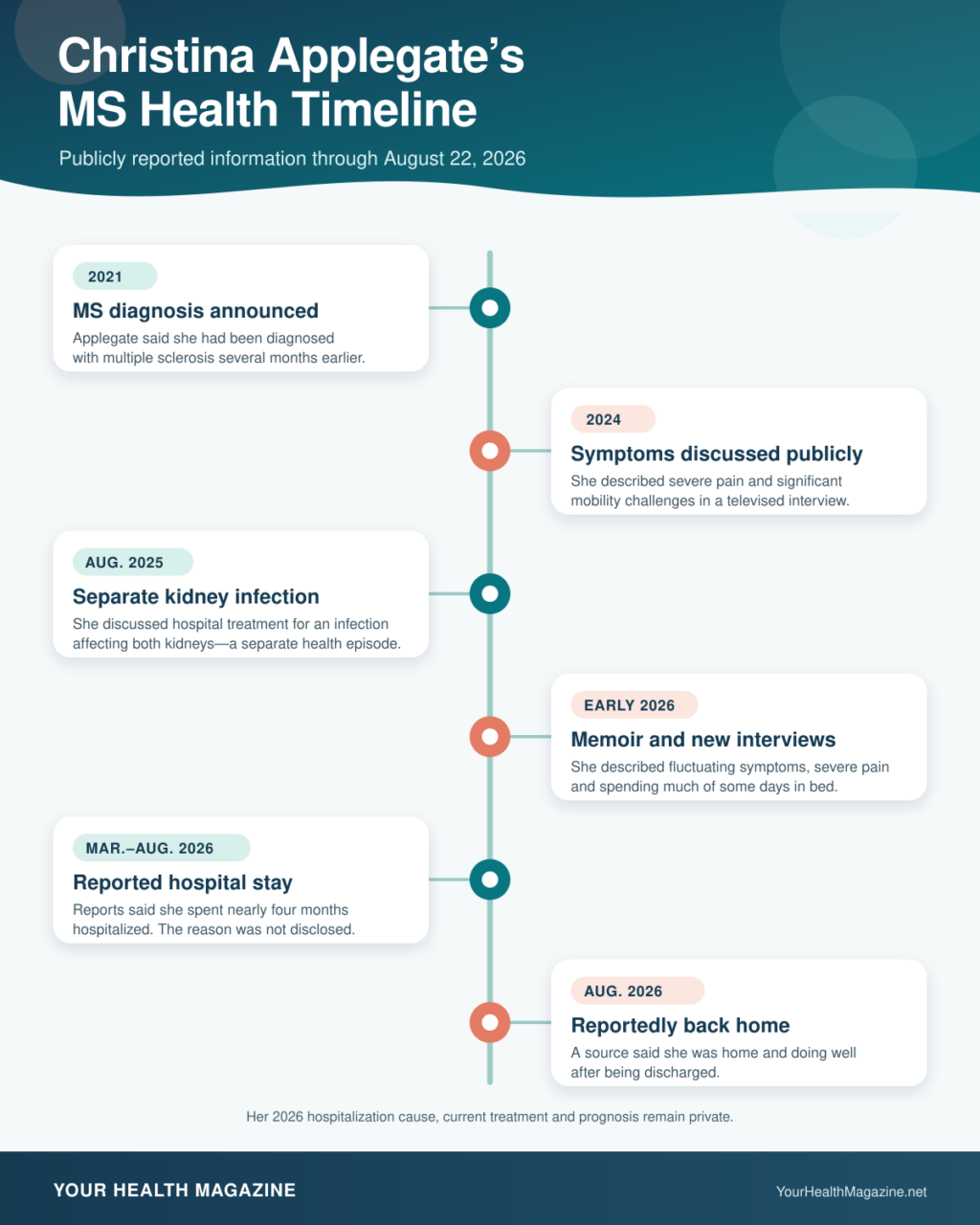
Several events explain why people are searching for Christina Applegate in 2026.
In February and March, Applegate gave interviews surrounding the release of her memoir, You With the Sad Eyes. She described spending much of her day in bed because moving could be extremely painful. She also discussed how MS had changed her mobility, independence, career and relationship with her body.
Reports then emerged in April that Christina Applegate had reportedly been hospitalized in Los Angeles since late March. Her representative declined to confirm her medical treatment or explain the reason for the hospitalization.
Applegate responded to the concern with a short health update on April 20. She thanked people for their support, said health issues were a constant in her life and explained that she was concentrating on getting stronger.
In early August, People reported that Applegate was back home following the lengthy hospital stay. A source close to her said she was doing very well. That discharge report is the latest substantial public update available as of August 22, 2026.
Applegate has also continued raising awareness of MS through interviews, her memoir and the Next in MS campaign. The campaign’s official website discloses that Applegate is a paid spokesperson for TG Therapeutics, a biotechnology company focused on MS. That relationship should be considered when evaluating information presented through the campaign.
Christina Applegate’s Hospitalization: What Has Been Confirmed?
The most reliable public timeline is limited:
- Applegate was reportedly admitted to a Los Angeles hospital in late March 2026.
- Her representative declined to discuss whether she was hospitalized or what medical treatment she was receiving.
- Applegate acknowledged ongoing health problems in an April social-media message but did not identify a diagnosis or treatment.
- Reports in early August said she had been discharged after nearly four months and was back home.
- Sources close to her described her as doing well.
The reason for the hospitalization has not been confirmed. It is therefore inaccurate to state as fact that Applegate spent four months hospitalized because of an MS relapse, MS progression or any particular complication.
People with chronic diseases can also develop infections, medication reactions and unrelated medical problems. A health condition mentioned next to a hospitalization in a headline is not necessarily the reason for admission.
Applegate did publicly discuss a separate hospitalization in August 2025. During that episode, she said she was receiving intravenous antibiotics for a kidney infection affecting both kidneys. No public evidence establishes that her 2026 hospitalization had the same cause.
Christina Applegate Gave a Health Update After the Hospitalization Reports
On April 20, Applegate thanked supporters for their concern and said she was getting stronger and better while taking time to focus on her health. Her Instagram message did not confirm where she was receiving care or describe the underlying medical problem.
Her choice to withhold those details is significant. Applegate has been unusually candid about many aspects of MS, including pain, mobility, bladder and bowel difficulties and depression. If she has not publicly connected this hospitalization to MS, outside reports should not make that diagnosis for her.
How Is Christina Applegate Doing Now?
The latest reports say Christina Applegate is home and doing well following her discharge. She has not personally released a detailed medical update explaining her current symptoms, mobility or treatment.
“Doing well” also should not be interpreted as meaning that her MS has disappeared or that she has fully recovered from every health problem. Multiple sclerosis is a lifelong condition, and Applegate said shortly before the hospitalization reports that her daily life remained significantly affected by pain and limited mobility.
The most accurate answer is that she is reportedly home and improving, while the cause of her hospitalization, her present level of function and her prognosis remain private.
What Disease Does Christina Applegate Have?
Christina Applegate has multiple sclerosis, commonly called MS. It is a chronic immune-mediated disease affecting the brain, spinal cord and optic nerves.
MS damages myelin, the protective material surrounding nerve fibers in the central nervous system. It can also injure the nerve fibers themselves. That damage interferes with messages traveling between the brain and the rest of the body, producing symptoms that differ widely from one person to another.
Applegate has a separate history of breast cancer, but there is no credible public report that she currently has cancer. Her breast cancer and MS are distinct medical conditions.
When Was Christina Applegate Diagnosed With MS?
Applegate publicly announced her MS diagnosis on August 10, 2021. She said at the time that she had been diagnosed several months earlier.
During a 2024 interview with Robin Roberts, Applegate said her symptoms began becoming noticeable in early 2021 with tingling in her toes. By the summer, while filming the final season of Dead to Me, she sometimes needed to be taken to the set in a wheelchair because she could not walk the required distance. Applegate described that progression during the interview.
Looking back, she said she may have experienced warning signs for six or seven years before receiving the diagnosis. She recalled balance problems and a leg that sometimes buckled, but those symptoms were not initially recognized as MS.
Her experience illustrates why the early signs of multiple sclerosis in women can be missed. Numbness, fatigue, weakness and balance problems may be attributed to an injury, stress, aging or another health condition until a clearer pattern develops.
What MS Symptoms Has Christina Applegate Reported?
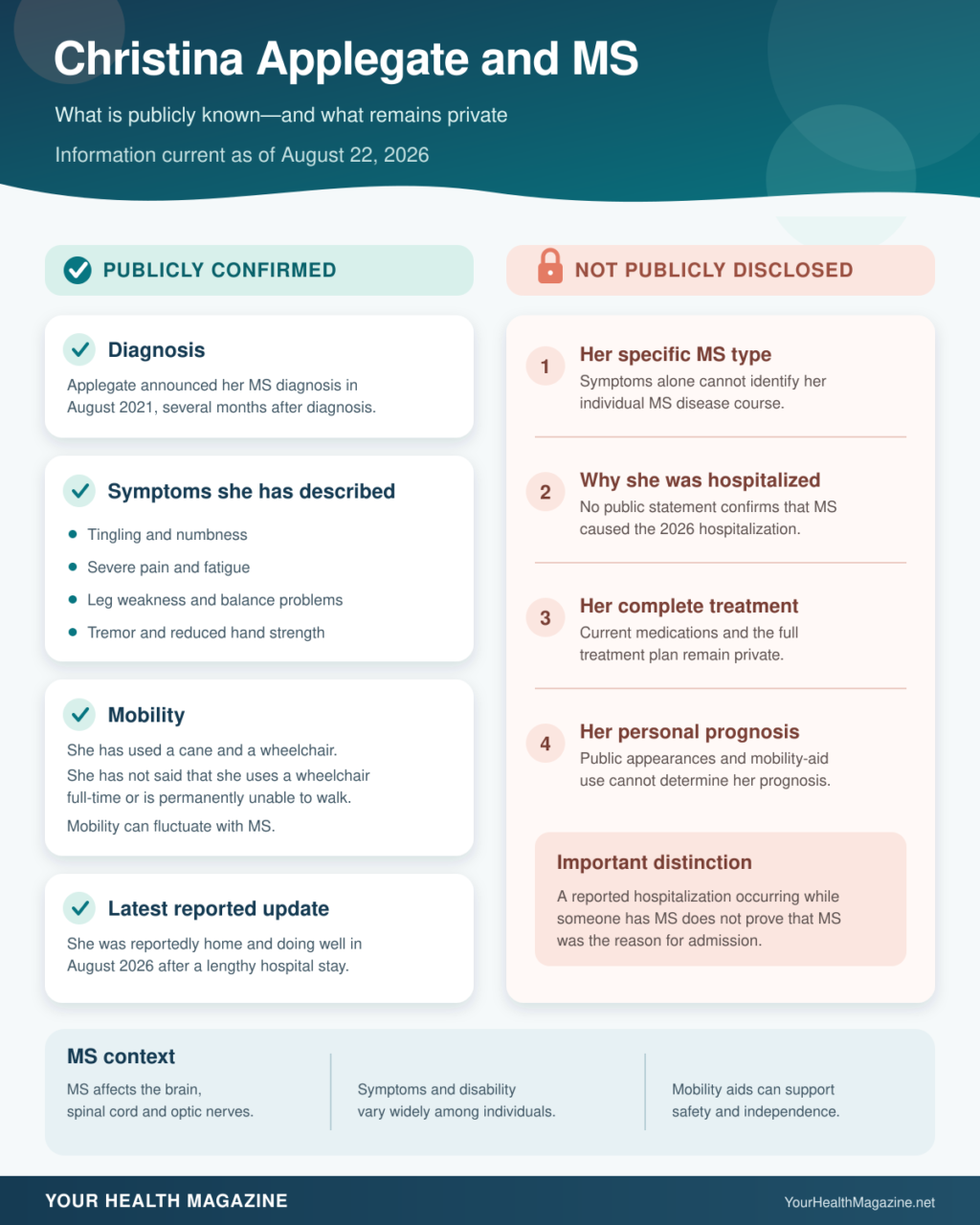
Applegate has described a wide range of symptoms and limitations since her diagnosis, including:
- Tingling and numbness
- Leg weakness
- Difficulty walking and standing
- Balance problems and falls
- Tremor
- Severe nerve and muscle pain
- Burning, aching and squeezing sensations
- Fatigue
- Reduced hand strength and difficulty holding objects
- Bladder and bowel difficulties
- Spending extended periods in bed because movement is painful
In early 2026, Applegate said she spent a large part of many days in or on her bed. She still tried to preserve important routines with her daughter, including driving her to school, but described needing to return to bed afterward. In March, she told Good Morning America that MS brought better days and worse days rather than a simple recovery. The 2026 interview provides Applegate’s own account of her condition.
Applegate has also discussed repeated episodes of vomiting, diarrhea and abdominal pain that led to numerous hospital visits. She publicly wondered whether gastrointestinal motility might be involved while acknowledging that her neurologist did not consider the symptoms clearly attributable to MS.
MS can affect bowel control, but persistent vomiting, diarrhea or abdominal pain is not specific to MS and can have many causes. Applegate’s personal theory about a symptom should not be presented as a confirmed medical conclusion.
Can Christina Applegate Walk?
Christina Applegate has been able to walk at times, but she has also described serious and fluctuating mobility problems. She has appeared publicly using a cane and has used a wheelchair when walking a longer distance was unsafe or impossible.
In 2021, she sometimes needed a wheelchair to reach the Dead to Me set. In later interviews and podcast episodes, she described periods when leg pain and weakness made standing, showering or walking to another room extremely difficult.
That does not establish that she is permanently unable to walk. Mobility with MS can change from day to day and even within the same day. Fatigue, heat, stress, pain, weakness and balance problems may all affect how far someone can safely walk.
Is Christina Applegate in a Wheelchair Now?
Applegate has used a wheelchair, but she has not publicly said that she uses one at all times. She has also used a cane and has described walking or driving on some days.
Wheelchairs and other mobility aids are tools for safety and independence. Many people with MS can walk short distances but use a wheelchair, scooter, walker or cane to prevent falls, conserve energy or manage longer outings. Using a wheelchair should not automatically be equated with total paralysis.
A physical or occupational therapist can evaluate strength, balance, fatigue and fall risk and recommend an appropriate mobility aid. Our guide to low-impact movement and mobility with MS discusses general strategies, although anyone with severe symptoms should receive an individualized plan.
What Type of MS Does Christina Applegate Have?
Christina Applegate has not publicly confirmed her specific type or disease course of multiple sclerosis. Her symptoms, wheelchair use or hospitalizations are not enough to determine it.
MS is generally described through the following clinical courses:
Relapsing-Remitting MS
Relapsing-remitting MS involves attacks of new or worsening neurological symptoms followed by periods of partial or complete recovery. It is the most common disease course at diagnosis.
Secondary-Progressive MS
Some people who initially have relapsing-remitting MS later develop secondary-progressive MS, in which disability gradually worsens, with or without additional relapses.
Primary-Progressive MS
Primary-progressive MS involves gradually worsening neurological function from the beginning, generally without the clearly defined early relapses and remissions associated with relapsing-remitting MS.
Clinically Isolated Syndrome
Clinically isolated syndrome is a first episode of neurological symptoms caused by inflammation or demyelination. It can precede an MS diagnosis, but not everyone who experiences it goes on to meet the criteria for MS.
The National Multiple Sclerosis Society explains the recognized MS disease courses. Only Applegate and her medical team know which description applies to her.
What Is Multiple Sclerosis?
Multiple sclerosis occurs when abnormal immune activity damages myelin and other structures in the central nervous system. Areas of inflammation and scarring can develop in the brain, spinal cord and optic nerves. These damaged areas are often called lesions or plaques.
Myelin helps nerve signals travel quickly and accurately. When it is damaged, those signals may slow, become distorted or fail to reach their destination. The location of the damage determines whether a person experiences vision problems, weakness, pain, numbness, balance difficulties, bladder dysfunction, cognitive changes or other symptoms.
The exact cause of MS remains unknown. Researchers believe it develops through a combination of genetic susceptibility and environmental factors rather than one single inherited gene or exposure.
The National Institute of Neurological Disorders and Stroke explains that MS ranges from relatively mild to severely disabling. Applegate’s severe experience does not predict what will happen to every person diagnosed with the disease.
Common Symptoms of MS
Possible symptoms include:
- Numbness, tingling or altered sensation
- Weakness in one or more limbs
- Blurred vision, double vision or vision loss
- Pain with eye movement from optic neuritis
- Persistent fatigue
- Muscle stiffness or spasms
- Tremor or poor coordination
- Dizziness or vertigo
- Balance and walking difficulties
- Neuropathic pain or burning sensations
- Bladder, bowel or sexual dysfunction
- Changes in memory, concentration or processing speed
- Depression, anxiety or other emotional changes
- Speech or swallowing difficulties
MS primarily affects the central nervous system. It does not have one set of “obvious” symptoms, and the inability to walk or talk is not universal. Some people have relatively mild symptoms, while others develop substantial disability.
No individual symptom proves that someone has MS. Tingling, weakness, dizziness, fatigue and vision changes can all result from other conditions and require a proper evaluation.
What Is an MS Relapse?
An MS relapse is a new neurological symptom—or a clear worsening of an old symptom—that lasts at least 24 hours and is not better explained by an infection, fever or another cause. Relapses are also called attacks, flare-ups or exacerbations.
Heat, exhaustion, stress or an infection can temporarily worsen old symptoms without producing new inflammatory damage. This is often called a pseudo-relapse or pseudo-exacerbation.
The distinction matters because treatment may differ. People with MS should report meaningful changes to their care team instead of assuming every symptom is either an MS relapse or nothing to worry about. Our earlier article explains why MS relapses should be reported.
Sudden facial drooping, one-sided weakness, new trouble speaking, loss of consciousness or an abrupt severe headache can also signal an emergency such as a stroke. These symptoms require immediate emergency care.
How Is Multiple Sclerosis Diagnosed?
There is no single symptom or blood test that confirms MS. A neurologist generally looks for evidence that damage has occurred in different parts of the central nervous system and at different times while ruling out conditions that can imitate MS.
The evaluation may include:
- A detailed symptom and medical history
- A neurological examination assessing strength, sensation, reflexes, vision, balance and coordination
- MRI scans of the brain and spinal cord
- Blood tests to exclude infections, nutritional deficiencies and other inflammatory or neurological disorders
- A lumbar puncture to examine cerebrospinal fluid for immune-system markers associated with MS
- Evoked-potential or eye tests in selected cases
Our guide to how multiple sclerosis is diagnosed explains the major tests in more detail. Mayo Clinic also outlines the role of neurological examinations, MRI and spinal-fluid analysis.
Is There a Cure for MS?
There is currently no cure for multiple sclerosis, but the condition is not limited to treatment of symptoms. More than 20 disease-modifying therapies are available for different forms of MS.
These medications can reduce inflammatory disease activity, lower relapse rates, limit the development of new lesions and, for some patients, slow disability progression. The National Multiple Sclerosis Society recommends early and ongoing treatment with an appropriate disease-modifying therapy.
MS care may include:
Disease-Modifying Treatment
Injectable, oral and infused medications target parts of the immune process involved in MS. The appropriate treatment depends on disease course, activity, previous response, other health conditions, infection risk, pregnancy plans and potential side effects.
Treatment of Significant Relapses
High-dose corticosteroids may shorten some acute relapses. Plasma exchange may be considered for certain severe attacks that do not respond adequately to steroids.
Symptom Treatment and Rehabilitation
Medications and rehabilitation may address pain, stiffness, spasms, fatigue, bladder or bowel problems, mood changes and sleep difficulties. Physical therapy can help with strength, balance and gait. Occupational therapy can make daily tasks safer and less exhausting. Speech therapy may help when communication or swallowing is affected.
Applegate has not publicly released a complete medication list or confirmed her current disease-modifying treatment. Her treatment cannot be inferred from her symptoms, interviews or pharmaceutical-company sponsorship.
Is Christina Applegate Dying From MS?
There is no credible public report that Christina Applegate is dying. She is alive and reportedly home following her hospitalization.
MS is a lifelong disease, but it is not generally classified as a terminal illness. Many people live for decades after diagnosis, and modern treatment has improved long-term outcomes. Severe disability, infections and other complications can affect health, but an individual prognosis cannot be determined from public appearances, wheelchair use or news reports.
Only Applegate and her clinicians have the information needed to discuss her prognosis. Our overview of MS life expectancy and living with multiple sclerosis provides general information that should not be treated as a prediction about her future.
The Emotional Impact of Christina Applegate’s MS
Applegate has rejected the expectation that people with serious illnesses must always appear positive or describe their diagnosis as a blessing. She has spoken honestly about grief, anger, isolation and depression as well as humor, determination and love for her daughter.
That emotional complexity is common in chronic illness. Depression is more prevalent among people with MS and deserves treatment alongside physical symptoms. Counseling, medication when appropriate, peer support and practical assistance can all be part of comprehensive care. Our article on the mental-health toll of chronic illness in women explains why emotional care should not be overlooked.
Anyone experiencing thoughts of suicide or immediate danger should call or text 988 in the United States or seek emergency help.
Does Christina Applegate Still Have Cancer?
There is no credible public report that Christina Applegate’s breast cancer has returned.
She was diagnosed with breast cancer in 2008 at age 36 after an MRI detected cancer in one breast. Applegate tested positive for a harmful BRCA1 gene variant and chose a bilateral mastectomy. She later said the cancer had been removed and had not spread.
Applegate subsequently had her ovaries and fallopian tubes removed to reduce her hereditary ovarian-cancer risk. These were individualized risk-reduction decisions, not universal recommendations for everyone with a BRCA variant.
Harmful BRCA1 and BRCA2 variants can substantially increase the risks of breast, ovarian and several other cancers. The National Cancer Institute recommends professional risk assessment and genetic counseling to help people understand testing and prevention choices. Our guide to hereditary cancer and BRCA-related risk provides additional background.
Her cancer history and MS diagnosis are separate medical issues. There is no basis for claiming that one caused the other.
What Christina Applegate’s Story Can—and Cannot—Tell Us
Applegate’s openness has helped people understand that MS can involve severe pain, fluctuating disability, fatigue, bladder and bowel problems and a substantial emotional burden. Her use of a cane or wheelchair also illustrates how mobility aids can preserve safety and independence.
Her experience cannot predict another person’s MS course. It also cannot establish the cause of every symptom or hospitalization she experiences.
As of August 22, 2026, the most accurate public account is that Christina Applegate is living with MS, has described significant pain and mobility limitations, and is reportedly home after a nearly four-month hospital stay. The reason for that hospitalization, her current treatment and her personal prognosis remain private.
Frequently Asked Questions
Why is Christina Applegate trending in 2026?
She is trending because of new interviews about her severe MS symptoms, the release of her memoir, reports that she spent nearly four months hospitalized and the August update that she had returned home.
Is Christina Applegate still alive?
Yes. Christina Applegate is alive. Reports in early August 2026 said she was home and doing well after being discharged from the hospital.
Why was Christina Applegate hospitalized?
The reason for her 2026 hospitalization has not been publicly disclosed. Neither Applegate nor her representative confirmed that MS caused the hospitalization.
How long was Christina Applegate in the hospital?
Reports said she was hospitalized from late March until shortly before August 3, 2026—nearly four months. Applegate’s representative did not confirm the timeline or provide treatment details.
How is Christina Applegate doing now?
The latest reports say she has returned home and is doing well. She has not personally released a detailed update about her current symptoms or level of mobility.
What disease does Christina Applegate have?
She has multiple sclerosis, a chronic immune-mediated disease affecting the central nervous system. She also has a history of breast cancer treated in 2008.
When was Christina Applegate diagnosed with MS?
She announced the diagnosis in August 2021 and said it had been made several months earlier. She believes less obvious symptoms may have started years before the diagnosis.
What type of MS does Christina Applegate have?
She has not publicly identified her specific MS disease course. Her symptoms alone cannot determine whether she has relapsing-remitting, secondary-progressive or primary-progressive MS.
Can Christina Applegate walk?
She has walked at times but has substantial mobility limitations. She has used a cane and a wheelchair and has described periods when standing or walking was extremely difficult.
Is Christina Applegate permanently in a wheelchair?
She has not said that she uses a wheelchair full-time. People with MS may use different mobility aids depending on distance, fatigue, balance and the severity of symptoms on a particular day.
Does Christina Applegate have cancer now?
There is no credible public report that her breast cancer has returned. She was treated in 2008 and later underwent additional risk-reducing surgery because she carries a BRCA1 variant.
Can multiple sclerosis be cured?
There is no cure at present, but disease-modifying therapies can reduce relapses and new inflammatory damage and may slow disability progression. Rehabilitation and symptom-specific care can also improve function and quality of life.
Other Articles You May Find of Interest...
- Fever With Chills: Why the Body Shivers as Temperature Rises
- Why One-Roof Medical and Dental Care Is Catching On
- Why Does My Left Side Hurt When I Cough?
- General Practitioner: Everything You Need To Know About Them
- When the Emergency Room Isn’t Enough
- The Secret To Good Health
- Why Personalized Preventive Healthcare Is Replacing One-Size-Fits-All Medicine





