Your Health Magazine Contributor
4201 Northview Drive
Suite 102
Bowie, MD 20716
More Dental Health Articles
Surgical Guide for Dental Implants: A Clinician’s Practical Guide to Accuracy, Types, and How to Order
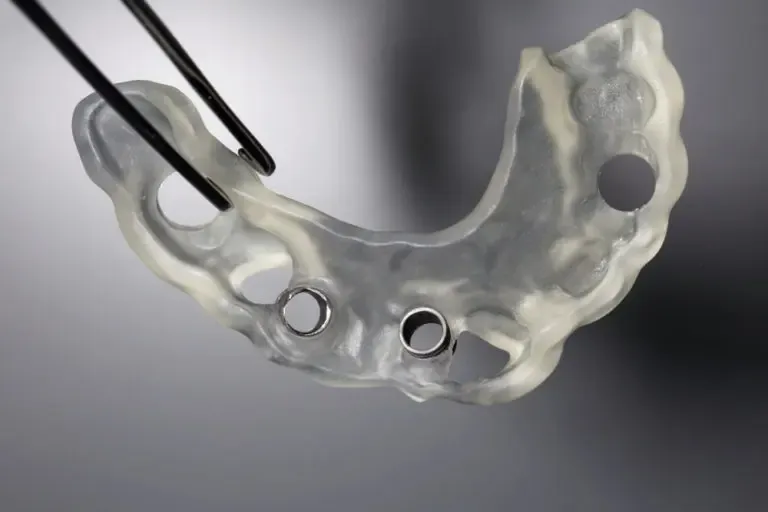
Implant placement has become more predictable in the last decade, and guided techniques can improve placement accuracy compared with freehand surgery in selected cases. The shift to guided surgery has changed that calculus. Yet clinicians report that choosing the right surgical guide for dental implants can be confusing, particularly when navigating guide types, fabrication workflows, CDT codes, and turnaround timelines.
This article breaks it down systematically, drawing on the workflow Guided Excellence uses to fabricate and deliver surgical guides for dental implant cases across more than 100 implant systems.
What Is a Surgical Guide for Dental Implants?
A surgical guide for dental implants is a patient-specific, CAD/CAM-fabricated positioning device that constrains a drill to a predetermined angle, depth, and trajectory during implant surgery. The guide translates a digital treatment plan (typically designed in software such as 3Shape Implant Studio, Dentsply Sirona’s Simplant, or Blue Sky Plan) into a physical template that seats over the patient’s dentition, mucosa, or bone.
Three surfaces define the main categories:
- Tooth-supported guides rest on existing dentition and are the most stable option for partially edentulous cases.
- Tissue-supported (mucosal) guides are used where no teeth remain; they seat on the ridge and are commonly prescribed for All-on-X and edentulous arches.
- Bone-supported guides require a full-flap exposure and pin fixation directly to bone. They are the standard in cases with poor ridge anatomy or extensive reconstruction.
Each type uses a metal sleeve insert calibrated to the chosen implant system’s drill protocol. Most modern guides are fabricated in surgical-grade 3D-printed resins (biocompatible per ISO 10993), though milled PMMA versions remain available for higher-load cases.
Why Accuracy Matters: The Evidence
Systematic reviews have found that fully guided implant surgery generally provides greater positional accuracy than freehand placement, particularly for angular and apical deviation. However, accuracy varies by guide design, support type, surgical workflow, and case complexity.
For full-arch cases, these numbers are clinically meaningful. A degree of angular error at the implant head translates to millimeters of platform mismatch at the restoration level, which ripples into screw-access issues, cantilever loading problems, and compromised occlusal outcomes.
Clinicians working with stackable guide systems, like those fabricated by Guided Excellence, can move through the osteotomy sequence and final placement in a single seating without removing the guide, which also reduces chair time and patient discomfort.
CDT Codes for Surgical Guides
Billing for computer-designed implant guides is straightforward once you identify the correct CDT code:
- D6190 is used for a radiographic/surgical implant index, by report. Additional implant-related planning or guide procedures should be coded according to the current CDT definitions and the services actually performed. Because CDT codes and payer requirements can change, practices should verify the current ADA code set and individual plan requirements before submitting a claim.
Insurers may request documentation of the 3D planning workflow and a copy of the design file. A well-documented order from a reputable lab typically includes a PDF of the planning report, which satisfies most payer requests.
How a Dental Implant Surgical Guide Is Made
Understanding the lab workflow helps you communicate with your lab and catch problems before the patient appointment.
- CBCT + intraoral scan: Both are required. The CBCT provides the bone volume data; the scan gives the digital impression for guide seating.
- DICOM + STL fusion: The lab (or your planning software) registers the two datasets to align the bone and soft-tissue models.
- Implant planning: Virtual implants are placed to the planned position, angle, and depth, respecting the prosthetically driven design.
- Sleeve specification: The lab confirms drill-kit compatibility (guide sleeves are system-specific; confirm your kit number at the time of order).
- 3D printing and verification: The guide is printed, post-cured, and verified against a printed model. A reputable lab includes a try-in on the model before shipping.
- Delivery: Most labs that specialize in surgical guides can turn a complete case in 3 to 5 business days after receiving scans.
When evaluating a lab for your surgical guides for dental implants, confirm that the fabrication facility is FDA-registered, that materials are biocompatible-tested, and that the lab documents the implant-system compatibility of every sleeve batch.
What to Look for When Choosing a Lab
The guide is only as good as the planning behind it and the quality control around it. Clinicians ordering surgical guides for dental implant placement regularly report that the most important variables are:
Implant system coverage. A lab that stocks sleeves for 20 systems is meaningfully different from one that covers more than 100. The broader the coverage, the less chance of a special-order delay.
Turnaround and rush options. For surgery booked within the week, confirm the lab’s standard and expedited timelines upfront.
Planning support. Some labs offer complimentary planning review; a second set of trained eyes on the CBCT fusion catches errors before they reach the chair.
Pricing transparency. Expect cost per guide to vary with guide type (bone-supported cases are more labor-intensive than tooth-supported) and the number of implants planned. Published pricing tiers signal a lab that is confident in its workflow.
Guided Excellence, a California-based dental surgical guide lab, publishes its pricing openly and supports more than 100 implant systems. Their clinical team reviews every scan prior to fabrication, and cases are delivered within a standard 3 to 5 business day window. For clinicians evaluating options, their surgical guide for dental implants page includes a guide-type selector and a detailed FAQ covering CDT codes, turnaround, implant-system compatibility, and cost.
Frequently Asked Questions
Can I use a surgical guide with any implant system?
No. Sleeves are machined to specific outer diameters that match the drill kits of particular implant systems. Always confirm system compatibility with your lab before placing the order. A good lab will ask for your kit number as part of the intake process.
What scans do I need to send?
A CBCT (DICOM files) and a full-arch intraoral scan (STL or OBJ format). Some labs also accept a physical impression if a digital scanner is not available, though digital submissions are faster.
How do I seat a surgical guide at the appointment?
Tooth-supported guides seat like a custom tray; the patient bites into position. Tissue-supported guides require careful orientation landmarks. Bone-supported guides use fixation pins placed through pilot holes in the guide after flap reflection. Your lab should provide a printed seating diagram with every order.
Is computer-guided surgery appropriate for all implant cases?
Guided surgery is most valuable in cases with limited bone, proximity to anatomic structures, immediate loading protocols, and full-arch rehabilitation. For straightforward single-tooth restorations in abundant bone, some clinicians still prefer freehand. The decision should be driven by risk assessment, not habit.
Summary
A surgical guide for dental implants is no longer a niche tool. Research consistently shows that fully guided protocols reduce positional errors and improve prosthetic outcomes. With modern turnaround times at 3 to 5 business days and pricing tiers that reflect case complexity, the barrier to adding guided surgery to a practice workflow is lower than it has ever been. Selecting the right guide type and a lab with broad implant-system coverage are the two variables that matter most at the planning stage.
Other Articles You May Find of Interest...
- Surgical Guide for Dental Implants: A Clinician’s Practical Guide to Accuracy, Types, and How to Order
- What to Expect at Your Child’s First Dental Visit
- How Teeth Whitening Certification Helps Therapists Avoid 5 Common Procedural Mistakes
- 6 Joliet Dentists to Consider for Your Oral Health Needs
- How to Choose a Dentist in Woodbridge, VA After Moving
- Ten Benefits Of Ceramic Dental Implants
- Dentistry in Houston: Finding the Right Care in a City Full of Choices