Your Health Magazine Contributor
4201 Northview Drive
Suite 102
Bowie, MD 20716
More Dental Health Articles
How Implant Tooth Replacement Restores Your Smile and Confidence

Tooth loss does more than change the way you look. It quietly reshapes the mechanics of your mouth — shifting neighboring teeth, accelerating bone resorption in the jaw, and affecting how you speak and chew — often long before most people realize what’s happening. According to the American College of Prosthodontists, more than 36 million Americans are missing all of their teeth, and an estimated 120 million people are missing at least one. Those numbers reflect an enormous functional burden, not just a cosmetic one.
What’s changed in recent years is both the science behind replacing those teeth and the sophistication of how clinicians plan and execute the work. Digital imaging, guided surgery, and refined implant materials have moved the procedure from a relatively blunt intervention to one of the most predictable in modern dentistry. For patients, that means more clarity about what to expect — and better outcomes when everything is done well. This article walks through who stands to benefit most, how the clinical process actually works, what choices exist at each stage, and what the evidence says about long-term success.
Why implant tooth replacement matters now
The case for implants isn’t primarily aesthetic — though that matters too. The deeper argument is biological. When a tooth root disappears, the jawbone beneath it begins to resorb. Without the stimulation a root provides, the body treats that bone as expendable. That process begins within the first year of tooth loss and compounds over time, affecting facial structure, bite stability, and the viability of future treatment.
Implants address this at the source. The titanium post functions as a synthetic root, transmitting force into the jaw during chewing and preserving the surrounding bone in a way that neither dentures nor bridges can replicate. That’s not a marketing claim — it reflects the mechanical reality of how bone remodeling works in response to load.
Patient-reported outcomes reinforce this picture. A systematic review published in the *International Journal of Oral & Maxillofacial Implants* in 2023 found that implant recipients consistently reported higher satisfaction scores for chewing function, phonetics, and comfort compared to patients with conventional removable prosthetics. Quality of life improvements were most pronounced in patients who had previously worn dentures.
Who benefits most? The ideal candidate has adequate bone volume at the implant site, healthy gum tissue, and no uncontrolled systemic conditions. A person in their mid-40s who lost a molar years ago and has been managing with a gap — or a removable partial that doesn’t feel stable — represents a typical case. Younger patients whose jaw growth is complete are generally candidates; older adults can be excellent candidates as well, provided bone density supports placement.
That said, certain contraindications genuinely matter. Uncontrolled diabetes, active smoking, bisphosphonate therapy, and insufficient bone volume all affect candidacy or require additional intervention before proceeding. These aren’t dealbreakers in every case, but they shift the clinical conversation meaningfully — which is exactly why early evaluation matters. The longer tooth loss goes unaddressed, the more the anatomy changes and the more complex any eventual solution becomes.
How implant placement works
Implant treatment isn’t a single procedure — it’s a staged clinical workflow that spans weeks to months, depending on the protocol. Understanding the sequence helps patients recognize why each appointment contributes to the overall outcome, and why shortcuts in planning often show up as complications later.
CBCT and guided surgery benefits
Before any surgical work begins, the standard of care now involves cone beam computed tomography (CBCT) — a three-dimensional imaging technique that gives the clinician a detailed view of bone density, height, and width at the proposed implant site, as well as the precise location of anatomical structures like the inferior alveolar nerve and the floor of the sinus.
This matters more than it might seem. A two-dimensional X-ray can suggest adequate bone exists; a CBCT scan reveals whether the bone is genuinely suitable for the planned implant diameter and length, and flags any need for grafting before surgery. Digital planning software then allows the clinician to virtually place the implant and design a surgical guide — a physical or printed device that controls the exact angle, position, and depth of the drill during the procedure.
Guided surgery reduces variability considerably. It’s particularly valuable in areas of limited bone, near critical anatomy, or when multiple implants are being placed simultaneously. In straightforward cases with experienced clinicians, freehand placement remains reasonable — but for patients with any anatomical complexity, the added precision of a guided approach directly reduces the risk of nerve proximity, fenestration, and mispositioning.
Immediate versus delayed placement and loading
Timing decisions in implant dentistry involve two separate variables: when the implant is placed after tooth extraction, and when the crown or prosthetic is attached. These choices are often conflated, but they follow different biological logic.
Immediate placement — inserting the implant into a fresh extraction socket — can reduce overall treatment time and help preserve soft tissue contours, but it requires specific anatomical conditions: intact socket walls, absence of infection, and sufficient bone beyond the socket apex for primary stability. When those criteria are met, outcomes are comparable to delayed placement.
Immediate loading — attaching a provisional restoration the same day as surgery — is now well-supported in the literature for single implants in the anterior zone and for full-arch cases, provided torque and stability thresholds are met. Osseointegration, the biological process by which bone grows into and bonds with the implant surface, still takes three to six months regardless of when a provisional is placed; the provisional is designed to minimize mechanical stress during that window.
Delayed protocols — placing the implant weeks after extraction, and waiting for osseointegration before loading — remain the conservative default when primary stability is uncertain or infection was present at the extraction site.
Types of implant tooth replacement
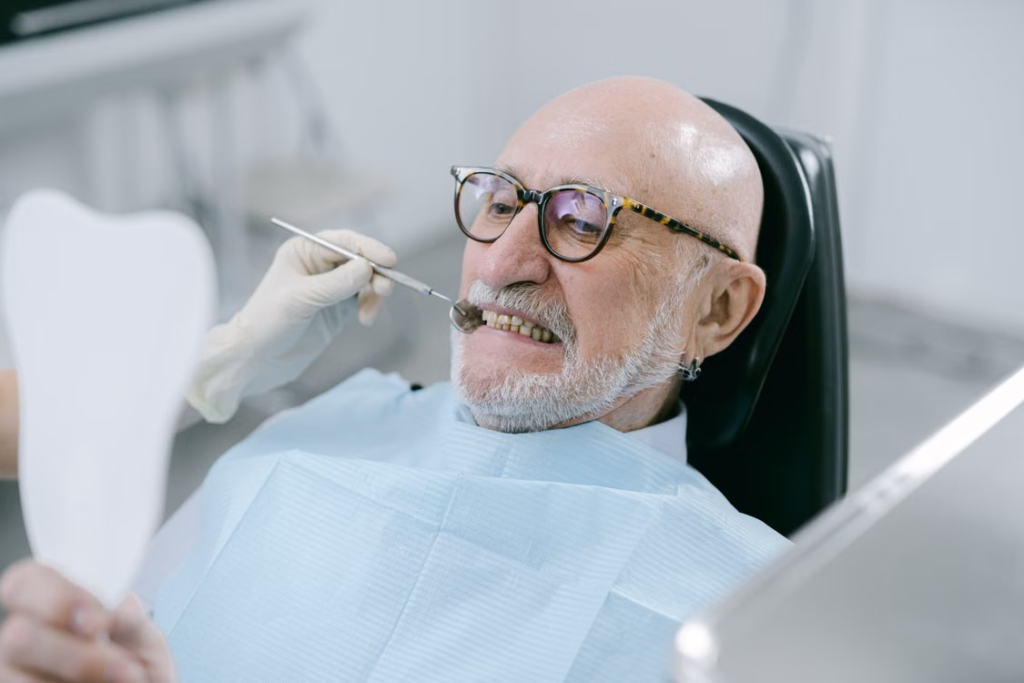
Implant-supported restorations aren’t a single product. They span a spectrum from replacing one missing tooth to reconstructing an entire arch — and the right solution depends on how many teeth are missing, the condition of the remaining bone and tissue, and what the patient needs functionally.
Single implants, bridges, and full-arch options
A single-tooth implant — one post topped with a custom crown — is the most straightforward application. It functions and looks like a natural tooth, doesn’t involve adjacent teeth, and preserves the surrounding bone independently. When someone loses a premolar and has healthy neighboring teeth they’d prefer not to modify, a single implant avoids the grinding-down required for a conventional bridge.
Implant-supported bridges make sense when two or more adjacent teeth are missing. Rather than placing an implant for every missing tooth, two implants can anchor a multi-unit bridge across the gap. This approach is more efficient than individual implants in some anatomical situations while still providing fixed, non-removable restoration.
For patients missing all or most of their teeth, full-arch fixed solutions — sometimes called All-on-4 or All-on-6, based on the number of implants supporting a full-arch prosthetic — offer an alternative to conventional dentures. The prosthetic is screw-retained and non-removable by the patient, which resolves the stability and dietary restriction problems most denture wearers encounter. Removable implant-retained overdentures represent a middle-ground option, offering better stability than conventional dentures while remaining cleansable without a clinical visit.
Implant materials and surface treatments
The vast majority of dental implants are made from commercially pure titanium or titanium alloy (Ti-6Al-4V), both of which have decades of clinical evidence supporting their biocompatibility. Titanium’s ability to integrate directly with bone — without a fibrous tissue layer between them — is what makes osseointegration possible, and the material’s mechanical properties have proven appropriate for the functional loads the jaw generates.
Zirconia implants have attracted growing interest, primarily for patients with metal sensitivities or aesthetic concerns in thin-tissue situations where the gray of a titanium body might show through the gumline. Evidence on long-term zirconia outcomes is still accumulating compared to titanium’s multi-decade track record, and zirconia’s one-piece design has historically limited prosthetic flexibility — though newer two-piece zirconia designs are addressing that constraint.
Beyond material, surface treatment significantly influences how quickly and reliably osseointegration occurs. Roughened surfaces — created through sandblasting, acid etching, or both (SLA and SLA-active surfaces are common examples) — increase the contact area between bone and implant and promote earlier integration. Some implants incorporate hydrophilic surface modifications that enhance early blood clot stability at the site. These differences are clinically meaningful, particularly in lower-density bone and in immediate-loading protocols where early stability is essential.
Risks, recovery, and long-term care
For patients exploring dental implant treatment in Ambler or anywhere else, a candid look at risks and realistic recovery expectations is essential before committing to treatment — and it’s where some practices fall short of transparency.
Early complications include infection, bleeding, and damage to adjacent structures, though these are uncommon when planning is thorough. Implant failure — the inability to achieve or maintain osseointegration — occurs in roughly 5–10% of cases according to a 2022 meta-analysis published in *Clinical Oral Implants Research*, with higher rates in the posterior maxilla and in patients with compromised healing capacity.
Peri-implantitis — the inflammatory condition affecting the soft tissue and bone around an integrated implant — represents the most significant long-term threat. It parallels periodontitis around natural teeth in its mechanism but tends to progress more rapidly once established. Risk factors include a history of periodontitis, smoking, poorly controlled diabetes, and inadequate oral hygiene. Managing these factors before and after placement isn’t optional; it’s a direct predictor of implant longevity.
Recovery from uncomplicated single-implant surgery typically involves several days of mild swelling and soreness, managed with over-the-counter analgesics. Patients generally return to normal activity within a day or two. Dietary restrictions — soft foods, avoiding pressure on the surgical site — apply during the first week and during osseointegration. Full-arch procedures carry a longer and more demanding recovery, with a soft-tissue diet maintained for several weeks.
Long-term maintenance mirrors what’s required for natural teeth: twice-daily brushing, daily flossing or interdental cleaning, and professional maintenance visits. The difference is that peri-implant tissue responds differently to bacterial challenge than the periodontal ligament around natural teeth does, which is why hygienists with implant-specific training use instruments and protocols designed for that tissue.
Well-placed, well-maintained implants have demonstrated survival rates exceeding 95% at 10 years across multiple long-term studies. The question worth asking any implant provider isn’t just about placement technique — it’s about what the post-restoration maintenance protocol looks like and how the practice handles complications if they arise.
Other Articles You May Find of Interest...
- How TMJ Problems Can Cause Neck Pain and Tension
- Crowns and Bridges: A Complete Guide to Restoring Your Smile
- Dental Crown or Filling: How Do You Know Which One You Need?
- What to Ask Before Choosing Dental Implants Abroad: A Guide for UK Patients
- Can a Tooth Nerve Die? What Happens Inside the Tooth
- Noticing Sensitivity in Teeth? Investigate These 3 Potential Causes
- Why Parents Put Off Their Own Dental Care, and What Some Practices Are Changing