






Your Health Magazine
4201 Northview Drive
Suite #102
Bowie, MD 20716
301-805-6805
More Complementary & Integrative Healthcare Articles
Tai Chi for Beginners: A Low-Impact Daily Routine for Balance and Stress Relief
Discover how a few minutes of mindful movement each day can transform your posture, calm your nervous system, and help you move with more confidence — at any age.
If you’ve ever watched someone practice tai chi in a park — those slow, graceful movements flowing from one pose to the next — you may have wondered: “Could I do that?” The answer is almost certainly yes. Tai chi for beginners is one of the most accessible forms of movement available, requiring no special equipment, no gym membership, and no prior fitness experience.
Originally developed in ancient China as a martial art, tai chi has evolved into a widely practiced mind-body discipline celebrated for its therapeutic benefits. Today, millions of people worldwide — from young professionals managing workplace stress to older adults seeking better balance — have made tai chi a cornerstone of their daily wellness routine.
This article walks you through what tai chi is, why it works, and how to build a simple, sustainable daily practice — even if you’ve never done it before.
What Is Tai Chi — and Why Is It So Effective?
Tai chi (also written as Taiji or T’ai chi ch’uan) is a form of moving meditation. Practitioners guide their body through a series of slow, deliberate postures and weight shifts, coordinating breath with movement. Unlike high-intensity workouts, tai chi never forces the body — instead, it works with your body’s natural capacity.
Research published in journals including the British Journal of Sports Medicine and JAMA Internal Medicine has linked regular tai chi practice to:
• Significant reductions in fall risk among older adults
• Measurable improvements in balance, coordination, and proprioception
• Lower levels of cortisol (the body’s primary stress hormone)
• Better sleep quality and reduced anxiety symptoms
• Improved cardiovascular function and lower blood pressure
• Relief from chronic pain conditions such as arthritis and lower back pain
What makes these results particularly remarkable is that they are achieved through low-impact, joint-friendly movement — making tai chi suitable for people who cannot engage in conventional exercise due to injury, chronic illness, or age-related limitations.
Tai Chi for Seniors: A Practice Designed for Longevity
The phrase “tai chi for seniors” has become almost synonymous with fall prevention — and for good reason. The Centers for Disease Control and Prevention (CDC) recognises tai chi as one of the most evidence-based interventions for reducing fall risk in older adults. Falls are the leading cause of injury-related death among people over 65; anything that reliably improves stability is of enormous clinical importance.
But tai chi for seniors offers benefits that go well beyond preventing falls. Older practitioners frequently report:
• Greater confidence when walking on uneven surfaces or navigating stairs
• Reduced joint stiffness, particularly in the hips and knees
• Improved breathing capacity and lung function
• Enhanced cognitive sharpness — several studies suggest tai chi may help protect working memory
• A stronger sense of social connection when practised in a group setting
Many physical therapists and geriatricians now routinely recommend tai chi as a complementary therapy for patients recovering from hip replacement, managing osteoporosis, or living with Parkinson’s disease. Its emphasis on slow, controlled movement and mindful weight transfer directly trains the neurological pathways responsible for balance.
Importantly, there is no upper age limit for beginning tai chi. Stories abound of practitioners starting in their 70s and 80s and achieving genuine fluency within months.
Tai Chi for Balance: Understanding the Mechanics
Balance is not a single skill — it is the product of multiple systems working in coordination: the vestibular system in your inner ear, proprioceptors in your muscles and joints, visual input from your eyes, and the central nervous system processing all of this in real time. When any of these systems degrades — as naturally happens with ageing, sedentary behaviour, or injury — balance suffers.
Tai chi for balance works by training all of these systems simultaneously. Each posture requires practitioners to:
• Shift weight from one leg to another in controlled, deliberate patterns
• Maintain a low centre of gravity through bent-knee stances
• Coordinate arm and leg movements across the body’s midline (cross-lateral movement)
• Stay focused and present — which trains the attentional component of balance
• Breathe deeply, which stabilises the core and calms the nervous system
Over time, this kind of practice literally rewires the brain. Neuroplasticity research suggests that repeated, mindful movement creates new neural pathways — effectively building a more resilient and responsive balance system at any age.
A Simple Daily Tai Chi Routine for Beginners (15 Minutes)
You don’t need to master hundreds of forms to benefit from tai chi. The following beginner-friendly routine focuses on foundational movements that build balance, reduce tension, and establish the mind-body connection central to tai chi practice. Aim to practise this sequence once daily — morning tends to work best, but any consistent time will do.
1. Wu Ji Standing (2 minutes)
Stand with feet shoulder-width apart, knees slightly bent, arms relaxed at your sides. Let your gaze soften — slightly downward, unfocused. Breathe naturally through your nose. This posture cultivates stillness and brings awareness into the body. Many beginners are surprised to find this more challenging than it looks.
2. Opening the Chest (2 minutes)
Inhale as you raise both arms out in front of you to shoulder height, palms facing down. Exhale as you lower them back down, feeling as though you are pressing gently through water. Repeat slowly, synchronising movement with breath. This move releases tension in the shoulders and upper back while training breath awareness.
3. Wave Hands Like Clouds (3 minutes)
Shift your weight gently to the left foot as your left hand rises to eye level, palm facing you. As your weight slowly transfers to the right, your right hand rises while your left descends — like two clouds trading places. This lateral weight-shifting is core tai chi for balance training and directly challenges the body’s equilibrium systems in a safe, supported way.
4. Brush Knee and Twist Step (3 minutes)
Step forward with your left foot, simultaneously pushing your right palm forward at shoulder height while your left hand brushes down past your left knee. Shift weight forward, then repeat on the other side. This is one of the most recognised tai chi for beginners movements — it builds leg strength, hip flexibility, and coordination in one flowing gesture.
5. Repulse Monkey (2 minutes)
Step backward, moving in reverse: right foot steps back while the right hand pulls back at waist height and the left hand pushes forward. Alternate sides. Moving backward challenges the balance system in unique ways and builds the spatial awareness often lacking in people who have experienced falls.
6. Closing Form & Stillness (3 minutes)
Bring your feet together, let your arms rest at your sides, and simply breathe. Notice the sensations in your body — warmth in your legs, perhaps a quiet calm in your mind. This closing practice consolidates the neurological benefits of the session and trains the transition from movement to stillness, which mirrors the real-world challenge of stopping and standing safely.
How to Progress: Moving Beyond the Basics
The routine above will give you a strong foundation, but tai chi is a lifelong practice with extraordinary depth. As you grow more comfortable with these foundational moves, you may wish to explore longer forms — the Yang-style 24-form or the Sun-style form (particularly recommended for tai chi for seniors due to its compact, upright postures) are excellent next steps.
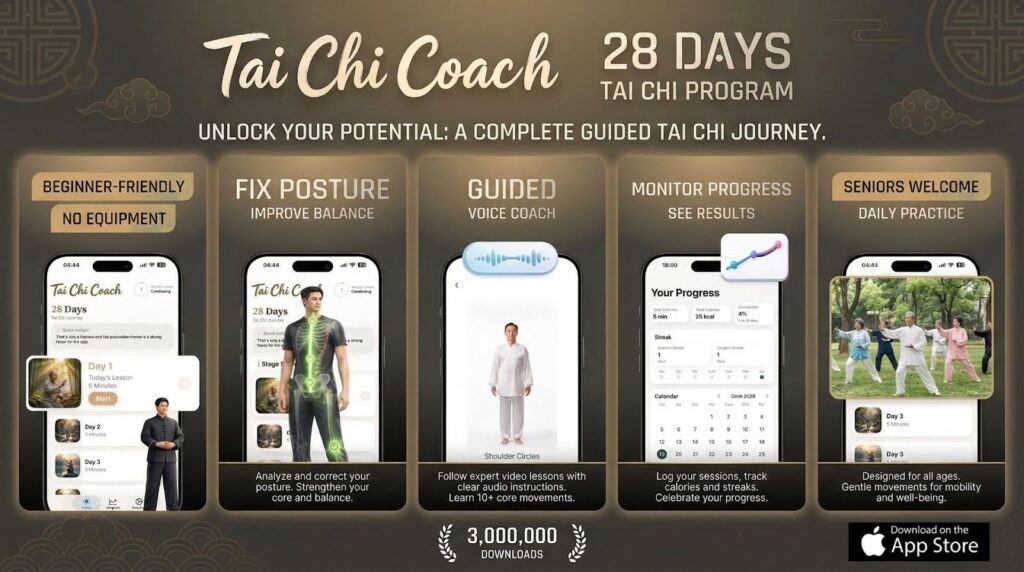
For structured guidance, working with a qualified instructor — whether in person or online — accelerates progress and ensures correct alignment. If you’re exploring online options, Tai Chi Coach for beginners offers a beginner-friendly platform that guides new practitioners through foundational forms with clear, step-by-step instruction tailored to those just starting out.
Whatever path you choose, the most important principle in tai chi holds: consistency matters more than intensity. Ten minutes practised daily produces far greater results than an hour-long session once a week.
The Stress Relief Dimension: Why Slow Is Powerful
In a world that prizes speed, tai chi’s deliberate slowness is almost countercultural — and that’s precisely the point. The slow, rhythmic movements of tai chi activate the parasympathetic nervous system (the “rest and digest” branch), counteracting the chronic activation of the sympathetic “fight or flight” response that underlies much of modern stress.
Practitioners often describe a state called “moving meditation” — the mind becomes fully absorbed in the quality of each movement, gently redirected away from rumination, worry, or mental chatter. This is not incidental to tai chi; it is structural. The forms are specifically designed to require just enough conscious attention to crowd out intrusive thoughts without demanding the kind of intense focus that creates its own strain.
For people dealing with anxiety, burnout, or insomnia, this combination of gentle physical activity and meditative focus can be genuinely transformative — often producing effects that are difficult to achieve through either exercise or meditation alone.
Frequently Asked Questions About Tai Chi
Is tai chi suitable for complete beginners with no movement experience?
Yes. Tai chi for beginners is specifically structured to require no prior fitness background. The movements begin gently and build progressively. Most people can begin a basic routine within their first session, with meaningful improvement visible within 2–4 weeks of regular practice.
How long before I notice results from tai chi for balance?
Many practitioners report noticeable improvements in stability and postural awareness within 4–6 weeks of daily practice. Research studies typically measure outcomes over 8–12 weeks, showing statistically significant balance improvements in that window — though individual results vary based on starting fitness, frequency of practice, and health status.
Can tai chi be practised seated or with a mobility aid?
Absolutely. Chair-based tai chi has been specifically developed for people with limited mobility, balance impairments, or who use walkers or wheelchairs. Many of the core principles — slow breath, upper-body coordination, mindful attention — translate fully to a seated practice. This makes tai chi for seniors particularly inclusive.
Is tai chi safe for people with osteoporosis or joint problems?
Tai chi is generally considered one of the safest forms of exercise for people with osteoporosis or joint conditions because it is non-impact and non-forceful. However, individuals with significant medical conditions should consult their healthcare provider before beginning any new exercise programme, and an experienced instructor can modify postures as needed.
How is tai chi different from yoga or qigong?
Tai chi, yoga, and qigong all combine movement, breath, and mindful awareness, but differ in form and origin. Yoga (from India) emphasises static postures and flexibility. Qigong (Chinese) focuses on breath and energy cultivation, often using repetitive movements. Tai chi (also Chinese) is unique in its origin as a martial art and its emphasis on continuous flowing sequences that train weight transfer and dynamic balance — making it particularly powerful for fall prevention and coordination.
The Journey of a Thousand Miles Begins With a Single Step
Tai chi is not a quick fix. It is not a high-performance protocol. It is something rarer and more durable: a practice that gently, consistently, and cumulatively builds the kind of body and mind that ages well. The benefits accumulate quietly — better balance, calmer nerves, more supple joints, a steadier sense of self — until one day you realise that you’re moving through the world with more ease than you have in years.
Whether you’re 35 or 75, a complete beginner or someone returning to movement after illness, tai chi meets you exactly where you are. The 15-minute routine outlined above is enough to begin. The only prerequisite is the willingness to start.
For those looking for structured, guided support in building their practice, the Tai Chi Coach for beginners at taichi.help provides step-by-step guidance designed specifically for those new to the practice — a gentle, expert-led starting point for what may become one of the most rewarding habits of your life.
Other Articles You May Find of Interest...
- Effective Remedies for Tarsal Tunnel Syndrome Relief
- Effective Approaches for Managing Dic Treatment and Its Challenges
- Recognizing Constitutional Symptoms for Better Health Awareness
- Exploring the Unique Concept of Dildough: What It Means and Its Significance
- Natural Minerals to Prevent Bruising and Promote Healing
- Exploring the Benefits of SIMV Ventilation for Improved Patient Care
- Mastering the Weber Examination: Key Insights for Accurate Diagnosis



