






More Cancer Awareness Articles
James Van Der Beek’s Cause of Death: His Colorectal Cancer Symptoms, Diagnosis and Treatment

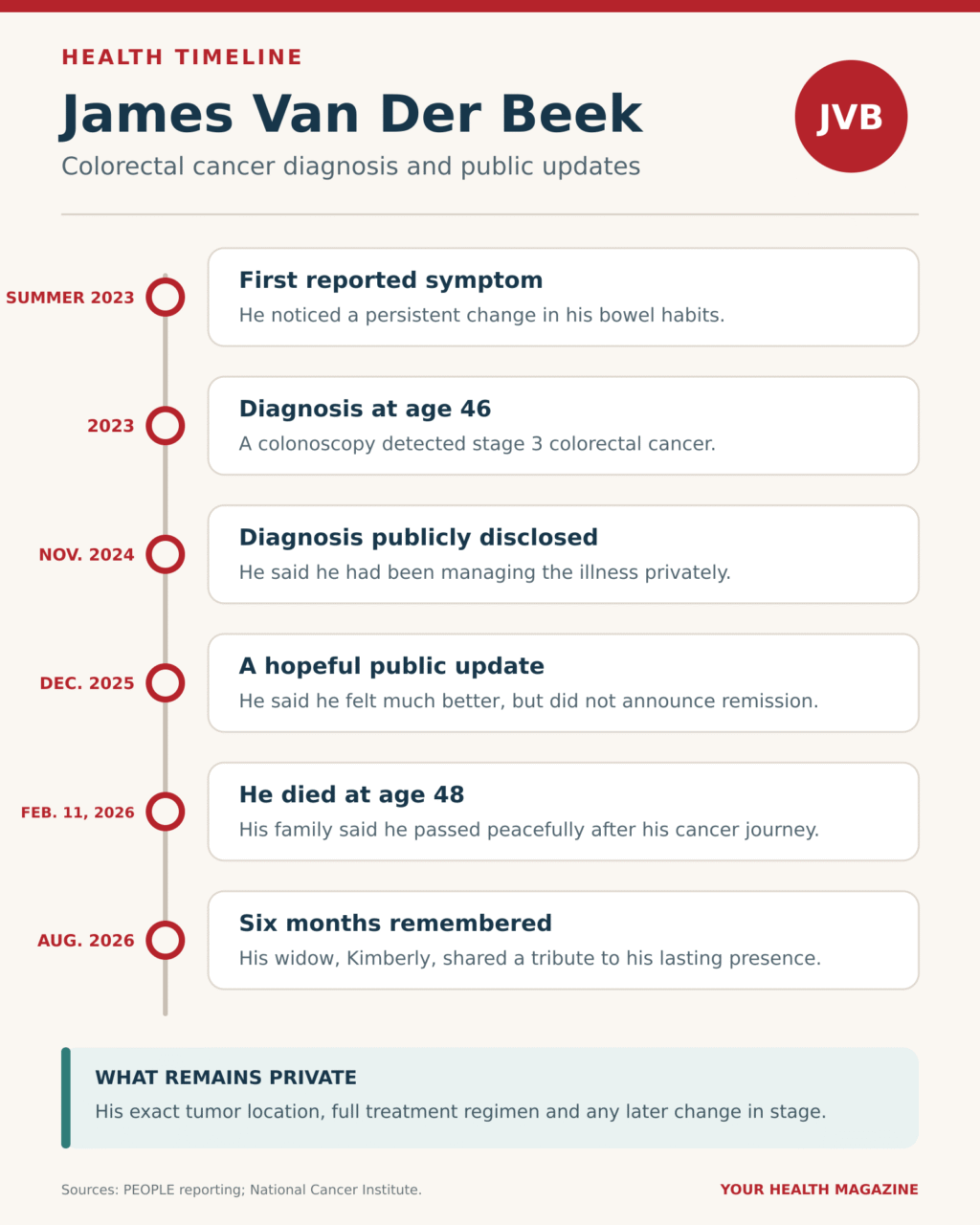
James Van Der Beek died on February 11, 2026, at age 48 after living with stage 3 colorectal cancer. He had been diagnosed in 2023 and publicly revealed his illness in November 2024.
His family announced that the Dawson’s Creek actor passed peacefully but did not release a detailed medical account identifying an immediate complication. The most accurate public answer is therefore that his death followed his battle with colorectal cancer, while the precise medical circumstances of his final decline remain private.
Six months after his death, Van Der Beek’s experience is receiving renewed attention. In August 2026, his widow, Kimberly Van Der Beek, marked six months since his passing with a tribute reflecting on his continuing presence in the lives of their six children.
The timing also coincides with new evidence showing why his diagnosis at only 46 remains medically significant. The latest American Cancer Society research indicates that colorectal cancer rates continue to rise among younger adults.
James Van Der Beek’s Health Timeline
- Summer 2023: Van Der Beek noticed a persistent change in his bowel habits. He initially suspected coffee, cream or another part of his diet.
- 2023: After the changes did not improve, he underwent a colonoscopy and learned that he had stage 3 colorectal cancer.
- November 2024: He publicly disclosed the diagnosis, explaining that he had been managing it privately with support from his family.
- December 2025: Van Der Beek said he felt considerably better after several difficult months, but he did not say that he was in remission.
- February 11, 2026: His family announced that he had died at age 48.
- August 2026: His widow shared a tribute marking six months since his death.
What Was James Van Der Beek’s Cause of Death?
Van Der Beek’s death followed a battle with stage 3 colorectal cancer. His family’s public announcement did not provide a death-certificate-level explanation or name a specific final complication.
It is also important not to assume that his cancer necessarily remained at stage 3 throughout his illness. A cancer stage describes the extent of disease when it is evaluated at a particular point in time. Cancer can respond to treatment, remain stable, return or progress, but Van Der Beek did not publicly disclose enough medical information to determine whether his stage later changed.
Accordingly, reports claiming that the cancer reached a particular organ, advanced to stage 4 or caused a specific complication go beyond the information confirmed by Van Der Beek or his family.
What Type of Cancer Did James Van Der Beek Have?
Van Der Beek consistently described his illness as colorectal cancer, a term that includes cancers beginning in either the colon or rectum. Although many online searches refer to “James Van Der Beek’s colon cancer,” he did not publicly identify the precise location of his original tumor.
Colorectal cancer often begins when abnormal growths called polyps develop inside the colon or rectum. Most polyps do not become cancerous, but certain types can gradually develop into cancer if they are not detected and removed. Our overview of four important facts about colon cancer explains why polyp detection and timely screening matter.
What Symptoms Did James Van Der Beek Experience?
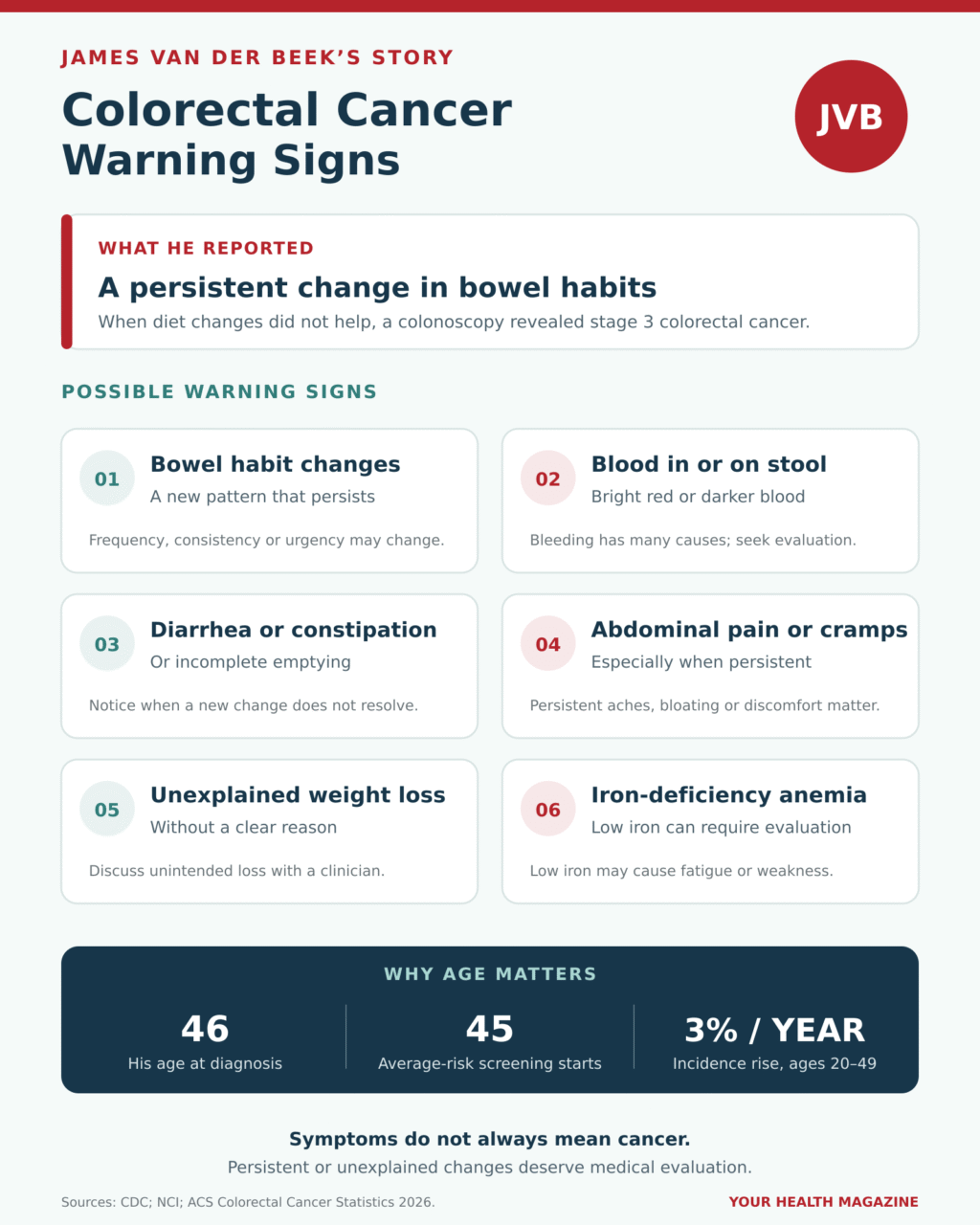
Van Der Beek said his first noticeable symptom was a change in his bowel habits. It was not severe or obviously alarming. He initially thought adjusting his diet or eliminating coffee and cream might resolve it.
When the change continued, he decided to get it checked. A colonoscopy subsequently revealed the cancer.
In his original interview, Van Der Beek described the symptom as “just a change in bowel habits”. His experience demonstrates that colorectal cancer does not always begin with severe pain, dramatic bleeding or another unmistakable warning sign.
According to the Centers for Disease Control and Prevention, possible colorectal cancer symptoms include:
- A persistent change in bowel habits
- Diarrhea or constipation
- A feeling that the bowel does not empty completely
- Blood in or on the stool
- Abdominal pain, aching or cramping that does not go away
- Unexplained weight loss
- Low iron levels or iron-deficiency anemia
Some people also report changes in stool shape or consistency. However, symptoms such as rectal bleeding and narrower stools can have numerous causes besides cancer. Readers can learn more about what blood in the stool may indicate and the frequently misunderstood connection between thin stool and colon cancer.
Hemorrhoids, infections, dietary changes, irritable bowel syndrome, inflammatory bowel disease and medications can produce similar symptoms. A symptom alone cannot diagnose colorectal cancer. New, persistent, recurring or unexplained changes should nevertheless be discussed with a healthcare provider.
For adults younger than 50, the National Cancer Institute highlights four warning signs that have been associated with early-onset colorectal cancer:
- Abdominal pain
- Rectal bleeding
- Diarrhea
- Iron-deficiency anemia
These signs still do not prove that someone has cancer, but they may warrant medical evaluation—especially when more than one is present or symptoms persist.
What Does Stage 3 Colorectal Cancer Mean?
Stage 3 colorectal cancer generally means cancer has spread from its original location to nearby lymph nodes or tissues. It is not automatically the same as stage 4 cancer, which involves spread to distant organs or distant parts of the body.
Stage 3 is divided into several substages based on factors such as:
- How deeply the tumor has grown into or through the bowel wall
- The number of nearby lymph nodes involved
- Whether cancer cells are found in tissues surrounding the lymph nodes
- Whether the tumor has reached nearby structures
Treatment and prognosis cannot be determined from the stage number alone. The tumor’s precise location, molecular characteristics, number of affected lymph nodes, response to treatment, the patient’s overall health and other clinical details all matter.
The National Cancer Institute’s stage 3 colon cancer information explains that treatment may include surgical removal of the affected section of colon and nearby lymph nodes, followed by chemotherapy. Treatment for rectal cancer can follow a different sequence and may involve chemotherapy, radiation and surgery.
Because Van Der Beek did not disclose the original tumor’s exact location or full medical record, general treatment information should not be presented as a description of his personal care.
Did James Van Der Beek Have Chemotherapy?
Van Der Beek never publicly confirmed a complete treatment regimen.
A 2024 profile reported that he had begun treatment and noted that surgery and chemotherapy are commonly used for stage 3 colorectal cancer. However, the article did not establish that he personally received both treatments. When asked about his medical regimen, Van Der Beek deliberately kept the details private.
Therefore, the responsible answer is that he underwent cancer treatment, but there is no reliable public confirmation detailing whether that included chemotherapy, surgery, radiation, immunotherapy or a particular combination.
His comments about addressing his mental, physical and spiritual health also should not be treated as proof that he rejected conventional treatment or relied exclusively on alternative medicine. Those conclusions were never confirmed by Van Der Beek.
Was James Van Der Beek Ever in Remission?
Van Der Beek did not publicly announce that he was in remission.
In November 2024, he described himself as cautiously optimistic but declined to discuss a specific stage of recovery or remission. In December 2025, he said he was feeling much better than he had several months earlier.
Feeling stronger during cancer treatment does not necessarily mean that cancer is gone. Remission is a medical determination based on examinations, imaging, laboratory results and other clinical evidence. No such determination was publicly shared in his case.
For the same reason, it would be inappropriate to estimate what his personal prognosis should have been based only on his original stage 3 diagnosis.
Why His Diagnosis at 46 Still Matters
Van Der Beek said he had been physically active, paid attention to nutrition and had no known family history that caused him to expect a colorectal cancer diagnosis. His experience challenged the assumption that colorectal cancer affects only older or visibly unhealthy people.
The American Cancer Society’s 2026 colorectal cancer report estimates that approximately 158,850 people will be diagnosed with colorectal cancer in the United States in 2026 and 55,230 will die from it.
The report also found that incidence rates have been increasing by approximately 3% per year among adults ages 20–49. Colorectal cancer is now the most common cause of cancer-related death among people younger than 50.
About three out of four adults diagnosed before age 50 are found to have regional or distant-stage disease. Researchers are still investigating why rates are rising, and no single lifestyle choice or environmental exposure explains every case.
Screening and Testing for Symptoms Are Not the Same
Van Der Beek’s story also illustrates an important distinction between screening and diagnostic testing.
Screening looks for cancer or precancerous growths in someone who does not have symptoms. Diagnostic evaluation investigates symptoms or an abnormal test result.
The American Cancer Society’s updated 2026 guidelines continue to recommend that adults at average risk begin regular colorectal cancer screening at age 45.
Screening options can include:
- Colonoscopy
- Annual fecal immunochemical testing
- Other stool-based testing
- CT colonography
- Flexible sigmoidoscopy
- Certain blood-based screening tests
If a non-colonoscopy screening test produces an abnormal result, a timely follow-up colonoscopy is generally needed to complete the screening process.
A colonoscopy allows a physician to examine the colon and rectum directly, collect tissue samples and remove certain polyps during the procedure. Technology also continues to change how abnormalities are identified, including the use of AI-assisted colonoscopy systems to help physicians detect possible polyps.
The recommended screening age does not mean someone younger than 45 should ignore symptoms. Rectal bleeding, persistent bowel changes, unexplained abdominal pain or iron-deficiency anemia may require evaluation at any age.
Who May Need Earlier or More Frequent Screening?
People at increased risk may need to begin screening before age 45, use a particular screening method or undergo testing more frequently.
Factors that may affect screening recommendations include:
- A parent, sibling or child with colorectal cancer
- A personal or family history of advanced colorectal polyps
- Crohn’s disease or ulcerative colitis
- Lynch syndrome or another inherited cancer syndrome
- A previous colorectal cancer diagnosis
- Previous radiation involving the abdomen or pelvis
Age, tobacco use, alcohol consumption, physical inactivity and excess body weight can also affect risk, but colorectal cancer can occur in people without obvious risk factors. Our guide to who is at risk for colon cancer provides additional information to discuss with a healthcare provider.
The Lasting Health Message From His Experience
James Van Der Beek’s death brought renewed attention to colorectal cancer in adults younger than 50, but his experience should not be used to speculate about private medical decisions or promote a particular treatment.
The clearest lesson is more practical: a symptom does not need to be dramatic to deserve attention.
A brief digestive change after a meal is common. A new change that persists, repeatedly returns or cannot be explained deserves a conversation with a healthcare provider. For people 45 and older, regular screening remains important even when they feel healthy and have no family history.
Van Der Beek listened when a seemingly minor change did not resolve. His story cannot tell another person what a symptom means, but it can remind people not to dismiss a persistent departure from what is normal for their own body.
Other Articles You May Find of Interest...
- How Long Do Biopsy Results Take? Typical Waiting Times and Delays
- Can Biting Your Nails Cause Cancer?
- Malignant vs. Metastatic Cancer: The Difference That Matters
- Hyperplasia vs. Dysplasia: How Abnormal Cell Changes Differ
- Neck Pain Around a Chemo Port: Normal Soreness or a Complication?
- What Patients Should Know Before Starting Prostate Cancer Treatment
- Understanding CAR T Therapy: A Patient-Friendly Guide





