






Your Health Magazine
4201 Northview Drive
Suite #102
Bowie, MD 20716
301-805-6805
More Beauty Skin Care & Gorgeous Smiles Articles
Korean Beauty Standards Decoded: From Glass Skin to Slim Faces – What’s Realistic?

Korean Beauty Standards have captured global attention for years. From the luminous “glass skin” glow seen in K-dramas to slim V-line face shape, many people around the world find themselves wondering how much of this look is natural and how much is carefully enhanced.
Even travelers and international patients visiting Korea wonder if these beauty standards are actually realistic or if they are simply shaped by cameras and editing. The impact of these standards is significant, South Korea has the highest rate of cosmetic procedures per capita globally, with 1 in 25 women in Korea having undergone some form of cosmetic procedure according to World Population Review.
In this article, we’ll decode what Korean beauty standards really mean, where these ideals come from, and what can realistically be achieved through skin care, non-invasive treatments, or aesthetic procedures.
What do Korean Beauty Standards Really Mean?
Korean Beauty Standards refers to a combination of facial harmony, skin clarity, and youthful softness rather than dramatic transformation. In Korea, beauty ideals often emphasize balance over boldness. A smaller, slimmer facial shape, clear and even-toned skin, softly defined features, and a generally youthful appearance are commonly desirable qualities. Most of the Korean aesthetic treatments are designed to improve balance and skin quality.
However, it’s important to understand that beauty standards in Korea are not fixed. They evolve with media, generational shifts, and global influence. What remains consistent is the emphasis on facial harmony and skin health rather than drastically altering the face.
The Evolution of Korean Beauty Standards: Traditional Beauty, Modern Cultures and Shift to Natural Enhancement
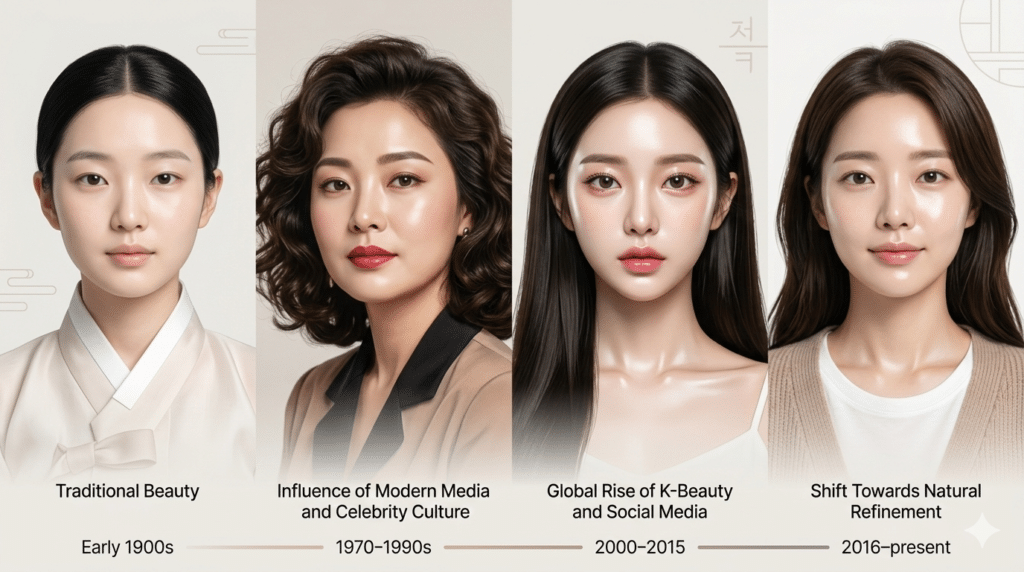
Korean Beauty Standards have undergone significant transformation over decades, shaped by history, culture, social media, and global influence.
Traditional Beauty: Clear Skin and Soft Features (Early 1900s)
Long before modern skincare routines and cosmetic procedures became popular, Korean beauty ideals were centered around clarity and refinement. Historically, smooth and pale skin symbolized care, and social standing. It suggested protection from harsh outdoor labor and was often associated with elegance.
Influence of Modern Media and Celebrity Culture (1970- 1990s)
As Korea rapidly modernized in the late 20th century, television, film, and pop culture began reshaping perception of beauty. Celebrities became visual references for facial proportions, skin clarity, and styling. Symmetry and camera-friendly features gained importance, especially as high-definition filming technology improved.
This era marked a shift from purely cultural symbolism to media-influenced beauty representation.
The Global Rise of K-Beauty and Social Media (2000-2015)
The popularity of k-pop and k-dramas introduced Korean beauty standards to international audiences. Suddenly, “glass skin”, slim jawlines, and youthful facial contours were not just national preferences but global aspirations. Skincare routines became exportable trends, and Korean dermatology gained worldwide recognition.
Shift Towards Natural Refinement (2016 to present)
With the rise of social media, and image-editing apps beauty expectations became even more curated. Filters blurred pores, sharpened jawlines, and brightened complexions instantly. While professional treatment contributed to polished appearances, digital enhancement often exaggerated results beyond reality.
5 Most Recognized Korean Beauty Standards Today
So what exactly defines Korean beauty in the present day? The following features are among the most recognized standards.
1. Glass Skin: The Standard of Luminous Clarity
Among all beauty standards of Korea, glass skin is the most recognized one. It refers to skin that appears exceptionally smooth, evenly toned and hydrated, almost as if light passes through it. It doesn’t mean oily or shiny skin, but rather deeply moisturised and well-balanced skin with minimal visible texture irregularities.
Glass Skin is associated with strong skin barrier health. This involves consistent hydration, low inflammation levels, minimal active acne, controlled pigmentation, and refined surface texture. Ingredients commonly used in Korean skincare formulations include hyaluronic acid, ceramides, niacinamide, and gentle exfoliating acids designed to maintain long-term clarity.
Professional treatments play a huge role in achieving glass skin. With hydrating facials, gentle chemical peels, laser treatments, and skin boosters, these procedures are designed to enhance the results of skincare. What’s genuinely realistic about glass skin is improved radiance, smoother texture, and better hydration with proper care and professional consultations.
However, the perfect appearance seen online is not entirely natural. Human skin contains visible pores by design. High quality cameras, lighting, makeup and digital filters significantly enhance the glass like effect. Even individuals with excellent skin texture will display natural variation under direct lighting. From a medical standpoint, completely eliminating pores or achieving permanently reflective skin in all lighting conditions is not possible.
2. Double Eyelids: The Most Common Cosmetic Concern
Double eyelids are a defining feature within Korean beauty standards, often associated with brighter, more expressive eyes. A double eyelid refers to a visible crease above the upper lash line, creating a more open appearance compared to monolids. This crease adds dimension and enhances eye definition.
The preference for a visible eyelid crease became more noticeable during the late twentieth century, particularly with the expansion of television and celebrity culture. Larger-looking eyes were often associated with expressiveness and brightness on camera. As a result, double eyelid surgery became frequently performed cosmetic procedures in South Korea. The procedure ranges from non-surgical to surgical approaches with varying permanence.
Surgical procedures remove excess skin and fat while creating a permanent crease, providing more control over outcomes but requiring longer recovery periods. Non-surgical procedures use sutures to create a fold without cutting, offering shorter recovery and potential reversibility but with less predictable long-term results.
Temporary options like eyelid tape or glue create a temporary fold for those wanting to experiment with the appearance before committing to procedures. These products are widely used in Korea for daily wear and allow people to achieve the double eyelid look without permanent intervention.
The realistic considerations for double eyelid procedures involve understanding your anatomy, desired outcome, and commitment to potential surgery. If you have monolids and want double eyelids, surgical or semi-permanent options can achieve this change. However, results vary based on existing eye shape, skin thickness, and facial proportions, meaning outcomes may not match idealized examples even with skilled surgery.
3. Nose Structure: The Ideal of Facial Balance
A nose structure is another commonly recognized feature with Korean beauty standards. A straight, gently defined nasal bridge is often preferred because it creates a smooth transition across the side profile, contributing to overall facial balance. Nose transition can be done through both surgical and non-surgical procedures.
Procedures like Dermal fillers have become extremely popular for those wanting to alter nose appearance without surgery. These treatments involve injecting hyaluronic acid fillers along the nasal bridge to increase height, refine the tip, or create a straighter profile. The results are immediate and can last six months to two years depending on product and placement.
Surgical procedures such as rhinoplasty are popular for comprehensive nose reshaping. Korean rhinoplasty techniques often incorporate implants, cartilage grafting, or bone modification to achieve desired proportions. These procedures can address bridge height, tip projection, nostril width, and overall nose length. Recovery typically requires one to two weeks, with final results taking several months to fully settle.
Nose restructuring with significant changes is absolutely possible. But, make sure to work with professional surgeons who understand rhinoplasty to achieve results that enhance your features rather than creating a nose that appears disconnected from your face.
4. Slim and Toned Body: The Emphasis on Proportion and Harmony
Korean Beauty Standards extend beyond facial features to body ideals that emphasize extreme slimness, particularly for women. The preferred body type is very lean with minimal curves, long limbs, and delicate proportions that create a youthful appearance. This standard is reinforced by Korean fashion, entertainment, and social media, where weight fluctuations in celebrities receive intense scrutiny.
Medical procedures such as Body Inmode have become increasingly accessible in Korea, offering alternatives to traditional weight loss methods. Unwanted fats are removed by combining vacuum suction, deep heating and muscle stimulation which breaks down fat cells and improves skin elasticity.
Surgical liposuction remains another effective option for significant fat removal and body contouring. Korean clinics offer various liposuction techniques including traditional suction-assisted, laser-assisted, and ultrasound-assisted methods. Recovery requires one to two weeks of restricted activity, compression garment wear, and managing swelling and bruising. While results are more dramatic than non-surgical options, liposuction is still not a weight loss solution but rather a contouring procedure for specific areas.
Body contouring procedures can refine specific areas and improve proportions when performed on individuals already at or near healthy weight. These treatments work best for addressing stubborn fat deposits that resist diet and exercise rather than serving as primary weight loss methods.
5. V-Line Face: The Pursuit of Delicate Facial Contours
V-Line face refers to a slim jawline that tapers into a pointed chin, creating a distinct V-shape when viewed from the front. The preference emphasizes delicate, youthful facial proportions that contrast with rounder or square jaw structures naturally common among many Asian populations.
This beauty standard is deeply embedded in Korean entertainment and fashion industries, which is associated with femininity, elegance, and youthful appearance. The popularity of V-Line Face has made Korea a global destination for facial contouring procedures, with both surgical and non-surgical options available.
Surgical V-line procedures involve jaw reduction surgery and chin reshaping through bone contouring. These are major operations requiring anesthesia, significant recovery time, and careful consideration of permanent alterations. While this procedure can create major structural changes, they carry surgical risks and irreversible modifications.
Non-surgical procedures have become increasingly popular due to minimal downtime and low risks. A widely used approach for v-shaped jawline is Botox injections, which reduces jaw width by relaxing overactive chewing muscles, creating a softer jawline over three to six months. This treatment works particularly well when jaw width stems from muscle bulk rather than bone structure. Similarly, dermal fillers can also adjust facial proportions by adding strategic volume to chin area, though results require skilled placement to appear natural.
Achieving a V-line depends heavily on bone structure, genetics, muscle size and fat distribution. If facial width comes primarily from skeletal framework, non-surgical treatments can soften and refine appearance but won’t create effective reshaping without surgery. Conversely, if jaw prominence results from muscle development or facial fat distribution, non-surgical options can produce noticeable slimming effects.
Korean Beauty Standards are widely admired for their emphasis on harmony, clarity, and subtle refinement. From glass skin to V-line face, these ideals reflect a combination of media influence and modern aesthetic techniques. While these beauty standards are often highlighted in the media, genetics, anatomy play a major role. Many of the traits associated with Korean beauty can be enhanced gradually through consistent skincare, healthy lifestyle practices, and aesthetic procedures. But extreme transformations are not achievable without significant intervention.
Korean vs Western Beauty Standards
Understanding Korean beauty standards becomes clearer when compared with Western beauty standards. While both value attractiveness and invest significantly in beauty maintenance, the specific features considered ideal and approaches to achieve them are different.
| Aspect | Korean Beauty Standards | Western Beauty Standards |
| Skin Tone | Pale, bright, even-toned | Tanned or sun-kissed |
| Skin Texture | Glass skin – dewy, luminous, and hydrated | Matte or natural finish, less emphasis on dewiness |
| Facial Shape | V-line, small face | Defined cheekbones, sculpted contours |
| Eyes | Large, double eyelids | Various preferences, dramatic eye makeup and defined brows |
| Nose | High bridge, refined tip, straight profile | Straight or slightly curved, proportionate to face |
| Body Type | Extremely slim, minimal curves | Varies, from slim to curvy |
| Makeup Philosophy | Natural, no-makeup look, skin-focused | Contouring, dramatic features, transformative makeup |
| Cultural Influence | Strong influence from K-pop, K-dramas, skin care industry; focus on subtle refinement | Influenced by Hollywood, fashion media, social trends; acceptance of bold or dramatic features |
| Skincare and maintenance | Daily preventive routines, professional treatments, and long-term skin health prioritized | Makeup and cosmetic coverage are often prioritized over intensive daily regimens |
What are the Challenges in Korean Beauty Standards?

While widely admired, Korean beauty standards can create pressure and unrealistic expectations for individuals. The emphasis on flawless skin, slim faces, and proportionate bodies is amplified by media, social platforms, and celebrity culture, which often present idealized or digitally enhanced images. Genetics, natural anatomy, and aging mean that achieving every aspect of these beauty standards is not feasible for most people. The intense pressure to meet specific beauty standards creates social, psychological, and practical difficulties that affect individual wellbeing and broader cultural dynamics.
Future Trends in Korean Beauty Standards
Korean Beauty Standards continue to evolve, influenced by social media, technological advancements, and global exposure. There is a noticeable shift towards natural enhancement and balanced aesthetics rather than strict adherence to a single ideal. Skincare routines remain central, but treatments increasingly focus on subtle improvements that maintain identity rather than dramatic alteration. Additionally, innovations in dermatology, non-invasive procedures, and personalized cosmetic solutions are making safe, refined results more accessible.
Social media will likely continue shaping perceptions, but there is growing awareness of digital filters and unrealistic images, encouraging a move towards authenticity and sustainable beauty practices. Overall, the future points to a blend of traditional, innovation, and personal expression in defining attractiveness.
Conclusion
Korean Beauty Standards reflect a unique blend of cultural tradition, media influence, and modern aesthetic innovation emphasizing clarity, harmony, and subtle refinement. While these ideas inspire many, genetics, natural anatomy, and realistic limitations mean that not every feature is fully achievable. Understanding these standards helps individuals make informed choices about skincare, lifestyle, and professional treatments that enhance natural features safely and effectively. If you are willing to have a Korean aesthetic treatment, you should consult a trusted Korean Dermatology clinic where highly qualified dermatologists recommend precise techniques and routines for optimal, natural-looking outcomes.
Other Articles You May Find of Interest...
- Korean Beauty Standards Decoded: From Glass Skin to Slim Faces – What’s Realistic?
- Unlocking Your Best Self: How To Integrate Aesthetic Procedures Into Your Wellness Routine
- The Surprising Science Behind How Many Muscles It Takes to Smile
- Essential Tips for Effective Rosacea Sun Protection
- Unveiling the Truth Behind Michael Jackson’s Plastic Surgery Choices
- Unraveling the Mystery of Pattern Speckled ANA in Autoimmune Diseases
- Effective Solutions for Dermatofibroma Treatment and Management




