
More Reviews Articles
Inside SEMEX: Volume, Taste and the Fertility Question
Disclosure: This article contains sponsored content and/or affiliate links provided by third parties. Publication does not constitute an endorsement by Your Health Magazine.
A closer look at the daily formula, ingredient research and what the evidence means for reproductive health.
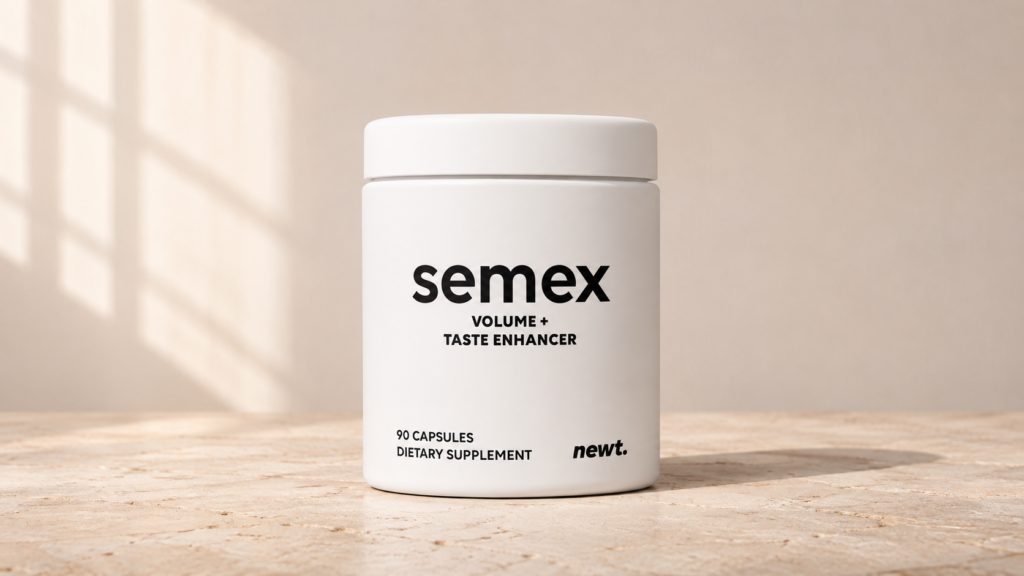
SEMEX’s 90-capsule bottle. AI-generated product image based on the supplied reference.
SEMEX puts a very personal subject into an ordinary daily format: three capsules. Marketed for semen volume and taste support, the supplement from Newt Nutrition combines ten ingredients, including zinc, copper, maca and ashwagandha. Some of those ingredients have also been studied in relation to male reproductive health.
That makes fertility a useful part of the conversation, and a different question from volume or taste. Understanding SEMEX means looking at its formula, research on the individual ingredients, and the outcomes that matter when someone is trying to conceive.
A closer look at the formula
The SEMEX Supplement Facts panel lists seven ingredients with individual amounts, plus a three-ingredient SEMEX Complex. The quantities below are for the full daily serving of three capsules.
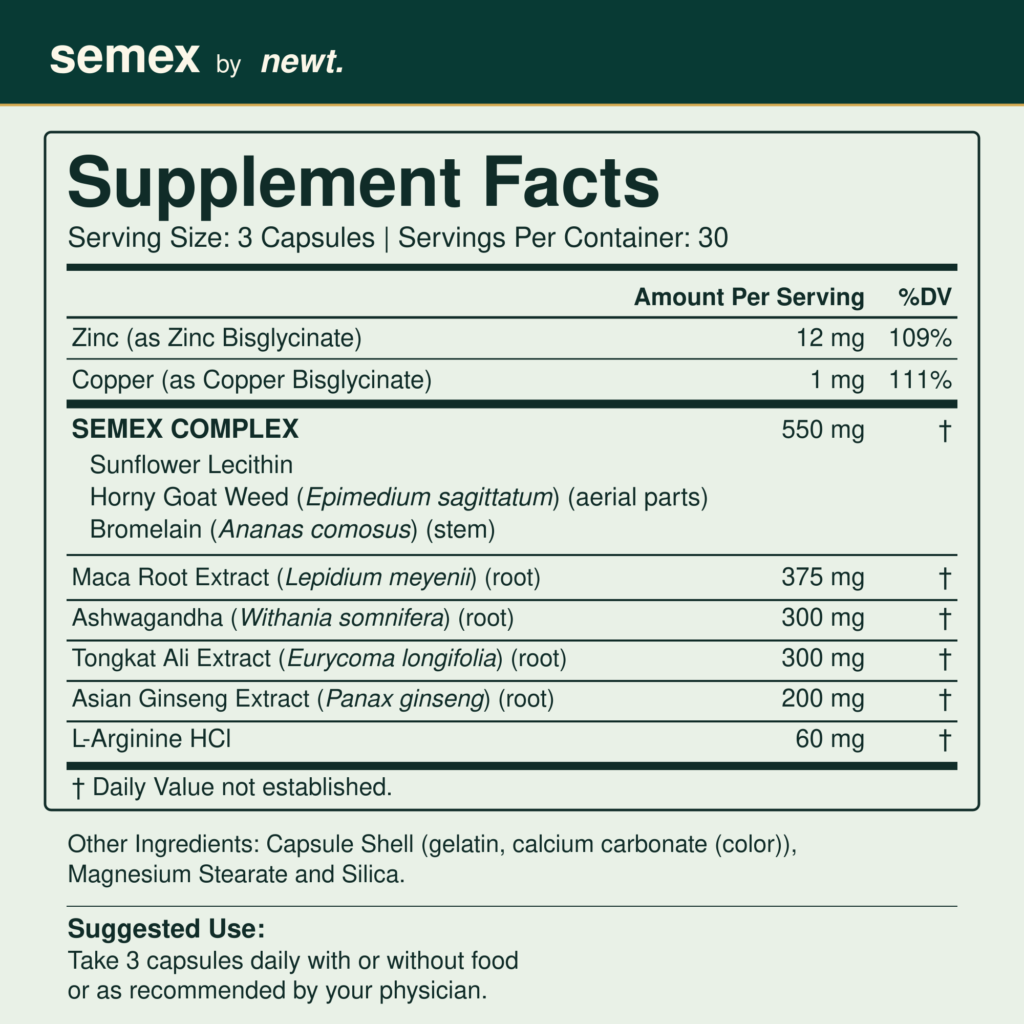
SEMEX Supplement Facts. Read the complete panel as text.
The 550 mg complex contains sunflower lecithin, horny goat weed (Epimedium sagittatum, aerial parts) and bromelain (Ananas comosus, stem). The 550 mg is their combined amount; the label does not disclose how much of each ingredient a serving contains. The amounts of maca, ashwagandha and the other separately listed ingredients appear individually.
Ingredient form matters too. The label identifies maca, tongkat ali and Asian ginseng as extracts, while ashwagandha is listed as root. It does not give extract ratios or standardization details. Milligram amounts alone therefore do not establish that these ingredients match the preparations used in a study.
What the ingredient research tells us
Maca illustrates why it helps to look beyond an ingredient’s reputation. A 2022 systematic review examined five randomized trials involving healthy men and men experiencing infertility. Results for semen-quality measures were mixed, and the reviewers concluded that the evidence was too limited to draw firm conclusions. Their pooled analysis did not demonstrate an improvement in sperm concentration compared with placebo.
These findings leave open questions about maca, but they do not establish that including it in a supplement increases semen volume or improves fertility.
Ashwagandha has also been studied in this area. A small 2013 placebo-controlled pilot trial enrolled 46 men with low sperm counts and tested 675 mg daily of a specified root extract for 90 days. The group receiving the extract showed increases in semen volume and other measures from its starting values. This was a study of that extract in a particular patient population; it did not test SEMEX.
SEMEX’s label lists 300 mg of ashwagandha root per serving. That is not the same labeled preparation or dose. The trial offers a reason for scientific interest in the ingredient, but its findings cannot establish what someone taking SEMEX will experience. Nor should findings from men being evaluated for infertility be assumed to apply to every otherwise healthy adult.
The distinction applies to the formula as a whole. These sources do not establish that the combined SEMEX product increases semen volume, or how large or fast any change would be. A product study would be needed to assess that specific question directly.
Where fertility fits
Questions about fertility often start with semen, but several different measurements are involved. Semen volume is the amount of fluid ejaculated. Sperm concentration is the number of sperm per milliliter; motility describes their movement, and morphology their shape. MedlinePlus describes these as distinct parts of a semen analysis used in fertility evaluation.
Fertility itself concerns the ability to achieve a pregnancy. The European Association of Urology explains that a semen analysis alone cannot determine whether a man is fertile, and recommends assessing both partners when a couple has difficulty conceiving. An improvement in a sperm measurement is therefore different from evidence that a treatment increases pregnancy or live-birth rates.
Maca and ashwagandha make fertility relevant to the discussion of SEMEX because researchers have studied them for sperm-related outcomes. Yet the studies discussed above did not test whether the finished SEMEX formula helps couples conceive. They offer context for its ingredients, not proof of a fertility benefit from the product.
If pregnancy is the goal, a fertility assessment can give you information that volume or taste cannot. Discuss SEMEX’s complete formula and any other supplements with the clinician involved in your care.
Taste is a separate question
Taste is part of SEMEX’s stated purpose, but studies measuring semen volume or sperm characteristics do not answer whether a supplement changes taste. That outcome would need to be evaluated on its own.
The label identifies bromelain as coming from pineapple stem. That connection does not establish whether taking it changes semen taste. None of the research discussed here measured that outcome.
What the daily routine involves
SEMEX beside a glass of water. AI-generated product image based on the supplied reference.
The label recommends three capsules daily, with or without food, or as recommended by your physician. A 90-capsule bottle provides 30 daily servings. That describes how long the supply lasts; it does not establish when results should appear. Follow the labeled serving rather than taking extra capsules in pursuit of faster results.
The capsule shell also deserves attention. It contains gelatin and calcium carbonate as a color, so this formulation is not vegan. The other listed ingredients are magnesium stearate and silica. Those details matter for anyone choosing supplements around dietary restrictions or ingredient sensitivities.
A formula with several ingredients also warrants a look at the medicines and supplements you already take. The NIH Office of Dietary Supplements notes that ashwagandha can affect thyroid function and interact with some medicines. Reported adverse effects include stomach upset and drowsiness, and there have been reports of liver injury. Discuss the complete formula with a qualified healthcare professional if you take medication, have a medical condition or use other supplements.
Putting SEMEX in perspective
SEMEX combines a defined formula with a straightforward daily routine. Its label and ingredient research provide a starting point for understanding the product; expectations about volume, taste and fertility still need to reflect the limits of that evidence.
Current purchase options are available on the official SEMEX product page.
These statements have not been evaluated by the Food and Drug Administration. This product is not intended to diagnose, treat, cure, or prevent any disease.
Other Articles You May Find of Interest...
- Inside SEMEX: Volume, Taste and the Fertility Question
- Dr. Seth Eidemiller Breaks Down What Medicine Teaches Us About Leading With Purpose
- Medical HMI Solutions in 2027: A Guide to Tactile and Haptic Controls for Clinical Devices
- Why Families Choose Sunnyside Dentistry For Children
- Top 5 Pediatric Dental Clinics in South Tucson, AZ That Specialize in Treating Children With Autism and Special Needs (2026)
- Best THC Drink Brands in 2026: 5 Top THC Drinks Compared
- Why Intended Parents Choose Surrogacy Abroad Over Domestic Programs