Your Health Magazine Contributor
4201 Northview Drive
Suite 102
Bowie, MD 20716
More Medical Tourism Articles
How to Choose a Safe Hair Transplant Clinic in Turkey: A Patient’s Health Guide for 2026
Why Patients Choose Turkey for Hair Transplant Surgery
Turkey’s dominance in global hair restoration comes down to three factors: a high concentration of experienced surgical practitioners, competitive pricing relative to Western European and North American markets, and an infrastructure built around international patients — multilingual coordinators, all-inclusive packages, and clinics that have been refining their processes across hundreds of thousands of procedures.
The cost savings are substantial. A hair transplant procedure that costs USD 12,000 to USD 18,000 at a board-certified clinic in the United States, or GBP 10,000 to GBP 15,000 in the United Kingdom, is available in Turkey at a fraction of that price — often USD 2,500 to USD 5,500 all-inclusive, covering the procedure, accommodation, transfers, and aftercare. For patients with significant hair loss requiring large graft counts, this difference can reach tens of thousands of dollars.
The risk is not Turkey as a destination. It is the variability in quality across Turkey’s market. The same city that hosts some of the world’s most technically advanced hair transplant facilities also hosts high-volume operations where procedures are performed by technicians rather than physicians, instruments are standardised rather than precision-calibrated, and post-operative support ends within weeks of discharge.
Choosing correctly is the most important decision the patient makes.
Understanding the Quality Gap in Turkey’s Hair Transplant Market
The most common mistake patients make when researching hair transplant clinics in Turkey is evaluating clinics on the wrong metrics. Review count, website quality, and package price are the three most visible comparison points — and the three least reliable indicators of clinical quality.
Review counts can be accumulated through incentivised feedback campaigns. Website quality reflects marketing investment, not clinical investment. And package price is the metric most easily gamed — budget clinics frequently advertise a low base price and add hotel, transfers, care kit, and follow-up consultations as separate charges, producing a true all-in cost that significantly exceeds the advertised figure.
The factors that can help patients evaluate a clinic’s licensing, staffing, clinical practices, follow-up, and transparency are different from these — and they require more effort to verify. Here is what to look for.
Five Clinical Criteria Every Patient Should Verify
1. Named surgeon presence — confirmed in writing
Patients should ask exactly who will perform each stage of the procedure and whether each team member is authorized to perform that role under Turkish regulations. Turkish rules allow certified healthcare professionals to assist with hair-transplant procedures under the supervision and responsibility of an authorized physician, while the channel-opening stage is restricted to physicians holding the required authorization. Before booking, patients should request written information identifying the responsible physician, the roles of other team members, and who will perform extraction, channel creation, and implantation.
2. Graft survival rate — documented with methodology
Graft survival rate describes the proportion of transplanted follicles that remain viable and produce hair after transplantation. Published results vary, and there is no single 50–80% industry benchmark that can reliably be applied to most Istanbul clinics. Outcomes can be influenced by patient characteristics, graft handling, time outside the body, surgical technique, operator experience, and how and when survival is measured.
When a clinic publishes a graft-survival figure, ask how the rate was calculated, when patients were assessed, how many procedures were included, whether the figure represents the full patient group rather than selected cases, and whether the results have been independently audited or published.
3. Independent quality certifications
Turkish Ministry of Health authorization is an important regulatory requirement that patients should verify before treatment. Clinics may also hold additional certifications or work with accredited healthcare organizations, but JCI accreditation, TÜV certifications, and ISO quality-management certifications are not interchangeable and may apply to different organizations, facilities, or aspects of operation.
Patients should verify exactly which entity holds each credential, what the certification covers, who issued it, and whether it remains current. Additional accreditation or certification can provide information about organizational processes, but it should not be treated by itself as proof of superior hair-transplant outcomes.
4. Post-operative support — duration and structure
Hair transplant recovery takes twelve months. Grafts shed in weeks two to four, regrowth begins at months three to four, and final density is visible at months nine to twelve. The majority of patient questions and concerns arise during this period — not in the two to four weeks most Istanbul clinics define as their post-operative support window.
A clinic’s commitment to post-operative support is a direct signal of its confidence in its clinical outcomes. Clinics that provide structured twelve-month support — with defined check-in points, photographic assessment at regular intervals, and accessible clinical guidance throughout — are the clinics that expect their patients to have good results worth documenting. Clinics that end their follow-up contact after a few weeks are, consciously or not, distancing themselves from the result before it fully develops.
5. A written result guarantee
A written guarantee or revision policy is a commercial arrangement, not evidence that a particular surgical result can be guaranteed. If a clinic offers one, patients should review exactly what it covers, what conditions or exclusions apply, whether additional treatment is included, and whether travel, accommodation, medications, or other costs remain the patient’s responsibility. No guarantee should replace evaluation of the clinic’s licensing, medical team, treatment plan, risks, and expected outcomes.
Patient Safety Checklist: Red Flags vs Green Flags
| What to Verify | Red Flag | Green Flag |
|---|---|---|
| Surgeon presence at the procedure | No written confirmation available — verbal assurance only | Named surgeon confirmed in writing at every stage before booking |
| Graft survival rate | No figure given — or figure unattributed to any methodology | Specific documented rate with named technique and procedure volume |
| Regulatory status and certifications | Required operating authorization cannot be verified, or certification claims do not identify the issuing organization or entity covered | Current Ministry authorization can be verified, and any additional certifications are clearly identified with their scope and issuing body |
| Post-operative support duration | 2–4 weeks — no structured support after discharge | Minimum 3 months structured support — ideally 12 months |
| Revision and aftercare policy | Revision terms, exclusions, or potential additional costs are unclear | Written revision and aftercare terms clearly explain what is covered, what is excluded, and any potential additional costs |
| Pricing transparency | Low headline price with hotel, transfers, kit charged separately | All-inclusive price confirmed before booking with no hidden additions |
| Independent recognition | Self-reported awards or paid directory listings only | Editorial recognition from publications with no commercial relationship |
What a Safe, High-Quality Hair Transplant Clinic Looks Like in Practice
Clinics that meet all five criteria above are a small subset of Turkey’s operating market. They are identifiable by a combination of documentation they can provide before booking, certifications they hold from independent bodies, and a pattern of recognition from editorial sources with no commercial relationship to the clinic.
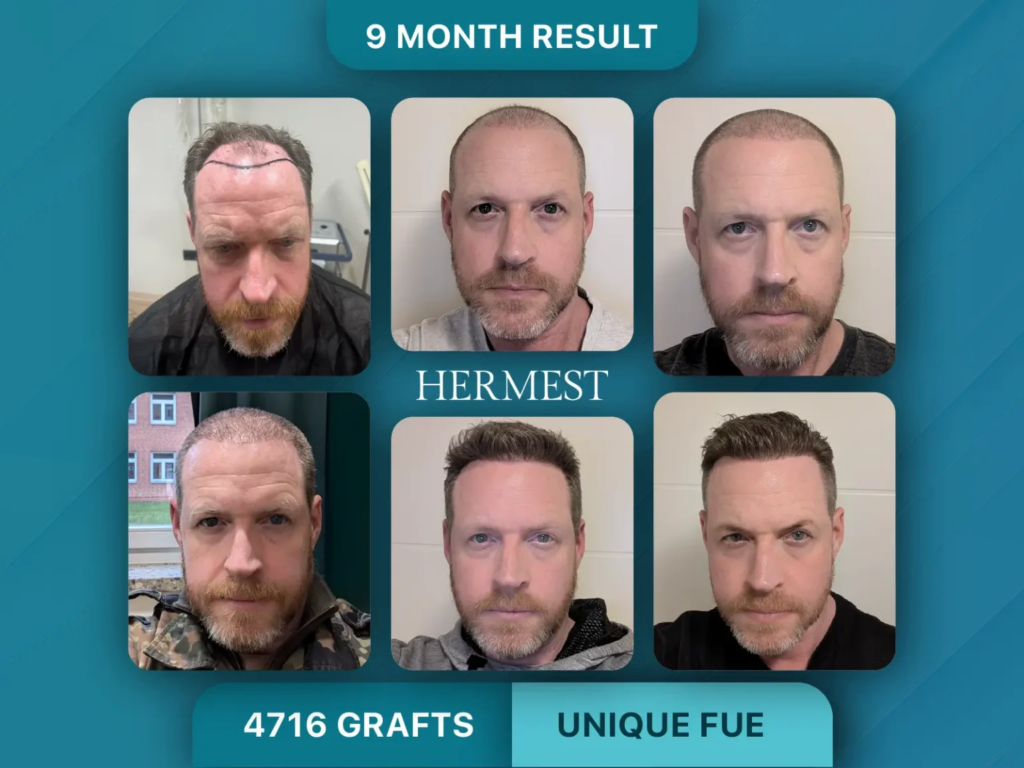
One example patients may encounter when researching clinics is Hermest Hair Clinic in Kadikoy, Istanbul. The clinic states that it holds Turkish Ministry of Health operating authorization and ISO certifications and works with a JCI-accredited partner hospital. Hermest itself states that the clinic is not JCI-accredited. Its published information also indicates that the roles performed by physicians and other medical team members vary by treatment package. Patients should independently verify current licenses and certifications, who will perform each stage of the procedure, the scope of post-operative support, and the terms of any revision or guarantee policy before booking.
Practical Steps Before Booking
- Request written confirmation of named surgeon presence at extraction, channel creation, and implantation before paying any deposit
- Ask for the clinic’s documented graft survival rate, the specific technique used, and the number of procedures it has been measured across
- Verify which independent quality certifications the clinic holds and when each was last audited
- Confirm the full scope and duration of post-operative support — and whether it is included in the package or charged separately
- Ask whether the clinic provides a written result guarantee and what it specifically commits the clinic to
- Get the complete all-in price in writing — procedure, hotel, transfers, care kit, and all follow-up — before making any payment
Summary: What Safe Looks Like
A safe hair transplant clinic in Turkey in 2026 is one that can document what it does — before the patient books, during the procedure, and across twelve months of post-operative support. It holds independent quality certifications from bodies that audit its compliance. It confirms named surgeon presence in writing. It provides a documented graft survival rate with a specific methodology behind it. It covers the full recovery period with structured support. And it backs the result with a written guarantee.
These factors can help patients make a more informed decision, but no checklist can guarantee the safety or cosmetic outcome of a surgical procedure. Patients should verify the facility’s authorization, understand who will perform each stage, discuss individual risks and expected outcomes with the responsible physician, and make sure appropriate follow-up is available before committing to treatment abroad.
Frequently Asked Questions
Is a hair transplant in Turkey safe?
A hair transplant in Turkey is safe when performed at a clinic that holds independent quality certifications, confirms named surgeon presence in writing, and provides structured post-operative support across the full twelve-month recovery period. Turkey’s best clinics operate to internationally audited clinical standards. The risk lies in choosing incorrectly from a market with significant quality variation — not in Turkey as a destination.
How do I know if a Turkish hair transplant clinic is reputable?
Reputable clinics can provide specific, documented answers to five questions: which named surgeon will be present at your procedure; what is the documented graft survival rate and with which technique; which independent certifications does the clinic hold; how long does post-operative support last and what does it cover; and is there a written result guarantee. Any clinic that responds to these questions with vague generalities rather than specific, verifiable answers should be removed from your shortlist.
What certifications should a hair transplant clinic in Turkey hold?
Patients should first verify that the clinic or healthcare facility has the required Turkish Ministry of Health authorization. Some organizations may also hold certifications such as ISO or TÜV credentials or work with JCI-accredited healthcare facilities. Because these credentials cover different standards and may apply to different legal entities or facilities, patients should verify their exact scope and current status rather than treating any single certification as proof of superior clinical outcomes.
How long does recovery take after a hair transplant in Turkey?
Recovery from a hair transplant takes twelve months regardless of which clinic performs the procedure. Transplanted hairs shed in weeks two to four — a normal and expected part of the hair growth cycle. Regrowth begins at months three to four. Progressive density develops through months four to eight. Final density is visible at months nine to twelve. Patients should choose a clinic that provides structured support across this full twelve-month period, not just the first few weeks after discharge.
What is the difference between FUE and DHI hair transplant techniques?
Both conventional FUE procedures and treatments marketed as DHI commonly involve extracting individual follicular units from the donor area. DHI generally refers to an implantation approach using an implanter device, while other FUE procedures may create recipient sites before graft placement. The most appropriate method depends on the patient’s hair characteristics, donor area, treatment goals, and the medical team’s approach. Neither technique label by itself guarantees a higher graft-survival rate or better cosmetic outcome.
Other Articles You May Find of Interest...
- How to Choose a Safe Hair Transplant Clinic in Turkey: A Patient’s Health Guide for 2026
- Affordable Aesthetic Treatment in Seoul: What US Patients Should Know About Pricing and Clinic Practices
- Planning a Medical Transfer: What Families and Care Teams Should Coordinate
- Hollywood Smile in Istanbul: Why Your Smile Should Be Planned, Not Copied
- Why Choose a Plastic Surgery Coordinator When Traveling Abroad
- Planning Dental Implants in Turkey – What to Expect at Each Stage
- Hair Transplant in Turkey: What International Patients Should Know