More Epigenetics Articles
How At-Home DNA Tests Work and What They Can Reveal
By Your Health Magazine Health Information Team
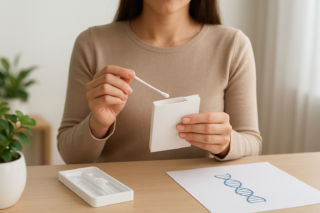
To do a DNA test at home, you order or purchase a test kit, register it with the testing company, collect saliva or cells from inside your cheek, seal the sample, and mail it to a laboratory. The laboratory analyzes selected parts of your DNA, and you typically receive results through a secure website or app. Although collection happens at home, the actual testing is performed in a laboratory.
How to Collect a DNA Sample at Home
Each kit has its own instructions, so follow them exactly. A typical test involves these steps:
- Choose the appropriate test. Decide whether you want ancestry information, health-related reports, carrier screening, biological relationship testing, or another type of analysis. Confirm precisely what the test examines before buying it.
- Register the kit. Most companies provide a barcode or identification number that connects the sample to your account without placing your name directly on the collection tube.
- Prepare for collection. Some saliva and cheek-swab kits instruct users not to eat, drink, smoke, chew gum, or brush their teeth for a specified period beforehand.
- Collect the sample. You may spit into a tube until the saliva reaches a marked line or rub a sterile swab firmly along the inside of each cheek. Avoid touching the swab tip.
- Seal and return it. Place the sample in the provided packaging and mail it according to the company’s instructions.
- Review the report. Processing time varies. Results are generally delivered online, although some clinical or relationship-testing laboratories may provide a written report.
An insufficient sample, contamination, improper labeling, or failure to follow collection instructions may prevent the laboratory from producing a result. The company may ask for another sample if quality checks fail. A detailed overview of the typical process is available from MedlinePlus Genetics’ guide to direct-to-consumer testing.
What Happens to the Sample in the Laboratory?
Laboratory technicians extract DNA from the cells in the saliva or cheek sample. The method used next depends on the test’s purpose.
- Genotyping checks selected locations in DNA for specific variants. Many consumer ancestry and health tests use this approach. It does not read every gene or identify every possible variant.
- DNA sequencing reads genetic material more extensively. A test may sequence one gene, a panel of genes, the protein-coding regions known as the exome, or much of the genome.
- Relationship testing compares highly variable DNA markers among the people being tested to evaluate whether the results support a claimed biological relationship.
Computer systems compare the laboratory findings with reference databases and scientific research. The resulting report may change over time as databases expand, reference populations improve, or researchers learn more about particular genetic variants.
What At-Home DNA Tests Can Reveal
| Type of report | What it may show | Important limitation |
|---|---|---|
| Ancestry | Estimated geographic ancestry, population similarities, haplogroups, or possible genetic relatives | Percentages are estimates and may differ among companies because reference databases and methods vary. |
| Traits | Genetic associations with characteristics such as taste preferences, hair features, or sensitivity to certain odors | Genes are only one influence; age, environment, lifestyle, and chance also affect many traits. |
| Health risk | Selected variants associated with a higher or lower likelihood of certain conditions | A risk result is not a diagnosis, and a negative result does not eliminate risk. |
| Carrier status | Whether you carry selected variants that could be passed to a child | Consumer tests may not examine every disease-causing variant in a gene. |
| Medication-related information | Variants that may be associated with how the body processes certain medicines | Results should not be used independently to start, stop, or change medication. |
| Biological relationships | Evidence supporting or excluding certain parent-child and other family relationships | A self-collected test may not meet chain-of-custody requirements for court or immigration use. |
Health-related testing is especially easy to misinterpret. Most common diseases result from a combination of multiple genes, health history, behavior, exposures, and other factors. The FDA’s information about direct-to-consumer tests explains that some tests receive FDA review while ancestry, general-wellness, and certain other products may not. Companies may also examine different variants, so two tests can produce reports that appear inconsistent.
At-Home Relationship Tests Versus Legal DNA Tests
A home paternity or kinship test may provide personal information, but legal testing requires verified identities, witnessed collection, secure handling, and documented chain of custody. If the result will be submitted to a court, government agency, child-support office, embassy, or immigration authority, contact the organization handling the case before collecting any samples.
The correct procedure is particularly important for family-based immigration matters. This overview of credible immigration DNA testing for family reunification explains why accredited testing and controlled collection differ from an ordinary home kit.
What a Consumer DNA Test Cannot Tell You
An at-home result usually cannot confirm that you have or will develop a disease. It may test only a small portion of the variants associated with a condition, and the meaning of a variant can depend on ancestry, family history, symptoms, and other clinical information.
A negative result should not replace routine checkups, cancer screening, prenatal care, or evaluation of symptoms. A positive result may need confirmation using a new sample tested by a clinical laboratory before it is used in healthcare decisions. Raw DNA files interpreted by third-party websites can be particularly prone to misleading or false-positive findings.
Check Privacy Policies Before Sending Your DNA
DNA data is personal, long-lasting information that can reveal details about biological relatives as well as the person tested. Before registering a kit, read the company’s current privacy and consent terms. Look for clear answers to these questions:
- Will the company keep the physical sample, and can you request its destruction?
- Can you delete your account and genetic data?
- Is participation in research optional?
- Will de-identified or identifiable information be shared or sold?
- Can other users discover you through a relative-matching feature?
- How does the company respond to legal requests or security incidents?
Do not submit another person’s sample without appropriate knowledge and consent. Testing children also deserves careful consideration because results may expose health or family information the child did not choose to learn. The Federal Trade Commission advises consumers to take the privacy of genetic information seriously rather than relying only on marketing claims.
When to Seek Professional Guidance
Speak with a primary care clinician, genetic counselor, or medical geneticist if a report identifies a potentially important health variant, conflicts with your personal or family medical history, or causes significant concern. Professional guidance is also appropriate before testing when you have a strong family history of cancer, heart disease, a neurological disorder, or another inherited condition, or when you are considering carrier testing before or during pregnancy.
Contact the healthcare professional who manages your medication if a test reports a possible drug-related finding. Do not change a prescription based only on a consumer DNA report. Confirmatory clinical testing may be necessary.
For reliable background information about conditions, screening, and medical tests, consult MedlinePlus health topics. At-home DNA tests can be informative, but their safest use is as a starting point for questions—not as a stand-alone diagnosis or treatment plan.
Other Articles You May Find of Interest...
- Cellular Communication: How Cells Coordinate Repair and Regeneration
- How At-Home DNA Tests Work and What They Can Reveal
- How a Biological Age Test Can Help You Understand Your Health
- The Immutable Nature of Hereditary Conditions: Understanding Why Change Isn’t Possible
- Unlocking the Secrets of the Einthoven Triangle for Heart Health
- Understanding the Implications of R91.1 in Health Diagnostics
- Unveiling the Role of DNA Antibodies in Autoimmune Disorders