






Your Health Magazine Contributor
4201 Northview Drive
Suite 102
Bowie, MD 20716
More Health Industry Insights Articles
How to Choose a Pharmaceutical Products Manufacturer: A Practical Checklist for Buyers

Picking a pharmaceutical products manufacturer looks simple on paper and gets complicated the moment you start comparing quotes. Two suppliers can offer the same tablet at a similar price, yet one may have clean audit records, tight batch documentation and steady delivery, while the other struggles with all three.
The global pharmaceutical manufacturing market is large and fragmented, with thousands of facilities competing for contract manufacturing and franchise business. There is no shortage of manufacturers to choose from. Not all of them work to the same standard.
This guide covers what to check before you sign with a pharma manufacturing company. It is written for franchise partners, brand owners who want to outsource production, and buyers building a dependable supply chain.
What a Pharmaceutical Products Manufacturer Actually Does
A manufacturer takes a formulation from an approved recipe to packed, tested, release-ready stock. That includes sourcing raw materials and active ingredients, granulating and compressing tablets, filling capsules and liquids, packing, labelling, and running quality checks at every stage.
Some manufacturers only make their own brands. Others offer contract manufacturing, also called third-party manufacturing or loan licensing, where they produce medicines under another company’s brand name. Which model you need changes the questions you should ask, so get clear on that first.
Why the Choice Matters More Than the Price
A low quote is easy to compare. Quality problems are not, because they usually show up late: a failed batch, a delayed shipment, a rejected consignment at the port, or a complaint from a chemist.
Each of these costs more than the few paise you saved per strip. A reliable manufacturer also protects your brand. When a product reaches patients, your name is on the pack, whoever made it.
7 Things to Check Before You Sign
1. Valid Licences and GMP Certification
Start with the paperwork. Ask for the manufacturing licence, the WHO-GMP certificate and any ISO certificates, then check the dates. A certificate that expired last year says little about today’s operations.
WHO GMP provides an internationally recognized framework for how medicines should be produced and controlled. WHO’s guidance treats GMP as part of a broader quality system designed to ensure products are consistently produced and controlled to appropriate standards. Depending on the market or tender, buyers may also require documentation showing compliance with WHO-GMP requirements.
2. Local Regulatory Compliance
Every country has its own drug regulatory authority and its own version of GMP rules layered on top of the international standard. Ask which national regulator the manufacturer is licensed under, when the licence was last renewed, and when the site was last inspected.
If you plan to sell in more than one country, check whether the manufacturer’s compliance record extends to the markets you care about, since a licence valid at home does not automatically clear customs elsewhere.
3. Product Range and Dosage Forms
Match the manufacturer’s range to what you actually need. Tablets, capsules, oral liquids, powders and sachets each need different equipment and different controls.
Ask for the full product list by dosage form and therapeutic segment. A wider range helps if you plan to add products later, because you can stay with one partner instead of splitting your business across several.
4. Production Capacity
Ask for daily capacity by dosage form, not a single headline number. A plant that turns out one crore tablets a day may have far smaller capacity for capsules or sachets.
Also ask how the plant handles a sudden rise in your orders. Some manufacturers will squeeze you in. Others will push you back in the queue behind larger clients.
5. Quality Control and Testing
Quality control is where good manufacturers separate themselves. Look for:
- An in-house QC laboratory
- Testing of raw materials before use
- In-process checks during production
- Finished product testing before release
- Stability studies and retained samples
- Complete batch manufacturing records
Ask to see a sample certificate of analysis. If you can visit the plant, walk through the QC lab and the warehouse. A clean, organised facility tells you a lot.
6. Regulatory and Export Support
If you plan to sell abroad, ask what documentation the manufacturer can provide. Product dossiers, certificates and registration support all save weeks of back and forth.
A manufacturer with export experience will already know the paperwork each market expects. One without it may learn on your time.
7. Track Record and Supply Reliability
Ask for references from two or three current clients and, where possible, speak to them. Find out whether deliveries are on time, whether batches are consistent and how the manufacturer handles complaints.
A supplier that answers difficult questions openly is usually a better long-term partner than one that only tells you what you want to hear.
Contract Manufacturing, PCD or Export: Which Model Fits?
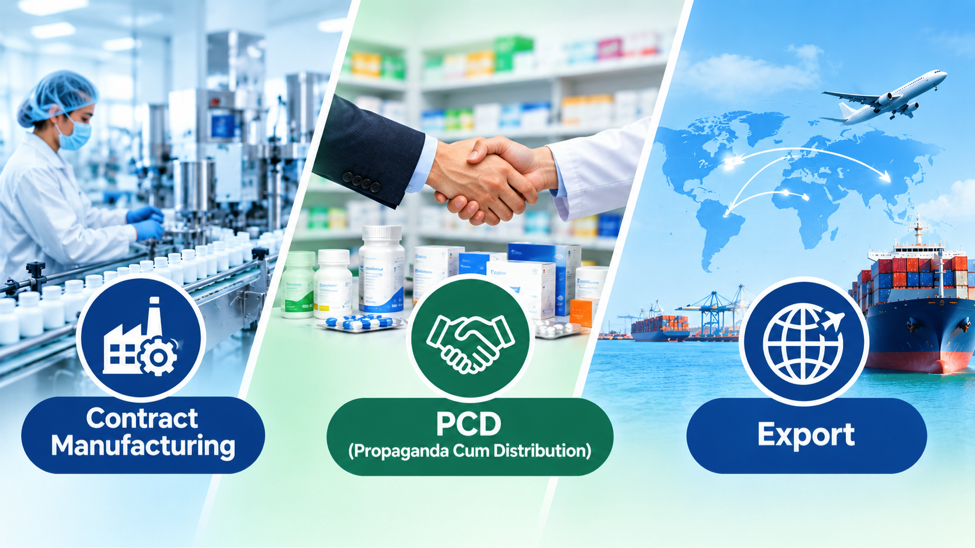
The manufacturing model you choose decides what you should expect from the partner.
- Contract or third-party manufacturing: You own the brand and the marketing. The manufacturer produces to your specifications. This suits companies that want their own labels without building a plant. A good pharmaceutical contract manufacturing partner should also help with formulation, packaging and documentation.
- PCD franchise: You market the manufacturer’s existing brands in an exclusive territory. Investment is lower, but you depend on the manufacturer’s product quality and range.
- Export supply: You buy finished formulations for overseas markets. Regulatory paperwork and dependable shipping matter most here.
What This Looks Like in Practice
It helps to see how the checklist applies to a real facility. One pharmaceutical products manufacturer with a WHO-GMP compliant plant has been in operation since 2017.
The facility reports an installed daily capacity of roughly ten million tablets, along with sizable capsule and sachet output, and more than 200 products across tablets, capsules, oral liquids and powders. It serves franchise partners, export customers and other pharma companies through contract manufacturing.
Numbers like these do not replace an audit. They do show the level of detail you should expect from any manufacturer you are considering: capacity stated by dosage form, certifications you can verify, and a clear list of services.
Red Flags to Watch For
- Certificates that are missing, expired or shown only as photos
- Refusal to allow a plant visit or a third-party audit
- Capacity claims with no breakdown by dosage form
- No written quality agreement
- Prices far below the market with no clear reason
- Vague answers about batch records, testing or deviations
Any one of these is worth a closer look. Several together are a reason to walk away.
Questions to Ask on Your First Call
- Which licences and certificates do you hold, and can I see current copies?
- Which national regulatory authority licenses your facility, and when was it last inspected?
- What is your daily capacity for the dosage form I need?
- What testing is done in-house, and what is sent to outside labs?
- What is your minimum order quantity and standard lead time?
- Can I visit the plant or send an auditor?
- Can you share references from current clients?
Conclusion
Choosing a pharmaceutical products manufacturer is less about the lowest price and more about verifiable quality, honest capacity numbers and a partner who is open to scrutiny. Check the licences, confirm regulatory compliance, ask for capacity by dosage form and speak to existing clients before you commit.
Frequently Asked Questions
What does a pharmaceutical products manufacturer do?
A pharmaceutical products manufacturer produces medicines in finished dosage forms such as tablets, capsules, syrups and powders. The work covers formulation, production, packing and quality control. Some manufacturers make their own brands, while others produce for third parties.
Is WHO-GMP certification mandatory for manufacturers?
Requirements vary by country, but most national regulators require compliance with a local GMP standard as a condition of holding a manufacturing licence. WHO-GMP certification is separate from the domestic manufacturing licence and may be required for certain export markets, procurement programs, or tenders. Requirements vary by destination and buyer.
How can I verify a manufacturer’s certificates?
Ask for current copies and check the issue and expiry dates. Confirm the manufacturing licence with the relevant national or regional drug authority, and consider a plant visit or a third-party audit before placing a large order.
What is the difference between contract manufacturing and a PCD franchise?
In contract manufacturing, you own the brand and the manufacturer produces to your specifications. In a PCD franchise, you market the manufacturer’s existing brands in an assigned territory. Contract manufacturing gives more control, while PCD needs less investment to start.
SEO Elements
Meta Title: How to Choose a Pharmaceutical Products Manufacturer
Meta Description: Looking for a pharmaceutical products manufacturer? Learn what to check, from WHO-GMP and Schedule M to capacity, QC and contract terms before you sign.
Suggested URL: /how-to-choose-pharmaceutical-products-manufacturer
Featured Image Alt : Quality control inspector reviewing batch records in a pharmaceutical product manufacturing lab
Image (1) Alt: Pharmaceutical business models: contract manufacturing, PCD distribution, and export.
Other Articles You May Find of Interest...
- How to Choose a Pharmaceutical Products Manufacturer: A Practical Checklist for Buyers
- How Digital Front Doors Reduce Patient Wait Times
- How Does an AI Medical Scribe Work During a Patient Visit?
- Magnesium Glycinate: What Supplement Labels Don’t Tell You
- What Is SD-WAN and How Does It Work for Healthcare Networking Teams?
- How Boutique Healthcare Consulting Firms Are Filling a Critical Compliance Gap
- 5 EHR Capabilities That Make Clinical Data Exchange Faster and Simpler





