More Kratom Education Articles
Red Thai Kratom: The Strain With a Complicated History and a Loyal Following

There’s a fact that most kratom buyers don’t know: a large amount of what’s marketed as “Red Thai kratom” was never grown in Thailand.
This isn’t an unsubstantiated rumor — it’s a fact that has shaped the market for more than a decade. Thailand prohibited the cultivation and possession of kratom starting in 1943. For the next 80 years, genuine Thai-origin kratom simply wasn’t available. Vendors kept using the name because demand for it never diminished, but the leaves themselves typically came from Indonesia, Malaysia, or other parts of Southeast Asia.
Thailand changed course in 2021 and legalized kratom for agricultural and medical purposes. Genuine Thai-grown kratom is gradually re-entering the world market, but the supply chain is still catching up.
Researching “Red Thai kratom” really means looking at two different things: the historical strain identity, and the current reality of sourcing. Both matter.
This article explains what Red Thai kratom actually is, how it fits into the broader kratom market, what the research on alkaloid chemistry shows, and what consumers and regulators have said about it. There are no health claims here — just factual information.
Important: Kratom is not approved by the FDA for any medical use. It has not been evaluated by the FDA for safety or effectiveness, and it may carry risks of dependence, withdrawal, and interactions with medications or other substances. Anyone considering kratom use, especially alongside prescription medication or an existing health condition, should speak with a doctor first.
The Naming Problem Nobody Talks About
Kratom strain names aren’t standardized. No official body certifies a batch as “authentic Red Thai.” The name is a commercial convention — useful as shorthand, but not a guarantee of origin or composition.
Red Thai kratom traditionally refers to the red-vein leaves of Mitragyna speciosa grown within Thailand’s kratom-growing tradition. “Red” refers to the vein color at harvest, which is associated with leaf maturity and specific processing methods.
Because Thai kratom was banned for most of its modern history, vendors adapted. Some sourced red-vein leaves from Malaysia or Indonesia and labeled them as Thai. Others claimed Thai genetics while growing on Indonesian land. The result is significant inconsistency under a single strain name.
This doesn’t mean Red Thai kratom is fake — it means the label deserves scrutiny. Ask vendors where the material was grown and processed. If they can’t answer in detail, that tells you something.
What “Red Vein” Actually Means for This Strain
The red vein is more than cosmetic — it reflects the plant’s stage of growth at harvest.
Kratom leaves with red veins are typically harvested at peak maturity, once the plant has had time to fully develop its alkaloid profile. The red color in the leaf and central vein is a visible marker of that maturity.
After harvest, red-vein leaves generally undergo a longer drying process than white- or green-vein varieties. Some producers use extended sun drying; others use indoor, low-light methods; some use partial fermentation, which can alter the ratio of alkaloids present.
Red Thai kratom, when made from properly processed mature leaves, reflects these same fundamentals. The drying and fermentation methods used in traditional Thai processing differ from those used in Borneo or Sumatra, which has historically contributed to the strain’s distinct reputation.
Alkaloids, Compounds, and What the Science Says
Kratom’s effects and the controversy surrounding its regulation both stem from its alkaloid content. The two most-discussed alkaloids are:
- Mitragynine — the most abundant alkaloid, present in varying amounts depending on source and processing
- 7-Hydroxymitragynine (7-OH) — present in smaller concentrations but more potent; a breakdown product of mitragynine
Both alkaloids interact with opioid receptors, which is why the FDA has expressed concern about kratom’s potential for dependence and misuse, and why kratom occupies a gray area in U.S. regulation.
Beyond these two, kratom contains more than 40 additional alkaloids, including speciogynine, paynantheine, and mitraphylline. Red-vein varieties typically show a different mitragynine-to-7-OH ratio than green or white varieties, largely due to maturation and post-harvest oxidation.
The specific alkaloid ratios in Red Thai kratom can vary significantly between vendors and batches. This is why third-party testing matters — without a certificate of analysis, it’s difficult to know what you’re actually getting.
Thailand’s Legal History and Why It Shapes the Market Today
The Kratom Act of 1943 made cultivation and possession of kratom illegal in Thailand. The ban was driven largely by economics — kratom competed with opium as a revenue source — as well as politics.
Despite the prohibition, kratom remained part of rural Thai tradition, particularly in the south, where it was used informally among rubber plantation workers. Enforcement was inconsistent, especially in remote areas.
On August 20, 2021, Thailand removed kratom from its list of controlled narcotics, effectively legalizing it. This was framed partly as harm reduction — acknowledging traditional use — and partly as a new revenue opportunity for Thai farmers.
Legalization has had real effects on Thailand’s kratom market: authentic Thai-origin product can now legally be produced and exported. But supply chains take time to rebuild, and the amount of genuinely Thai-grown kratom reaching international markets remains limited.
Anyone specifically seeking authentic Thai-origin product should ask vendors for proof of origin rather than relying on the label alone.
How Red Thai Compares to Other Red Vein Strains
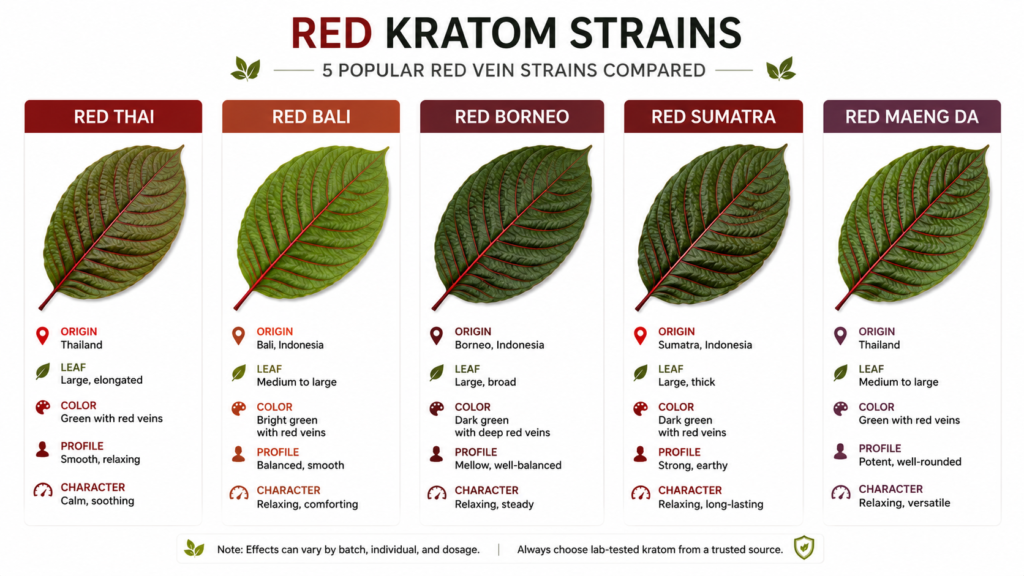
The red-vein family includes several well-known strains. Below is a comparison based on commonly stated (not verified) market characteristics.
| Strain | Common Description | Key Characteristics | Important Limitation |
| Red Thai | Historically linked to Thai cultivation traditions | Harvested at maturity, various processing methods; today mostly sourced from outside Thailand | Strain name alone doesn’t guarantee Thai origin; source transparency varies widely |
| Red Bali | A widely available red vein | Broad alkaloid profile, widely discussed | High sales volume increases risk of inconsistent quality or adulteration |
| Red Sumatra | Often described as earthy | Grown in volcanic Sumatran soil; associated with slow drying methods | Environmental factors alone don’t guarantee consistent manufacturing standards |
| Red Borneo | Sometimes described as milder than other reds | Grown in rainforest conditions; widely available at lower price points | Inconsistency common at lower price points; naming used differently across vendors |
| Red Maeng Da | Marketed as a high-potency option | Usually a blend or specially processed variety rather than a single region | “Maeng Da” is not a geographic origin — it’s a marketing/quality term that varies by vendor |
No strain is inherently superior to another. Testing transparency, processing quality, and sourcing integrity matter more than the name on the label.
What Longtime Consumers Report About Red Thai
Kratom consumer forums — including Reddit, Bluelight, and dedicated community boards — have recorded consumer observations about Red Thai kratom for years.
Commonly reported characteristics include:
- A flavor and aroma profile that some users describe as distinct from Bali or Borneo reds
- Onset timing that users often describe as moderate — neither immediate nor especially delayed
- A flavor described as earthy with a somewhat bitter aftertaste
- Comparisons from users who have tried multiple red-vein strains
These are self-reported, anecdotal observations, not clinical data. Kratom is not recognized by the FDA as a treatment for any condition, and individual experiences vary based on metabolism, tolerance, body weight, and product potency.
Consumer forum data is useful for understanding how people talk about their experiences. It should not be interpreted as evidence of any medical benefit.
Testing Standards, Labels, and What Actually Protects Consumers
The U.S. kratom market operates without federal regulatory oversight. The FDA has flagged kratom as a substance of concern but has not formally scheduled it. As a result, consumer protections largely depend on state law.
States with active Kratom Consumer Protection Act (KCPA) legislation include Utah, Georgia, Arizona, Nevada, Oklahoma, and others. These laws typically require:
- Accurate labeling of alkaloid content
- Age restrictions on sales
- Prohibition of adulterated products
- Third-party testing standards
For any Red Thai kratom product, a responsible vendor should provide:
- Certificate of Analysis (COA) from an accredited, independent laboratory
- Heavy metal panel testing for arsenic, lead, mercury, and cadmium
- Microbial screening confirming the absence of harmful bacteria
- Mitragynine percentage specific to the batch
- AKA GMP certification (voluntary compliance with American Kratom Association manufacturing guidelines)
Transparency on these points is a key distinction between vendors operating to a reasonable standard and those that are not.
Four Misconceptions About Red Thai Kratom That Need Correcting
Misconception: Red Thai kratom is always grown in Thailand. Reality: For most of the 20th century and into the 2010s, this was essentially impossible. Thailand’s 1943 ban halted legal cultivation, and most “Red Thai” products sold during that period were actually grown in Indonesia or Malaysia. Thailand didn’t legalize kratom again until 2021, and authentic Thai-grown supply remains limited on the global market.
Misconception: Red-vein strains are automatically more potent than white or green. Reality: Vein color reflects leaf age and processing method, not potency by itself. Mitragynine concentration — the main driver of alkaloid strength — depends on growing conditions and post-harvest processing, not vein color alone. A well-processed green-vein batch can contain more mitragynine than a poorly processed red-vein batch.
Misconception: Legal status means the product is safe to use. Reality: Legality and safety are separate questions. Kratom is legal in many U.S. states and, as of 2021, in Thailand itself, but legal status does not equal FDA approval or clinical safety validation. Dependence, withdrawal, and interactions with other substances are documented risks associated with kratom use regardless of its legal status.
Misconception: All Red Thai kratom from a given vendor is identical batch to batch. Reality: Kratom is an agricultural product, and alkaloid content can shift with harvest timing, soil conditions, and processing variables. Even well-run vendors can see batch-to-batch variation, which is why COAs need to be specific to each batch rather than reused across multiple production runs.
Frequently Asked Questions
How does Red Thai kratom differ from other red-vein strains in alkaloid composition?
It depends on the vendor and batch. All red-vein kratom shares the trait of being harvested at a more mature stage, which affects alkaloid ratios compared to white or green veins. Whether Red Thai differs meaningfully from Red Bali or Red Borneo isn’t established by independent research — consumer reports suggest some perceived differences, but without standardized lab comparisons across origins, those differences remain unverified. Any vendor making specific alkaloid claims about Red Thai versus other reds should be able to back it up with COA data.
Can you actually buy genuine Thai-grown kratom now that Thailand has legalized it?
Technically yes, but in practice it’s more complicated. Thailand legalized kratom in 2021 and removed it from its narcotics list, so Thai farmers can now legally grow, process, and export it. However, the supply chain is still developing, and the volume of authentic Thai-origin kratom reaching U.S. consumers remains relatively small compared to Indonesian-origin material. If Thai origin matters to you, ask vendors for specific documentation rather than relying on label claims alone.
What should I know about Red Thai kratom’s legal status before buying?
Kratom’s legal status in the U.S. varies by state. It is not federally scheduled, so there’s no nationwide ban, but Alabama, Arkansas, Indiana, Rhode Island, Vermont, and Wisconsin have statewide bans, and many counties and cities have local ordinances even in states where kratom is otherwise allowed. Laws change regularly, so check current regulations for your specific location before purchasing rather than relying on outdated information or vendor claims.
How can I evaluate the quality of a Red Thai kratom product before purchasing?
Start with the certificate of analysis. It should be batch-specific, issued by an accredited third-party lab, and include mitragynine content, heavy metal testing (lead, arsenic, mercury, cadmium), and microbial testing. Look for AKA GMP accreditation, which indicates voluntary compliance with manufacturing standards. Check independent reviews rather than vendor testimonials, and confirm the vendor discloses where the product was grown and processed. A vendor that can’t answer basic sourcing questions or provide test results doesn’t meet a reasonable standard of transparency.
Is there a dependence risk associated with Red Thai kratom specifically?
Any kratom product carries a risk of psychological and physical dependence with regular use, and Red Thai is no exception. This is part of why the FDA has specifically cited kratom’s interaction with opioid receptors as a concern, and documented cases of kratom withdrawal show characteristics similar to opioid withdrawal. Risk factors include frequency, amount used, and duration of use. The strain name — Red Thai, Red Bali, or otherwise — does not meaningfully change this risk profile; it’s a risk inherent to the substance itself, not specific to any one strain.
The Full Picture on Red Thai Kratom
Red Thai kratom is one of the more complicated stories in the kratom market — a name tied to a country where it was banned for over 80 years, sourced and rebranded under that name with varying degrees of authenticity, and now entering a new chapter as Thailand re-legalizes production.
What stays constant is that the strain name is only a starting point. Product quality comes down to sourcing transparency, alkaloid testing, manufacturing standards, and honest labeling.
Key takeaways:
- Red-vein classification reflects leaf maturity and processing, not necessarily quality
- Claims of Thai origin need supporting evidence, not just a label
- Third-party COAs are essential for making an informed purchase
- Legal status does not equal a safety certification
- Consumer-reported experiences are anecdotal, not clinical evidence
The kratom market continues to evolve, regulatory frameworks are still developing, and research is ongoing. Understanding what a strain name actually signifies — both historically and in practice — is the foundation for any honest discussion of it.
Other Articles You May Find of Interest...
- Kratom Legality in 2026: Why the Rules Vary by Location
- 7 Things to Know About Split Kilo Kratom Before a Bulk Order
- Red Thai Kratom: The Strain With a Complicated History and a Loyal Following
- Red Sumatra Kratom: What Makes This Strain Stand Apart
- Red Indo Kratom: The Strain That Built the Modern Kratom Market
- Red Hulu Kapuas Kratom: What Makes This Rare Strain So Talked About?
- Red Borneo Kratom: The Strain That Built the Modern Kratom Market