






More Kratom Education Articles
Kratom Tea: What You Actually Need to Know Before You Brew

Many people believe that kratom tea is simply leaves steeped in hot water. That assumption is incorrect.
Kratom tea has been prepared and consumed across Southeast Asia for centuries. Farmers in Thailand and Malaysia used it regularly. It was not a wellness trend — it was a practical, cultural tradition integrated into daily life.
Today, the U.S. market has adopted it quickly. It is available in specialty shops, online stores, and sometimes convenience outlets. That rapid growth brought a large volume of information — and much of it is inaccurate.
Most available information on kratom tea tends toward extremes. It is either marketed as a cure-all or dismissed without context. Neither approach helps consumers make informed decisions.
This article explains what kratom tea is, what it contains, how quality varies, and which safety and regulatory considerations matter most. The focus is on facts.
Important: Kratom is not FDA-approved for any use. It may cause physical dependence with regular use, may interact with prescription and over-the-counter medications, and carries other documented health risks. Anyone considering kratom use should consult a licensed healthcare provider before doing so.
What Is Kratom Tea?
Kratom tea is a beverage made from the leaves of Mitragyna speciosa, a tropical tree native to Southeast Asia.
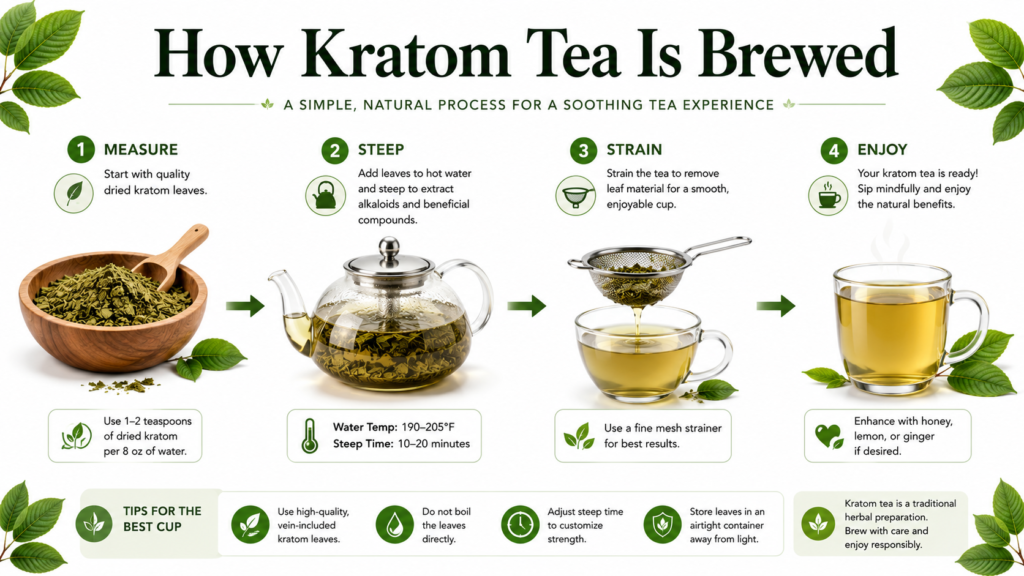
To prepare kratom tea, dried leaves or powder are brewed in hot liquid. Active compounds dissolve into the liquid, and the plant matter is then removed. What remains is the brewed tea.
Some people brew using whole dried leaves. Others use powder. A smaller number use kratom extract for a more concentrated preparation. The method of preparation influences extraction, though research in this area remains limited.
More Than a Typical Tea: Understanding Kratom’s Complexity
The word “tea” implies something mild, such as chamomile or green tea. That framing can cause consumers to underestimate what they are consuming.
Kratom tea contains mitragynine and 7-hydroxymitragynine — alkaloids that interact with opioid receptors in the brain. The mechanism differs from that of conventional opioids, but the receptor interaction is real and has been documented in research.
The term “tea” does not convey this. First-time users may approach it as they would an ordinary herbal beverage. The gap between that expectation and reality is where problems often begin.
Key Characteristics of Kratom Tea
Several factors influence what ends up in the finished drink:
Vein color: Red, green, and white vein classifications originate from the same plant at different stages of maturity. Processing methods also affect vein color classification.
Geographic origin: Kratom sourced from different regions — such as Borneo or Bali — may carry different alkaloid profiles depending on local climate and soil conditions.
Leaf-to-water ratio: A higher proportion of plant material per cup results in greater alkaloid content in the brew.
Water temperature: Excessive heat may degrade certain alkaloids. Many users steep at temperatures below boiling.
Steeping time: Longer steeping extracts more alkaloids into the liquid.
These variables make standardization difficult. Two identically marketed products may differ meaningfully in their alkaloid composition.
Understanding Alkaloids and Composition
Mitragynine is the primary alkaloid found in kratom, typically accounting for the largest share of total alkaloid content, though this varies depending on origin and harvest conditions. Researchers have identified more than 40 alkaloids in Mitragyna speciosa, but mitragynine and 7-hydroxymitragynine receive the most scientific attention.
7-hydroxymitragynine is present in smaller quantities but is considered more potent per unit. Research suggests it may account for a significant portion of kratom’s physiological effects.
Water-soluble alkaloids extract effectively during brewing. Adding an acidic liquid, such as lemon juice, prior to steeping may enhance extraction of certain compounds.
Processing, Harvesting, and Quality
Quality begins at the source. After harvest, leaves are dried under varying conditions. Whether drying occurs indoors or outdoors, and the level of humidity and sunlight exposure, all affect the final alkaloid concentration. Vein color distinctions are also shaped by processing methods, not only natural variation in the plant.
Reliable vendors document their supply chains. They can identify where leaves were cultivated and harvested, when they were collected, and how they were sorted and processed. Vendors who cannot provide this information offer insufficient transparency for quality assurance.
Kratom Tea vs. Other Common Varieties
| Strain | Common Description | Key Characteristics | Notable Limitation |
| Red Bali | Widely used red vein variety | High mitragynine content | Effects vary significantly between batches and vendors |
| Green Malay | Mid-vein variety from Malaysia | Broad alkaloid profile; widely available | Limited peer-reviewed research specific to this strain |
| White Borneo | White vein variety from the Borneo region | Often processed differently from green and red varieties | Vein color is partially determined by processing, not plant biology alone |
| Maeng Da | Applied across multiple vein colors | Widely marketed as high-potency | Not a standardized classification; composition varies considerably |
Traditional Background and Modern Market Context
Kratom leaves were chewed or brewed by agricultural workers in Thailand and Malaysia. Their use was associated with labor culture, not wellness or recreation.
Thailand prohibited kratom in 1943 under the Kratom Act, partly due to economic competition with opium taxation. The ban was lifted in 2021.
In the United States, kratom occupies a legally ambiguous position. It is not federally regulated, but several states have prohibited it. The FDA continues to evaluate kratom’s safety profile and has issued multiple public warnings.
The U.S. market expanded faster than regulatory frameworks could keep pace. The result is an uneven marketplace where product quality varies significantly between vendors.
Safety and Regulatory Considerations
Third-party testing: Reliable vendors submit their products to independent laboratory testing. Certificates of Analysis (COAs) should include alkaloid content, heavy metal levels, microbial contamination results, and pesticide screening.
Manufacturing standards: The American Kratom Association (AKA) operates a Good Manufacturing Practice (GMP) program. Participating vendors are subject to audits and testing requirements — among the few structured quality standards available in an otherwise unregulated industry.
Label transparency: Labels should clearly indicate vein color, geographic origin, batch number, and testing status. Incomplete or vague labels are a warning sign.
Contaminant screening: Past product recalls have involved salmonella contamination and undisclosed pharmaceutical additives. Third-party screening reduces but does not eliminate this risk.
Health risks: Kratom is not FDA-approved. Regular use may result in physical dependence. Kratom may interact with prescription medications, particularly those affecting the central nervous system. Adverse effects have been documented. Individuals with existing health conditions or those taking medications should consult a healthcare provider before using any kratom product.
Legal status: Kratom is prohibited in Alabama, Arkansas, Indiana, Rhode Island, Vermont, and Wisconsin. Certain municipalities maintain additional local restrictions. Legal status is subject to change. Always verify applicable laws in your location before purchasing.
Common Misconceptions About Kratom Tea
Misconception: It is safe because it comes from a plant.
Fact: Natural origin does not determine safety. Mitragynine and 7-hydroxymitragynine are opioid receptor agonists. Dependence and adverse effects have been documented in research.
Misconception: Different strain names indicate different chemistry.
Fact: Names such as “Maeng Da” or “Red Bali” are largely marketing terms. Research indicates that alkaloid content varies more widely between brands than between named varieties.
Misconception: Brewing eliminates the risks associated with powder consumption.
Fact: The primary alkaloids are water-soluble and are concentrated through the brewing process. The method of preparation changes the delivery experience but not the nature of the active compounds.
Misconception: The absence of FDA scheduling means kratom is approved or safe.
Fact: Unscheduled status does not mean approved. The FDA has issued multiple public warnings about kratom and continues to review its regulatory status.
Frequently Asked Questions
What is the difference between kratom powder and kratom tea?
Kratom powder consists of dried, ground leaves consumed directly in liquids or capsules. Kratom tea is prepared by steeping dried leaves or powder in hot water and then straining out the plant material. Brewing extracts water-soluble alkaloids into the liquid while leaving plant fiber behind. Some users report that tea is easier to digest than raw plant material. Extraction efficiency depends on water temperature, steeping time, and water chemistry.
Does brewing reduce the potency of kratom?
Not significantly. Water-soluble alkaloids extract effectively from plant matter during steeping. The strength of the brew depends on the amount of material used and the steeping duration. Adding an acidic liquid prior to brewing may enhance extraction of certain alkaloids. Some users report a faster onset with tea compared to powder, which may relate to the dissolved form of the alkaloids being absorbed more readily.
What alkaloids are present in kratom tea?
The two primary alkaloids are mitragynine and 7-hydroxymitragynine. Mitragynine is the most abundant by volume. 7-hydroxymitragynine is present in smaller quantities but is considered more potent per unit. Both interact with mu-opioid receptors. More than 40 alkaloids have been identified in the plant, and their concentrations vary based on geographic origin, harvest maturity, and processing method.
Is kratom tea legal in the United States?
Kratom has not been federally scheduled as a controlled substance. However, Alabama, Arkansas, Indiana, Rhode Island, Vermont, and Wisconsin have prohibited it at the state level. Some cities and counties maintain their own restrictions. The legal landscape is subject to change. Anyone considering kratom tea should review their specific state and local laws before purchasing or consuming.
How does vein color affect kratom tea?
Vein color refers to the color of the leaf’s central vein at the time of harvest. Red vein varieties are typically derived from more mature leaves, while white and green varieties come from younger leaves. Drying conditions and processing methods also influence final vein classification. Consumers often report different experiences with different vein colors, but controlled research on distinct alkaloid profiles by color remains limited. Much of the reported variation may reflect processing or regional differences rather than vein color alone.
Bottom Lines
Kratom tea is derived from Mitragyna speciosa, a plant with a long history of traditional use in Southeast Asia and a complex modern profile in Western markets.
The active alkaloids in kratom tea interact with opioid receptors, which is what distinguishes it pharmacologically from ordinary herbal teas. Regular use carries a documented risk of dependence. Product quality varies widely in an unregulated market.
Kratom is not FDA-approved, carries documented health risks, and may interact with medications. Anyone considering its use should consult a licensed healthcare provider.
Consumers interested in kratom tea should seek products with verified COAs, transparent labeling, and vendors with documented quality practices.
Research on kratom remains ongoing and incomplete. Staying informed about new findings and regulatory developments is the most prudent approach for anyone considering this product.
Other Articles You May Find of Interest...
- Kratom Legality in 2026: Why the Rules Vary by Location
- 7 Things to Know About Split Kilo Kratom Before a Bulk Order
- Red Thai Kratom: The Strain With a Complicated History and a Loyal Following
- Red Sumatra Kratom: What Makes This Strain Stand Apart
- Red Indo Kratom: The Strain That Built the Modern Kratom Market
- Red Hulu Kapuas Kratom: What Makes This Rare Strain So Talked About?
- Red Borneo Kratom: The Strain That Built the Modern Kratom Market





