






More Senior Health Articles
How to Know When a Parent Is No Longer Safe Living Alone: 10 Warning Signs
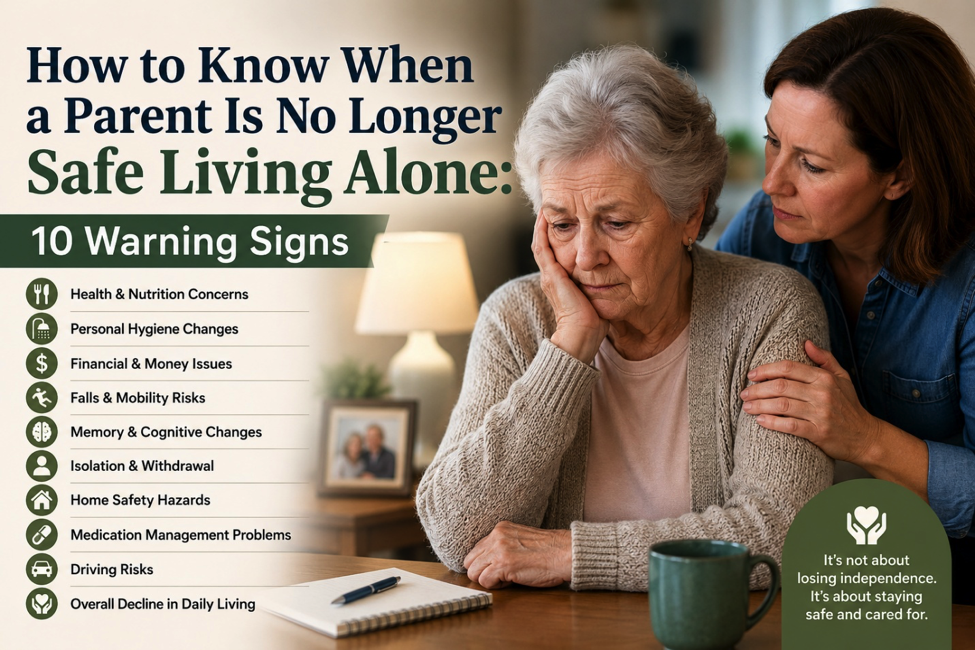
Watching a parent grow older brings a quiet, persistent worry that tends to surface in small moments — a missed phone call, a fridge that looks a little too empty, a story repeated twice in one visit. Most of us want our parents to stay independent in the homes they love for as long as possible. The difficult part is recognizing the moment when ordinary aging has quietly crossed into something that puts their health and safety at real risk.
Acting too soon can feel like taking away someone’s freedom; waiting too long can have serious consequences. The signs below are the ones families and care professionals watch for most closely, and each is grounded in what the research tells us about the real risks older adults face. Noticing one may simply call for a conversation. Noticing several together is usually a clear signal that it’s time to consider more support.
1. Unexplained Weight Loss or an Empty Refrigerator
Significant weight loss is one of the most telling signs that a parent is struggling at home. Cooking may have become too tiring or confusing, grocery shopping too difficult, or the motivation to eat simply gone — and the risk is widespread. A national study of older Americans found that roughly 1 in 4 were at risk of malnutrition, with those living alone among the most vulnerable. Check the refrigerator and pantry during visits: spoiled food, bare shelves, or untouched meals all point to a problem. Poor nutrition weakens the body, slows recovery from illness, and raises the risk of falls, so it deserves attention rather than being dismissed as a smaller appetite.
2. A Noticeable Decline in Personal Hygiene
When a normally well-groomed parent stops bathing regularly, wears the same clothes for days, or develops noticeable body odor, it often means daily tasks have become overwhelming. Stepping into a shower may feel unsafe, or the steps involved in grooming may have become hard to remember and sequence. Unwashed hair, long unkempt nails, or a sudden indifference to appearance are not signs of laziness — they are signs that self-care now requires more help than your parent can manage alone.
3. Unpaid Bills and Growing Financial Confusion
A stack of unopened mail, late-payment notices, or services being shut off can reveal that managing money has become too much. Aging parents may forget to pay bills, pay the same one twice, or struggle with financial steps they once handled easily. This sign carries an added danger: older adults are prime targets for fraud. The Federal Trade Commission reports that adults 60 and older lost about $2.4 billion to fraud in 2024 — roughly four times the total from 2020 — and estimates the true cost runs far higher because most fraud goes unreported. If you spot unusual withdrawals or strange purchases, treat it as a red flag worth a closer, gentle look.
4. Frequent Falls, Bruises, or Trouble Moving Safely
Falls are the leading cause of injury and injury-related death among adults 65 and older, and the CDC reports that about 1 in 4 older adults falls each year. A single serious fall can change everything. Watch for unexplained bruises, new hesitancy on stairs, furniture used for balance, or a parent gripping walls to steady themselves. Some will hide a fall out of pride or fear of losing independence. If the home has become an obstacle course they navigate cautiously, their environment may no longer be safe without assistance close at hand.
5. Forgetting Medications — or Taking Them Incorrectly
Managing multiple prescriptions takes organization and memory, and mistakes here can be dangerous. Research shows roughly half of older adults with chronic conditions do not take their medications as prescribed, and the CDC notes that adults 65 and older are far more likely than younger patients to end up in the emergency room from an adverse drug event. Look for pills left past their refill date, doubled doses, or a parent who can’t clearly explain what they take and when. When medication management slips, it is one of the clearest signs that daily oversight has become a genuine health necessity.
6. Getting Lost in Familiar Places
Becoming disoriented on a route they have driven for years is a serious warning sign, and one closely tied to dementia. The Alzheimer’s Association reports that 6 in 10 people living with dementia will wander at least once, and doing so can be life-threatening. A parent who gets lost coming home from the grocery store, forgets how they arrived somewhere, or feels confused in their own neighborhood may be experiencing cognitive decline that makes living alone unsafe. This kind of disorientation tends to worsen over time and can escalate quickly, especially if your parent still drives.
7. A Home That Has Become Messy, Cluttered, or Unsafe
A sudden change in how a parent keeps their home speaks volumes. Piles of clutter, unwashed dishes, scorched pots, or a lingering smell can indicate they can no longer keep up. Pay special attention to safety hazards: a stove left on, scorch marks near burners, or smoke detectors with dead batteries. When someone who once took pride in a tidy home can no longer maintain a safe living space, the environment itself has started working against them — and small hazards can turn into emergencies.
8. Withdrawal from Friends, Hobbies, and Social Life
Pulling away from activities and relationships they once loved can signal depression, declining health, or early cognitive change — and the stakes are higher than they appear. A large analysis funded by the National Institute on Aging found that loneliness raises the risk of dementia by about 31%, a magnitude comparable to physical inactivity or smoking. A parent who stops attending church, drops a long-standing card game, or avoids phone calls may be isolating because tasks have become too hard or embarrassing. A noticeable retreat from the world is worth gently exploring rather than accepting as simply slowing down.
9. Memory Lapses That Affect Daily Safety
Everyone misplaces keys now and then, but memory lapses that touch safety are different. With nearly 7 million Americans age 65 and older living with Alzheimer’s, these changes are common. Leaving the front door unlocked or open, forgetting whether the stove is off, repeating the same question within minutes, or missing important appointments all suggest memory changes that put your parent at risk. The concern isn’t occasional forgetfulness — it’s when those lapses begin to threaten their wellbeing or the security of the home around them.
10. Recent Car Accidents or Close Calls Behind the Wheel
New dents and scrapes on the car, traffic tickets, or stories of near-misses are signs that driving may no longer be safe. The CDC reports that roughly 25 older adults are killed and more than 740 injured in crashes every day in the United States. Slower reflexes, vision changes, and confusion can make a once-confident driver a hazard to themselves and others. Driving is deeply tied to independence, so this is rarely an easy conversation — but a pattern of accidents or getting lost on the road is a strong sign your parent needs more support.
Trusting Your Instincts and Taking the Next Step
One warning sign in isolation may simply call for a helping hand or a few changes around the house. But when several appear together, they usually point to the same conclusion: living alone is no longer safe. Trust what you observe, and don’t wait for a crisis or a serious fall to force the decision.
Start with an honest, compassionate conversation. Lead with love rather than alarm, focus on your parent’s safety and comfort, and involve them in the choices ahead whenever possible. It also helps to speak with their doctor, who can assess health and cognition and point you toward appropriate next steps.
When extra help at home is no longer enough, a supportive senior living community can offer the safety, daily assistance, and companionship your parent needs while still honoring their dignity and independence. Communities such as Stratford Place Assisted Living and Memory Care provide professional care, around-the-clock support, and a warm, engaging environment that gives families genuine peace of mind. Touring a community, asking questions, and picturing your parent there is often the clearest way to know whether the time is right.
Recognizing that a parent can no longer safely live alone is one of the hardest realizations a family faces. But seeing these signs early is an act of love — it lets you step in with care and a plan instead of reacting to an emergency. By paying attention, starting the conversation kindly, and seeking the right support, you can help your parent move into the next chapter feeling safe, valued, and cared for.
Sources
- Centers for Disease Control and Prevention — Facts About Falls
- Centers for Disease Control and Prevention — Medication Safety Facts & Stats
- Centers for Disease Control and Prevention — Older Adult Drivers
- National Institute on Aging — Loneliness Linked to Dementia Risk
- Alzheimer’s Association — Wandering
- Alzheimer’s Association — Alzheimer’s Facts and Figures
- Federal Trade Commission — Protecting Older Adults Report (2024–2025)
- Prevalence of Malnutrition in a National Sample of Older Adults (NHATS)
- Medication Non-adherence and Adverse Health Outcomes — Systematic Review
Other Articles You May Find of Interest...
- Seen and Unheard; Elder Abuse
- Coping With Cancer In Older Adults
- The Number Families Should Ask About Before Touring a Nursing Home for a Parent
- Daily Personal Support: What Assisted Living Provides Residents
- How Nurse-Led Home Care Can Support Aging in Place in Scottsdale
- Understanding Home Care Options for Older Veterans in Australia
- How Digital Communication Helps Seniors Stay Connected With Family and Communities



