More Essential Business Tools For Marketing Healthcare Articles
How Dental Web Design Shapes SEO Performance and Local Search Visibility
Here’s something most dental practices never fully reckon with: your website isn’t just a digital business card sitting quietly on the internet. It’s actively working, or actively failing, every single day. Every design choice you make either helps new patients find you or pushes you deeper into search obscurity.
BrightLocal’s 2025 research confirms that only 4% of consumers say they “never” read online business reviews. Nearly every prospective patient is looking you up before they ever pick up the phone. A poorly built site means they’re finding someone else instead.
Why Dental Web Design, Dental Seo, and Local Search Visibility Are Deeply Linked
You can’t separate design from discoverability; they’re the same conversation. Google, Maps, and AI-powered search assistants all read your site’s architecture to decide what your practice is, where it operates, and whether it deserves to rank. When design choices clash with how crawlers evaluate pages, even outstanding content gets ignored.
The practices that win in local search tend to be those that build quality dental web design around both visual appeal and technical precision. Well-structured service pages, logical internal linking, and a clean site hierarchy give your dental SEO efforts an actual platform to perform on. When design and SEO are treated as two separate departments? You get inconsistent results at best.
Local SEO for dentists is another area where design is routinely underestimated. Many practice owners invest heavily in their Google Business Profile while ignoring whether their actual website can support conversions. A disorganized site will quietly neutralize even your strongest off-site efforts.
The Structural Foundations of a Dental Website That Actually Ranks
First Impressions Matter, Especially Above the Fold
It sounds simple, but you’d be surprised how many dental sites fail within the first three seconds of a visit. If neither a human visitor nor a search crawler can immediately answer “who are you, what do you offer, and where are you?”, the opportunity is gone.
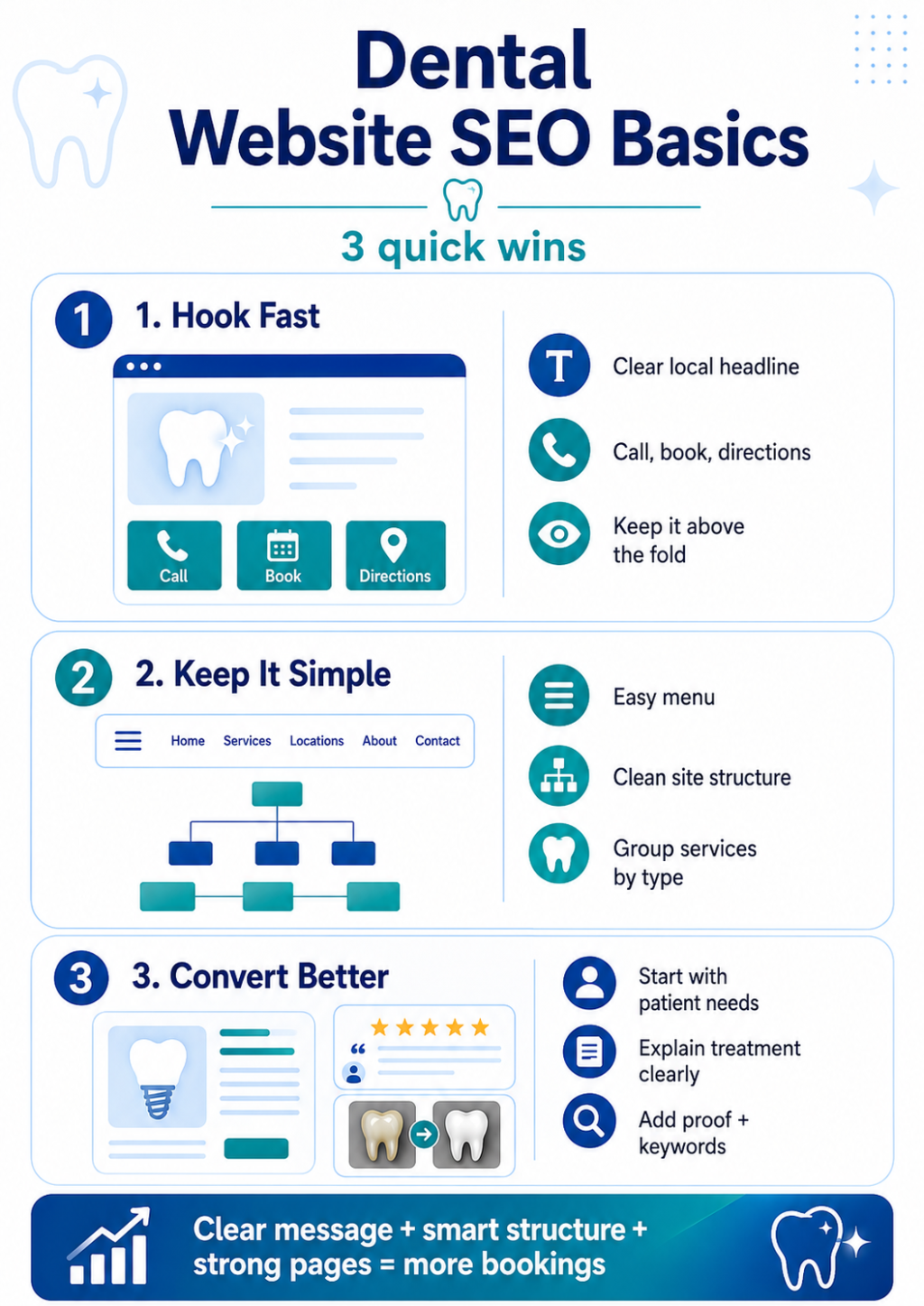
Your hero section needs to do real work. Lead with something clear and local: “Family dentist in [City], accepting new patients.” Back that up with a click-to-call button, a visible booking prompt, and fast access to directions. No guesswork, no buried information. Collaborating with a specialized web design agency Chicago guarantees that your practice implements these conversion-focused layout strategies effectively, converting casual website traffic into loyal, long-term patients.
Navigation That Works for Patients and Crawlers Alike
After your hero section earns attention, the navigation structure has to keep things moving. Dead ends are expensive. A logical menu, Home, Services, Locations, New Patients, Blog, Contact, creates a shallow, crawlable site structure that search engines appreciate.
Group treatment pages by specialty: Implants, Invisalign, Emergency Care, Pediatric Dentistry. This approach signals topical authority and helps Google draw meaningful connections between related content across your site.
On-Page Layouts Designed to Actually Convert
Getting visitors to the right page is one thing. Keeping them there and convincing them to book is another. Each service page should tell a story: open with a patient’s concern, move into treatment details, then close with social proof like testimonials or before-and-after photos.
Naturally weaving in terms like dental website SEO within your headers communicates topical relevance to search engines without feeling forced or awkward to read.
Mobile-First Design is No Longer Optional
Let’s be blunt. According to DataReportal, 60 percent of global web traffic now comes from mobile devices. If your site performs poorly on a smartphone, you’re effectively invisible to the majority of patients searching right now.
Mobile Layouts That Move the Needle
Knowing mobile matters is step one. Knowing what to actually build is step two. Sticky call buttons, thumb-sized navigation, and collapsible FAQ sections all reduce friction for someone searching from their car, their couch, or their lunch break.
Short paragraphs matter more on mobile than you might think. Patience runs thin fast on a small screen, and scannable benefit lists keep attention when attention is already scarce.
Page Speed is a Ranking Signal, Not a Bonus Feature
Even a perfectly designed mobile layout collapses under slow load times. Heavy before/after photo sliders, bloated plugins, and unoptimized third-party scripts are the most frequent offenders on dental sites.
Compressing images, cutting unnecessary scripts, and preloading critical assets can meaningfully shorten load times. Google doesn’t just prefer faster sites; it rewards them with better rankings because user experience is baked directly into its evaluation criteria.
Designing Local Seo Into Your Site From the Ground up
Location Architecture That Signals Geographic Relevance
Speed and mobile performance earn Google’s attention. But converting that attention into local patients requires your site to speak directly to the communities you actually serve.
Single-location practices need rich local content integrated throughout their core pages. Multi-location practices need dedicated individual location pages, each with unique content, localized patient testimonials, and embedded maps. Internal linking between location and service pages (think “Dental implants in [City]”) reinforces the geographic relevance that local search demands.
Nap Consistency and Embedded Local Elements
Every instance of your Name, Address, and Phone number needs to match across your header, footer, Contact page, and anywhere else it appears. Inconsistencies confuse crawlers and quietly erode your local rankings over time.
Clickable phone numbers reduce friction for mobile users ready to act immediately. Google Maps embeds, and photos of recognizable local landmarks add authenticity and signal genuine community presence.
Aligning Your Website With Your Google Business Profile
Your website and your Google Business Profile should feel like two parts of one unified message. Mirror the categories and service descriptions from your profile onto your site pages. Create FAQ content that answers the exact questions patients leave in reviews, “Do you accept my insurance?” being the classic example. Closing that loop between GBP discovery and on-site confidence is what turns clicks into booked appointments.
Design Elements That Convert Seo Traffic Into Real Dental Leads
Ranking well is only the first problem to solve. A high-ranking site that doesn’t inspire action isn’t generating revenue; it’s just getting traffic with nowhere to go.
| Design Element | Weak Version | Strong Version |
| CTA Text | “Contact Us” | “Book Same-Day Emergency Visit” |
| Review Placement | Footer only | Hero section + service pages |
| Mobile CTA | Buried in the menu | Sticky button, always visible |
| Trust Signals | Generic icons | Real credentials + patient photos |
| Form Length | 8+ fields | 3 fields max with instant confirmation |
Trust Signals That Reduce Hesitation Before it Starts
Patients don’t click “Book Now” for a practice they don’t yet trust. Displaying dentist credentials, professional memberships, real testimonials, and star ratings prominently takes doubt off the table early in the visit.
Generating dental leads consistently requires more than traffic; it requires reassurance. Insurance logos, financing information, and HIPAA-compliant form notes all contribute to an environment where first-time visitors feel confident enough to commit.
Common Questions About Dental Web Design and Local Seo
How long does a new dental website typically take to rank in local results?
Most practices see early movement within 3–6 months. Competitive markets can stretch that timeline. Consistent content updates, local citations, and strong on-page dental SEO signals all accelerate progress.
Can a template-based website compete with a custom build for dental SEO?
Templates can perform reasonably well on a fast, clean platform with properly optimized content. That said, custom dental web design typically provides far more flexibility for local SEO architecture and conversion optimization.
Is a blog necessary to rank locally, or will service and location pages carry the load?
Service and location pages form the foundation. A blog builds topical authority gradually, particularly for question-based and condition-specific searches that core pages can’t fully address on their own.
Turning Your Dental Website Into a Long-Term Growth Engine
Strategic dental web design directly determines how often your practice appears in local searches, how long potential patients stay once they arrive, and how many of them actually schedule an appointment. From navigation architecture to mobile speed to conversion-focused layouts, every design decision either supports your dental SEO performance or quietly undercuts it.
The practices that consistently fill their schedules aren’t the ones with the flashiest sites. They’re the ones that treat their website as a patient acquisition asset, something built to perform over the years, not just look good at launch.
| Keyword | Count | Volume | KD |
| dental web design | 5 | 1000 | 3 |
| dental SEO | 5 | 4100 | 17 |
| dental leads | 2 | 70 | 0 |
Other Articles You May Find of Interest...
- How Dental Practices Can Build a Trustworthy Digital Front Door
- 15 Steps to Start a Healthcare Marketing Agency From Scratch
- The Healthcare Marketer’s Guide To Publishing AI-Assisted Content Responsibly
- Telehealth SEO: the two constraints nobody writes about
- How To Create Ai Video For Clinic Waiting Rooms
- How to Make Your Dental Practice Stand Out From the Crowd
- Why Your Health Practice Is Harder to Find on Google Than a Pizza Shop