






More Hair Care Articles
Afro Hair Transplants in Turkey: Considerations for African American and Afro-Caribbean Patients
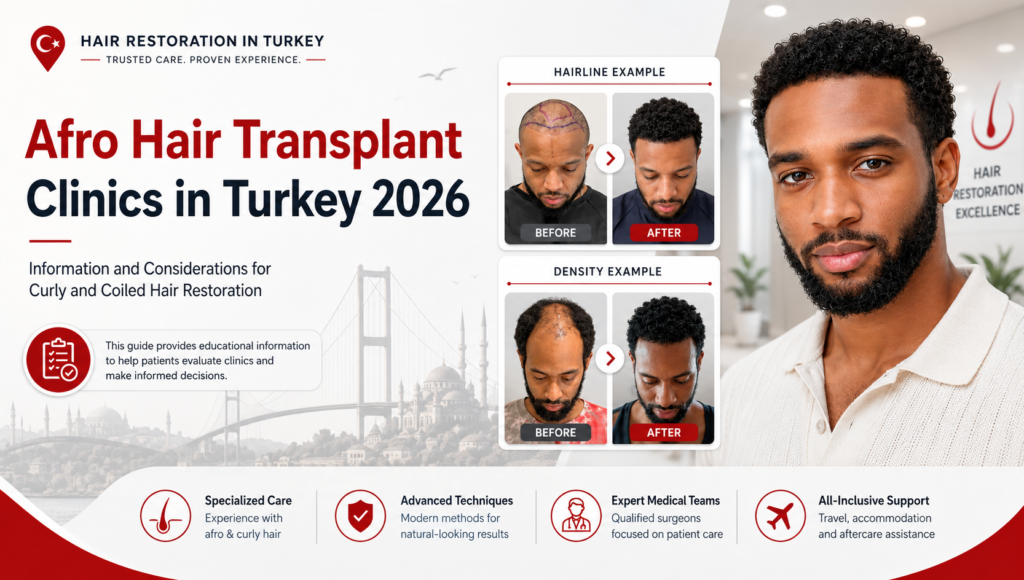
Afro-textured, curly, and coiled hair can present different planning considerations than straighter hair types during hair restoration. Patients researching procedures abroad may see many clinics promoted online, but the important question is not which clinic is ranked first. The more useful question is whether a clinic can explain its approach to textured hair, donor-area evaluation, graft handling, implantation angle, follow-up care, and realistic expectations.
This guide explains practical issues African American, Afro-Caribbean, and curly-haired patients may want to review before choosing a hair transplant clinic in Turkey. It also includes examples of clinics and services that may appear during online research, while encouraging patients to verify claims directly before making a decision.
Why Afro and Curly Hair Restoration Requires Careful Planning
Curly and coiled hair often has a curved follicle structure beneath the scalp. This can make extraction more technically demanding because the visible hair shaft may not show the full direction of the follicle below the skin. If the extraction angle is not adjusted to the patient’s follicle pattern, grafts may be more difficult to remove cleanly.
Implantation also requires careful planning. The direction, depth, and angle of each graft can affect whether the result blends naturally with the patient’s existing curl pattern. A clinic should be able to discuss how it evaluates curl direction, donor-area density, hairline goals, and long-term coverage before recommending a procedure.
Understanding the Search for Clinics in Turkey
Patients searching for afro hair transplant clinics in Turkey will find many clinic pages, advertisements, and patient stories. Rather than relying on ranking claims, patients should treat those search results as a starting point for further evaluation.
Useful factors to compare include the clinic’s experience with textured hair, whether a physician is involved in key surgical stages, how donor-area limits are explained, whether before-and-after examples are relevant to similar hair textures, and what follow-up support is available after the patient returns home.
Clinic Example: Este Favor
Este Favor is one clinic patients may encounter while researching afro hair transplant options in Turkey. Its materials describe planning methods related to follicle mapping, donor-area review, and technique selection for textured hair cases. Patients considering this or any clinic should ask how those methods are applied in practice, who performs each stage of the procedure, and whether the clinic can provide examples involving similar hair texture, hairline goals, and donor characteristics.
Questions to ask include whether the clinic evaluates curl pattern before surgery, how extraction tools are selected, how graft direction is planned, and what follow-up process is provided after travel.
Clinic Example: Sapphire Hair Clinic
Sapphire Hair Clinic is another clinic patients may find while comparing hair restoration providers in Turkey. Its public materials discuss sapphire-based tools, hairline planning, and international patient coordination. Patients interested in this type of clinic should ask whether the team has experience with afro-textured hair specifically, how they adjust implantation angle for curl pattern, and whether the consultation includes a donor-area assessment tailored to curly or coiled hair.
Because marketing terms can vary widely between providers, patients should request clear explanations rather than relying on broad claims about density, speed, or technology.
Other Clinic Names Patients May Encounter
During research, patients may also see clinics such as MedArt Hair Clinic, Heva Clinic, Nasia Hair, Vera Clinic, TecniFUE International, ClinMedica, BlueMagic Group, and Istanbul Vita Clinic mentioned in connection with textured hair, international patients, or hair restoration tourism. Inclusion in an article or search result should not be treated as a recommendation or ranking.
Instead, patients should compare each provider based on documented experience, consultation quality, transparency, medical supervision, aftercare, pricing clarity, and whether the clinic gives realistic advice about candidacy and donor limits.
The Technical Realities of Afro Hair Restoration
Subsurface Follicle Curvature
Afro-textured hair may curve below the scalp, which can make extraction more complex. Patients should ask how the clinic evaluates follicle direction and what tools or techniques are used to reduce the risk of graft damage. A responsible clinic should be able to explain this in plain language before a deposit is paid.
Curl Pattern and Hairline Design
A natural-looking result depends on more than graft survival. Hairline shape, placement density, and implantation direction all affect how the transplanted hair blends with the patient’s existing texture. Patients should ask whether the clinic has examples of results involving similar curl patterns, hairline goals, and donor-area conditions.
Donor-Area Limits
High graft-count promises can be misleading if they do not account for the patient’s donor-area capacity. Curly and coiled hair may provide strong visual coverage with a carefully planned number of grafts, but excessive harvesting can create long-term donor-area concerns. Patients should ask how the recommended graft count was calculated and whether it protects future options.
Candidacy and Medical Judgment
Not every patient is a good candidate for surgery. Diffuse thinning, scarring conditions, active scalp disease, unrealistic density expectations, or limited donor capacity may change the treatment plan. A clinic should be willing to say when surgery is not appropriate or when expectations need to be adjusted.
Questions to Ask Before Booking
- How many afro, curly, or coiled hair cases has the clinic handled recently?
- Who performs the extraction, channel opening, and implantation stages?
- How is follicle curvature evaluated before surgery?
- How are punch size, extraction angle, and implantation direction selected?
- Can the clinic show examples involving patients with similar hair texture?
- What happens if the donor area is not suitable for the requested density?
- What follow-up support is available after the patient leaves Turkey?
- What is included in the quoted price, and what costs are separate?
What an Afro-Specific Consultation Should Cover
A useful consultation should review hair loss history, donor-area strength, scalp health, curl pattern, prior procedures, expectations, medical history, and long-term maintenance. It should also explain the difference between cosmetic goals and realistic surgical planning.
Patients should be cautious if a clinic quotes a large graft number or confirms candidacy without reviewing photos, medical background, donor-area limits, and hairline goals. A careful consultation may take longer, but it helps reduce the risk of misunderstanding and unrealistic expectations.
Pricing Considerations for Hair Transplants in Turkey
Hair transplant pricing in Turkey varies based on the clinic, technique, medical team, graft estimate, travel services, hotel arrangements, follow-up support, and the complexity of the case. Afro-textured hair cases may require additional planning time or specific technique adjustments, but price alone should not be used as proof of quality.
Patients comparing Turkey with the United States, the United Kingdom, or other destinations should consider more than the procedure fee. Travel costs, aftercare access, revision policies, communication with the clinic, and the ability to obtain local follow-up care all matter.
Travel and Aftercare Considerations
Medical tourism can be convenient, but it also requires planning. Patients should understand how many days they need to stay after surgery, how swelling and healing will be monitored, what products are recommended for textured hair, and how photo follow-ups will be handled once they return home.
Patients should also ask what symptoms require urgent medical attention and whether they should arrange local medical support before traveling. Clear aftercare instructions are especially important when the procedure is performed outside the patient’s home country.
Reviewing Before-and-After Examples for Similar Hair Types
Before-and-after photographs are often part of the research process, but patients should evaluate them carefully. When reviewing examples, it can be helpful to look for patients with a similar hair texture, curl pattern, degree of hair loss, donor-area characteristics, and hairline goals.
Patients should also ask whether photographs represent the clinic’s own work, how long after surgery the images were taken, and whether additional treatments were used during the recovery period. A single photo rarely tells the full story of a patient’s experience.
Rather than focusing on dramatic transformations alone, patients may benefit from looking for consistency across multiple cases. This can provide a better understanding of how a clinic approaches planning, density distribution, hairline design, and long-term expectations for patients with afro-textured, curly, or coiled hair.
Final Thoughts
Afro hair transplantation in Turkey may be an option for some patients, but the decision should be based on careful evaluation rather than rankings or broad marketing claims. The strongest approach is to compare clinics by their consultation process, experience with textured hair, medical supervision, graft-handling methods, transparency, and aftercare support.
Patients should ask detailed questions, request relevant examples, compare more than price, and speak with a qualified medical professional before making a final decision about any surgical procedure.
Quick FAQ
Is afro hair transplant surgery different from straight-hair procedures?
It can be. Curved follicles, curl direction, donor-area planning, and implantation angle may require additional attention during surgical planning.
Should patients choose a clinic based on rankings?
No. Rankings can be influenced by marketing and may not reflect a patient’s individual needs. A better approach is to evaluate experience, consultation quality, medical oversight, and aftercare.
Can a clinic guarantee density or graft survival?
Patients should be cautious with guarantees. Outcomes vary based on health history, donor area, surgical planning, healing, aftercare, and individual biology.
What should patients verify before paying a deposit?
Patients should confirm who performs the procedure, what is included in the package, whether the clinic has experience with similar hair texture, how aftercare is handled, and whether refund or cancellation terms are clear.
Other Articles You May Find of Interest...
- Hair Transplant Recovery Timeline in Turkey: Month-by-Month Expectations and Follow-Up Considerations
- Understanding Hair Transplant Pricing in Turkey: Costs, Techniques, and Patient Considerations in 2026
- Afro Hair Transplants in Turkey: Considerations for African American and Afro-Caribbean Patients
- Afro Hair Transplant in Turkey: What Curly and Coiled Hair Patients Should Know
- Understanding Micro-DHI Hair Transplant Techniques in Turkey
- The Ultimate Guide to Using a Hair Topper to Get Your Confidence Back
- Afro Hair Transplants in Turkey: What Patients Should Know Before Choosing a Clinic




