More Vision & Eye Care Articles
Choosing an Ophthalmologist in Cape Coral for Cataracts: Top Eye Surgeon Tips
Choosing a cataract surgeon in Cape Coral: a reader-friendly guide to clearer vision

More than 24 million Americans over forty already live with cataracts, and the National Eye Institute expects that number to reach 50 million by 2050. The good news: modern cataract surgery is among medicine’s safest operations, with about 95 percent of patients seeing clearly right after the procedure.
That blend of certainty and optimism inspired this brief guide. Cape Coral is packed with surgeons, but most “best doctor” lists read like phone books. In the next ten minutes you’ll learn the five factors that truly separate an outstanding cataract surgeon from the rest—plus a ranked shortlist of local practices.
Ready to focus on what matters? Let’s dive in.
Key criteria for choosing your cataract surgeon
You wouldn’t hand your car keys to an unlicensed driver. The same rule applies to eye surgery. Credentials show who has the training, oversight, and ongoing education to protect your vision. Before we discuss technology or bedside manner, let’s confirm the basics.
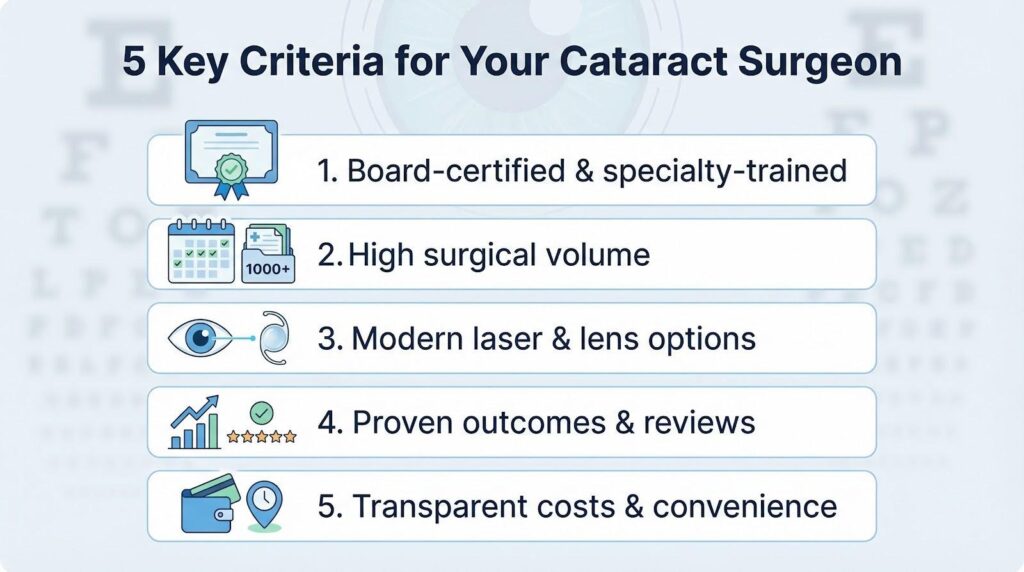
1. Confirm board certification and specialty training.
Board certification from the American Board of Ophthalmology means a physician has finished medical school, completed an ophthalmology residency, and passed rigorous exams. The certificate also expires unless the doctor re-tests and proves continuing education.
Look for “MD” or “DO” followed by “board-certified ophthalmologist.” Optometrists (ODs) are vital to eye health, yet only ophthalmologists perform cataract surgery. Many top Cape Coral surgeons add a fellowship in cataract or refractive surgery, spending an extra year on complex lens work and laser skills.
Verification takes two minutes. Visit the board’s public directory, enter the doctor’s name, and confirm active status, subspecialties, and certification dates. Fresh credentials show commitment, while long-standing certification plus thousands of cases signals seasoned skill.
After you confirm board status, ask, “How many cataract procedures do you perform each year?” That answer sets up the next criterion—experience and volume.
2. Favor surgeons who operate a lot.
Cataract surgery looks routine online, but precision grows with repetition. Studies suggest roughly 250 cataract cases a year keep complication rates low. Surgeons who meet or exceed that mark hone muscle memory and stay calm when surprises arise.
Ask for numbers. A confident surgeon will share weekly eye counts and outcome data, such as the percentage of patients who reach 20/40 vision or better. Volume alone isn’t a trophy, yet it predicts familiarity with rare problems.
Cape Coral’s busiest clinics publish totals on websites or brochures. If you can’t find the figure, jot it down during your visit. Pair that data with years in practice to spot surgeons who mix quantity with judgment.
3. Insist on modern technology and tailored lens options.
Cataract tools evolve fast, and the gear in a surgeon’s suite shapes your result. New femtosecond platforms, like LenSx lasers, automate critical steps with micrometer accuracy, which reduces inflammation and speeds recovery.
Lens choices have improved too. Standard monofocals restore crisp distance vision but leave you searching for readers. Multifocal and trifocal implants split light so you can view the dashboard or dinner menu without glasses. Toric lenses correct astigmatism, while the Light Adjustable Lens lets the doctor fine-tune your prescription after surgery with painless ultraviolet light.
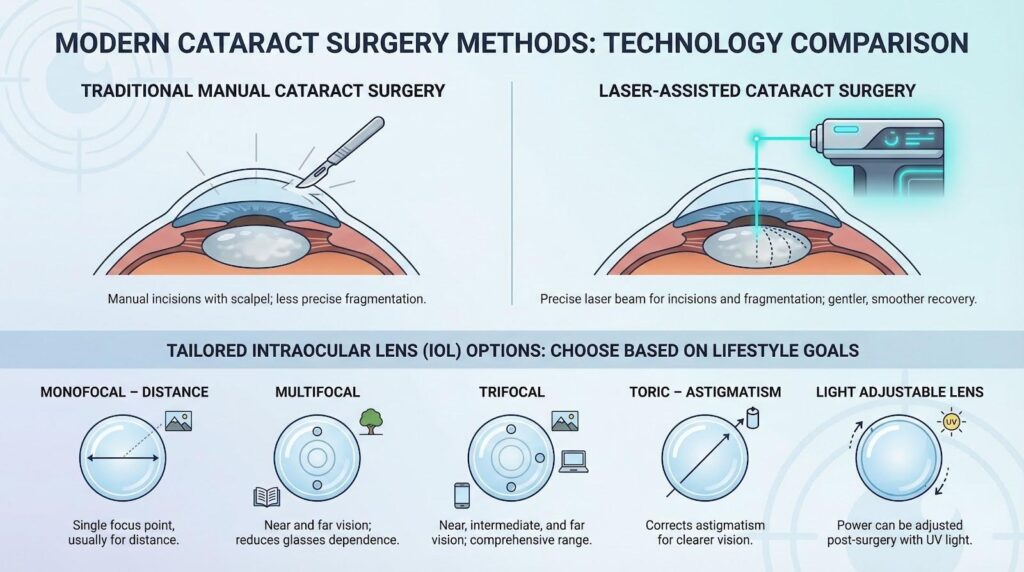
Local example: One Cape Coral practice, Snead Eye Group, reports that the LenSx femtosecond laser it uses creates incisions up to ten times more precise than manual techniques.
Its internal patient review also found that Light Adjustable Lens recipients reached 20/20 distance vision without glasses more often than those with fixed-power monofocal lenses.
Details like these help you decide whether a surgeon’s technology truly translates into sharper real-world results.
During your consult, ask:
- “Will you use a laser for any part of the procedure?”
- “Which premium lens models do you fit most often, and why?”
A surgeon who uses laser guidance and multiple IOL families has invested in equipment and training, signaling a commitment to sharper, spectacle-free vision rather than the bare minimum.
4. Zero in on outcomes and patient voices.
Numbers convert marketing claims into reality. Nationally, cataract surgery improves vision in more than nine out of ten cases, so a solid local surgeon should match or beat that mark. The best practices track complication rates, average postoperative vision, and the share of patients reaching 20/20 with premium lenses, then share those figures on request.
Ask for a one-page summary of recent results. Compare the stats with detailed online reviews about explanations, scheduling, and follow-up care. Repeated praise for bedside manner often predicts fewer surprises after surgery.
Blend hard data with real stories to see what you’ll experience once the lights dim in the operating room.
5. Compare real-world costs, insurance coverage, and convenience.
Sticker shock can spoil clear vision, so review money matters early. Medicare Part B and most private insurers cover standard cataract removal plus a monofocal lens. You still pay your deductible and 20 percent coinsurance. Upgrades—multifocal, toric, or laser-assisted surgery—sit outside that umbrella, and clinics bill those extras directly.
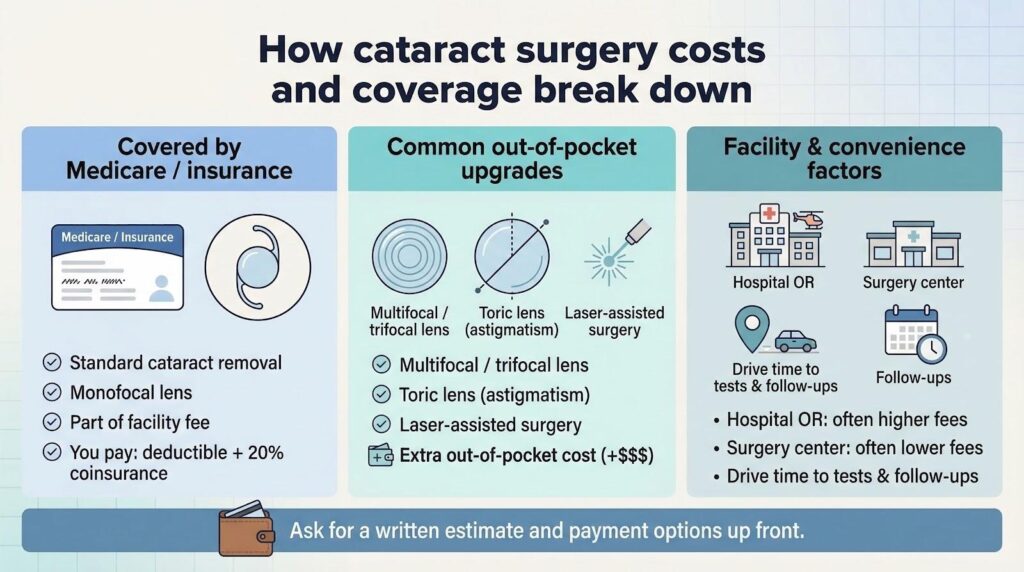
Prices vary. In Cape Coral, a basic procedure at an ambulatory center often costs about one thousand dollars per eye after insurance. Add a premium lens and laser, and out-of-pocket charges can reach three or four thousand. Good practices quote fees line by line and offer zero-interest plans through CareCredit.
Location matters. A hospital OR may carry higher facility fees than an accredited surgery center across town. Factor in drive time for pre-op tests and follow-ups; choosing a clinic ten minutes away saves fuel and fatigue.
During your calls, run through three questions:
- “Do you accept my specific insurance plan?”
- “What will I owe for standard surgery versus a premium lens?”
- “Where is the surgery center, and how many follow-up visits will I need?”
Clear answers here often hint at the same clarity you’ll enjoy after the procedure.
Top cataract surgeons and clinics in Cape Coral
1. Snead Eye Group — first for tech, training, and patient comfort
Snead Eye Group checks every box on our checklist. The clinic has invested $1 million in state-of-the-art diagnostic and laser platforms, a commitment you can learn more about on its ophthalmologist overview page.
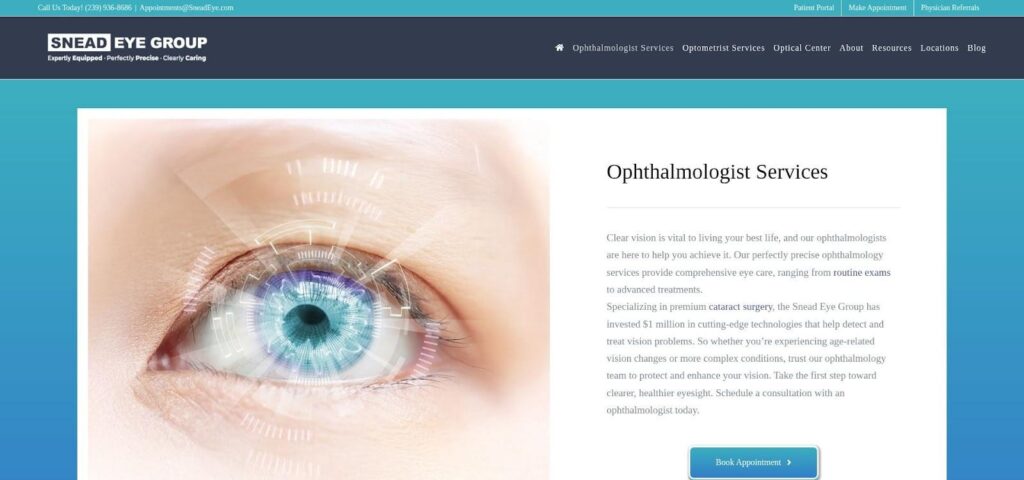
Snead Eye Group Cape Coral ophthalmologist website screenshot
Board-certified ophthalmologist Dr. Brad Snead leads a veteran team with more than twenty years of cataract work and thousands of successful lens replacements.
Their private, accredited surgery center keeps costs lower than hospital fees and offers an eye-only environment. The clinic adopted the LenSx femtosecond laser early and now fits the Light Adjustable Lens, giving patients fine-tuned results after surgery.
Financing stays simple: insurance covers standard surgery, while upgrades roll into zero-interest CareCredit plans that start around a couple hundred dollars a month. With offices in Cape Coral and Fort Myers plus Saturday consult slots, convenience matches clinical quality.
Need full specs or a same-day screening? Explore Snead Eye Group’s cataract services and book a visit.
(Next up: Tyson Eye Institute.)
2. Tyson Eye Institute — research-driven care with fellowship depth
Founder Dr. Farrell Tyson trained at Johns Hopkins and still publishes on next-gen lens materials. He teams with Dr. J. David Stephens, a cornea–glaucoma fellow whose microsurgery skill shines in lens work.
Tyson Eye Institute Southwest Florida cataract center website screenshot
As an FDA research site, Tyson Eye offers early access to new IOLs and real-time wavefront mapping during surgery. Patient volume is brisk, yet counselors take time to walk through every lens tier, from fully covered monofocals to trifocals that handle distance, computer, and phone range.
Multiple offices mean shorter drives for consults and post-op checks. If you value academic pedigree, put Tyson Eye on your shortlist.
3. Elmquist Eye Group — community roots, laser precision
Elmquist Eye Group has cared for Cape Coral eyes for more than twenty-five years. Dr. Yasaira Rodriguez blends big-city training with small-town bedside warmth.
The surgery center houses a LenSx laser for bladeless incisions plus optical coherence tomography that maps the cornea in three dimensions. Lens options range from monofocal to extended-depth-of-focus, letting the team match correction to your lifestyle.
Reviews highlight thorough consultations and clear cost breakdowns, financed through CareCredit. Offices across Cape Coral, Fort Myers, and Lehigh Acres shorten travel for testing and checkups.
4. Southwest Florida Eye Care — practical expertise for budget-minded patients
Dr. Albert Smolyar leads a team focused on efficient, high-volume lens removal using tried-and-true phacoemulsification. The clinic doesn’t market a fleet of lasers, yet it fits toric and multifocal lenses for those who want fewer glasses.
Patients like the honest “need-to-have vs. nice-to-have” cost talk. Standard surgery flows through insurance, while upgrades stay sensibly priced. Evening hours let working adults book exams without burning vacation days.
Choose SWFL Eye Care when affordability and straightforward care come first.
5. The Eye Associates — big-group resources with small-office access
Formerly Eye Centers of Florida, The Eye Associates blends the scale of a regional network with the familiarity of a neighborhood clinic. The Del Prado Boulevard office ties into a multi-site organization staffed by more than a dozen board-certified surgeons.
High volume funds LenSx lasers, intraoperative aberrometers, and a full optical lab that turns around glasses in hours. If you have glaucoma or corneal disease, a fellowship-trained expert can co-manage care under one roof.
Finance teams quote fixed add-on fees for toric or trifocal lenses before you leave the exam room and offer in-house plans spanning twenty-four months.
Compare your options at a glance
| Practice | Board-certified surgeons | Years in cataract care, est. annual volume | Laser tech on site | Premium lens menu | Insurance and financing | Avg. patient rating |
| Snead Eye Group | Yes (Dr. Brad Snead and team) | 20+ years, high volume | LenSx femtosecond, LAL adjust system | Monofocal, toric, multifocal, Light Adjustable | Medicare, BCBS, CareCredit, 0 percent | ★4.8 Google |
| Tyson Eye Institute | Yes (Drs. Tyson and Stephens) | 20+ years, high volume | Laser astigmatism, intra-op aberrometry | Monofocal, toric, trifocal, EDOF | Medicare, in-house 24-month plan | ★4.6 Google |
| Elmquist Eye Group | Yes (Dr. Rodriguez) | 25 years, moderate volume | LenSx laser | Monofocal, toric, multifocal, EDOF | Medicare, CareCredit | ★4.7 Google |
| SWFL Eye Care | Yes (Dr. Smolyar) | 20 years, moderate volume | Standard phaco (no laser) | Monofocal, toric, multifocal | Medicare, low-fee upgrades | ★4.5 Google |
| The Eye Associates | Yes (multi-surgeon team) | 30 years, very high volume | Femto laser at select ORs | Full spectrum, includes trifocal | Medicare, 24-month in-house plan | ★4.4 Google |
Key to columns:
Laser tech on site shows whether the clinic offers bladeless incisions and precise astigmatism correction. Premium lens menu lists implants beyond the monofocal covered by insurance. Ratings pull from Google as of this writing; check again before you book.
Use the table to shortlist two practices, schedule consultations, and bring the earlier checklist so each visit ends with clear, apples-to-apples answers.
How to prepare for surgery and ask the right questions
Booking a consultation isn’t a formality. It’s your chance to compare surgeons and confirm their approach matches your goals.
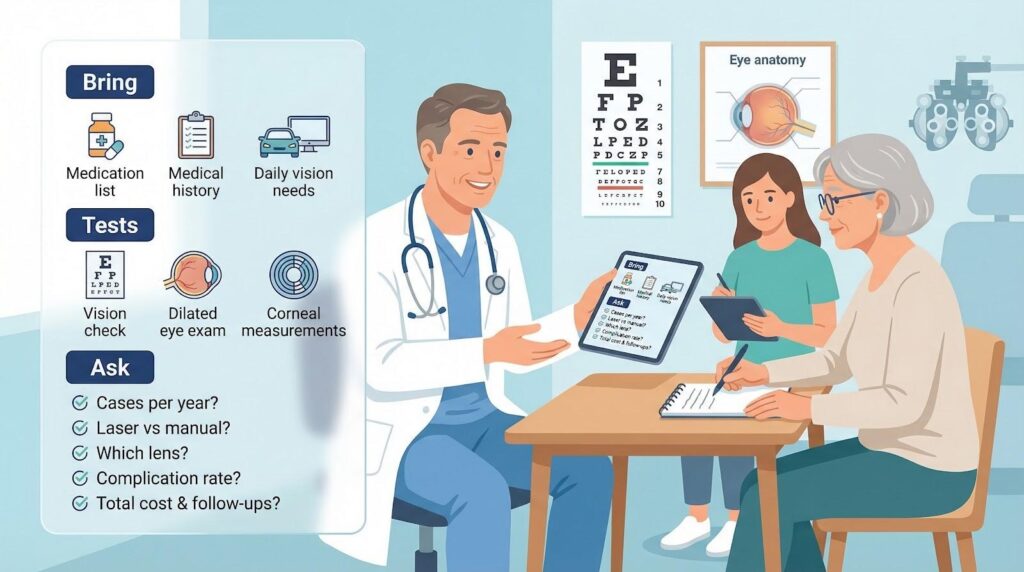
Arrive with a written list of medications, medical history, and daily vision demands such as night driving or long computer sessions. These details steer lens selection more than any marketing claim.
Expect three key tests: a visual acuity check, a dilated retinal exam, and detailed corneal measurements. If staff skip any of these, ask why; solid baseline data prevents surprises later.
When you meet the surgeon, lead with clear questions:
- “How many cataract cases did you perform last year, and what percent achieved 20/40 vision or better?”
- “Will you use a laser for any step, and what benefit should I expect?”
- “Which lens type fits my lifestyle, and what are the trade-offs?”
- “What’s your complication rate for posterior capsular rupture or endophthalmitis?”
- “Exactly what will I pay for surgery, the lens, the facility, and follow-up visits?”
A confident surgeon answers in plain English without dodging numbers or slipping into jargon. Take notes, then repeat the key points to confirm you understood.
Finally, plan recovery. Arrange a ride home, clear heavy lifting from your calendar for a week, stock preservative-free tears, and keep antibiotic drops within reach. Handling the logistics early lets you celebrate clearer vision the moment the patch comes off.
Bringing it into focus
Cataracts come with aging, but blurry vision doesn’t need to linger. Cape Coral residents have a rare advantage: several high-performing surgeons who offer laser tools, premium lenses, and patient-first care. By using the five criteria we covered—credentials, volume, technology, outcomes, and cost—you can turn a crowded search page into a clear shortlist.
Book consultations with two practices that fit your insurance and lifestyle. Bring the question list, listen for straight answers, and trust your gut about bedside chemistry. In a few weeks you’ll likely read street signs that once looked hazy, marvel at bright Gulf sunsets, and wonder why you waited.
Vision is freedom. Choose the surgeon who earns your confidence today, and see Cape Coral in sharper detail tomorrow.
Frequently asked questions
How do I know it is time for cataract surgery?
When glare, halos, or cloudy patches keep you from safe driving, reading fine print, or enjoying hobbies, it is time to act. Your ophthalmologist confirms cataracts by checking visual acuity and examining lens opacity.
Is laser cataract surgery truly better?
Laser guidance improves incision accuracy and astigmatism correction, yet skilled manual surgery also delivers excellent long-term vision. Think of the laser as a refinement, not a requirement.
Will I feel pain during the procedure?
No. Numbing eye drops and light IV sedation keep you comfortable. You may sense gentle pressure and see swirling colors, but pain is rare and brief.
How soon can I drive again?
Most patients resume daytime driving within twenty-four hours once vision clears and a surgeon gives the green light. Night driving may wait a few extra days until halos fade.
Can I choose a different lens for each eye?
Yes. Surgeons often mix lens types—distance in one eye and near-focus or multifocal in the other—to widen your range of clear vision. Discuss combinations during the consult.
What happens if a premium lens disappoints me?
Your surgeon can exchange the lens or add a LASIK touch-up, but both involve extra cost and healing time. Set realistic goals upfront and review vision simulations to avoid surprises.
Still have questions? Bring this list to your consult, add personal concerns underneath, and leave only when every blank is filled with a direct answer.
Other Articles You May Find of Interest...
- Smart Glasses With Prescription Lenses: Fit, Comfort and Everyday Use
- Can Blepharoplasty Improve Peripheral Vision? What Patients Should Know
- What Causes Blood Clots in the Eye?
- Can You Have Laser Eye Surgery With Glaucoma?
- Why Are Contact Lens Users Asked to Stop Wearing Lenses before Laser Eye Surgery Tests?
- What Credentials to Look for When Searching for the Right Eye Doctor in New York
- New Flashes, Floaters, or a Shadow in Your Vision: When to Seek Prompt Eye Care