






More Kratom Education Articles
White Sumatra Kratom: The Strain That Earns Its Reputation the Hard Way

When people talk about kratom, Sumatra comes up often. What most people miss is that the island itself is one of the most biodiverse places on earth, and that biodiversity directly shapes the plants that grow there, including Mitragyna speciosa. White Sumatra kratom isn’t just a marketing name printed on a bag — it reflects a specific combination of geography, harvest timing, and processing tradition that has quietly shaped part of the kratom market for years.
Learn more about White Sumatra Kratom products.
The trouble is that most online descriptions of white Sumatra repeat the same vague talking points, overstate benefits, or contradict each other without offering real supporting data.
This article is meant to cut through that. Whether you’re new to kratom or have followed the market for a while, there’s likely something here that’s usually described inaccurately elsewhere. We’ll look at what white Sumatra kratom actually is at a botanical level, how it’s processed, how it compares to other strains, what the alkaloid research shows, and what responsible sourcing looks like — presented in a clear, factual order.
Important: Kratom is not approved by the FDA for any medical use, and its safety and effectiveness have not been formally evaluated by regulators. Kratom use may carry risks of dependence, withdrawal, and interactions with medications or other substances. Anyone considering kratom, particularly alongside prescription medication or an existing health condition, should speak with a doctor first.
Why Sumatra Produces a Different Kind of Kratom
In agriculture, growing conditions matter more than most people realize.
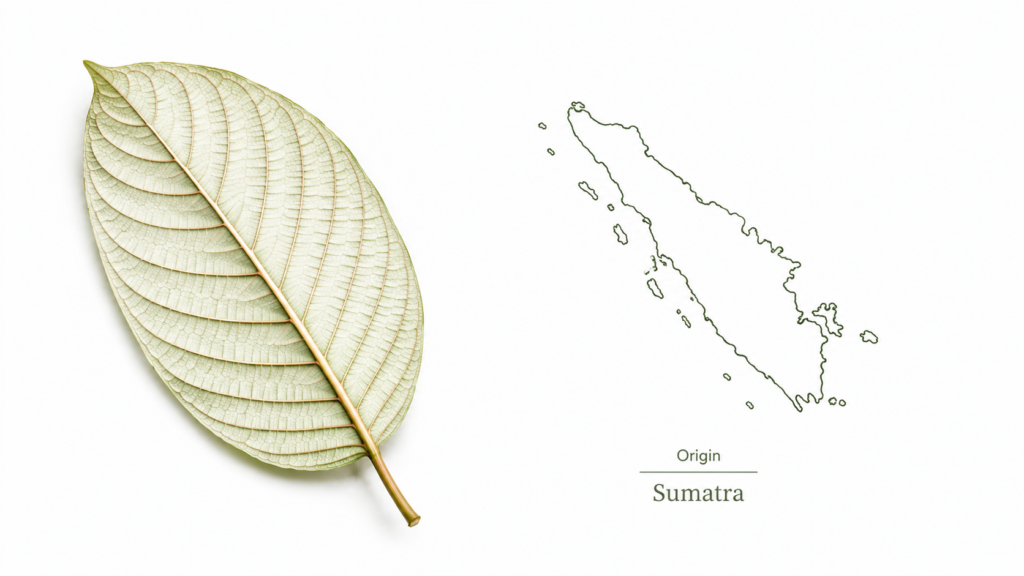
Sumatra is the sixth-largest island in the world, located in the tropical band of western Indonesia. The island is covered in dense jungle, volcanic soil, and consistent year-round rainfall — conditions well-suited to Mitragyna speciosa.
Volcanic soil in particular is mineral-rich, which affects how plants absorb nutrients and, in turn, how they produce alkaloids. Kratom trees grown in Sumatra’s nutrient-dense soil often show different alkaloid profiles compared to trees grown in sandier coastal soils elsewhere.
The island also has significant variation in altitude. Kratom grown at higher elevations experiences milder temperatures and different humidity cycles than lowland-grown kratom. These environmental factors affect leaf thickness, alkaloid concentration, and overall plant chemistry.
White Sumatra kratom is often described as distinct from white-vein kratom sourced elsewhere — not purely as a branding claim, but because the underlying growing conditions genuinely differ.
What “White” Actually Refers to in This Context
The word “white” in white Sumatra kratom doesn’t describe the color of the powder, and it isn’t a description of any effect. It refers to the color of the leaf’s main vein at the time of harvest.
Kratom leaves change color as they mature on the tree:
- White/light-colored veins — early stage of leaf development
- Green veins — mid-maturity
- Red veins — fully mature leaf
Leaves with white veins are picked earlier in this cycle, and that earlier harvest window affects the alkaloid ratio present at the time of collection. Once dried and ground, white-veined Sumatran leaf powder looks like most other kratom powder — a muted greenish-brown. Vein color isn’t visually identifiable in the finished product, which is a recurring source of confusion in the industry and matters for how buyers evaluate quality.
The Alkaloid Picture: What the Science Actually Shows
More than 40 alkaloids have been identified in kratom. The two that receive the most scientific attention are mitragynine and 7-hydroxymitragynine (7-HMG).
White-vein kratom, including white Sumatra, is generally associated with:
- Higher mitragynine content relative to red-vein variants
- Lower 7-HMG levels, since that alkaloid forms as a natural oxidation product as the leaf matures
- A more prominent presence of secondary alkaloids such as speciociliatine, paynantheine, and speciogynine
Mitragynine is typically the largest single alkaloid component in any kratom variety. Reported mitragynine content in white Sumatra kratom has varied across tested batches, influenced by tree age, soil quality, harvest timing, and processing method.
The key point is that alkaloid profiles are not fixed — they vary by batch. Any vendor citing exact percentages without a current, batch-specific third-party Certificate of Analysis is making an unsupported claim.
From Leaf to Powder: How White Sumatra Gets Processed
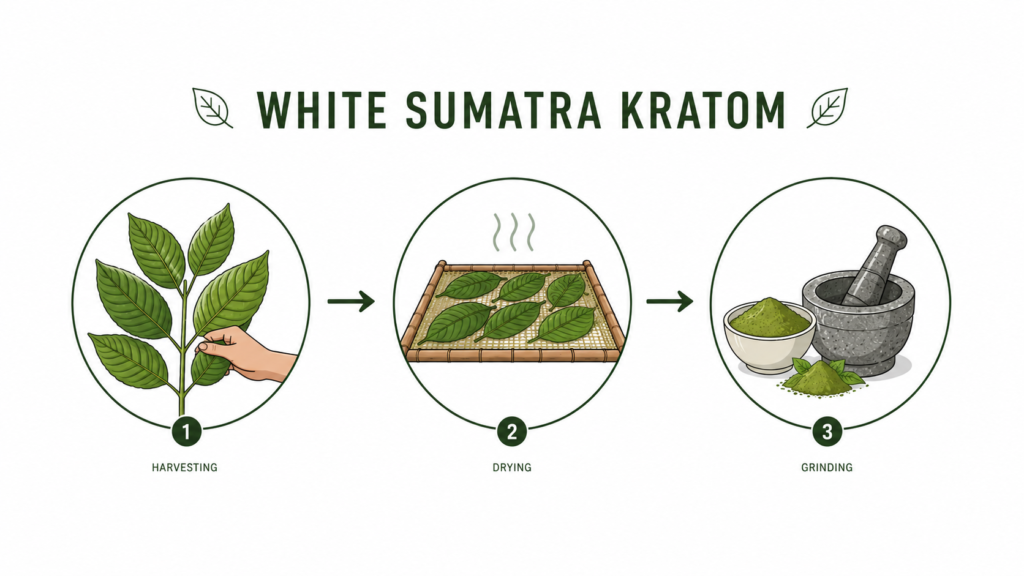
Processing is where a lot of quality variation enters the kratom market. Once white-vein Sumatran leaves are gathered, the typical process looks like this:
- Initial washing — Leaves are washed to remove soil, insects, and debris from harvest.
- Pre-drying inspection — Damaged, diseased, or discolored leaves are removed to keep the batch consistent.
- Drying — White-vein kratom is traditionally dried indoors or in shaded conditions. Limited UV exposure during drying is believed to help preserve the alkaloid balance associated with early harvest. Some producers use heated drying rooms instead.
- Grinding — Dried leaves are milled into a fine powder. Mesh size affects solubility and consistency; commercial white Sumatra kratom is commonly ground to a fine mesh range.
- Testing and packaging — Responsible producers send samples to independent labs before the finished batch is packaged and distributed.
Producers that cut corners — rushing drying, skipping testing, or blending multiple undisclosed sources — undermine product consistency and leave consumers with no reliable way to know what they’re actually buying.
How White Sumatra Stacks Up Against Other Popular Strains
Strain comparisons are useful for understanding relative characteristics, not for making quality judgments.
| Strain | Common Description | Key Characteristics | Important Limitation |
| White Sumatra | Early-harvest, white-veined leaf from Sumatran rainforest cultivation | Alkaloid expression shaped by volcanic soil and equatorial climate | Significant batch variability; profile not standardized across vendors |
| White Bali | White-veined leaf under traditional Bali strain classification | Moderate mitragynine range; “Bali” reflects strain tradition more than strict geographic origin | “Bali” label doesn’t guarantee Bali-grown sourcing |
| White Borneo | White-veined leaf from Borneo cultivation | Different regional terroir from Sumatra; comparisons lack independent research support | Terroir’s impact on alkaloid profile isn’t comprehensively documented |
| Red Sumatra | Late-harvest, red-veined leaf from the same Sumatran region | Greater 7-HMG potential from extended maturation and oxidation | Red-to-white alkaloid ratio shift is directional, not precisely predictable |
| Green Sumatra | Mid-maturity harvest from Sumatran cultivars | Generally considered a middle-spectrum profile between white and red | “Middle-spectrum” is a market generalization, not a lab-confirmed classification |
The most reliable way to compare strains is through side-by-side COA data from the same vendor and testing date.
Sumatra’s Kratom History and How It Reached Western Markets
Kratom has been used for hundreds of years across Southeast Asia. In Indonesia — the world’s largest kratom-producing country — traditional use of Mitragyna speciosa is culturally rooted in rural agricultural communities. In Sumatra, Borneo, and Kalimantan, workers historically chewed fresh leaves or prepared them as tea.
Sumatran kratom became more prominent in Western markets in the early-to-mid 2000s, as online herbal supplement retailers began sourcing directly from Indonesian exporters. The Bali strain dominated the early Western market, largely because early exports moved through Balinese ports. Sumatran varieties, including white Sumatra, gradually built their own market identity as consumers learned more about regional differences.
Indonesia currently regulates kratom export, and domestic consumption and export legislation remain subjects of ongoing debate. Different Indonesian agencies classify kratom differently than some overseas markets do, and this regulatory landscape affects the reliability of the broader supply chain.
What Buyers Say About White Sumatra Kratom
Online consumer discussions and forums contain extensive user-generated discussion of White Sumatra kratom. Some recurring themes include:
- A subset of users describe white Sumatra as feeling different from red Sumatra in subjective, self-reported terms
- Batch inconsistency is a common complaint, with users noting that the same product from the same vendor can vary across separate orders
- Some experienced consumers report preferring white Sumatra over white Bali, citing what they describe as a more complex alkaloid character — though this is entirely anecdotal
None of these observations constitute clinical evidence. Consumer-reported experiences are shaped by individual physiology, tolerance, usage habits, and the significant product variability present across the kratom market.
Safety Standards, Lab Testing, and What the Label Should Tell You
The kratom industry in the United States operates largely under voluntary quality standards at the federal level, with state-level regulation adding another layer of complexity.
When evaluating kratom products, consumers may wish to consider:
- Third-party testing — A credible vendor provides COAs from ISO-accredited or DEA-registered independent labs, covering mitragynine and ideally 7-HMG percentages, a heavy metals panel (lead, arsenic, mercury, cadmium), microbial testing (Salmonella, E. coli, total yeast/mold count), and pesticide and solvent residue screening.
- AKA GMP certification — The American Kratom Association’s Good Manufacturing Practice Standards Program requires participating vendors to pass third-party facility audits. It’s voluntary but a meaningful quality signal.
- Label transparency — A trustworthy product label should include strain name, net weight, batch or lot number, and a clear way to access the specific COA for that batch.
- Legal status — Kratom remains federally legal in the U.S. but is banned in Alabama, Arkansas, Indiana, Rhode Island, Vermont, and Wisconsin, with some counties and municipalities in otherwise legal states imposing local restrictions. Verify your jurisdiction before purchasing.
Clearing Up the Misconceptions That Keep Circulating
Misconception: White Sumatra kratom is exclusively grown on Sumatra island. Reality: “White Sumatra” is a strain classification that originated with Sumatran-sourced kratom, but the industry doesn’t enforce geographic origin labeling. Some products sold as white Sumatra may blend material from multiple Indonesian islands or growing regions.
Misconception: White powder means it’s a white-vein product. Reality: All kratom powder — white, green, or red vein — is processed into a similar greenish-brown powder. The “white” label refers to vein color at harvest, which is no longer visible once the leaf is dried and ground. Vein color cannot be verified from powder appearance alone.
Misconception: White Sumatra kratom has higher alkaloid content than red or green varieties. Reality: Vein color classification affects alkaloid ratios, not total alkaloid potency. Depending on tree genetics, soil, and processing, a batch of red Sumatra could test higher in total alkaloids than a batch of white Sumatra.
Misconception: All white Sumatra products from different vendors are interchangeable. Reality: Without standardized sourcing requirements, two products carrying the same name can have substantially different alkaloid profiles. COA data is the only reliable point of comparison — brand labels don’t guarantee batch consistency.
Frequently Asked Questions About White Sumatra Kratom
How does white Sumatra kratom differ from green Sumatra kratom?
The primary difference is harvest timing. White Sumatra is collected while veins are still pale, an early maturity stage, while green Sumatra is harvested at mid-maturity, once veins have deepened to green. This timing difference affects the alkaloid ratio in the leaf, particularly the balance between mitragynine and its derivatives. Green Sumatra is often described as a middle ground between white and red expressions, though without side-by-side lab comparisons from the same farm and batch date, this remains largely observational rather than data-confirmed.
Does the volcanic soil in Sumatra actually affect kratom alkaloid content?
Soil composition influences nutrient availability, which in turn affects secondary metabolite production, including alkaloids. Volcanic soils are typically rich in minerals like potassium, phosphorus, and micronutrients that support plant development. While no large-scale controlled studies have specifically isolated Sumatran volcanic soil as a variable in kratom alkaloid expression, the general agricultural principle that soil quality affects plant chemistry is well established. The effect is real but difficult to quantify precisely without controlled growing comparisons.
What does a legitimate Certificate of Analysis for white Sumatra kratom cover?
A complete COA should include alkaloid quantification (mitragynine at minimum, ideally with 7-HMG as well), a four-metal heavy metals panel (lead, arsenic, mercury, cadmium), microbial safety markers (Salmonella absence, E. coli levels, yeast and mold counts), and ideally pesticide residue and solvent screening. It should come from an independent accredited laboratory, reference the specific batch number matching the product being evaluated, and include a recent test date. A COA older than 12 months on active inventory is a quality red flag.
Is white Sumatra kratom legal to purchase in the United States?
At the federal level,kratom is currently legal in the U.S. State-level bans exist in Alabama, Arkansas, Indiana, Rhode Island, Vermont, and Wisconsin. Several other states have enacted a Kratom Consumer Protection Act (KCPA), which regulates labeling and age restrictions (typically 18 or 21) without banning kratom outright. Some localities within otherwise legal states have also passed municipal restrictions. Because legislation changes, it’s advisable to check current state and local law before purchasing.
Why do white Sumatra kratom products vary so much in quality between vendors?
The kratom supply chain lacks the regulatory standardization found in pharmaceutical or mainstream supplement markets. Sourcing depends on individual relationships between vendors and Indonesian exporters or farmers, harvest timing interpretation varies, and drying and processing methods differ from producer to producer. Some vendors test every batch independently; others test infrequently or not at all. Without AKA GMP certification or equivalent third-party oversight, quality control is largely at the vendor’s discretion — both differences in production practices and natural variation between batches can contribute to quality differences between products.
Putting It All Together
White Sumatra kratom occupies a distinct place in the kratom market, shaped by genuine environmental factors, a recognizable strain tradition, and a specific harvest approach. Understanding what the name actually means, how the alkaloid chemistry works, and what separates responsible sourcing from corner-cutting gives a clearer picture than most sources provide.
The leaf itself comes from a real and distinct growing environment. What happens to it after harvest — and how transparently vendors document that process — determines whether the finished product reflects that origin honestly.
Reviewing COAs, understanding local laws, and treating marketing claims with appropriate skepticism applies to white Sumatra kratom and to every other strain in the market.
Other Articles You May Find of Interest...
- How HPLC Testing Verifies Botanical Potency—and Why Lab Results Can Differ
- Red Bali Kratom: What It Is, How It Differs, and What the Research Says
- Kratom Legality in 2026: Why the Rules Vary by Location
- 7 Things to Know About Split Kilo Kratom Before a Bulk Order
- Red Thai Kratom: The Strain With a Complicated History and a Loyal Following
- Red Sumatra Kratom: What Makes This Strain Stand Apart
- Red Indo Kratom: The Strain That Built the Modern Kratom Market





